● Tesla Showdown, Musk AI Empire or Governance Meltdown
Tesla’s “Voting War” Opens: A One-Stop Overview from CalPERS’ Public Opposition, a 4% Stock Drop Right After BOA’s Praise, to the EV Reset and the True Variables of Robo-Taxi/Optimus.
It is noteworthy that only the key points have been summarized—why the California pension fund (CalPers)’s “opposition to Musk’s compensation plan” immediately shocked the stock market, how the actual vote count unfolds, and how Tesla’s artificial intelligence and robotics roadmap splits depending on the approval/rejection scenario.
It ties together sensitive triggers in the global economy and interest rate environment, ranging from GM and Ford slowing down their EV efforts, Tesla’s Semi factory and Cybercap (robo-taxi) status, Israel’s push for FSD approval, to the Cybertruck recall issue.
In particular, a separate section delves into aspects rarely covered by other news outlets, such as the impact of proxy advisory firms, the vote of ETF “pass-through” shareholders, legal risks, battery capex bottlenecks, and the correlation between interest rates and robo-taxi valuation.
[Breaking Summary] 6 Headlines That Shook the Market Today.
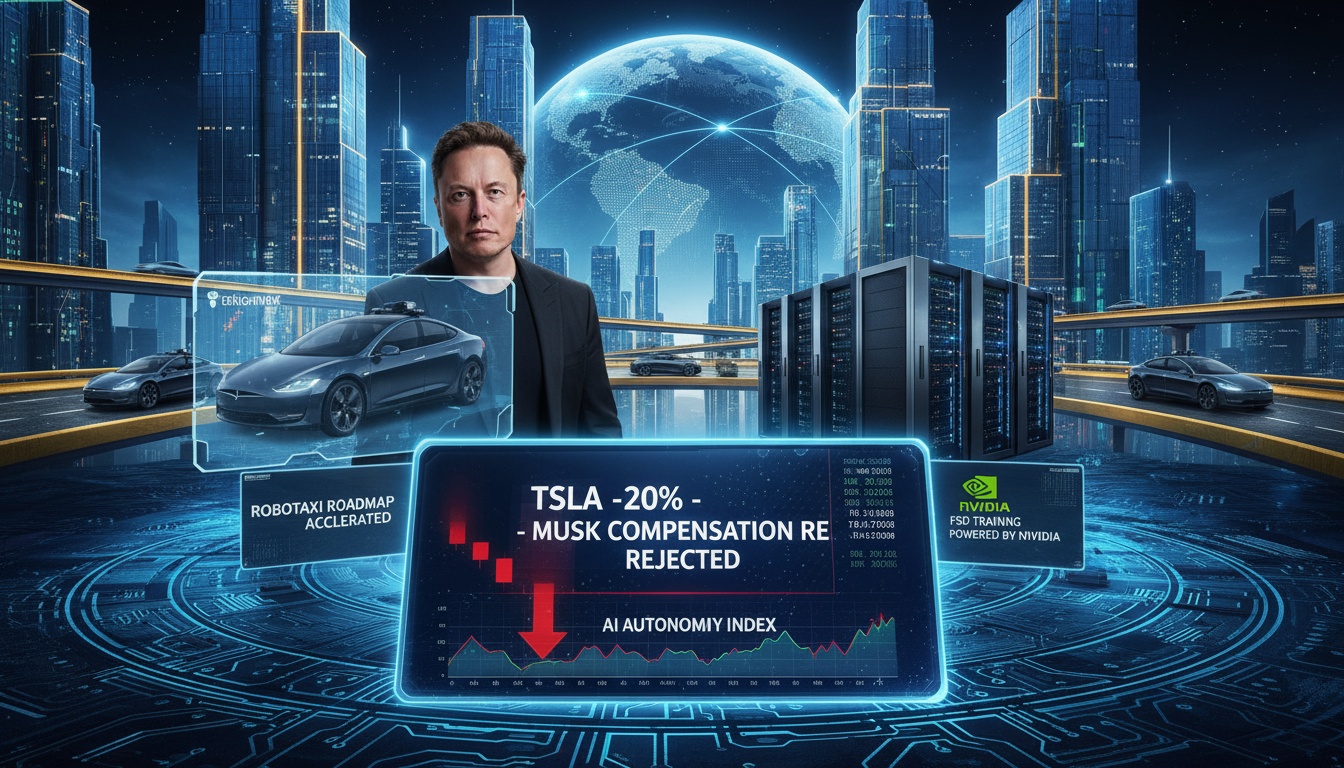
- Right after BOA revalued Tesla as an “artificial intelligence company instead of an automaker” and raised its target price, the stock fell by over 4% in one day.
- The cause was pointed to the official opposition of CalPers, one of the largest U.S. pension funds, to the “Musk compensation plan.”
- GM will suspend its Michigan “Factory Zero” EV line by the end of November, and Ford is also slowing its EV rollout, as the global shift to electric vehicles faces headwinds from the economy and interest rates.
- Drone photos revealed that Tesla’s dedicated Semi factory near Nevada is in the final stages of exterior finishing, signaling preparations for mass production.
- Test vehicles for “Cybercap (robo-taxi test)” have been spotted on roads in California, indicating that the actual verification phase is underway.
- The Israeli government is formalizing the FSD approval process, drawing attention to the possibility of regulatory spread from North America to the Middle East.
1) CalPers’ Opposition: Compensation Scale vs. Governance, What Is the Essence?
CalPers is an institutional investor that has long valued ESG and transparent corporate governance.
The core argument of this opposition is more about the “risk of power concentration” rather than the “scale of the compensation” itself.
There is significant concern that if the compensation plan passes, Musk’s influence over decision-making could expand excessively.
The opposition signal, possibly spreading to other pension funds and ESG funds with a similar stance, directly triggered market volatility.
On the other hand, the board and the community emphasize the proposition that “without Musk, it would be difficult to realize Tesla’s AI and robotics vision.”
2) The Reality of Vote Counting: Retail Shareholder Fervor vs. Institutional Math.
Tesla’s voting structure is estimated to be roughly 30% retail shareholders and around 70% institutions and funds.
For non-routine agenda items, “broker non-voting shares” are not included in the count, so in practice, the simple majority of “voted shares” is what matters.
The introduction of “pass-through” (reflecting individual shareholder opinions) by large ETFs such as BlackRock and Vanguard has somewhat increased retail influence, yet the recommendations of proxy advisory firms (ISS and Glass Lewis) still have a significant impact on institutional voting.
While some in the community circulate guides such as “vote for items 1–5 and 7, and against the rest,” the final outcome is determined by the collective stance of large institutions.
An approval would strengthen the continuity of Musk’s leadership, while a rejection would clearly lead to strategic divergence with the possibility of external deployment of AI and robotics, accompanied by legal risks.
3) BOA’s Framework: 12% from Automobiles vs. 80%+ from AI and Robotics Value Decomposition.
Some investment banks view Tesla’s valuation as the sum of “artificial intelligence, robotics, robo-taxi, FSD, and energy” rather than just “automobiles.”
A recent BOA report presented a similar framework and raised the target price accordingly.
However, this framework presupposes Musk’s execution ability, talent attraction, and regulatory prowess.
In other words, if the compensation/governance issue wavers, the underlying assumptions of the valuation—especially the commercialization speed of the robo-taxi and Optimus—could be re-discounted.
The global economy’s persistent high interest rates and expanding risk premiums impose even harsher conditions on the “AI option value,” which is sensitive to distant future cash flows.
4) The “EV Reset” of Traditional Automakers: The True Battle After Subsidies.
GM’s discontinuation of its line and Ford’s pace control reflect a mismatch between costs and demand in the face of inflation, high interest rates, and reduced/strengthened tax credits.
As subsidies fade, the battle will be fought head-on on product strength, cost competitiveness, and vertically integrated supply chains.
It appears that Musk’s “real competition after subsidies” scenario is unfolding on the ground.
Although there is a stabilizing trend in electric vehicle battery and raw material prices, in a global economy with elevated interest rates, the payback period for inventory and facility investments is prolonged.
Tesla is aiming for economies of scale through parallel expansion with its 4680 and soft-pack batteries as well as energy storage.
5) Semi Trucks: The Paradox of Factory Visibility and Battery “Capacity Leverage.”
It has been observed that Tesla’s dedicated Semi factory near Nevada is in the final stages of exterior finishing.
The market is revalidating guidance for full-scale production in 2026, as test runs and facility setups are spotted in pursuit of an annual target of about 50,000 units.
It is estimated that the battery in one Semi truck is equivalent to that of 7–8 passenger vehicles, making battery capacity a strategic variable in revenue mix.
While an increase in Semis could boost related revenues from energy storage and charging infrastructure, it also creates a battery allocation trade-off with passenger vehicle production.
In short, optimizing the combination of “total battery supply” and “high-margin products” is the key puzzle for performance from 2025 to 2027.
6) Cybercap (Robo-Taxi) and the Regulatory Threshold.
A test vehicle equipped with a temporary side mirror and driver’s seat was spotted near California.
Rather than rushing into full driverless commercialization, it is likely to go through a hybrid verification process—with a steering wheel and pedals—before following a gradual approval pathway.
Full-scale revenue from robo-taxis will depend on domain-specific safety indicators, insurance models, and regulatory sandboxes in different cities.
In high interest rate environments, the present value of remote, future cash flows such as those from robo-taxis is even more sensitive.
Thus, the intersection of the regulatory timeline and the interest rate trajectory is the key to valuation elasticity.
7) Israel’s Push for FSD Approval: Will It Become the First Official Reference in the Middle East?
Reports indicate that the Israeli transport authorities are adjusting the FSD approval process to meet international standards.
The petition from local Tesla owners is being noted as a case that spurred regulatory changes.
If the first official commercialization precedent in the Middle East is established, it could serve as a benchmark for regulatory agencies in various countries.
There is also a potential for this “consumer-driven” regulatory transition model to spread across multiple markets, including domestically.
8) Cybertruck Recall: Faded Light Bars, Rapid Response Efforts.
According to a U.S. NHTSA notice, approximately 6,197 Cybertrucks have been voluntarily recalled due to an adhesion problem with the front auxiliary lights (light bars).
The investigation determined that the cause was the use of non-compliant materials in the installation process rather than a parts defect.
The recall procedure is underway with replacements or repairs being conducted at no cost to customers, and because the safety issue concerns the trim level rather than the core powertrain, the fundamental impact is limited.
9) 7 “True Core” Points That Other News Outlets Rarely Address.
- Proxy Advisory Variable: Recommendations from ISS and Glass Lewis are decisive for large institutions’ voting.
- ETF Pass-Through: Certain ETFs from BlackRock and Vanguard reflect individual shareholder opinions, increasing the influence of retail consolidation compared to the past.
- Legal Risk: Separately from shareholder approval, courts (including jurisdiction changes) focus on fairness and procedure, and there may be a time lag until legal confirmation.
- Stakeholding Threshold: If Musk’s influence exceeds 25%, some ESG and governance funds may be forced to reduce their holdings due to internal regulations.
- Battery Bottleneck: The allocation of batteries among semis, energy, and passenger vehicles determines the margin mix. The 4680 cells are the lynchpin for all new business initiatives.
- Interest Rate Sensitivity: The DCF values of robo-taxi and Optimus are extremely sensitive to interest rates and risk premiums. The global economic interest rate trajectory is the hidden switch in valuations.
- Revenue Recognition Structure: Before regulatory L4 commercialization of robo-taxis, FSD subscriptions and OTA upgrades serve as cash cows. Subscription retention and insurance models are the key KPIs.
10) Investment Checklist (Not an Action Guide).
- The timing of proxy advisory recommendations and public statements from large institutions.
- Disclosure of quorum and majority requirements for each agenda item at the general meeting, along with the handling of broker non-voting shares.
- Indicators for ramp-up in battery production (4680 and supply chain) and the Semi line.
- Evolution of FSD software versions and the scope of safety indicators (collisions, incident reports) disclosure.
- The global interest rate trajectory, inflation, and changes in stock market risk premiums.
11) Community Issue: The Controversy Over “Voting Guides.”
Some communities are circulating guides such as “vote for items 1–5 and 7, and against the rest.”
However, it remains fundamental that each shareholder independently reviews and judges the business, governance, and legal risks for each agenda item.
This article is provided for informational purposes and does not constitute a recommendation for any specific trading or voting action.
< Summary >
- The direct trigger for Tesla’s stock drop was CalPers’ announcement opposing the compensation plan.
- The outcome is likely to be determined more by the proxy advisory firms and the stance of large institutions rather than by retail shareholder consolidation.
- If approved, the continuity of the AI and robotics roadmap will be reinforced; if rejected, there will be increased legal battles and risks associated with external deployment.
- The slowdown of traditional automakers in the EV space is a combined result of higher interest rates, cost issues, and reduced subsidies, highlighting Tesla’s relative strength in vertical integration.
- The parallel expansion in semis, Cybercap, FSD, and energy is sensitive to battery supply, regulatory timelines, and interest rates.
[Related Articles…]
- The Real Impact of Pension Funds’ Voting on Big Tech Stock Prices
- Robo-Taxi Commercialization Timeline and Its Relationship with Interest Rates
*Source: [ 오늘의 테슬라 뉴스 ]
– 美 최대 연금펀드, 머스크 1조달러 보상안 ‘반대’ 선언! BOA의 찬사 하루 만에 폭락, 테슬라 운명은 어디로?”
● RoboTaxi Reckoning – Texas Tests Driverless Future
Tesla Robo-Taxi Regulation Controversy Fact Check: Texas Driverless, Cybercap Sightings, Uber Comments, and Up to 99% Re-purchase Intention for Chinese EVs – Key Points Only
Today’s article includes 1) a fact-check on The Information’s report on the “Arizona-Nevada regulatory hurdles”, 2) the framework that makes driverless services possible in Texas, 3) the cybercap sighting claims and FSD v14 community feedback, 4) Uber CEO’s 20-year outlook and Tesla’s alternative approach, 5) the implications of Chinese electric vehicle re-purchase intention data of up to 99% for industry restructuring.
It also examines how global economic factors such as interest rates and inflation interact with the unit economics of autonomous driving.
Additionally, we have separately summarized points on the “actual operation of regulations” and the “transition of insurance, liability, and revenue model” that are rarely addressed in other YouTube or news outlets.
Headline Check: What is True in The Information’s Report
Report Summary: Headlines stating that Tesla’s robo-taxis are facing regulatory hurdles in the expansion process in Arizona and Nevada have pressured market sentiment.
Fact Check: Autonomous driving regulations vary by state along a spectrum of “permissive, neutral, and restrictive,” and even for the same issue, procedures and required documents differ by state.
The key point is not “total ban” but rather that the timing and conditions for transitioning to a driverless commercial service vary by region.
Investment Perspective: The robo-taxi rollout is expected to follow a step-by-step scenario starting with accumulating evidence in “friendly states” and then spreading to adjacent states rather than simultaneous nationwide expansion.
Lesson Learned: Twitter’s “-40% Revenue” Report and the Limits of Analysis
Past Example: Some media, including The Information, emphasized a narrative of “plummeting revenue → disaster” immediately after Twitter’s acquisition, but the key variables were cost structure and cash flow improvement.
Lesson: The direction indicated by financial and operational data is more important than the shock value of foreign media headlines.
In this case as well, actual permit frameworks, technological maturity, and pilot performance are key rather than the phrase “regulatory hurdles.”
Regulatory Map Update: Why Texas is the Starting Point
Texas: There are analyst comments noting that the laws and policies are relatively friendly and that explicit additional approval procedures for driverless operation are not required in some cases.
Arizona & Nevada: Although they have had favorable experiences with testing and limited commercial services, individual submission and reporting obligations based on operator, vehicle, and operational scope remain variables.
California Lesson: The Cruise case showed that when technological or operational issues arise, administrative actions can be swiftly executed.
Federal Level: NHTSA’s authority for recalls and safety investigations along with compliance with FMVSS are the overarching frameworks.
Political Variables: Federal-level autonomous driving promotion legislation is heavily influenced by the administration and congressional composition.
Investment Point: Early commercialization will center on friendly regions like Texas, and the success there will provide a leading signal regarding “politics, public opinion, and insurance.”
Technology Stack Status: FSD v12~v14, Cybercap, and the Current Lidar Debate
Camera-Centric Approach: Tesla has been reinforcing its end-to-end neural networks while adhering to a strategy that avoids dependency on lidar.
Lidar Competitive Landscape: The drop in stock prices of leading lidar companies reflects a trend of “delays in mass commercialization” and a strengthened soft fusion of cameras and radars.
FSD Updates: Based on community videos, improvements in handling unexpected objects and parking precision have been shared in v14 compared to v12, though fine control and special cases still require improvement.
Cybercap: Sightings in places like Palo Alto continue to be reported, but Tesla’s official specifications and timeline disclosures are separate.
Key Point: As long as the data scale and learning pipeline continue to improve, performance is likely to enhance gradually and exponentially.
Dissecting Unit Economics: Revenue Models, Sensitivity to Interest Rates & Inflation
Unit Economics: The competitiveness of robo-taxis is determined by vehicle CAPEX, depreciation, insurance & maintenance, energy costs, and utilization rates.
Tesla’s Advantage: Its in-house EV platform, OTA software updates, energy cost optimization, and simplified parts count help to lower the cost curve.
Interest Rate Environment: Rising interest rates increase the acquisition costs for vehicles and infrastructure, pushing up the breakeven CPM; however, high utilization rates can mitigate this effect.
Inflation: Increases in parts and insurance premiums pose pressures, though an expanding revenue ratio from software and improved energy efficiency provide a buffer.
AI Trends: Reduced costs for training and inference as well as model efficiency improvements simultaneously drive enhancements in safety metrics and operational automation.
Global Expansion Signals: Gateways in China and Europe
China: External signals such as participation in import expos and accumulating commercial experience with robo-taxis among local companies are emerging.
Key Issues: Localization of HD maps and data, regulations regarding sidelink communication and high-precision maps, along with security reviews and policy priorities, are critical hurdles.
Europe: Challenges include UNECE standards, permit systems of national transportation safety agencies, and regulations related to data privacy and liability laws.
Strategy: Building trust with regulatory bodies through local partnerships and pilot projects on the municipal level is an effective approach.
Interpreting Uber CEO’s Comments: A “20-Year” Outlook and Tesla’s Differentiation
Uber’s Perspective: Emphasizing that full autonomous driving is over 20 years away, with cost curves and safety metrics being key factors.
Tesla’s Differentiator: With its integrated hardware, software, and data approach, Tesla is positioned to lower cost curves and accelerate improvements in key metrics.
Implication: Uber is likely to pursue a strategy that aggregates various autonomous driving providers within its network, while Tesla’s fleet-first model results in a different profitability profile.
Shifts in Demand Structure: The Implication of a 99% Re-purchase Intention for Chinese EVs
Data Point: A survey result was shared stating that 99% of pure electric vehicle users in China intend to choose an EV for their next purchase.
Implication: The irreversible transition from internal combustion vehicles to EVs is accelerating, hastening the pace of energy transition.
Connection with Robo-Taxis: High satisfaction with electric vehicles as hardware supports the expansion and penetration of autonomous driving, where software value is key.
Market and Stock Price: Volatility is the “Normal State,” Positioning is about “Scenarios”
Tesla has historically shown high inherent volatility, and its stock price often moves in tandem with news headlines.
The focus is not on short-term momentum but on the trajectory of regulatory expansion and technological metrics.
Scenario Approach: 1) Successful initial commercialization centered in Texas followed by expansion to adjacent states, 2) a temporary adjustment and strengthened risk management framework in the event of incidents or accidents, 3) acceleration of economies of scale driven by the upgrade of federal guidelines.
Points Overlooked by Other Media: Regulation is a Matter of “Liability” Not Just Permits
Insurance and Liability Transition: With driverless operation, accident liability shifts from individuals to the system or operator, making insurance premium determinations and reinsurance structures critical variables for industry profitability.
Civil Liability Regime: Punitive damages and class action lawsuit risks vary by state, meaning that even the same accident can incur vastly different costs.
Operational Technology: An integrated “fleet operation stack” that covers charging, maintenance, car washes, and remote assistance determines unit economics.
Data Moat: The speed at which massive real-world driving data is accumulated is a key factor in determining model quality, making it difficult to replicate in the short term.
AI Infrastructure: A balance between cost and quality requires both powerful GPU clusters for training and optimized edge inference.
Macro Linkages: Changes in global economic interest rate regimes affect CAPEX financing costs, making capital efficiency and cash flow conversion speed important.
Practical Checklist: 6 Things to Verify Now
1) Check the scope of the Texas pilot and the frequency/format of safety metric disclosures.
2) Compare the reporting, insurance, and remote operation requirements in Arizona and Nevada.
3) Verify the consistency between FSD update release notes and community videos.
4) Confirm official communications regarding cybercap and whether there are certification and production plans.
5) Monitor how changes in insurance premiums and repair cycle time data affect unit economics.
6) Track the federal/state legislative calendars, hearing agendas, and NHTSA investigation statuses.
One-Line Conclusion
Headlines may be noise, and regulations are not obstacles but design variables.
Success in driverless commercialization in friendly regions serves as the real switch for service expansion.
As long as Tesla’s advantages in cost, data, and integrated technology persist, the economics of robo-taxis will become increasingly favorable over time.
Investment Memo: Risks and Upside
Risks: Administrative actions in specific states, class action lawsuits, and the possibility of slowed expansion following fatal accidents.
Upside: A virtuous cycle of Texas success → lower insurance premiums → increased utilization → lower CPM could lead to a re-rating of the valuation framework from “manufacturing” to “platform & infrastructure.”
Positioning Idea: A basket strategy that combines a segmented approach based on the regulatory event calendar with trends in AI and growing EV demand is promising.
News Briefing Summary
Breaking News: The Information’s report on regulatory hurdles is more a matter of differing regional procedures rather than a complete ban.
On the Ground: Texas is emerging as the leader in driverless commercialization, and its success metrics may influence regulations in other states.
Technology: FSD v14 community feedback indicates continuous improvements, though areas like parking still have room for refinement.
Analysis: While the Uber CEO envisions 20 years for full autonomy, Tesla’s integrated stack is poised to accelerate improvements in cost and key metrics.
Data: A 99% re-purchase intention among Chinese EV buyers underscores the irreversible transition in demand, supporting the expansion of robo-taxis.
Macro: Although global economic factors like interest rates and inflation affect CAPEX and insurance premiums, an increased software revenue share provides a buffer.
The Most Important Point (Overlooked by Other Media)
What is more crucial than permits is the design of the “accident liability, insurance premium, and litigation risk” structure, which is the true threshold for unit economics.
Without an integrated fleet operation stack encompassing charging, maintenance, car washing, and remote support, even excellent technology will not yield profits.
Securing a data moat and learning infrastructure is the decisive factor in maintaining long-term competitive advantage, more so than regulatory issues.
< Summary >
The Information’s report over-interprets regional procedural differences, and a step-by-step expansion centered around Texas is most likely.
FSD is improving through version updates, and cybercap, fleet operation capabilities, and a data moat are key to economic viability.
Unlike Uber’s 20-year framework, Tesla’s integrated stack has the potential to accelerate improvements in cost and key metrics.
A 99% re-purchase intention among Chinese EV buyers indicates an irreversible demand shift, bolstering global expansion.
While interest rates and inflation remain factors, software revenue expansion and operational optimization help defend against these pressures.
[Related Articles…]
Tesla Robo-Taxi: A Turning Point in Regulation Starting in Texas
99% Re-purchase Intention for Chinese EVs: A Decisive Shift in Global Demand Curve
*Source: [ 허니잼의 테슬라와 일론 ]
– 테슬라 로보택시 난관 봉착? 더 인포메이션 뉴스의 역사와 진실
● Nvidia Korea Power Play Ignites AI Gold Rush
After Jensen Huang’s Visit to Korea, Who Truly Benefits? A Comprehensive Overview of the “Korean AI Stargate” Scenario and Its Impact on the Stock Market
This article covers the possibility of a state-NVIDIA-large enterprise joint venture data center, key variables such as HBM, power, cooling, and network bottlenecks, the priority order of beneficiary stocks by scenario, methods to avoid pitfalls in theme stocks, and macro factors such as exchange rates, interest rates, and inflation.
It has moved beyond a simple “chicken meeting” story and has now been organized into a checklist that can be applied to trading right away.
[News Format] What Does Jensen Huang’s Message Suggest for the Korean Market?
NVIDIA’s Jensen Huang visited Korea and met with Samsung and Hyundai, and close collaboration with SK Hynix was also implied.
In public appearances, he actively mentioned Korean technology and content, showing a friendly gesture.
The key point is the scale and tone that hints at “state-level cooperation.”
Rather than simply being a customer, the market is reacting to the possibility of strategic collaboration on a “national” level.
For AI infrastructure expansion on a national scale, NVIDIA’s supply priority and HBM procurement are essential.
Currently, SK Hynix is leading in HBM, with Samsung Electronics also in pursuit.
In conclusion, there is growing anticipation for the emergence of a Korean version of a mega AI data center (dubbed the “Stargate” style) or a public-private joint AI infrastructure.
Core Point: “AI Data Centers” and “Supply Chain Bottlenecks” Dictate Stock Performance
Nationwide AI infrastructure must simultaneously address five bottlenecks: GPU procurement, HBM supply, packaging, power, cooling, and network.
Among these, Korea’s competitive edges lie in its strengths in HBM and power infrastructure expansion, as well as the execution capabilities of large enterprises.
Once the government’s AI investment plan is solidified, NVIDIA will have an incentive to allocate priority shipments to the Korean consortium.
From that moment, not only semiconductors but also power, construction, and communications will experience a “chain reaction benefit.”
In the stock market, the company closest to the starting point of this chain will be re-rated first.
Benefit Structure by Scenario: Which Is the Top Priority?
-
Scenario A: State-led construction of a mega data center (“K-Stargate”)
Large-scale GPU clusters and massive HBM usage, along with ultra-dense power and cooling facilities, are established.
Primary beneficiaries: HBM suppliers (SK Hynix, Samsung Electronics Memory) and partners within the NVIDIA ecosystem.
Secondary beneficiaries: Major construction companies (with data center EPC experience), power grid and substation equipment (transmission/distribution, transformers, circuit breakers, cables), and network/optical modules (benefiting from the 800G to 1.6T transition), as well as cooling-related sectors (water cooling, immersion cooling, heat exchangers).
Tertiary beneficiaries: Domestic CSPs and cloud providers (Naver Cloud, KT Cloud, Kakao, NHN, etc.), AI SaaS, GPU leasing, and companies related to data lakes/security. -
Scenario B: Public-private partnership + priority supply MOU (cloud GPU leasing model)
The key is the expansion of GPU leasing/co-location on the scale of at least several thousand to tens of thousands of units.
Primary beneficiaries: GPU operation/leasing operators, domestic CSPs, and NVIDIA DGX/software stack partners.
Secondary beneficiaries: IDC/power expansion, network backbone, optical interconnect, and cooling retrofits.
Tertiary beneficiaries: AI application sectors (search, commerce, gaming, media) with companies that can leverage performance with the adoption of generative AI. -
Scenario C: Symbolic cooperation announcement (limited scale)
Primary beneficiaries: Neutral re-rating for the HBM and packaging supply chain.
Secondary beneficiaries: Although short-term momentum is limited, there is enhanced visibility for medium- to long-term facility investments.
Sector Investment Points: Look at the Entire Chain
-
Semiconductor Core
Demand for HBM3E/next-generation HBM is a direct benefit from the expansion of data centers.
When packaging (such as COWoS and related) capacity constraints are eased, shipments will increase linearly.
The yield of HBM and the expansion of product lineups with higher bandwidth by Samsung and SK Hynix are crucial. -
Power & Infrastructure
Data centers are essentially “power businesses.”
The CAPEX impact spans from power intake capacity, substations, distribution panels, cables, UPS, switches, to ESS.
KEPCO’s expansion plans, tariff structures, and the speed of obtaining permits actually determine the timing of construction commencement. -
Cooling & Heat Management
There will be a rapid transition from air cooling to water cooling and immersion cooling.
Specialized value chains such as chillers, heat exchangers, cooling water pumps, and CDUs are the beneficiaries.
The spread of high-density racks (>30–60 kW) significantly leverages cooling investment. -
Network/Optics
The performance of GPU farms is meaningless if networking becomes a bottleneck.
800G optical modules, preparation for 1.6T, the transition of switch ASICs, and ultra-high-speed cables are essential.
Domestic telecom companies, backbone expansions, and investments in IX/traffic hubs will accompany this trend. -
Software/Cloud
Partners that are compatible with the NVIDIA AI Enterprise, Omniverse, and CUDA ecosystem will be favored.
Check for the possibility of joint offerings with domestic CSPs (similar to the DGX Cloud model, GPU leasing/reservations). -
Mobility/Robotics
Intersections with Hyundai could expand into autonomous driving computing, robotics, and digital twin (smart factories).
The transition to software-defined vehicles (SDV) in automobiles accompanies AI chip and simulation demands.
Today’s “Reality Checklist” for the Trading Day
-
1) The Three Elements of the Official Announcement
First, check the scale (CAPEX), supply (NVIDIA priority allocation), and timeline (construction commencement and operational start dates).
Once these three are confirmed, the market revaluation begins. -
2) Macro Variables
The level of interest rates and the path of inflation determine the valuation of growth stocks.
The directional movement of exchange rates (dollar/KRW) affects foreign inflows and the CAPEX burden of imported equipment.
Even amidst global economic slowdown, AI CAPEX remains relatively resilient, but fluctuations in oil prices and power tariffs can impact profit margins. -
3) Signals for Resolving Bottlenecks
Early indicators of performance turnaround include power permit approvals, large optical module orders, announcements of cooling facility expansions, and updates on HBM expansion plans.
Theme Stock Pitfalls: Avoid the Illusion of “Chicken-Banana Milk-Soju”
Consumer stocks exposed at the event tend to experience short-term spikes followed by sharp declines due to their hype value.
One-day materials unrelated to fundamentals only increase volatility.
Distinguish between companies that translate orders, CAPEX, and sales into actual performance and those that ride on hype themes.
In the long run, the “continuous orders” and “performance data” across the AI infrastructure chain drive stock prices upward.
The “Real Core” Often Not Discussed Elsewhere: Power, Cooling, and Networks Determine Winners
-
Power
Without securing power intake capacity, even GPUs cannot operate.
From the construction of substations to system connectivity, the lead time is long, making early permits virtually the maximum alpha. -
Cooling
AI clusters experience a significant increase in power density per rack.
Delays in the transition to water cooling or immersion cooling can critically deteriorate utilization rates and PUE.
Be sure to check the capacity and references of the domestic cooling/thermal management value chain. -
Network/Optics
The timing of the transition from 800G to 1.6T determines the efficiency of learning.
If optical modules, switches, and cables do not arrive on time, the speed of GPU installation is rendered meaningless.
The order announcements for these three pillars are the most leading signals of future sales.
Action Plan for Investors (Priority Order)
-
Increase the Weight in the Core Chain
Allocate primarily to the essential elements of HBM, packaging, power, networks, and cooling.
Diversifying across the chain is advantageous in terms of risk and return compared to a single theme. -
Event-Driven Strategy
Before and after official announcements, if you see confirmation of 1) scale, 2) timeline, and 3) resolution of bottlenecks, consider additional purchases in the core assets.
However, for theme stocks that become overheated on the day of the announcement, approach with a staggered entry, anticipating pullbacks. -
Monitor Macro Variables
Passing the peak of interest rates and a slowdown in inflation are favorable for multiple expansion.
Stable exchange rates reduce foreign inflows and ease the CAPEX burden.
Do not overestimate the disconnect between the economic cycle and AI CAPEX; verify through quarterly performance.
Watchlist (Examples by Category)
- Semiconductor memory/HBM, packaging, and materials.
- Major construction companies with data center EPC and MEP (electrical, mechanical, firefighting) capabilities.
- Equipment related to power distribution, transformers, distribution panels, cables, etc.
- Beneficiaries from the expansion of 800G/1.6T optical modules, switching equipment, and backbone upgrades.
- Water cooling/immersion cooling, chillers, heat exchangers, and refrigerant solutions.
- Domestic CSPs, GPU leasing companies, and AI software stack partners.
- Companies connected to mobility/robotics and digital twin applications.
Risk Management
There is a risk of permitting delays and “scale misses” if policy announcements do not meet expectations.
If bottlenecks in HBM and packaging persist, the recognition of performance may be delayed.
Macro factors (a sharp rise in interest rates, a resurgence of inflation, sudden exchange rate fluctuations) could pressure valuations.
Therefore, rather than event-driven trading, systematic scaling and reviews of value, orders, and cash flows are necessary.
< Summary >
- Jensen Huang’s visit implies the possibility of a state-NVIDIA-large enterprise joint AI infrastructure.
- The key to stock performance lies in whether bottlenecks in HBM, power, cooling, and networks are resolved.
- The priority order of beneficiaries spreads from semiconductor core → power/infrastructure → network/cooling → CSP/software.
- Hype themes like chicken and beverages only increase short-term volatility.
- Check macro variables such as interest rates, inflation, and exchange rates along with the three elements of official announcements (scale, supply, timeline).
[Related Articles…]
*Source: [ Jun’s economy lab ]
– 젠슨황 오늘 발언에 어떤 기업 주가가 오를까?