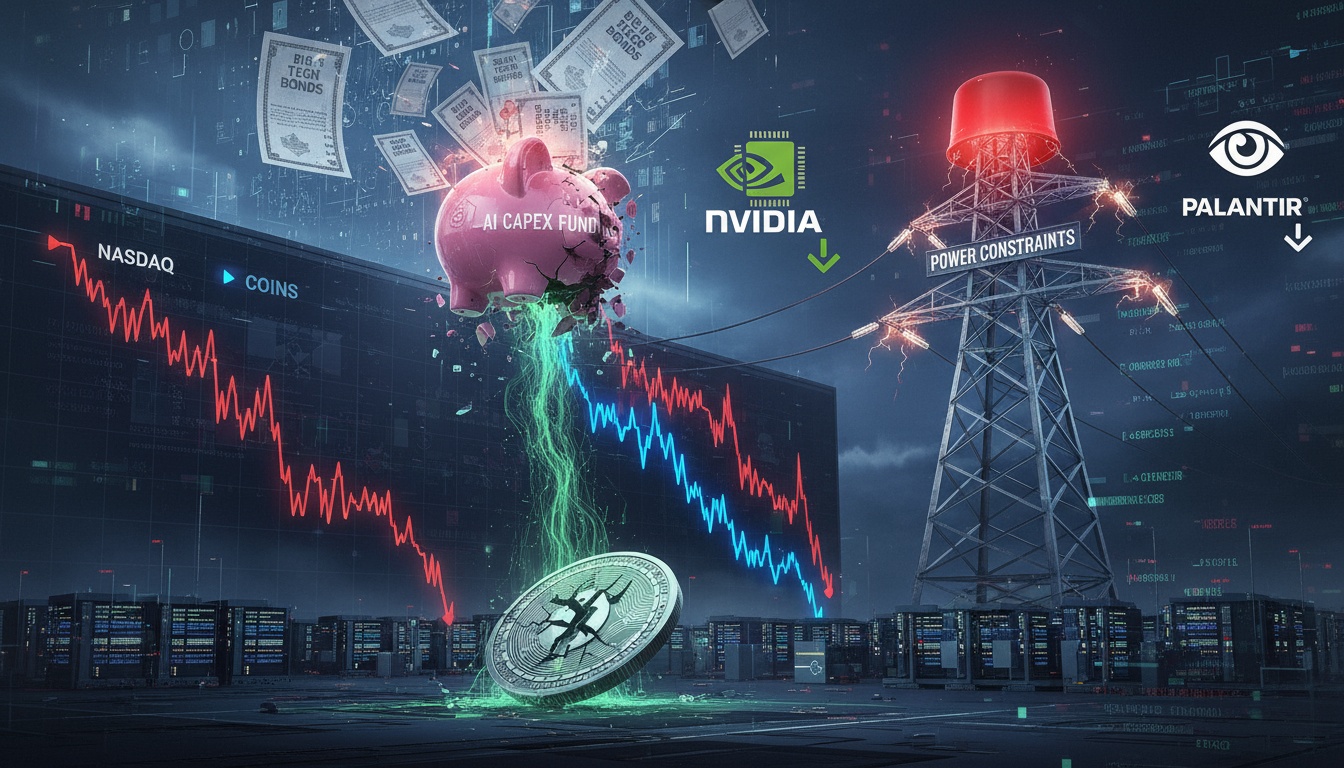
● AI Capex Debt Bomb, Burry Sparks Tech Panic
Real Reasons Behind the Nasdaq and Crypto Crash: Wall Street CEO Warnings Are Just Headline Decorations, with the Core Being Big Tech Corporate Bonds and AI Capex Funding Structures, and the Signal Thrown by Burry’s Puts
Today’s article contains five key points.
1) Separation of the superficial reasons for the Nasdaq decline from the fundamental factors.
2) The true meaning behind Michael Burry’s public disclosure of put options on Palantir and NVIDIA.
3) The reason for the decline despite Palantir’s upward earnings revision and the interpretation of a PSR of 85.
4) What the surge in big tech corporate bonds indicates about changes in AI data center capex funding flows.
5) The trigger for the crypto plunge and a short-term checklist (interest rates, credit spreads, power, and slowdown in cloud growth).
Today’s Market Briefing: Separating Headlines from the Essence
The Nasdaq fell by about 1.5%.
On the surface, Wall Street CEOs’ comments about “valuation caution” and Michael Burry’s put disclosure on these points were cited as reasons.
However, most of the remarks were theoretical, and Burry’s disclosure is based on notional values, meaning the actual capital deployed and profit/loss sensitivity may be smaller than the headline suggests.
The point closer to the essence than the news is the increase in big tech corporate bond issuance and changes in the funding structure for AI data center capex.
Additionally, crypto was hit hard as the Ethereum hacking issue coincided with a chain liquidation, sharply deteriorating sentiment.
Wall Street CEO Comments: Why They Seem Like ‘Warnings’ but Don’t Change the Market
Heads of major asset managers, investment banks, and hedge funds reiterated the general notion that “current valuations are anywhere from fair to overvalued.”
The Goldman Sachs CEO mentioned that a 10–20% correction over the next 12–24 months is possible, but historically, such movements are within the range of a normal year.
The Morgan Stanley CEO saw a 10–15% correction as healthy provided there isn’t any macro shock.
Citadel’s Ken Griffin stated that “it’s still a bull market.”
In other words, while the tone is cautious on the headlines, the messages are not at a level to trigger an immediate risk-off move.
Michael Burry’s Put Option Disclosure: The True Meaning Behind the Numbers
Burry disclosed his purchase of put options on AI representative stocks such as Palantir and NVIDIA.
The magnitude of the disclosure is based on notional values, so the actual capital deployed and profit/loss sensitivity might be smaller than the headline suggests.
Burry presented three main pillars as his rationale:
- Slowing sales growth in cloud companies.
- A sharp surge in big tech capex growth rates.
- The “circular funding” structure within the AI ecosystem (NVDA → AI startups → back to purchasing NVIDIA GPUs).
He referenced the oversupply issue in the early 2000s with telecommunications fiber-optic cables to warn of the risks of supply overhang and a mismatch in demand.
Palantir: The Reason for the Decline Despite Upgraded Earnings
Even though Palantir upgraded its earnings and guidance, its stock dropped by 7%.
The main reason is its valuation.
With a PSR (price-to-sales ratio) of about 85 times, it sits at the top end within the S&P, meaning that when expectations are very high, even “good earnings” can be read as a sign of waning momentum.
Typically, the same news might boost a stock, but at turning points in sentiment, similar news can be met with “disappointment.”
While Burry’s disclosure did affect sentiment, structurally, the expanded volatility in an overvalued range is the more critical factor.
Three Core Points Overlooked by the Media: Big Tech Corporate Bonds, Power Constraints, and Cash Flow
1) The surge in big tech corporate bonds is not just about ‘cheap borrowing’ but a signal of changes in the funding structure.
- In the past, data centers were built with operating cash flow, but now capex exceeds cash-generating capacity, increasing reliance on debt.
- This can lead to pressure on free cash flow (FCF) margins, reduced share buybacks, and more conservative dividend policies.
- As credit spreads widen, corporate bond issuance costs rise, necessitating a slowdown in AI capex plans.
2) Power and power transmission infrastructure constraints are the real bottlenecks for AI semiconductor demand.
- Even if GPU orders increase, if power, cooling, and transmission capacities cannot keep up, actual rack installations and operating rates will be delayed.
- This creates a timing risk where “there are many orders but revenue recognition is delayed,” thereby amplifying valuation volatility.
3) The ‘circular funding’ structure acts as both an amplifier of growth and an accelerator of bubbles.
- Cash flows to startups and then cycles back to GPU purchases magnify the upswing.
- Simultaneously, in times of credit and liquidity shortages, it increases downside beta.
- Ultimately, interest rates, credit spreads, and liquidity indicators are the true triggers for a re-rating in the AI sector.
Counterpoints to Burry’s ‘Dotcom-Fiber Optic Cable’ Analogy
GPU utilization today is fundamentally different from the idle rates seen in fiber-optic cables in the past.
Even NVIDIA’s older chips show stable operating rates, and developer demand remains steady.
However, when bottlenecks in power, transmission, and packaging (such as Cowos) are resolved and supply surges, there might be temporary margin and inventory risks.
In other words, it is more realistic to interpret the risk as stemming from a “timing mismatch between demand, supply, and infrastructure” rather than a decline in demand.
Crypto Plunge: The Trigger and Chain Liquidation
Bitcoin dropped by 3–4%, while altcoins fell by 5–10%.
A major Ethereum hacking issue dampened sentiment, triggering concerns over “the sale of stolen assets,” which set off a chain liquidation.
A reduction in leveraged positions followed, increasing volatility, and recently, liquidation has alternated in popular assets among retail investors (growth stocks, gold, crypto).
When liquidity tightens, the weakest link tends to break first—a typical pattern.
Why Interest Rates, Inflation, the Fed, and Credit Are Crucial Now
Even if interest rates gradually decline from high levels, widening credit spreads will put pressure on growth stock valuations.
If inflation does not ease or if service prices remain sticky, the Fed might maintain a high interest rate regime for an extended period.
When recession risks materialize, downward revisions in earnings estimates will accompany pressure on both multiples and profits.
In the end, while the AI semiconductor narrative remains strong, discount rates, credit conditions, and cash flows are now limiting the upside in valuations.
1–4 Week Checklist: From a Trading Perspective
- Credit Spreads: Check whether IG/HY spreads are widening to assess conditions for corporate bond issuance.
- Silicon, Packaging, and Power Bottleneck Newsflow: These directly affect the speed and timing of capex recognition.
- Cloud Growth Guidance: Hyperscaler QoQ comments will indicate the pace of AI investments.
- Options Positioning: Reduced delta/gamma positions in big tech could lead to increased volatility.
- Crypto Liquidity: Monitor derivatives market funding rates and stablecoin inflows/outflows on exchanges as signals for bottoms.
Investment Idea Sketch (for informational purposes)
- High-growth, high-valuation stocks are vulnerable to even slight “guidance disappointments” despite strong earnings.
- Stocks within the AI supply chain that focus on power/thermal management/packaging may experience high volatility but continue to enjoy structural benefits.
- Platforms with increased corporate bond issuance require close monitoring of their FCF margins and share buyback pace.
- For crypto, use the hacking issues and volatility spikes around option expiries as key risk management points.
< Summary >The Nasdaq decline is driven more by the rise in big tech corporate bonds and changes in AI capex funding than by CEO warnings or Burry’s disclosures.
Palantir experienced a sentiment turning point in an overvalued range (PSR 85) despite its earnings revision.
Burry bought puts based on slowing cloud growth, surging capex, and a circular funding structure, signaling increased volatility at the upper valuation levels.
Crypto fell further due to the hacking incident and chain liquidations.
Moving forward, it is essential to consider interest rates, the Fed’s stance, credit spreads, power constraints, and cloud guidance together.
[Related Articles…]
- AI Semiconductor Cycle 2025: Decided by Power and Corporate Bonds
- Bitcoin Volatility Reignited: ETF Flows and Option Expiry Checkpoints
*Source: [ 내일은 투자왕 – 김단테 ]
– 나스닥, 코인 폭락의 수수께끼
● AI Bubble Implodes, Tech Stocks Plummet
Wall Street Check: Burry’s Warning, Palantir Plunge, Uber Guidance Shock, New York Mayor Election Variable and December Rate Signal
Today’s article contains these key points.
- Michael Burry’s disclosure of his short positions and my perspective on whether we are at the peak of a bubble or just at its beginning.
- A concise news-style summary on why Palantir fell despite record earnings and why Uber underperformed despite solid results.
- An evaluation of the essence of AI infrastructure and the justification of stock prices through profitability comparisons in Big Tech cloud.
- What ISM manufacturing, JOLTS, and FedWatch signal for December rates, exchange rates, and the US stock market.
- The impact of the New York mayoral election and shutdown timing on the year-end GDP trajectory.
- Tesla’s compensation controversy and risks from weakening demand in China and Europe.
- And other points rarely mentioned by other news sources—“power/capital expenditure bottlenecks” and “AI accounting effects” highlighted in detail.
Today’s Market Briefing: Mixed Moves, Then a Sharp Fall, Followed by Reduced Decline
The Nasdaq fell intraday to -1.5% before partially recovering from its decline.The S&P 500, Dow, and Russell also started in sync with the weakness.There was significant adjustment led by semiconductor and AI-allied stocks.
- Nvidia, AMD, Micron, and Intel fell together, widening the AI beta.
- Palantir plunged over 7% despite its record revenue.
- Uber, despite strong earnings, saw a decline of around 9% due to disappointing guidance.
- Crypto beta stocks like Coinbase and Robinhood reflected negative momentum alongside declines in Bitcoin and Ethereum.Cyclical sectors such as oil and gas also predominantly weakened.The common themes across the market are interest rates, inflation, signals of weakening demand, and guidance risks.
Earnings Focus: Uber · Palantir · AMD · Coupang · SMCI
Uber.
- Quarterly earnings were solid with increases in active users and trip numbers.
- However, conservative guidance hinting at a slowdown in growth compared to the previous quarter weighed on the stock.
- Being a stock that has rebounded significantly this year, even good performance immediately leads to a discount when momentum slows.
Palantir.
- With high annual revenue growth, expansion in the commercial segment, and growing public references such as in the UK, fundamentals are improving.
- However, some reports note that its price-to-sales (P/S) ratio is extremely high compared to past averages.
- The essence of “good earnings but still falling” appears to be a combination of valuation pressures, the paradox of exceeding expectations, and Burry’s short-position noise.
Today/This Week’s Points to Watch.
- Pre-market: Shopify, Uber, Spotify, Pfizer. Post-market: AMD, Rivian, Coupang, Super Micro Computer.
- For AMD and SMCI, key comments will be on AI server demand, pricing, and lead times.
- For Coupang, the focus will be on whether it presents a profitability track and new business momentum.
Michael Burry’s Warning: Bubble vs. Just the Beginning, What to Watch
Burry stated on X, “Not playing the game is the only way to win,” signaling overheating.His portfolio disclosure confirmed a put position on prominent AI stocks, dampening sentiment.There are two interpretation points.
- Short-term: It serves as a risk management signal in an overheated market, especially exerting psychological pressure on high-valuation growth stocks.
- Mid-term: AI infrastructure CAPEX is in the actual rollout phase, and the variable is the gap between the speed of utilization (OPEX) absorption and the physical rollout.In other words, the boundary between a “bubble” and “just the beginning” will be determined by the speed of conversion from CAPEX to revenue and the resolution of power and labor bottlenecks.
Big Tech Cloud: Balancing Profitability and Growth
Big Tech’s Q3 aggregate revenue has reached a significant portion relative to global GDP.
- Amazon maintains steady growth with its dual tracks of commerce and AWS.
- Microsoft sustains fast Azure growth with high operating margins.
- Its strategic alignment with OpenAI is favorable for expanding cloud market share for AI workloads.The key is “how quickly AI traffic converts into actual paid workloads.”This is the key to justifying stock prices and multiples (valuations).
Macro Check: What ISM, JOLTS, and FedWatch Indicate
The ISM manufacturing PMI continues to contract, reaffirming the perceived slowdown in US manufacturing.Cumulative layoffs are reverting to levels last seen after the pandemic and the global financial crisis.Since JOLTS (job openings) tends to lead to a slowdown in wage inflation with a lag, it is significant for the Fed’s rate decisions.According to FedWatch, the relay of probabilities for a freeze/cut in December directly impacts the strong dollar and exchange rate volatility.
- If rate cut expectations wane, patterns emerge with increased US stock market volatility and upward pressure on the Korean won/depreciation of local currency.In summary, the paths for rates and inflation remain ambiguous.A market driven point by point data dependency is likely to continue.
Political Variable: New York Mayoral Election and Shutdown Timing
US local elections, particularly the New York mayoral race, are grabbing attention.Local reports indicate the rising issue of progressive candidates, with frames of “urban regulation, tax hikes, public safety, and budgeting” indirectly affecting market sentiment.The key focus is on the timing of a federal budget shutdown.
- If a deal is struck right after the local election, the risks to year-end consumer spending and government expenditures are alleviated.
- A delay until Black Friday could pose short-term burdens on Q4 GDP, rate expectations, and risk asset sentiment.
Tesla: Compensation Controversy and Weakening Demand
Norway’s sovereign wealth fund cast a vote against Elon Musk’s massive compensation plan, raising concerns over shareholder dilution.Rising competition in China’s EV market and slowing registrations in Europe are additional pressures due to regional demand volatility.It is essential to clarify the pricing strategy, new model roadmap, and FSD momentum.
Consumer/Retail: The Significance of Halloween Spending and the Rise of Dutch Bros
US Halloween spending has continuously increased over the long run and is a representative “community consumption” category.Seasonal employment and pop-up demand lay a positive base for domestic consumption.In the coffee market, Dutch Bros is rapidly expanding its market share centered on drive-thru services.Competition in recession-resilient categories will be determined by next year’s store expansion and pricing strategies.
Tonight/This Week’s Calendar: Volatility Triggers
- 10:00 (local): JOLTS job openings.
- Earnings: Pre-market – Shopify, Uber, Spotify, Pfizer. Post-market – AMD, Rivian, Coupang, Super Micro Computer.
- Later: The combination of the employment report and CPI on inflation/employment will reset the rate narrative.The checklist is simple.
- Monitor US stocks, rates, and exchange rates on one screen. If the dollar index rebounds, growth stocks become more volatile.
- During earnings calls, make sure to note the keywords “demand,” “price,” and “margin” in the guidance language.
- For high-valuation stocks, assume that “even if good, they can fall” as a default and set stop-loss/rebalancing rules in advance.
- Add the political calendar (local elections → shutdown) to your schedule, and during periods of high volatility, verify the allocation to cash/short-term bonds.
- Domestic investors should not forget exchange rate risks. Changes in the Fed’s stance can determine returns through won/dollar volatility.
< Summary >
- The market is pricing in uncertainties from rates and inflation alongside guidance risks.
- Burry’s warning exerts psychological pressure on high-valuation AI stocks, but AI infrastructure is in the phase of physical expansion.
- Big Tech defends with cloud profitability, and the focal point is the speed at which AI workloads convert into paid services.
- ISM, JOLTS, and FedWatch are key variables that will influence December rate expectations and exchange rates.
- The timing of a shutdown deal after the New York mayoral election is critical to the Q4 GDP trajectory.
- Tesla is exposed to both compensation controversy and weakening regional demand.
- Power bottlenecks and the accounting transition (from OPEX to CAPEX) are the true turning points for the AI cycle in 2025-2026.
[Related Articles…]
- The Real Impact of the Fed’s Rate Stance Changes on Tech Stock Valuations
- Post-Nvidia: Winners in the AI Server Value Chain and the Formula of Power Bottlenecks
*Source: [ Maeil Business Newspaper ]
– 美지방선거 뉴욕시장 맘다니 유력?ㅣ우버, 호실적에도 가이던스 실망ㅣ노르웨이국부펀드, 머스크 보상안 거부ㅣ홍키자의 매일뉴욕