● Nasdaq Bloodbath, Shadow Credit Bomb, On-Device AI Shock
Comprehensive Summary of the Real Reasons Behind the Nasdaq Plunge: Employment Slowdown, Private Credit Shadow Debt, On-Device AI (Apple×Google), and Shutdown Risks
Today’s article isn’t just about a simple decline in the news; it encapsulates everything from why “bad news = bad stock prices” has come to be, to the shadow debt structure of Private Credit boosting data center investments, the real impact of Apple and Google’s on-device AI collaboration, and what “smart money” is looking at to reduce its positions.
We have selected the key points that the market is truly worried about and organized them in a news format by group, while separately compiling the critical elements that are less covered on other channels.
Market Overview: Nasdaq Down 1.8%, a Focus Shift, Not a “Reasonless Decline”
- Major indices fell together: Nasdaq was down about -1.8%, while the Dow, S&P, and Russell recorded declines in the range of -1% to -2%.
- Triggering factor: Amid an official employment data gap, the private “Challenger Report” showed workforce cuts at record highs relative to the past 20+ years as of October, dampening sentiment.
- Shift in interpretation: Even if there is an expectation of a “rate cut,” the current phase is seen as a signal of “economic recession,” leading to a preference for risk-averse assets.
- Flow of funds: With yields on U.S. bonds such as the 2-year falling, the preference for safe-haven assets was strengthened.
- Supply-demand characteristics: The range of stocks that had been leading gains has narrowed further, resulting in an increased concentration in large caps, and a reduction in overall liquidity following the liquidation of individual-preferred assets such as cryptocurrencies and gold.
- Keyword capture: Nasdaq, rate cuts, the global economy, economic recession, and U.S. bonds are all operating simultaneously within one framework.
Employment Slowdown vs. Rate Cuts: Why “Good Ingredients” Have Become a Negative for Stocks
- Challenger Report: As of October, announcements of workforce reductions soared to the highest level since 2003, signaling a significant cooling of the labor market.
- Shutdown variable: With a prolonged government shutdown causing official statistics to be unavailable, the market impact of each piece of private data has become excessively amplified.
- Change in market sentiment: In the past, “bad employment = quick rate cuts” was often interpreted as a positive; now, the prevailing fear is that “real deterioration may come first.”
- Difficulty in reemployment: The signal that reemployment for the laid-off is becoming more difficult could lead to a slowdown in consumption and pressure on corporate sales.
Liquidity and U.S. Bonds: What the Decline in 2-Year Yields Indicates
- Behind the decline in yields: It wasn’t merely a simple bet on rate cuts; it also reflected a “flight to safety” in anticipation of an economic slowdown.
- Key point: If short-term yields fall simultaneously with weak equities, concerns about a “stagflation” scenario could emerge as the market’s basic narrative.
- Checklist: It is highly recommended to keep an eye on the supply-demand dynamics of U.S. bonds as well as the yield spread between short-term and long-term bonds (implying inflation expectations/growth).
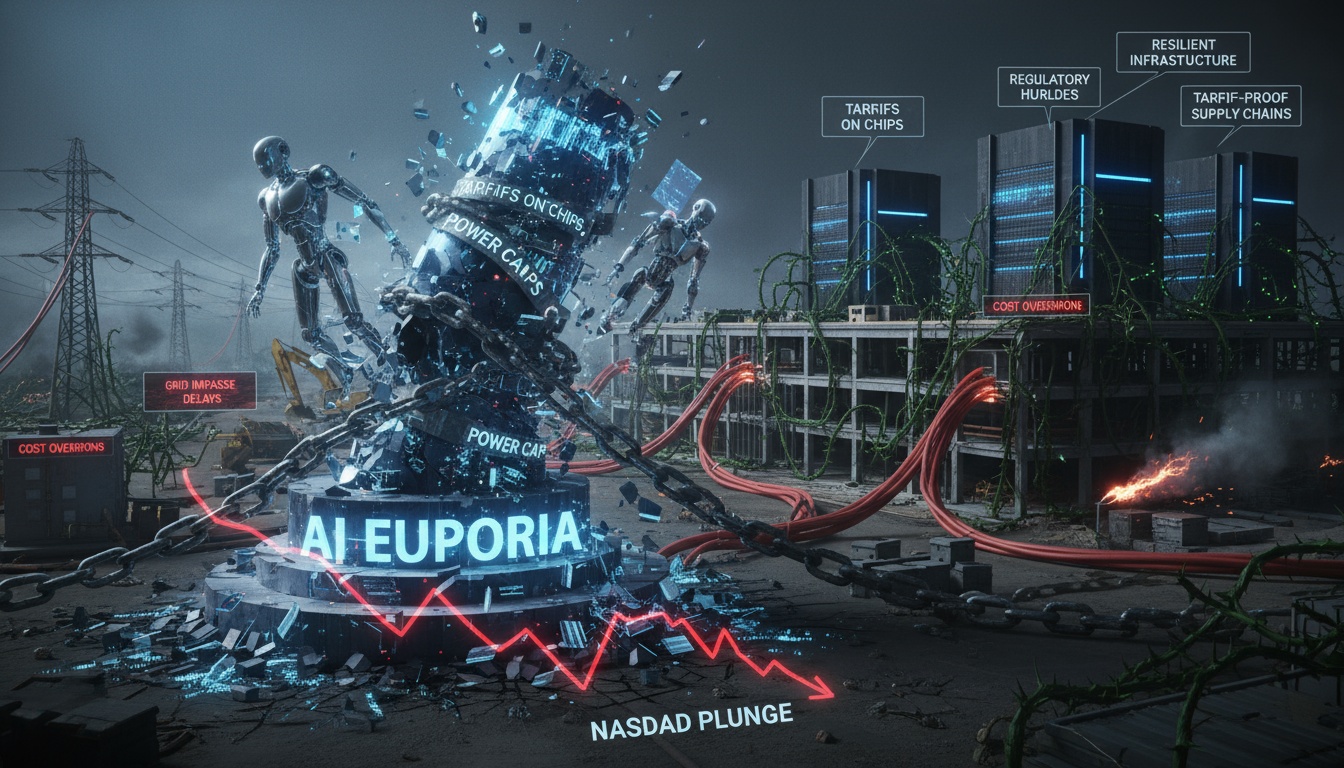
Structural Risks in the Market Decline: Data Center Investment and the Shadow of Private Credit (Private Loans)
- Why focus here: With the explosion in data center CapEx driven by the AI boom from 2024 to 2028, funding is shifting from banks to Private Credit.
- Structural summary: The spread of investment via SPVs (Special Purpose Vehicles) by big tech, coupled with lending provided by non-bank Private Credit, is on the rise.
- Off-Balance Sheet Debt Issue: Debts are not fully reflected on the parent company’s balance sheet and may be hidden in the form of “guarantees” or “similar financial obligations.”
- Example context: In some projects, the parent company holds only the SPV’s shares, while the SPV attracts funds through leveraged private loans.
If problems arise, the parent company may bear direct or indirect guarantee burdens; however, until the disclosures and notes are examined in detail, the risks cannot be accurately seen. - Why smart money is sensitive: With fixed rates, demand slowdowns, and rising construction costs all converging, “rollover risk” increases, and credit tightening among non-bank lenders could spread from specific projects to the broader financial system.
- Points to monitor
1) Disclosure notes on guarantee and repayment priority clauses, as well as the proportion of covenant-lite arrangements
2) Trends in private credit interest spreads and delinquency rates
3) Mismatches in cash flow due to data center lease rates, delays in power connection, and construction delays
On-Device AI: The True Meaning Behind Apple×Google Collaboration
- Core issue: Reports continue to suggest that Apple will incorporate Google’s Gemini-series model into key features of Siri, such as summaries and planners.
- Technical context: While foreign media mention the possibility of utilizing trillion-parameter models, the actual on-device implementation is likely to be a lightweight model + cloud hybrid.
- Why it is a catalyst: Native integration at the OS level transforms AI from being something that is used only when an app is opened to an AI that is “always by your side.”
This change could drive both smartphone replacement demand and an increase in service ARPU simultaneously. - Alignment of interests: Apple appears to be employing an external model to bridge short-term performance gaps while working towards internalizing the technology in the medium to long term to reduce dependency risk.
- Google’s perspective: Having exposure equivalent to being pre-installed on the iPhone serves as a powerful catalyst for restoring brand power and expanding its traffic pool.
MS’s “Superintelligence” Drive: Reconfiguring Partnerships and Increasing Competitive Intensity
- Directional shift: Microsoft is bolstering its dedicated team aimed at superintelligence (high-performance general-purpose AI that goes beyond AGI).
- Interpretation: The move to adjust the terms of its partnership with OpenAI is read as a focus on reducing dependency and accumulating internal capabilities.
- Industry impact: Should breakthroughs in challenging fields such as medicine and materials science translate into tangible results, the reallocation of demand for corporate IT and cloud services could accelerate further.
Signals from Smart Money: Narrow Breadth Rallies and Repricing of Volatility
- Reduction in breadth: A rally concentrated on a few mega-caps increases portfolio risk despite the index’s apparent gains.
- Reassessment of volatility: In a phase where rate cut expectations persist yet stock prices remain weak, there could be simultaneous downward revisions in earnings estimates and re-rating of valuations.
- Short-term tactic: While a technical rebound may occur after a sharp decline, managing downward volatility remains the top priority, which is close to the current consensus on positioning.
Government Shutdown: The Cumulative Impact on Growth Rates
- The cost of gaps: As the shutdown continues, disruptions in public services and gaps in official statistics widen, and the resulting cutbacks spread to real sectors such as aviation.
- Impact on growth rates: Although there is considerable variation in estimates, a conservative view suggests a downward pressure of around 0.1 percentage points per quarter, and if prolonged, a cumulative impact of 1–2 percentage points has been mentioned.
- Investment implication: The absence of official data increases the reliance on private data, amplifying noise.
In periods of event volatility, managing position sizes might lead to performance that outperforms the market.
News Summary (Key Points)
- The Nasdaq plunge is not merely driven by panic but is a systematic reaction of employment slowdown → recession fears → reduction in risk assets.
- While expectations for rate cuts remain, the current phase is characterized by “bad news = bad stock prices.”
- A flight to U.S. bonds and a reduction in breadth indicate a defensive positioning by smart money.
- The off-balance sheet risk associated with data center financing based on Private Credit has emerged as a lurking threat.
- On-device AI (Apple×Google) and MS’s superintelligence drive could serve as the next momentum drivers, although their implementation, costs, and regulatory factors remain key.
- The regression to U.S. bonds and the contraction in breadth also point to a defensive stance by smart money.
Highlighting the “Really Important” Points Often Overlooked Elsewhere
- The “shadow debt” of Private Credit could have ramifications beyond individual tech company issues, affecting liquidity in the non-bank sector.
It is essential to check the disclosure notes regarding guarantee clauses, the repayment priorities of SPVs, and structures with variable interest rates. - The AI layoffs issue, while reflecting immediate cost-saving benefits on earnings, may see delayed friction costs in re-education and redeployment.
One must consider the secondary effects of a cooling labor market → reduced consumption → pressure on sales. - The true value of on-device AI lies in “distributed inference.”
Companies that lower inference costs with a device + cloud hybrid and reduce regulatory risks by processing personal data locally will gain a competitive edge. - A prolonged shutdown poses a “data gap risk.”
Delays in official statistics cause the market to overreact to private data, prolonging the era of volatility.
Investment Checklist (For Informational Purposes)
- Macro
1) Whether the decline in short-term yields and the weakness in the Nasdaq occur simultaneously
2) Trends in unemployment/workforce cut announcements and consumer credit delinquency rates
3) Whether the gap between inflation expectations and actual inflation widens - Credit/Liquidity
1) Commentaries on Private Credit spreads, delinquency rates, and BDC performance
2) Disclosure on lease rates, power capacity, and construction delays of data center REITs - AI Trends
1) Data on the actual scope of integration and usage frequency of the Apple×Google hybrid function
2) Signals of transition from research to commercialization in MS’s superintelligence roadmap (partnerships, pilot customers, cost disclosures)
Three Scenarios (Key Points for Next Quarter)
- Soft Landing
A scenario where the employment slowdown is gradual and rate cuts help achieve a smooth landing.
If breadth improves, a rotation into mid-caps and cyclical sectors may occur. - Hard Landing
If further workforce cuts and a sharp drop in consumption occur, earnings estimates may be further revised downward and valuations could be compressed again.
A preference for defensive stocks and U.S. bonds would be reinforced. - AI-Fueled Rally
If the commercialization of on-device AI enhances perceived utility, simultaneous expansion in smartphone replacements, cloud, and semiconductor front-end demand could occur.
However, the clash with CapEx/Private Credit risks remains a new variable.
< Summary >
The Nasdaq plunge is a result of employment slowdown and recession fears dampening risk appetite.
While expectations for rate cuts exist, the current phase remains one of “bad news = bad stock prices.”
The off-balance sheet risk in data center financing based on Private Credit has emerged as a lurking threat.
Apple×Google’s on-device AI and MS’s superintelligence drive could serve as the next momentum, but implementation, costs, and regulatory issues are crucial.
The return to U.S. bonds and the contraction in breadth suggest a defensive stance by smart money.
[Related Articles…]
The Next-Generation Demand Cycle Triggered by On-Device AI
The Chain Reaction of Private Credit Risks and the U.S. Bond Market
*Source: [ 내일은 투자왕 – 김단테 ]
– 너무한 나스닥의 하락. 진짜 이유는 혹시 이것?
● Tariff Bomb, AI Bailout, Chip War
Tonight’s New York Market Key Issues Recap: U.S. Supreme Court ‘Tariff’ Ruling Risk, OpenAI Funding Controversy, Tesla Compensation Vote, ARM-Marvell Big Move, and Power, Crypto, and Retail
This article covers 1) the direct impact of the U.S. Supreme Court’s ‘Trump Tariff’ ruling on the global supply chain, exchange rates, and inflation, 2) the reality of capital funding for AI infrastructure revealed by the OpenAI CFO’s remarks, 3) signals to the stock market and valuation from Tesla’s annual meeting compensation vote, 4) SoftBank’s ARM-Marvell big picture, and 5) checkpoints on power, crypto, and retail performance.
It also separately summarizes practical points such as ‘refund mechanisms, government guarantees, project financing, and breakage accounting’ that other channels overlook.
Market Snapshot: Rebound Falters in Tech Stocks, Rate Expectations Remain
After yesterday’s rebound, high-valuation tech stocks are now seeing selling pressure as the Nasdaq and S&P 500 turn weak.
Mega caps like NVIDIA, AMD, and Microsoft have adjusted together, and Fortinet and DoorDash have plunged on disappointing earnings.
Continued weakness in crypto has widened the declines for Coinbase and Robinhood.
With the year-end FOMC around the corner, the probability of a rate cut in December has been revised upward, which has mixed effects on short-term stock market valuations and exchange rate volatility.
Remember these five key terms: global economy, interest rates, inflation, stock market, exchange rates.
U.S. Supreme Court ‘Trump Tariff’ Hearing: From Refund Possibilities to Global Economic Ripple Effects
The key issue is whether the International Emergency Economic Powers Act (IEEPA) of 1977 extends to ‘tariffs’.
Some conservative justices have even questioned whether a trade deficit can be considered an emergency, casting doubt on the legitimacy of the tariffs.
If ruled illegal, there is the potential for a refund issue of approximately $9 billion in tariffs already collected.
The refund process is crucial as it involves retroactive claims on a per ‘Importer of Record’ basis rather than a country-to-country settlement, making the procedure complex.
Scenarios and their impacts are outlined as follows:
– Tariffs maintained: Reduced uncertainty before the presidential election, strengthened inflation defense logic, neutral impact on import prices and exchange rates.
– Tariffs invalidated/refunded: Possible short-term easing of prices vs. legal chaos-induced distortions in corporate accounting and cash flows, amplified stock market volatility.
– Transition to alternative methods: If the administration reimposes tariffs using other trade laws such as Section 301/232, policy uncertainty could again tension the global supply chain.
While appearing as a short-term positive for Korean exports and K-semiconductors, prolonged legal confusion could delay order and inventory strategies, reducing earnings visibility.
OpenAI CFO Remarks Controversy: Signal of an ‘AI Infrastructure National Project’ Rather Than a ‘Government Guarantee’
The OpenAI CFO mentioned private-government collaboration and used the term ‘collateral’, only to later clarify his remarks.
The key point is the acknowledgment that investments in infrastructure—spanning mega models, data centers, power, and AI chips—face clear limitations when relying solely on private balance sheets.
Market estimates suggest that capital in the order of tens to hundreds of billions or even trillions of dollars will be required for AI infrastructure over the coming years, with a significant gap from current available revenues and cash flows.
Hyperscalers are already expanding capex commitments worth tens to hundreds of billions of dollars, while securing power, real estate, and GPU supply remains a major bottleneck.
The practical solution is to combine DOE loan guarantees (LPO), project financing, and PPAs to lower capital costs with a ‘non-recourse’ structure.
The market is gradually pricing in mixed financing of a ‘national infrastructure’ nature as a likely alternative to government guarantees.
SoftBank’s Next Move: ARM’s Strong Performance + Reports of a Marvell Acquisition Consideration
ARM has seen strong performance from AI-driven demand in IP licensing and royalties.
The report of a potential Marvell acquisition suggests a strategy to enhance AI data center competitiveness through a vertical and horizontal integration with ARM in custom accelerators and networking.
This can be interpreted as a strategy to directly challenge the ASIC/SoC plus networking structure dominated by Broadcom and NVIDIA.
If combined with large-scale national AI infrastructure projects like ‘Stargate’, control over the entire value chain—from design-IP, manufacturing, packaging, to networking—could be significantly strengthened.
Power Infrastructure Reality: Vistra Misses Earnings, Warns of Overestimated Grid Capacity
Vistra’s revenue and guidance fell short of expectations.
Management mentioned that the waiting demand for grid connectivity might be overestimated by three to five times compared to actual demand.
Nonetheless, with data center power demand, aging grid replacements, and changes in power pricing structures, the medium to long-term fundamentals remain solid.
Investment points include IRA tax credits, LT-PPA pricing, the added value of energy storage systems (ESS), and regional wholesale prices (Locational Marginal Pricing).
Fintech/Crypto: Robinhood Posts Solid Earnings Yet Declines, Dual-Edged Volatility
Despite diversified revenue sources such as trading, staking, and cash sweep interest, Robinhood has been adjusted downward in the wake of a sharp short-term surge, burdened by valuation concerns and crypto weakness.
Coinbase similarly experiences declines due to reduced trading volumes and re-emerging regulatory risks.
However, high volatility can be positively interpreted in the medium to long term as it supports platform fees and net interest margins (NIM).
Tesla Annual Meeting: The Real Meaning Behind the Compensation Vote
While headlines suggest ‘exorbitant compensation’, the payouts are in the form of performance-linked stock awards and do not involve cash outflows.
Amid slowing electric vehicle delivery growth, robo-taxis, FSD, and humanoids are key to earning a revaluation.
Approval of the compensation plan aligns executive incentives with long-term innovation bets, but overly ambitious targets could also increase stock volatility.
The crucial factor is the verification of the ‘path to achieving targets’, with production, cost, and regulatory schedules determining the roadmap’s realism.
The Real Cash Machine of U.S. Year-End Spending: Gift Cards and ‘Breakage’
The U.S. gift card market is estimated to grow at double-digit annual rates, peaking at the end of the year.
Companies secure interest-free working capital through advance payments, and unused balances (breakage) boost net profit margins.
Starbucks, for instance, steadily holds substantial prepaid balances, effectively acting as a ‘micro bank’ outside regulatory oversight.
In a global economic environment where high interest rates prevail for extended periods, the contribution of interest income from these prepaid balances increases.
Investment Checklist: Positioning Needed Right Now
Prepare for post-tariff ruling volatility by hedging exposure in stocks with significant global supply chain and exchange rate risks.
For AI infrastructure beneficiaries, prioritize stocks that link ‘power – grid – data centers – custom silicon’.
For crypto and fintech, assess valuations by separating sensitivities to trading volumes from those of NIM.
For retail, monitor key checkpoints such as prepaid balances, breakage, and royalty accounting disclosures.
Key Points Not Covered Elsewhere
– The tariff refund is fundamentally retroactive on a per-importer basis, meaning refund claims, litigation, and class actions could drag on and destabilize corporate cash flows.
– Should the administration lose, it could reintroduce a tariff under a different guise using laws like Section 301/232, meaning the policy risk would not vanish completely.
– Mega projects like those of OpenAI are best financed by a combination of DOE loan guarantees, long-term PPAs, and data center REITs/project bonds to minimize capital costs.
– The ARM+Marvell combination focuses on ‘custom accelerators + networking’, enabling margin expansion in inference and carrier-grade networking rather than just training.
– In the power sector, beyond simple demand stories, regional LMP, outage and congestion costs, and the pace of IRA credit implementation are key levers for earnings.
– Robinhood’s cash sweep interest and margin loans, linked to the interest rate cycle, might cause earnings volatility to exceed that of trading volumes.
– Gift card ‘breakage’ accelerates revenue recognition to boost profitability, making year-end guidance a crucial indicator.
News Brief at a Glance
– U.S. Supreme Court Tariff Hearing: Conservative justices express skepticism over the IEEPA interpretation, highlighting refund possibilities.
– OpenAI CFO Remarks: Clarified ‘government guarantee’; in reality, implying the need for mixed financing in AI infrastructure as a national project.
– ARM Strong Performance + Marvell Acquisition Consideration: SoftBank’s bet on expanding in custom silicon and networking.
– Vistra Earnings Miss: Short-term disappointment, but the long-term investment theme in power and grid remains valid.
– Robinhood and Coinbase Declines: Crypto weakness and valuation pressures amid heightened volatility, with long-term fees and NIM potentially benefiting.
– Tesla Compensation Vote: Performance-linked stock awards; verifying the realism of the innovation roadmap is key.
– Year-End Gift Cards: Prepaid balances and breakage serve as hidden engines for retail profitability.
< Summary >
The Supreme Court tariff ruling could set a pivotal moment for the global supply chain, exchange rates, and inflation.
The OpenAI remarks signal that funding for AI infrastructure should be approached as a ‘national project with mixed financing’.
The ARM-Marvell news points to a reorganization around custom accelerators and networking.
In power, fintech, and retail, the real levers lie in performance and cash flow metrics.
[Related Articles…]
AI Chip War, The Next Move of the NVIDIA Alliance
Scenarios for Exchange Rates and the Stock Market After the Fed Holds Rates
*Source: [ Maeil Business Newspaper ]
– 오픈AI CFO, 자금조달 문제 내비쳐?ㅣ테슬라, 머스크 보상안 주총 개최ㅣ비스트라에너지 예상치 하회 실적ㅣ홍키자의 매일뉴욕