
● Samsung’s 2.5 Billion Acquisition Shakes Data Center Cooling Market
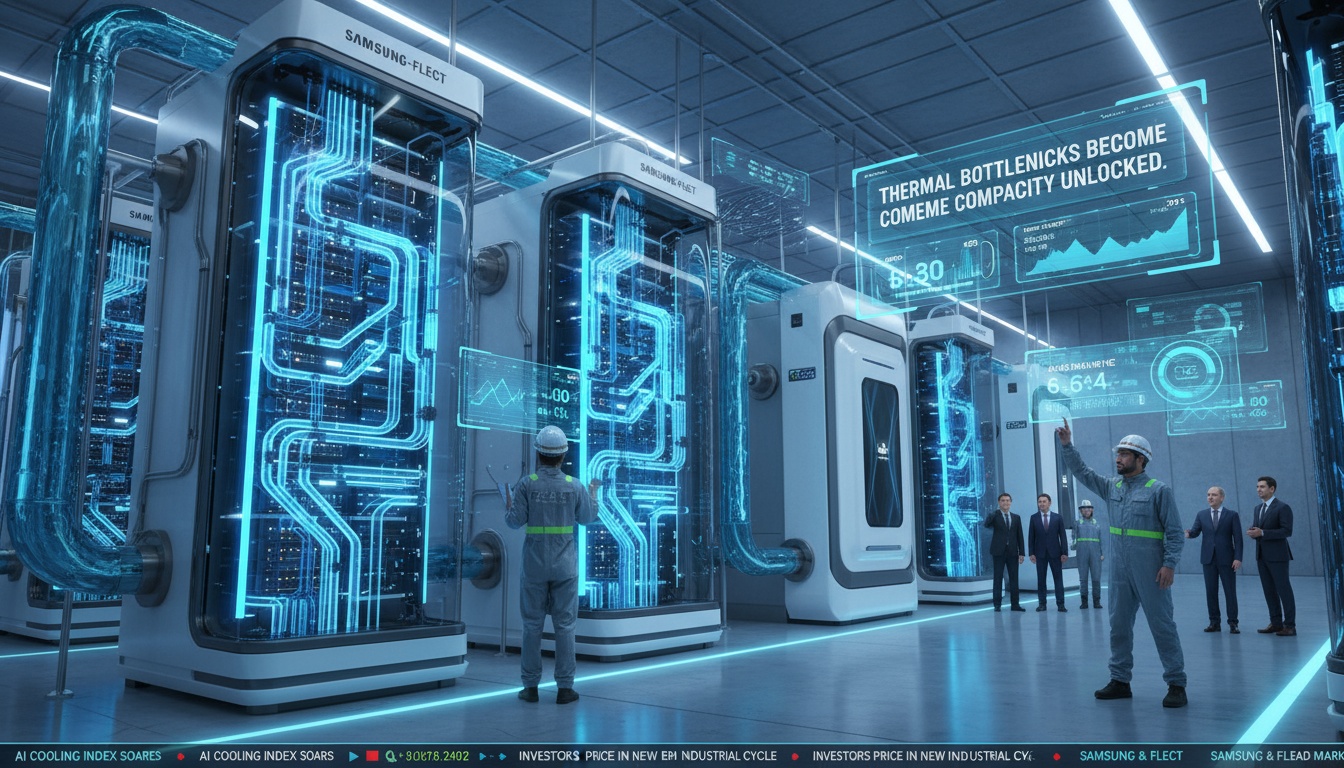
Samsung Electronics Acquires German Flect for 2.5 Trillion Won… Intent to Dominate the AI Data Center ‘Thermal Management’ Market
This article provides an overview and strategic significance of Samsung Electronics’ acquisition of Flect. It covers the transaction size and main conditions, Flect’s global capabilities, and manufacturing presence. It interprets the growth potential of the AI data center cooling market (forecasted to reach $44.1 billion by 2030) and Samsung’s link to AI ecosystem expansion. The analysis is broken down into stages, covering competitive dynamics, risk checklists, and implications from an investment and business perspective. Exclusive insights not covered by other news outlets or YouTube are also summarized separately. SEO key terms such as AI, data center, HVAC market, Samsung Electronics, and mergers and acquisitions are naturally incorporated throughout the text.
News Summary
Samsung Electronics completed the acquisition of 100% of Flect Group shares for 1.5 billion euros (approximately 2.48 trillion to 2.5 trillion won). Flect, a global HVAC company established in 1918, operates in 65 countries with annual sales of about 700 million euros. Through this acquisition, Samsung Electronics aims to secure capabilities in data center cooling solutions in line with the expansion of AI infrastructure. The global data center HVAC market is expected to grow to approximately $44.1 billion by 2030. The Flect brand and management will remain intact, operating as an independent subsidiary.
Transaction Overview — Key Items
Transaction amount and structure.Samsung Electronics acquired 100% of Flect shares for 1.5 billion euros, completing the procedure. The converted amount in Korean won is approximately 2.48 trillion to 2.5 trillion won.
Flect company profile.Established in 1918 as an HVAC specialist company, it operates in Europe, North America, the Middle East, and more, covering 65 countries. It records annual sales of approximately 700 million euros and holds HVAC equipment and data center cooling technologies. Its major subsidiaries include Woods, Samco, and SE Electronic, securing manufacturing bases in Europe and North America.
Operational method.Post-acquisition, Flect will be maintained as an independent subsidiary with its brand and management kept intact. The strategy is to secure customer and supply chain stability by maintaining brand identity and expertise.
Strategic Significance — Why Flect?
The core of thermal management for AI data centers.AI services and large-scale models require 24/7 high-load computation, and power consumption and thermal management directly link to cost competitiveness. A technology portfolio encompassing both air and liquid cooling becomes a differentiating factor in large AI infrastructure projects.
Expansion into the Samsung AI ecosystem.This acquisition completes a piece of Samsung’s infrastructure spanning AI semiconductors, servers, and data center equipment. Flect’s customer and project network significantly boosts Samsung Electronics’ cross-selling opportunities for servers and AI solutions.
Entry into the smart building and industrial HVAC market.Combining Flect’s technology with Samsung’s AI building integration platform allows expansion into smart building energy efficiency solutions. Immediate entry into industrial large HVAC markets such as hospitals, tunnels, ships, and factories is also feasible.
Securing global manufacturing and supply chains.Flect’s manufacturing bases in Europe and North America are advantageous from regional procurement requirements and supply stability perspectives. Particularly in public and industrial orders, local production bases function as a competitive advantage.
Market Outlook and Numerical Basis
Data center HVAC market.According to market research, the global data center HVAC market is expected to grow to approximately $44.1 billion by 2030. With the AI spread, the power and cooling demand in data centers rises sharply, leading to a surge in demand for high-efficiency cooling solutions.
Revenue points.Beyond hardware sales, there are prospects of building a recurring revenue model through maintenance and operation (SaaS and energy management). Customer total cost of ownership (TCO) reduction through energy efficiency improvement becomes a sales point.
Competitive Dynamics
Main competitors.Traditional HVAC leaders and data center specialized cooling companies, such as Daikin, Carrier, Schneider Electric, and Vertiv, compete. In the liquid cooling sector, specialized companies like CoolIT and Asetek are emerging as competitors.
Samsung’s differentiation factors.Integration with AI platforms, semiconductor and server production bases, and a global customer network synergize effectively. Maintaining brand and local management minimizes existing customer attrition.
Financial and Operational Risk Checklist
Revenue realization timing against acquisition costs.The period of ROI recovery on initial investments and assumptions (such as winning data center projects) is crucial.
Integration risks.Friction can arise from cultural integration, product lineup merging, and R&D direction alignment. While the brand is retained, strategic integration failure could lead to reduced synergies.
Regional regulatory and political risks.Data centers and HVAC equipment are influenced by regional energy and environmental regulations. Adapting to green regulations and procurement standards in Europe and the U.S. is necessary.
Technological risks.Failure to swiftly respond to technological advancements and standard changes in cooling technology can result in losing competitive edge.
Key Technical Points (Air Cooling vs. Liquid Cooling)
Air cooling.Installation and operation are relatively simple, with lower initial investment costs. It remains widely used in medium and small data centers.
Liquid cooling.Favorable for high-density, high-heat AI servers with high energy efficiency. Despite design and operational complexity, it has a competitive edge in terms of long-term TCO.
Hybrid approach.Flect’s capability to handle both air and liquid cooling implies responsiveness to diverse customer needs. There is substantial demand for hybrid solutions in large AI infrastructure projects (e.g., the Stargate program).
The Most Important Points Not Covered by Other News (Exclusive Insight)
Flect’s regional manufacturing bases, when combined with Samsung’s server and semiconductor supply chains, can provide a ‘regionally-tailored integrated infrastructure package.’ This package enables not only HVAC equipment sales but also turnkey data center construction, long-term maintenance contracts, and energy management services, leading to high-margin recurring revenues. If Samsung integrates Flect-based cooling solutions and supplies them to its semiconductor clients (cloud and AI companies), it can establish a ‘one-stop solution’ advantage over competitors. The European and North American manufacturing bases favor meeting eco-friendly procurement requirements, beneficial for winning public and corporate projects. Although maintaining the brand and management may appear as risk avoidance on the surface, it is a strategic move to gradually realign technology roadmaps and sales networks with Samsung’s strategies over time. Strengthened energy regulations (carbon pricing, energy efficiency requirements) may lead to upgrade demands for HVAC hardware, promoting opportunities for transitioning to subscription-based energy management services in the future. Internally, Samsung can propose its own AI semiconductor cooling design guidelines through data center cooling solutions, which ties directly to overcoming semiconductor performance limitations.
Practical Recommendations for Investors and Corporate Decision-Makers
Investor perspective.In the short term, reflect acquisition costs and check integration risks. In the mid to long term, focus on the potential for diversified revenue and recurring income generation following Samsung’s AI ecosystem expansion.
Business perspective.Quickly activate cross-selling strategies utilizing Flect’s existing customer and project lists. Integrate R&D roadmaps to secure technological superiority in liquid cooling and hybrid solutions.
Policy response.Thoroughly review the green policies and procurement regulations in Europe and the U.S. and incorporate them into project acquisition strategies.
< Summary >Samsung Electronics completes the acquisition of German Flect for about 2.5 trillion won, accelerating entry into the data center cooling and HVAC market. Flect’s air and liquid cooling technology and global manufacturing bases combine with Samsung’s AI semiconductor and server ecosystem to create a one-stop infrastructure solution. The global data center HVAC market is projected to grow to approximately $44.1 billion by 2030, with energy efficiency and service-oriented business models being key to future revenue. The brand retention strategy post-acquisition reduces short-term risks while securing time for long-term integration synergies. Investors and companies should closely observe the pace of acquisition integration, regulatory risks, and securing technological competitiveness.
[Related Articles…]AI Semiconductor Ecosystem Expansion and Data Center Investment StrategyGlobal M&A Trends and Strategies for Korean Companies
*Source: 서울경제TV
삼성전자, 2조 5천억 한방에…독일 플랙트 삼켰다