● Liquidity Frenzy – Inflation Alarm
The Conclusion of the U.S.-China Hegemony War, A Comprehensive Overview of the Liquidity Cycle and the 2026 Scenario Ushered in by the “Pivot Era”
Today’s article compresses the essential points regarding the conditions of the 2025-2026 liquidity market, the “stop signal” of 5-6% inflation, a pivot in U.S.-China relations and tariffs under a potential Trump 2.0 scenario, and even signals indicating an end to quantitative tightening (QT).
It also separately outlines strategic roadmaps for different asset classes including stocks, real estate, commodities, the dollar, and crypto assets, as well as a leading indicator regarding “stablecoin-liquidity” that other media have overlooked.
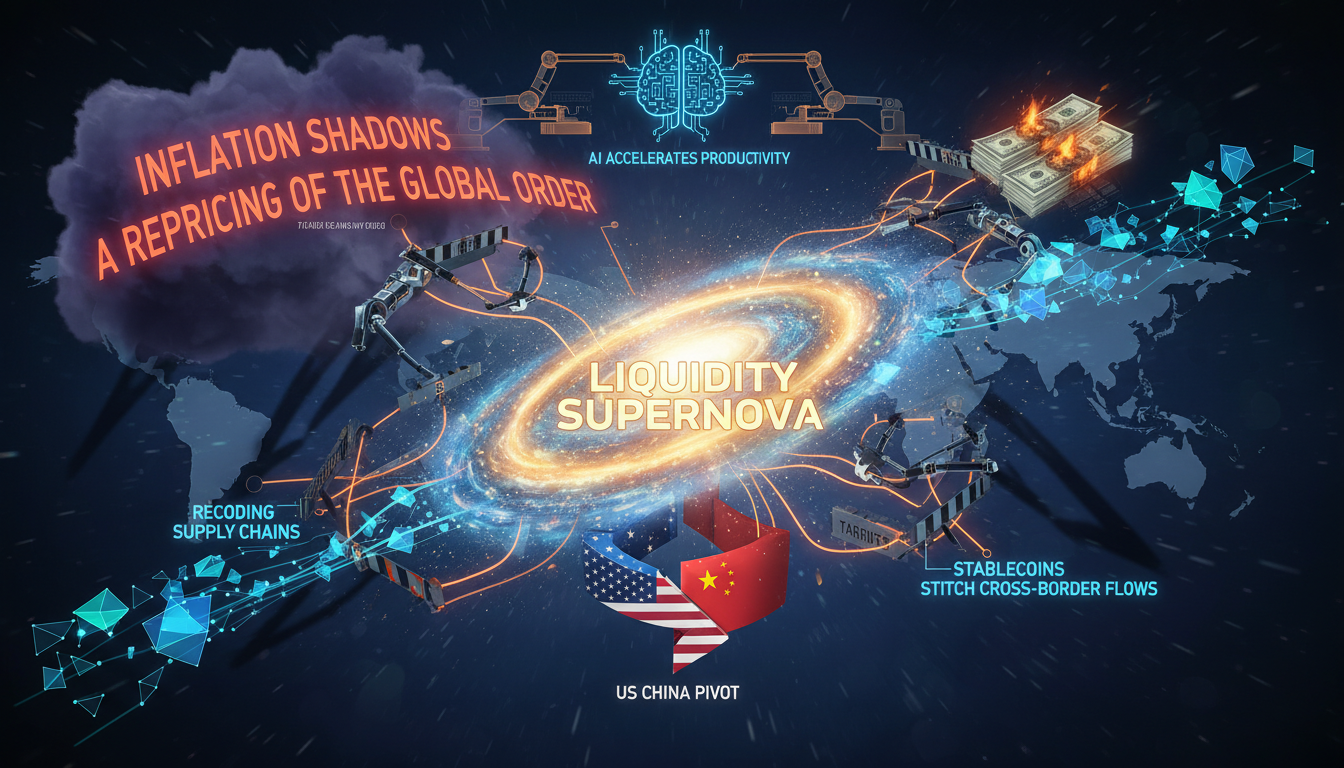
In an environment where the global economy is entrenched in low growth, the map is structured in a single diagram to clearly display the direction of interest rate pivots and liquidity.
1) News Key Summary: What Really Matters in the Market Right Now
Subsections: The Pivot Era, the Triple Shift in Interest Rates, Liquidity, and Policy.
Key Points: The 2025-2026 liquidity market is likely to continue as both interest rate cuts and changes in balance sheet policies occur simultaneously.
Key Points: However, if the CPI re-accelerates to the 5-6% range, it will serve as an “immediate stop” signal for the liquidity rally.
Key Points: In the lecture, the termination of QT as of December 1 was discussed, which is interpreted as the preparatory stage for a transition to quantitative easing (QE).
Key Points: Assuming a Trump 2.0 scenario, possibilities such as easing U.S.-China tensions and lowering (or exception-applying) tariffs to curb inflation are suggested.
Key Points: In a regime of entrenched low growth, the answer is not to “work harder” but to “work differently,” and a strategy that flexibly aligns with the liquidity cycle is required.
2) What is the Pivot Era: The Three Aspects of Interest Rates, Balance Sheet, and Policy
Subsections: Interest Rate Pivot.
Key Points: The lecture premise is a scenario where the U.S. policy rate is expected to be cut further from the 4% range to the 3% range.
Key Points: This depicts a scenario in which easing becomes the default amidst weak real growth and diminishing inflation.
Subsections: Quantitative Policy Pivot (Preparation for Transition from QT to QE).
Key Points: The liquidity tap is not switched on and off instantaneously.
Key Points: A step-by-step cycle operates where the pace of QT is slowed and then declared to end, with a transition to QE if necessary.
Key Points: When this transition signal appears, leading assets such as stocks and crypto react first, while real estate and tangible assets follow with a time lag.
Subsections: Executive Policy Pivot.
Key Points: In order to curb inflation, there is a high possibility of prioritizing measures such as partial relaxation of tariffs towards China, supply chain cooperation, and price stabilization of daily necessities and intermediate goods.
Key Points: As a rekindling of U.S.-China tensions could immediately lead to upward pressure on prices, the political cost would be high.
3) The “Stop Signal” of the Liquidity Market: The 5-6% Inflation Rule
Subsections: Why 5-6%?
Key Points: The order in which stocks lead, real estate follows, and prices peak last has been reaffirmed since the massive easing of 2020-2021.
Key Points: Since the current easing originates from a 2-3% inflation level, any overheating may occur faster than in previous cycles.
Key Points: If the CPI surges back to 5-6%, the market will immediately price in the possibility of halting further interest rate cuts or even reinstating hikes.
Subsections: The Policy Reaction Function.
Key Points: The Federal Reserve cannot push through rate cuts in the face of high prices without proper justification.
Key Points: Therefore, a CPI in the 5-6% range becomes the inflection point triggering either a halt or a reversal of the easing cycle.
Subsections: The Investment Signal Deployment.
Key Points: If the CPI breaches the 5% range again, it is advisable to reduce exposure to high-beta growth and high-risk crypto, while increasing allocations to defensive stocks, quality credit, and cash.
4) The Trump 2.0 Scenario: Reorganizing U.S.-China Relations, Tariffs, and Exchange Rates
Subsections: The objective is a pragmatic “devalue the money.”
Key Points: A weak-dollar tendency combined with tariff easing creates an environment favorable to manufacturing and asset markets by lowering inflation.
Key Points: However, if geopolitical conflicts intensify, there is a high possibility that inflation could be reignited by factors such as energy, grains, and shipping costs, making the political calculus conclude that “the cost of cooperation is less than the cost of inflation.”
Subsections: Impact on Korea/Asia.
Key Points: Tariff relief and realignment of supply chains could be favorable for Korea’s exports and semiconductor cycle.
Key Points: On the other hand, a renewed escalation in U.S.-China conflicts could increase volatility in the KOSPI through higher raw material and shipping costs as well as exchange rate fluctuations.
5) Asset Class-Specific Strategic Roadmap 2024H2-2026
Subsections: Stocks.
Key Points: The basic strategy in the pivot phase is “accumulate on dips under the assumption of an upward trend.”
Key Points: However, if the CPI re-accelerates into the 5% range, it is necessary to shift from high-beta stocks to value stocks with strong quality and cash flow.
Key Points: AI infrastructure (semiconductors, foundries, and cloud capital expenditure) will be the first to benefit from the liquidity, but near the cycle peak, it will be crucial to monitor any slowdown in profit estimates.
Subsections: Bonds.
Key Points: During the easing cycle, long- to medium-term duration provides resilience, but in the phase of re-heated prices, reducing duration and shifting towards TIPS and floating-rate bonds is effective.
Subsections: Commodities/Gold.
Key Points: Maintaining a proportion of gold in anticipation of policy credibility risks is valid.
Key Points: While a U.S.-China détente (easing) may limit short-term overheating of industrial metals and energy, geopolitical risks could amplify upward risks in oil prices.
Subsections: Real Estate.
Key Points: Considering the time lag from interest rates to stocks to real estate, recovery and divergence in transactions are expected after 2025.
Key Points: It is important to monitor risks such as vacancies and refinancing in commercial offices, and to balance the effects of lower rates and reduced supply in the residential market.
Subsections: Foreign Exchange/Dollar.
Key Points: The combination of interest rate cuts and tariff easing structurally supports a weak dollar; however, if inflation re-accelerates, a rapid shift to a “strong dollar-risk-off” environment may occur.
Key Points: Continuously monitor transition signals of the U.S. Dollar Index (DXY) within a 95-110 box regime.
Subsections: Crypto/Stablecoins.
Key Points: Increases in the market capitalization of stablecoins tend to serve as a leading indicator of global liquidity.
Key Points: The strength of risk-on sentiment is confirmed by a drop in BTC dominance coupled with an expansion in the beta of altcoins, and if the CPI breaches the 5% range again, a swift conversion to cash and a defensive pivot centered on BTC is necessary.
6) From a Korean Economic Perspective: How to Earn “Differently” in Entrenched Low Growth
Subsections: Rules of the Low-Growth Regime.
Key Points: The “labor + savings” formula of the high-growth era drastically reduces returns in a low interest rate, low growth environment.
Key Points: Although holding cash comes with an opportunity cost, cash during a pivot cycle acts as “ammunition for buying on dips.”
Key Points: In a regime of rising liquidity, maintaining cash is equivalent to a strategy of making incremental purchases during downturns.
Subsections: Korean Portfolio Proposal.
Key Points: 1) Core semiconductor/AI supply chain names, 2) high dividend and strong cash flow stocks, 3) partial hedging with gold/dollar, 4) medium- to long-term bonds and cash, 5) a selective exposure to real estate centered on REITs/residential properties.
Key Points: If the CPI re-accelerates into the 5-6% range, reduce exposure to high-beta, long-term non-earning growth stocks, while increasing allocations to defensive sectors such as essential consumer goods and healthcare.
7) Data Checklist Driving the Market (Including Threshold Values)
Subsections: Inflation.
Key Points: U.S. CPI headline/core annualized over 3 months, and monitoring if it breaches 5% again.
Key Points: Whether the 5-year 5-year (5y5y) inflation expectations remain continuously above 2.6%.
Subsections: Interest Rates/Liquidity.
Key Points: The Fed’s interest rate path dot plot and the number of expected rate cuts in the swap market over the year.
Key Points: Changes in the Fed’s balance sheet, and the recovery trends of RRP and bank reserves.
Subsections: Exchange Rates/Trade.
Key Points: Regime shifts around the U.S. Dollar Index (DXY) and USDKRW around the 1,300 level.
Key Points: Announcements of tariff/China-related sanctions easing, and any rebound in shipping indices.
Subsections: Leading Risk Indicators.
Key Points: A warning of risk-off if the HY-IG spread exceeds 450 basis points.
Key Points: The three-month net change in stablecoin market capitalization, and the correlation between crypto and the Nasdaq.
8) The Most Important Point Other Media Have Overlooked
Subsections: The Leading Nature of Stablecoin-Liquidity.
Key Points: In addition to central bank liquidity, the outstanding issuance of stablecoins is a new indicator that measures the short-term “risk appetite” for risk assets.
Key Points: Observing both traditional liquidity (M2, bank reserves) and digital liquidity (stablecoins) together can help capture phase transitions in stocks and crypto more quickly than other media.
Subsections: The Micro Path of QT Termination.
Key Points: The moderation and termination of QT signals a recovery in bank reserves and a rebalancing of asset duration.
Key Points: In this process, funds first flow into quality credits and mega-cap stocks, and then gradually spread to mid-small caps and thematic stocks, a “top-down” movement frequently observed.
Subsections: The Direct Path of Tariffs and Prices.
Key Points: Tariffs deliver an “immediate cost plus expected inflation” shock, making tariff relief one of the fastest policy levers for short-term price stabilization.
Key Points: Unlike items such as energy and rents, which have long lag effects, tariffs have a relatively short policy lag.
9) Three Risk Scenarios and Their Responses
Subsections: Goldilocks (Baseline).
Key Points: Amid weak growth with inflation in the 2-3% range, easing continues and the liquidity rally persists.
Key Points: The strategy is characterized by net inflows into stocks and crypto, a neutral bond duration, and a neutral allocation to gold.
Subsections: Reflation Overshoot (Warning).
Key Points: With CPI at 5-6%, there is concern over halting further cuts or a return to tightening.
Key Points: The response is to reduce exposure to high-beta stocks, increase holdings in cash/short-term bonds, rotate to quality/defensive stocks, and raise the gold allocation.
Subsections: Stagflation (Tail Scenario).
Key Points: Characterized by slowed growth, re-heated prices, and a strong dollar.
Key Points: Defensive strategies center on energy and essential consumer sectors, hedging foreign exchange, and de-leveraging.
10) Execution Checklist (For Immediate Application)
Subsections: Mapping the Liquidity Cycle.
Key Points: Pre-record the Fed’s interest rate path and balance sheet change calendar to gradually adjust your position sizes.
Subsections: Setting Inflation Trigger Boundaries.
Key Points: Pre-establish an automatic deceleration rule if the CPI breaches 5% again.
Subsections: Redefining the Role of Cash.
Key Points: Cash is reserved as “ammunition for staggered buying during downturns,” and should be used aggressively only in a regime of rising liquidity.
Subsections: Risk Budgeting.
Key Points: Quantify the exposure to high-beta stocks and the concentration of individual stocks/themes, setting an upper limit.
Subsections: Monitoring Digital Liquidity.
Key Points: Keep an eye on the three-month trend in stablecoin market capitalization and the risk premium on exchanges.
11) Understanding the Lag in Real Estate as an Indicator of the Pivot Era
Subsections: 2020-2021 Easing → Asset Surge, 2022-2023 Tightening → Price Corrections.
Key Points: In the 2024-2026 pivot, stocks lead while real estate recovers with a time lag.
Key Points: The effects of lower interest rates and normalization of transactions are likely to appear as regional and product-specific divergences after 2025.
12) Conclusion: The Big Picture Through 2026
Subsections: Basic Premise.
Key Points: It is presumed that the liquidity market will persist throughout 2026, although CPI levels in the 5-6% range represent a powerful brake.
Subsections: Policy Direction.
Key Points: Under the assumption of a Trump 2.0 scenario, a détente in U.S.-China relations and tariff easing are favorable for curbing inflation and supporting asset markets through a weak dollar.
Subsections: Investment Principles.
Key Points: In a global economy entrenched in low growth, earning “differently” and flexibly managing risk in line with liquidity direction fosters success.
< Summary >The liquidity rally for 2025-2026 may be driven by interest rate cuts and signals of QT ending.
However, if the CPI re-accelerates into the 5-6% range, the easing cycle will be halted, necessitating a shift to high-beta reduction and defensive allocations in cash and defensive stocks.
Assuming a Trump 2.0 scenario, U.S.-China détente and tariff easing help stabilize prices and support risk assets via a weak dollar.
Monitoring both the stablecoin market cap and the Fed’s balance sheet—the “digital + traditional liquidity”—is the key point that other media overlook.
In a low-growth regime, the strategy of using cash as ammunition for buying on dips and setting data-driven automatic deceleration rules is essential.
[Related Articles…]
2026 Economic Outlook and Liquidity Cycle, Overview of Asset-Specific Battle Lines
Signals of the End of Quantitative Tightening and the Pivot Era Investment Checklist: 10 Points
*Source: [ 경제 읽어주는 남자(김광석TV) ]
– 돈의 흐름이 이상하다. “미중 패권 전쟁의 결말은? 피벗의 시대 개막, ‘유동성의 끝’을 준비하라” [클로즈업 – 교보문고 강연 2편]
● Blackbox AI Dethroned, Decentralized AI Slashes Costs ninety-percent
The End of Black Box AI Monopoly: The Reality of “Verifiable Decentralized AI” and Token Economics Opened by 0G
This article covers everything from the risks of black box AI monopolies, 0G’s five-layer “Decentralized AI Operating System,” a mechanism that cuts costs by 80-90%, NASDAQ-listed digital asset treasury (ZeroStack) and token burn/buyback structure, the Korean strategy with a 3-year KBW sponsorship, and even the risks and indicators investors must check immediately.
In particular, it summarizes hidden key elements such as the “AI Safety Node,” “Layer 2 linkage with Data Availability,” and “circulation reduction through NASDAQ treasury,” which are rarely discussed in other content.
Check out the roadmap that materializes economic growth and GDP discussions, as well as the investment signals amid the interest rate and exchange rate environment.
Breaking News Summary|Key Points from 0G CEO Michael Heinrich’s Interview (Filmed on 2025-10-20)
Michael Heinrich, co-founder and CEO of 0G Labs, pointed out the safety and accountability issues of black box AI and proposed verifiable decentralized AI infrastructure as an alternative.
0G announced that it is building a “Decentralized AI Operating System” composed of a high-performance Layer 1, decentralized storage, compute network, service marketplace, AI Safety Node, and data availability layer.
It claimed that by aggregating consumer GPUs, the cost of AI training and inference could be reduced by up to 80-90%.
They successfully conducted decentralized training of a 107-billion-parameter model and revealed DiLoCoX research that optimizes Google’s DiLoCo by 357 times.
The token is used on three axes: security (staking, re-staking), governance, and utility (storage, compute, gas, market payments), and it introduced a design that reduces circulation through app revenue buybacks/burns and the expansion of holdings by NASDAQ-listed treasury (ZeroStack).
A message was emphasized that they are fully committing to the Korean market with a 3-year long-term contract as the main sponsor with KBW.
Why Black Box AI Is Dangerous|A Void of Accountability, Safety, and Governance
If the data source, labeling entity, model version, and weights/biases cannot be verified, it is difficult to hold the AI accountable for accidents when it operates critical infrastructure like airports.
The key risk is that we cannot ensure that the AI’s objectives are properly aligned with the interests of corporations and humans.
This risk goes beyond the realm of regulations and standards, shaking the foundations of economic growth and industrial trust.
In an environment with high interest and exchange rates, the uncertainty of costs and responsibilities leads to reduced investments, burdening GDP as well.
0G’s Solution|Decentralized AI Operating System (5+1 Layers)
-
Layer 1 (Ultra-High Performance Execution Environment).
This is the foundation for running smart contracts and applications, aiming for a philosophy of “virtually unlimited scalability.”
-
Storage Network.
It increases reliability and traceability by storing models and memories using a combination of on-chain and off-chain methods.
-
Compute Network.
It aggregates distributed resources such as consumer GPUs to provide inference, fine-tuning, and pre-training services.
-
Service Marketplace.
This is an app store layer where data providers and AI services connect like plugins.
-
AI Safety Node.
Serving as the system’s “police,” it is a governance security layer responsible for monitoring abnormal activities and enforcing policies.
-
Data Availability Layer (DA).
This is a linkage point that allows external projects to connect as Layer 2 on top of 0G, ensuring scalability.
This architecture is designed with the assumption of proof of origin and reproducibility of models, data, and compute, and includes traceability as a default requirement for mission-critical environments.
Cost and Performance Breakthrough|Decentralized Compute and 107-Billion-Parameter Training
By harnessing idle resources across a network of distributed GPUs instead of centralized data centers, CAPEX and OPEX can be drastically reduced.
0G stated that this approach can reduce training and inference costs by 80-90%.
From a research standpoint, they claimed a completely decentralized training of a 107-billion-parameter model was achieved, made possible through DiLoCoX, which optimizes Google’s DiLoCo by 357 times.
Economic growth is ultimately a function of productivity, and the reduction in the unit cost of AI acts as leverage at the GDP level.
Token Economics and Circulation Reduction Mechanism|Staking, Buyback/Burn, NASDAQ Treasury
-
Network Security.
Economic security is enhanced through staking, re-staking, and liquid staking.
-
Governance.
This is a stake-based token that participates in upgrade, parameter, and policy voting.
-
Utility.
The token is used as the base for storage, compute, gas, and market payments, and it also serves as the reserve asset for the DeFi layer.
-
Circulation Reduction Mechanism 1.
It involves allocating a certain percentage of app revenue towards buyback and burning.
-
Circulation Reduction Mechanism 2.
The strategy is for the NASDAQ-listed digital asset treasury ZeroStack to accumulate 0G tokens long-term, thereby absorbing circulating supply by increasing the holding per share of 0G.
This design is intended to increase token scarcity as demand rises.
However, since the burn rate based on revenue and the actual network demand are key variables, it requires precise tracking from an investment perspective.
Ecosystem, Partnerships, and Korean Strategy|3 Years with KBW, the Fusion of Big Tech and Web3
It was announced that global companies such as Alibaba Cloud, Google, and NTT Digital will be partnered alongside web3-native partners like Plum and Chainlink.
Team strengthening was also mentioned, including the addition of a former Chainlink BD Head and ex-CEO of the Avalanche Foundation.
In Korea, they secured a 3-year long-term main sponsorship with KBW and mentioned participation from Korean investors such as Samsung, promising ongoing activities.
The integration with the local Korean ecosystem takes into account investment sentiment, exchange rate sensitivity, and regulatory compliance.
Roadmap and Vision|Catching Up on Infrastructure in 1 Year, Dominating Mission-Critical by 5 Years
-
Short Term.
Catch up with the quality of centralized AI infrastructure and build a DeFi liquidity layer (AMM DEX, PERP DEX, lending/borrowing).
-
Application.
Expand on-chain “AI agent ownership” and real-world business agent services.
-
Research Leadership.
Accumulate technology to lower the marginal costs of decentralized training and inference, based on adoption at top conferences.
-
Governance.
Gradually decentralize and transfer operational authority to the community.
-
5 Years.
Aim for a dual structure where mission-critical workloads such as robotics, airports, logistics, and administration operate on 0G while lower-risk services run on centralized AI.
Sharing a narrative similar to UC Berkeley’s Stuart Russell’s outlook that if AI’s potential is realized, global GDP could increase tenfold.
Investment decisions should be made by critically assessing the gap between growth narratives and actual performance.
Unique Perspective|Critical Details Overlooked Elsewhere
-
The Meaning of the AI Safety Node.
It goes beyond simple moderation to serve as an enforcement body capable of mandating compliance and accident response through on-chain procedures.
-
The Strategic Value of the DA Layer.
External projects can use 0G as a “data and consensus backbone” and attach themselves as Layer 2, exponentially expanding network effects.
-
The Impact of the NASDAQ Treasury on Token Supply.
The increase in long-term holdings on the balance sheet of a listed company functions to lock up freely circulating supply, providing consistent buying discipline even in times of interest rate fluctuations.
-
“Pizza vs. Airport” Norm Differentiation.
This is a realistic regulatory and industrial framework that employs a combination of centralized and decentralized infrastructures depending on the service risk level.
-
Execution Indicator Framework.
Monitor metrics such as Effective Staking Ratio (ESR), paid burn rate, GPU utilization, agent MAU/ARPU, storage usage, net developer inflow, and transaction revenue/subsidy ratio on a monthly basis.
Investment Checklist and Risks|Intersection of Macro Environment, Technology, and Token
-
Execution Difficulty.
Building Layer 1, storage, compute, and marketplace simultaneously presents significant bottleneck risks.
-
Intensifying Competition.
Differentiation is essential between centralized big tech and decentralized competitors (io.net, Bittensor, Gensyn, etc.).
-
Sustainability of Token Economics.
Buybacks and burns rely on app revenue, and alignment with token inflation and unlock schedules is critical.
-
Regulation and Compliance.
Entry into mission-critical areas requires certification and audit systems, and failure could incur high trust costs.
-
Macro Variables.
Persistent high interest rates and a strong dollar lead to repeated de-rating of risky assets, while exchange rate volatility affects GPU procurement costs and cross-border fund inflows.
Investment decisions must balance the anticipation of economic growth with macro variables and the continuous improvement of real network usage indicators.
Impact on the Korean Industry|Semiconductors, Robotics, and Regulatory Sandboxes
The increase in demand for decentralized compute serves as an opportunity for domestic supply chains of GPUs, storage, and network equipment.
In real-world AI applications such as autonomous driving, robotics, and logistics, “verifiability” can be a competitive advantage, making collaboration with regulatory sandboxes favorable.
Stable won exchange rates and policy interest rate paths remain variables that affect capital costs and valuation sensitivity in investment strategies.
Signals of Trust in Partnerships and Team Composition
The operational personnel, including 11-year MSR researchers, core engineers with awards from MIT and the University of Toronto, and veterans from Binance, Chainlink, and Avalanche, underpin execution capability.
Collaborations with Alibaba Cloud, Google, and NTT Digital provide leverage through enterprise sales pipelines.
However, since partnerships are at different stages between “pilot” projects and “large-scale sales,” it is necessary to verify the contract size and the sustainability of recurring revenues.
Market View Summary|What to Look For
-
Actual Usage.
Concurrent rises in compute/storage revenue and agent MAU.
-
Cost Efficiency.
Whether the unit cost decline of decentralized compute maintains at least a 50 percentage point advantage over centralized solutions.
-
Security and Quality.
The frequency of Safety Node handled cases and the periodical release of accident reproducibility reports.
-
Token.
Buyback/burn rate, net purchases by ZeroStack, and changes in net circulating supply.
-
Macro Environment.
Trends in interest rate paths, exchange rate volatility, and correlations with the beta of risky assets.
Conclusion|The ‘Verifiability Premium’ of Mission-Critical AI
In areas such as airports, logistics, and administration where safety and accountability are paramount, verifiability translates into regulatory compliance and competitive bidding power.
The “Decentralized AI Operating System” and token economics proposed by 0G strive to implement these requirements on-chain.
When the growth narrative aligns with real usage indicators, investment momentum strengthens and the narrative of productivity improvement at the GDP level becomes a reality.
< Summary >
Black box AI has limitations in mission-critical deployment due to a lack of accountability and safety verification.
0G proposes a “Decentralized AI Operating System” composed of Layer 1, storage, compute, marketplace, Safety Node, and DA.
It presented cases of cost reduction by 80-90% using distributed GPUs and decentralized training of a 107-billion-parameter model.
The token operates on three axes—security, governance, and utility—with app-revenue-based burns and NASDAQ treasury mechanisms to reduce circulating supply.
It aims to catch up with infrastructure within 1 year and dominate mission-critical applications within 5 years, while making a long-term investment commitment in Korea through a 3-year KBW sponsorship.
Key investment points include actual usage revenue, cost advantages, Safety outcomes, buyback/burn rate, and the ongoing impact of interest rates and exchange rates.
[Related Articles…]
- Impact of Decentralized AI on Airports and Logistics
- 0G Token Economics Core: Staking and Burn Models
*Source: [ Jun’s economy lab ]
– AI 독점 문제 심각해질 겁니다(ft.0G CEO Michael Heinrich)
● Shipbuilding Goldrush, Defense Payday, Crypto Payment Coup, Grocery Cash Crunch
Checklist for the Shipbuilding and Defense Supercycle, the Real Variables Connecting Fintech and Cryptocurrency, and the Cash Flow Trap of Market Kurly Summarized at Once
This article covers only the essentials on how to interpret the advance payments and order backlogs that serve as evidence of the shipbuilding supercycle, the long-term contract structure and risks of defense stocks, the next stage of the financial-cryptocurrency ecosystem inaugurated by the NAVER-Dunamu big deal, the cash flow trap behind Market Kurly’s accounting profits, and even the staggered investment strategy when performance and expectations deviate from each other.
Core keywords such as global economic outlook, interest rates, inflation, exchange rates, and AI trends are also integrated into the actual investment checklist.
Details that are rarely mentioned in other YouTube channels or news sources—such as the “ship refund guarantee (RG) limit,” “bottlenecks in shipbuilding wages and subcontracting,” “time lags in exchange rate effects due to hedging,” “defense inspection risks,” and “cross-border stablecoin payments”—have been organized into separate sections.
Shipbuilding Stocks: The ‘Real’ Supercycle Signal Indicated by Advance Payments and Order Backlogs
Shipbuilding expands slowly and faces capacity constraints, so pricing power resurfaces periodically.
In a tight cycle like the current one, a key signal is whether the ordering company provides cash up front with an “advance payment,” and how many years’ worth of sales the order backlog represents.
-
Checkpoint 1: Proportion of Advance Payments and the Transition in Cash Flow.
Observe if the proportion of advance payments rises to 20–30% or more at the time of contract and whether the operating cash flow turns positive.
When cash comes in first, it reduces working capital stress and provides the strength to withstand rising interest rates. -
Checkpoint 2: The ‘Quality’ of the Order Backlog.
Differentiate between firm orders and options, and verify if the increased quoted price is linked to raw material prices (e.g., steel prices) to protect margins.
Since the plate price is reflected with a time lag, tracking the gap between the quoted price and the cost on a quarterly basis is key. -
Checkpoint 3: Management of Financial Costs and Leverage.
Even if operating profit improves, financial costs can become a constraint.
For example, certain shipbuilding and construction companies have experienced a jump in financial costs amounting to tens to hundreds of billions in the first half of the year, and when the interest coverage ratio falls below 2, valuation discounts become significant.
A recent case revealed accumulated financial costs of 15.4 billion over six months, suggesting that a systematic (staggered) approach is more rational than aggressive betting in this zone. -
Checkpoint 4: Exchange Rates and the Timing of Hedge Effects.
A weak won increases the won-denominated value of the order backlog, and with contract prices set in dollars, margins become more favorable.
However, since most hedging is done using forward contracts, short-term exchange gains are limited and margin improvements are gradually recognized at the time of delivery. -
Strategy Note.
During the early to mid-stages of the supercycle, build a basket of large shipbuilders and equipment suppliers (engines, propulsion systems, LNG tanks, cables), while for interest rate-sensitive small-to-medium companies, establish base positions incrementally after the expansion of collateral.
Defense Stocks: The ‘Compound Time’ Created by Long-Term Contracts and Structural Reforms
Defense stocks often have long-term contracts spanning 5–10 years, providing high revenue visibility, but cash inflow is not consistent.
-
Checkpoint 1: Milestones in Long-Term Contracts.
Be sure to check the revenue recognition structure, which is divided into development, mass production, and follow-on logistics support.
For overseas exports, the risk of delays in inspection and approval before delivery is high, and the timing of cash inflows varies according to national financial (ECA) structures. -
Checkpoint 2: Business Restructuring and Portfolio Mix.
When the proportion of high-margin items such as guided missiles, K-defense wheeled vehicles, ammunition, radar, and C4I increases, the multiples are re-evaluated.
Conversely, one-time costs from the process of eliminating loss-making businesses may distort operating profit and require separate analysis. -
Checkpoint 3: Macro Variables.
If global inflation drives up raw material and labor costs, margins may be squeezed for contracts that are not linked to price increases.
Interest rates also influence the order pipeline in line with the pace of defense budget expansion.
NAVER-Dunamu Big Deal: Laying the Foundations of a Payment Network Connecting Finance, Cryptocurrency, and Content
The combination of major domestic tech companies and virtual asset operators is an attempt to bundle traffic, wallets, and payment data into a single customer journey.
-
Expected Benefits.
When a multi-wallet integrating points and coins is activated across market, payment, and content platforms, there will be substantial savings on transaction fees and strong customer lock-in effects.
New revenue streams such as security tokens (STO), NFT tickets, and global creator payments can emerge. -
Regulatory Checks.
Key variables include the boundaries between virtual asset operators and electronic financial businesses, classification as investment contract securities, segregation of customer assets, and the travel rule.
For practical payment use, a stablecoin or won-pegged token with low volatility is necessary, and the stability of the banking virtual account partnerships is critical. -
Investment Perspective.
Big deals create a “story premium,” but actual revenue recognition proceeds in stages.
Set and monitor KPIs in the order of DAU → transaction volume → take rate → ARPU.
Market Kurly: The Cash Flow Trap Behind Growth and Accounting Profits
In e-commerce, there is often a disconnect between accounting profits and cash flows.
-
Checkpoint 1: Accounting Profits vs. Operating Cash Flow.
If promotion and point expenses are allocated as marketing costs, short-term profits may appear favorable.
However, if the expansion of fulfillment centers (FCs) leads to increased lease liabilities and depreciation, and if working capital requirements rise, operating cash flow may continue to be negative. -
Checkpoint 2: GMV and Inventory Turnover.
Examine whether GMV (Gross Merchandise Volume) growth translates into an improvement in gross profit margins, and whether increased inventory turnover days are tying up cash.
A high proportion of fresh food can lead to greater volatility in inventory loss provisions. -
Checkpoint 3: Conditions for a Positive Transition in Free Cash Flow (FCF).
A simultaneous increase in the average order value (AOV), improvement in delivery density, reduction in last-mile costs, and normalization of inventory turnover are all necessary.
Practical Risk Management When Performance and Expectations Diverge
When stock prices lead, a “performance-expectation gap” emerges, and the greater the gap, the higher the volatility.
-
Staggered Buying/Selling.
Even during a supercycle, avoid going all-in; accumulate a baseline position incrementally and adjust the weight flexibly around events. -
Weighting by Scenario.
Establish three monthly scenarios—Bull, Base, Bear—and pre-set numerical targets for the target price, stop-loss levels, and rebalancing rules. -
The Three Financial Checkpoints.
Assess the “quality of earnings” by checking the interest coverage ratio, the turnover days of net working capital, and changes in contract assets/liabilities.
Positioning Guide
Instead of going 100% all-in, build a core of 60–70% in shipbuilding and defense stocks incrementally, and allocate satellite positions in companies benefiting from equipment, fintech momentum, and logistics efficiency.
Adjust allocations automatically based on rules before and after macro events (interest rates, exchange rates, inflation) to reduce emotional interference.
When performance and expectations start to diverge, prioritize reallocating to areas where “cash flow improves first.”
< Summary >
The key to the shipbuilding supercycle lies in the influx of advance payments, firm order backlogs, and the time lag in hedge effects.
In defense, long-term milestones, price-linked clauses, and quality risks determine the multiples.
For the NAVER-Dunamu deal, revenue materializes when the integrated wallet and payment logic connects to the defined KPIs.
With Market Kurly, instead of accounting profits, focus on operating cash flow, inventory turnover, and lease liabilities.
Link macro variables such as interest rates, inflation, and exchange rates with AI trends, and manage risks through staggered investments and the three financial checkpoints.
[Related Articles…]
The Mechanism of Won Weakness and Shipbuilding Profitability
Defense Export Supercycle: The Relationship Between Interest Rates and National Defense Budgets
*Source: [ 달란트투자 ]
– 현금으로 전부 조선주 사라. 조선 대장은 당연히 ‘이 주식’ | 강대준 회계사 2부