● OpenAI Bailout Fury, AI Bubble Warning, Bond Market Crack, Data Center Power Crunch
Comprehensive Overview of the Debate on the First Entry into the “Caution Stage” of the AI Bubble: Covering the OpenAI–Government Guarantee Controversy, Wall Street’s Hartnett Warning, Big Tech Corporate Bond Risk Signals, and Even the Hidden Time Bombs of Data Center PF and Power Grids
This article contains four key points.
1) The controversy over OpenAI’s “government loan guarantee” and the White House’s immediate rebuttal, along with the rapidly shifting public sentiment.
2) The core points and figures of BofA’s Michael Hartnett’s “AI Bubble Watch-Out (Caution)” report.
3) A second ripple effect that other media rarely address: the connection between data center project financing (PF), power grids, and the gap in corporate bond demand.
4) A risk checklist and positioning guide for individual investors (e.g., refraining from using leverage, prioritizing cash and short-term bonds).
The article naturally weaves in keywords including the global economic outlook, U.S. stock market, financial markets, bond market, and big tech companies.
[News Summary] This Week’s Key Headlines and Context
- Spread of the OpenAI “government guarantee” issue → The White House announced, “There is no rescue financing for AI companies,” drawing a clear line.
- Sam Altman’s statement interpreted as “Too Big To Fail” further worsened public sentiment.
- Michael Hartnett, one of Wall Street’s foremost pessimists, stated, “The AI bubble has entered the caution stage; it’s not yet time for a rebalancing, but watch out,” according to his report.
- The focus is not on stock prices but on fundraising: early signs of a “demand gap” in the big tech corporate bond and loan markets are emerging.
- In names such as Oracle, Microsoft, and CoreWeave, credit spreads and default risk indicators are observed to be nearing their one-year highs.
- Projections suggest that big tech’s AI investments (in data centers, GPUs, and power infrastructure) in 2025–2026 could approach 70–80% of their free cash flow (FCF), heightening concerns.
1) Summary of the OpenAI Controversy: The Market’s Discomfort Lies in the “Message” and “Timing”
The facts are that the reported “government guarantee request” overlaps with market interpretation, leading to a delicate public sentiment.
Americans are particularly sensitive to the idea of using taxpayers’ money to save certain companies, especially given the trauma from the 2008 financial crisis.
A White House official drew a line by stating, “There is no rescue financing for AI companies; there are several alternative competitors,” directly refuting the “Too Big To Fail” argument.
As a result, the triangle among OpenAI, big tech, and the government was prevented from evolving into a narrative of “moral hazard vs. strategic industry cultivation.”
This issue is also read as a signal that market expectations for a “policy backstop” in the context of the global economic outlook have diminished.
2) Wall Street Report Key Points: “It’s Not a Bubble Burst, but Watch the Funding Fractures”
The essence of Hartnett’s view is simple.
- U.S. stock prices are not yet at the “sell” level; the stage is one of caution.
- The problem is not the stock price but the “cash flow.”
- Even big tech companies may come to rely more on corporate bonds and loans, as they find it difficult to fully fund their planned AI investments solely with cash flow.
- However, in the bond market, the demand for big tech issuances may fall short without sufficient “pricing” (interest rates and spreads).
- Corporate bond and CDS spreads are rising first, setting the stage for potential ripple effects throughout the broader financial market.
Here, the leading indicators in the financial markets are presented as an “increase in big tech corporate bond spreads” and “a weakening of issuance absorption capacity.”
3) The Funding Gap in Numbers: FCF vs. AI CAPEX
- Estimates are spreading that by 2025, AI infrastructure investment could amount to 70–80% of the annual FCF of some big tech companies.
- With cash alone being insufficient, the reliance on external financing through corporate bonds, loans, convertible bonds, etc., is bound to increase.
- An increase in issuances will prompt a pricing reaction in the bond market (yield↑, spread↑).
- It is already observed that some names (Oracle, certain Microsoft maturities, CoreWeave, etc.) are approaching risk premiums that are near their one-year highs.
The key point is simple.
The logic behind AI investment is not flawed; rather, it is the capital-raising cycle outpacing the investment cycle that is adding stress.
4) Three Truly Key Points That Other Media Rarely Address
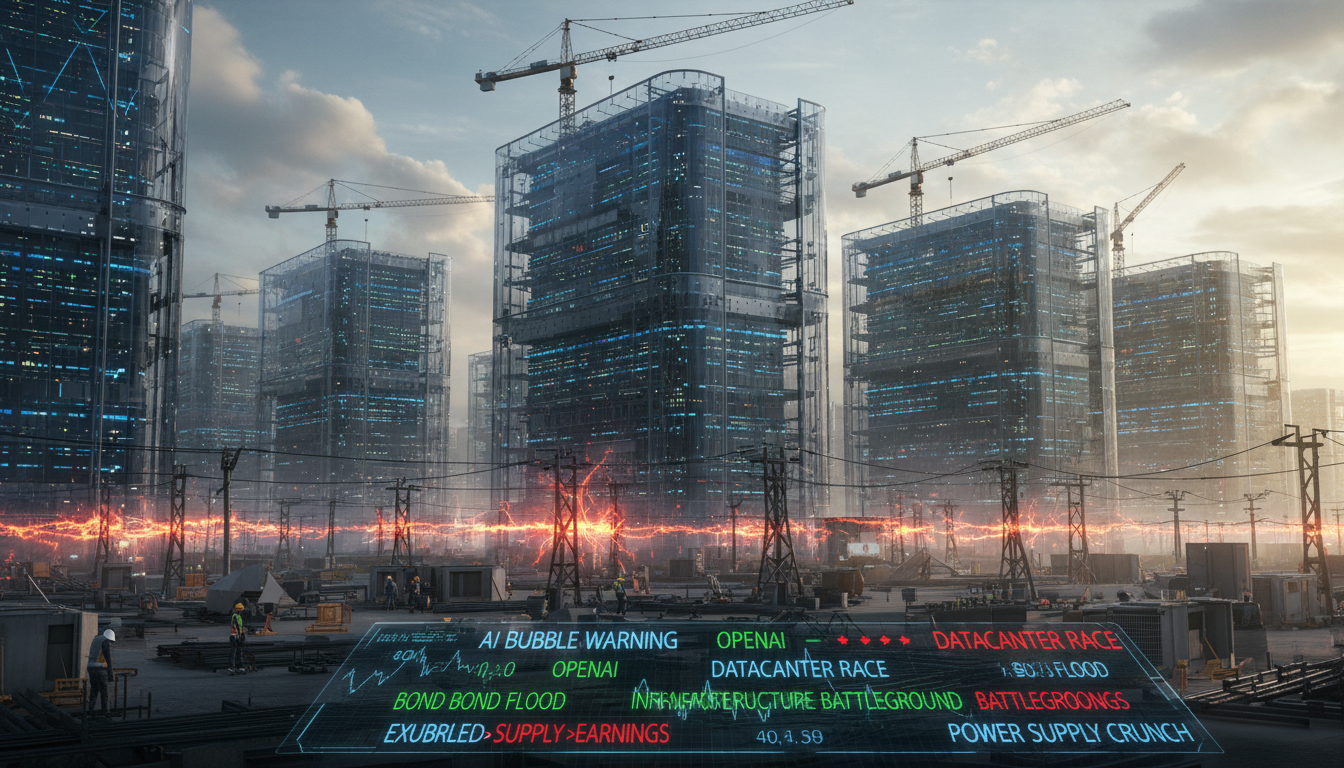
- The synchronized risk of data center PF and utility power grids
Expansion of data centers is not financed solely through internal cash and corporate bonds.
Project financing (PF), which bundles land, construction, and power transmission connections, and the CAPEX of local utilities move in tandem.
If, due to soaring costs in the bond market or if PF consortiums become more conservative, the construction start or completion timeline is delayed, then the delay in completion translates into delayed revenue recognition.
Meanwhile, if utility bonds and local government bonds (related to transmission lines and substations) weaken concurrently, the ripple effect in the financial markets could widen. - The lag between demand and monetization and the “commit burn” risk
While there are long-term usage commitments (AI commitments) from cloud customers, actual user monetization occurs with a lag.
If the rate of decline in inference cost per token fails to keep pace with the increase in demand, margins will shrink, and delays in burning through commitments may postpone cash recovery.
Particularly, if the conversion speed from B2B pilots to full-scale contracts slows, the corporate bond market may react first. - The reversed price effect of bottlenecks in power and equipment
Long lead times for HV transformers, switchgears, and cooling systems, as well as waiting queues for power grid connections, contribute to an increase in total project costs.
Even if GPU prices decline, rising BOS (Balance of System) costs may offset these savings, thereby reducing IRR.
At this point, if the required yields in the bond market rise further, some projects may see their NPV turn negative, leading to increased cancellations or postponements in issuances.
5) The Market Ripple Effect: Bond Market → Financial Markets → U.S. Stock Market
The sequence is usually as follows.
- Bond Market: Expansion of big tech and data center-related corporate bond spreads, deterioration of new issuance conditions, and signals of shrinking demand.
- Financial Markets: A cascading ripple through PF, utility, and local government bonds, sensitization of credit fund risks, and an increase in yield premiums in the privacy market.
- U.S. Stock Market: Rather than a multiple discount, a more conservative earnings guidance driven by delays in the “investment–monetization timeline” will be observed first.
From a global economic outlook perspective, the higher and more entrenched the interest rate regime, the more pressure there is for price adjustments in the bond market to surface first.
6) Michael Burry’s Hint: Decoupling of Overcapacity and Underutilization
Burry recalls the disconnect during the dot-com bubble between “overbuilt communication networks and underwhelming actual traffic” and sees similar timing risks in AI infrastructure.
The key is not overinvestment per se, but that if monetization lags one step behind, credit risks will be shaken before valuations are affected.
7) Investment Checklist: Practical Responses During the Caution Stage
- Position Sizing
Reduce exposure to leverage and credit financing; avoiding triple-leveraged ETFs during event periods is advisable. - Cash and Short-Term Bond Buffer
Secure a spending cushion covering at least 3–6 months with T-bills and MMFs spread across different maturities. - Monitoring the Bond Market
Keep an eye on big tech corporate bond spreads, new issuance absorption rates, changes in broadband guidance, and whether CDS are renewing at one-year highs. - Earnings Call Checkpoints
Listen for guidance on AI CAPEX, power grid connection and completion schedules, the rate of burning through customer commitments, unit economics (cost per token/ARPU), and the billing structure relative to usage. - Scenario-Based Actions
If spreads ease and issuances proceed smoothly → maintain risk on.
If spreads widen and cancellations of issuances increase → manage the allocation to growth stocks, and defend with dividend/quality factors that have solid cash flows. - Approach with a Long/Long Basket within the Theme
Core supply chains such as “essential power, cooling, and networking” tend to have relative resilience, while the oversupplied and highly competitive application software sector may require volatility management.
8) The Conclusion to Remember Now
- The current phase is not one of a “bubble burst,” but rather a period to “monitor funding fractures.”
- Micro signals in the financial markets (especially the bond market) are more crucial than the overall direction of the U.S. stock market.
- Big tech’s drive for AI investment continues, but the increasing cost of corporate bonds and tougher PF conditions are raising the hurdles.
- Expectations for a policy backstop have diminished, and the capital efficiency and credibility of individual companies’ timelines are key to any re-rating.
< Summary >
- In the wake of the OpenAI “government guarantee” controversy, the White House declared that rescue financing is impossible, thereby lowering market expectations for a policy backstop.
- BofA’s Hartnett warned of an “AI bubble watch-out” and cautioned that funding fractures in the corporate bond market need attention over stock prices.
- Big tech’s AI CAPEX is straining FCF, and this could have ripple effects through corporate bond spreads, PF, and utility sectors.
- The checklist includes monitoring spreads, issuance absorption, power grid connections, commitment burn rates, and unit economics.
- Navigate the caution phase by reducing leverage, maintaining cash/short-term bond buffers, and managing allocations toward quality factors with strong cash flows.
[Related Articles…]
AI Funding and Big Tech Corporate Bonds: Reading the Next Cycle Through Bond Market Signals
Post-OpenAI Controversy: Big Tech CAPEX and Risk Mapping for the U.S. Stock Market
*Source: [ 소수몽키 ]
– AI버블 주의 단계 첫 진입? 월가에 등장한 섬뜩한 경고 보고서
● AI Gold Rush, Data Center Energy War
AI Bubble? A Real Infrastructure-led Industrial Revolution Different from the Dotcom Bubble: A Glimpse at P/E Alignment, Data Center-Power Battle, and M7 Circular Investment
This article includes: ① A structure where stock prices and earnings move in tandem, centered on Nvidia; ② A reshaping of power infrastructure created by an explosion in data center demand; ③ A circular investment mechanism underpinned by the surplus cash of the M7; ④ The real causes of volatility and the limitations of the AI bubble narrative; ⑤ An investment checklist and risk scenarios for 2025–2027.
It is also organized to incorporate core keywords such as global economic outlook, stock market, interest rates, inflation, and recession.
News Briefing: The 5 Key Points in Today’s Market
The AI bubble narrative is often invoked as a pretext for a short-term correction, yet the demand for tangible infrastructure is actually accelerating.
Core AI value chain companies like Nvidia show stock prices and earnings moving in tandem, demonstrating a cycle different from the dotcom bubble.
Worldwide data centers are experiencing pre-leasing even before completion, while bottlenecks in supply chains such as GPUs, HBMs, and CoWoS intensify.
The next bottleneck is the power infrastructure.
Cooling, transformers, transmission (HVDC), and electricity prices will determine the pace of AI expansion.
The surplus cash of the M7 (mega tech companies) is estimated to be in the hundreds of billions of dollars, and mutually interlinked investments and customer integrations are accelerating the industrial revolution through circular investments.
How It Differs from the Dotcom Era: The Core of “Stock Price-Earnings Alignment”
During the dotcom era, infrastructure investments did not quickly translate into earnings.
This was because the demand base was not yet mature.
Now, digital demand is already deeply embedded in everyday life, so investments in AI infrastructure convert into revenue and earnings relatively quickly.
For instance, Nvidia is a representative example where sales and operating profits accelerate together, limiting any disconnect with stock price trends.
Before debating whether stock prices are excessive, the key point is that the trajectory of earnings is different from the past.
In other words, while valuations may adjust, this is not a “earnings-less rally.”
From a global economic outlook perspective, regardless of debates over peak interest rates, sectors supported by strong earnings are more likely to generate relative excess returns.
The Chain Reaction of Tangible Infrastructure Demand: Data Centers → GPUs/HBMs → Networks → Cooling
Data center demand is so intense that pre-leasing occurs even before completion.
This immediately drives GPU demand, which then extends to HBMs and advanced packaging (CoWoS).
Networking (switches, NICs, optical modules) as well as high-density power equipment and immersion/cooling solutions see CAPEX expansion along a chain.
This chain reaction is mirrored in software.
Model training-inference, agent/automation, enterprise workflows, and security/governance all experience growth simultaneously.
In other words, “infrastructure-platform-service” are all profiting at the same time.
Reshaping the Power Infrastructure: The Next Bottleneck Is ‘Electricity’
Large data centers require hundreds of megawatts of power, with a single facility increasingly matching the power needs of a mid-sized city.
Since power disruptions would halt services, backup power and redundancy are essential.
In this context, transformer lead times, expansion of transmission networks (HVDC), distributed generation, PPA/long-term power contracts become strategic issues.
Cooling plays a key role in both cost and energy efficiency.
Transitions from air cooling to water cooling/immersion cooling are accelerating, while thermal management solutions and concerns over water usage become prominent simultaneously.
A reconfiguration of the energy mix among nuclear, gas, and renewable sources is necessary.
National power policies and carbon policies now directly determine a country’s competitiveness in attracting data centers.
Electricity prices and inflation become interconnected.
Rising electricity bills put pressure on the unit cost and margins of AI services, linking them to debates on interest rates and recession.
M7 Surplus Cash and Circular Investment: ‘Cash Flow-Based Expansion’ Rather Than ‘Subprime Leverage’
The surplus cash of mega tech companies is estimated to be in the hundreds of billions of dollars.
They become each other’s customers, suppliers, and equity investors, and simultaneously pursue expansion in AI infrastructure and services.
This structure is different from subprime-style bad leverage.
It is a model of reinvesting internal cash flow into future growth areas.
Of course, if circular investments fail, the losses could be substantial.
Therefore, it is essential to check the conversion speed of CAPEX to sales/earnings, diversification of the customer mix, and regulatory risks.
The Real Cause of Volatility: AI Bubble Narratives Are a “Pretext,” While Macro Factors Are the “Trigger”
The trigger for short-term corrections is generally macro issues such as interest rate paths, unexpected inflation, geopolitical tensions, tariffs/elections, and fiscal/shutdown worries.
During correction phases, the market becomes more stringent on leading stocks, and the AI bubble narrative is quickly invoked.
However, in reality, changes in liquidity and risk premiums are what shake prices.
Ultimately, stock market volatility is explained more by macro variables than by any “lack of substance” in AI.
Checklist: 2025–2027 AI-Infrastructure Investment Map
– Semiconductor top end: GPUs, HBMs, CoWoS/advanced packaging, testing/inspection equipment.
– Data Centers: Power equipment (UPS, transformers), cooling (water/immersion cooling), racks/cables/power trays.
– Networks: Switches, NICs, optical transceivers, cabling, timing/clocks.
– Power Infrastructure: Transmission (HVDC), distribution, renewable/nuclear power, long-term PPAs, energy storage.
– Software: Models/platforms, enterprise AI (copilot, automation), data governance/security.
– REITs/Real Estate: Hyperscale/co-location DC REITs, edge data centers.
– Korea Focus: Expansion of domestic GPU clusters, redesign of power supply plans, expansion of communications/backhaul, localization of cooling/transformers.
Four Core Points Overlooked by Other Media
1) Electricity prices and contract structures determine AI margins.
Electricity costs are core to OPEX, and long-term PPAs, self-generation, and site strategies become key competitive factors.
2) The transition in cooling is a game changer that alters the total cost of ownership (TCO).
While water/immersion cooling has a higher initial CAPEX, improved PUE accelerates the payback period.
3) There is an “invisible inventory” created by extended lead times.
Prolonged lead times for transformers, CoWoS, optical modules, etc., delay the timing of sales recognition, thereby increasing quarterly earnings volatility.
4) Policies equate to site selection.
Expansion of transmission networks, regulations on carbon/water usage, and export controls determine profitability as much as technology does.
Risks and Scenarios
– Base Case: As bottlenecks in power and cooling ease, AI CAPEX will slow from its soaring levels, yet the earnings chain will be maintained.
– Upside: A return to low interest rates/stable inflation accelerates CAPEX, with expansion in edge/local AI.
– Downside: Strengthened GPU export controls, a sharp rise in electricity prices, and delays in CAPEX and earnings gaps due to intensified bottlenecks in specific processes.
Monitoring Indicators
Hyperscaler CAPEX guidance and actual expenditure rates.
Data center vacancy rates and pre-leasing rates.
Operating rates and lead times for HBMs and advanced packaging.
Electricity prices, PUE, transformer lead times, and the pace of transmission network expansion approvals.
Enterprise AI adoption rates, AI service ARPU/add-on revenues.
Strategic One-Line Summary
Do not interpret tangible expansion using bubble language; rather, read the transition of earnings in terms of bottlenecks.
Even if stock prices fluctuate, it is rational to bet on an industrial revolution as long as the flow of earnings does not cease.
< Summary >
AI, unlike the dotcom era, is a cycle led by tangible infrastructure with stock prices and earnings moving in tandem.
An explosion in data center demand is spreading to GPUs, HBMs, networks, cooling, and power grids—the next bottleneck being ‘electricity’.
Circular investments driven by the surplus cash of the M7 accelerate innovation, yet profitability is determined by power costs, lead times, and policies.
The trigger for short-term volatility is not the bubble narrative but macro factors such as interest rates, inflation, and policy.
Invest by focusing on the essential infrastructure of power, cooling, and networks that benefit from the easing of bottlenecks.
[Related Articles…]
Data Center Power Struggle, the Hidden Heart of AI Expansion
HBM Supercycle and Packaging Bottlenecks: The Key to the Next Rally
*Source: [ 경제 읽어주는 남자(김광석TV) ]
– AI 버블, 닷컴버블과 유사하다? 실물경제 움직이는 핵심 인프라의 수요 폭발하는 지금 ‘AI 거품’이 아니라 산업혁명 | 클로즈업 – 칠판강의 2편