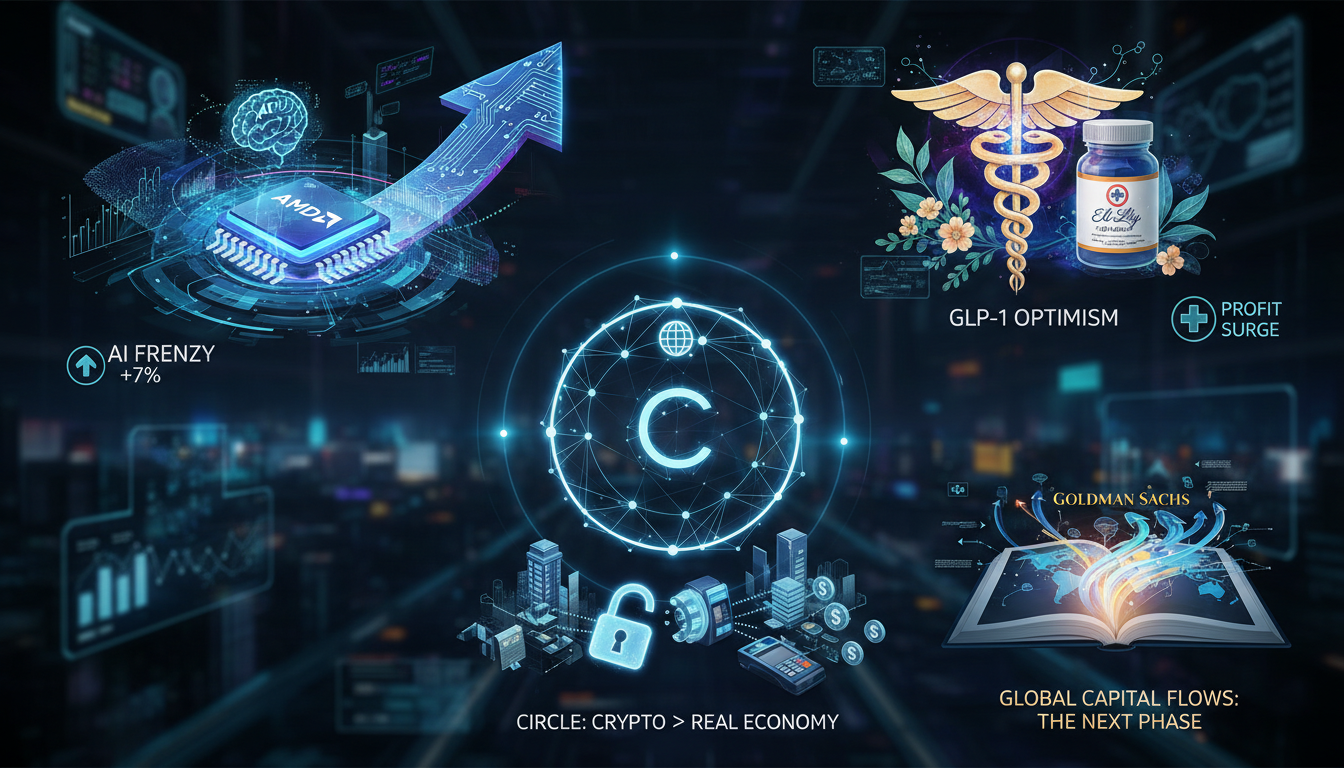
● AI Chip Bonanza, Lilly Mania, Stablecoin Squeeze
Wall Street Checkpoint: AMD AI-Chip Strong Results, Goldman 10-Year Roadmap, Circle Cost Increase Paradox, Citigroup’s Eli Lilly $1,500
This article features Goldman Sachs’ 10-year investment outlook roadmap and an S&P 500 7,600 scenario.
It dissects AMD’s “unprecedented” AI semiconductor demand and its 3–5 year growth trajectory in figures.
It examines Citigroup’s target of $1,500 for Eli Lilly and the ripple effect of GLP-1.
It structurally explains the “cost/interest rate paradox” causing share price declines for Circle (CRCL) despite impressive results.
It summarizes a checklist on what to check regarding JP Morgan’s AI ROI warning and what it means in terms of actual cash flow.
Today’s Market Briefing: Starting Steady, Led by AI and Financial Stocks
The Nasdaq started with a slight increase of about +0.2%, beginning steadily, and the S&P 500 also started on a similar note.
The Dow and Russell 2000 were relatively robust, starting with gains in the +0.5% range.
Sector-wise, AI semiconductors and financial stocks led the gains, while some mega-cap tech stocks were mixed.
Palantir saw a 2–3% pullback due to the recent strong rally, while Nvidia and Microsoft remained steady, and Tesla was slightly weak.
In consumer stocks, brand names like Starbucks (+2%) and Nike (+1.9%) rallied, driven by reopening and strong brand appeal.
In the crypto sector, Coinbase and Robinhood experienced modest gains, reflecting a temperate risk-on sentiment.
Company Focus 1: AMD — “AI Chip Demand is Unprecedented”
Key Points
- Performance: Record high data center AI revenue growth and robust guidance surpassed market expectations.
- Guidance: A 3–5 year revenue growth guidance corresponding to an approximate annual rate of 35% was provided.
- Stock Price · Relative Returns: Starting in 2025, an approximate +120% rise is projected, with excess returns noticeable relative to semiconductor indices.
Why It Matters
- Evidence against Bubble Concerns: It substantiates demand with “numbers, not words,” reinforcing the reality of the AI semiconductor cycle.
- Checkpoint on CapEx Flows: It serves as a beta indicator to verify if hyperscalers continue simultaneous expansion of GPU, HBM, and networking capacities.
Checklist
- Lead Time: Check whether constraints on HBM supply and packaging (advanced CoWoS, etc.) capacity are easing.
- Customer Mix: Monitor the pace of enterprise demand expansion beyond hyperscalers.
- Margins: Determine if total margins can be defended through mix improvements amid intensifying competition.
Company Focus 2: Eli Lilly — Citigroup Targets $1,500 (Approximately 50% Upside)
Key Points
- Drivers: Increased production of obesity treatments (GLP-1) like Zepbound and Mounjaro, expansion of indications, cardiovascular outcome data, and the Alzheimer’s (donanemab) pipeline.
- Momentum: Despite concerns over high valuations, improved earnings guidance and expanding market share support its value.
Why It Matters
- The Convergence of Consumer and Healthcare: GLP-1 creates a secondary ripple that affects not only healthcare but also sectors like food and beverage, apparel, insurance, and medtech.
- Index Impact: Its growing market capitalization exerts upward pressure on S&P 500 earnings estimates.
Checklist
- Production Capabilities: Monitor the speed at which supply chain bottlenecks in hospitals and demand responses per phenotype are addressed.
- Policy Risks: Watch for developments in drug pricing negotiations and changes in Medicare coverage.
Company Focus 3: Circle (CRCL) — Strong Results but Falling, ‘Cost/Interest Rate Paradox’
Key Points
- Performance: Revenue, net income, and EPS surpassed consensus, and an increase in USDC circulation and market share was observed.
- Stock Reaction: Pre-priced expectations and future cost increase forecasts have acted as a valuation drag, triggering a correction.
Why It Matters
- Interest Rate Sensitivity: Interest income from processing stablecoin reserves will be compressed if a rate cut cycle begins.
- Rising Costs: Costs related to regulatory compliance, global on- and off-ramp infrastructure, and travel rule/governance expenses are increasing simultaneously.
Checklist
- NII Trend: Observe quarterly changes in net interest income after the peak in interest rates.
- Circulation/Turnover: Monitor USDC activity and the pace of expanding on-chain payment partners.
- Regulatory Path: Check progress on licenses and reserve transparency in major jurisdictions (US, EU, Asia).
Macro & Policy: Goldman’s 10-Year View and Today’s Balance
Goldman Sachs presented an S&P 500 level of 7,600 by the end of 2026, offering a neutral and cautious scenario with an annual average return of 6.5% over 10 years.
The logic centers on factors such as high corporate net profit margins of around 13%, supply chain normalization, an interest rate cut cycle, and the potential for pro-business policies.
Conversely, the risks include recognition of elevated valuations, the sustainability of earnings upgrades, and signs of consumer spending contraction.
The University of Michigan Consumer Sentiment Index fell to 50.3 in November, indicating a slowdown in the real economy.
Delinquency rates on credit cards have surged significantly among low-income households, and increases were also observed among high-income groups, suggesting qualitative deterioration.
While Chipotle reached a 52-week low, stocks like Starbucks and Nike attracted value buying, highlighting the polarization in consumer behavior.
The interest rate path appears likely to include additional cuts within the year, while inflation is balancing between a slowing trend and persistent stickiness.
AI Investment Debate: JP Morgan’s Numbers and Their Interpretation
JP Morgan posited that if corporate AI investments are aimed at a minimum of 8–12% ROI, it would require approximately $650 billion of new revenue annually for a 10% ROI.
At 14% ROI, about $980 billion would be needed, a figure that constitutes a significant share of global GDP.
Given the difficulty of passing such costs onto consumers, the primary beneficiaries must come from enterprise productivity improvements.
Translated into Cash Flow Terms
- Indicators to Check: Separate AI revenue disclosures from the three major cloud providers, the proportion of AI workloads, estimated cost and price per query, and trends in AI gross margins.
- Cost Considerations: The possibility of rising total investment costs and decreasing capital efficiency due to bottlenecks in power, cooling, networking, and packaging.
- Macro Linkages: The extent to which the proportion of AI spending within the enterprise IT budgets actually increases by the 2026 fiscal year.
Korea & Asia Top Topics: Nvidia’s Moves in Korea and the Semiconductor Market
Nvidia CEO’s visit to Korea and the promise of large-scale GPU supplies have served as a psychological bulwark for Samsung Electronics and SK Hynix.
Leadership in HBM and advanced packaging has been reconfirmed as a key to resolving global AI semiconductor supply chain bottlenecks.
Even if the US stock market is volatile, Korean semiconductor stocks are attempting a decoupling with limited declines.
Collecting the Core Points Not Covered Elsewhere
- The Real Cause Behind Circle’s Earnings Paradox: Once interest rate cuts fully materialize, the decrease in interest income from reserves is structurally inevitable.
To defend earnings, a greater reliance on fee-based revenue from payment, remittance, and on-chain commerce rails is necessary.
In other words, short-term rate cuts could lead to a net interest income de-rating for high-quality crypto stocks. - The Invisible Variables in AI ROI: Data center power grid expansion and power rates for cloud AI in 2025–2026 could significantly influence gross margins.
Essentially, power costs and the pace of improving PUE will likely determine the upper limit for AI revenue gross margins. - The Secondary Ripple of GLP-1: The expansion in obesity treatments could structurally change demand in fast food, snack sectors, apparel sizing, and even demand for medical devices (for sleep apnea and orthopedics).
Eli Lilly’s expanding valuation is linked to this multi-dimensional growth story, potentially leading to a rising multiple.
Investment Checklist: What to Watch and How to Act Now
AI Semiconductors
- Monitor HBM/advanced packaging capacities and prices, 2026 order guidance from key customers, and lead times for power and cooling infrastructure.
- Consider staggered buying and trend following on the upcycle; early signals of a cycle reversal are likely to appear in inventory and shortened lead times.
Pharmaceuticals / GLP-1
- Keep an eye on production ramp-up schedules, cardiovascular outcome data timelines, changes in drug pricing policy or reimbursement, and supply chain issues.
- In periods of valuation pressure, an event-driven approach (data and approvals) can be effective.
Crypto/Stablecoin Exposure Stocks
- Prioritize monitoring interest rate sensitivity and the regulatory calendar.
- During a phase of net interest income deceleration, partnerships in payments and on-chain traffic can be key for performance defense.
US Equity (Index)
- Amidst the balance of Goldman’s base case (6.5% annually) and valuation pressures, simultaneously monitor the pace of earnings upgrades and consumer indicators (Michigan Consumer Sentiment, delinquency rates).
- Multiples may be re-adjusted depending on whether interest rate cuts continue without a rebound in inflation or if there is moderation in the pace of policy pivots.
Calendar & Headlines to Watch After Today
- Earnings: Watch for announcements and guidance tones from Cisco, On Holding, and steps toward listing for Naver Webtoon Entertainment.
- Macro: Monitor any changes in the probability of interest rate cuts, residual inflationary pressures, and easing uncertainties regarding tariffs and supply chain-related policies.
- Capital Flows: Observe changes in individual and institutional trading, the strength of buying deep dives, and levels of the volatility index.
< Summary >AMD confirmed AI semiconductor demand with its strong performance, leading a rally, while financial stocks also experienced gains.
Citigroup raised its target for Eli Lilly to $1,500, emphasizing a long-term growth story driven by GLP-1.
Circle, despite delivering strong results, saw its stock corrected due to structural issues of rising costs and interest rate sensitivity.
Goldman presented a conservative S&P 500 scenario of 7,600 with an annual growth of 6.5% over 10 years, and JP Morgan urged a reality check on AI ROI.
Signs of slowing consumer sentiment and rising delinquency rates indicate a need for careful positioning as interest rate and inflation paths, along with the pace of earnings upgrades, are monitored.
[Related Articles…]
- The True Length of the AI Semiconductor Demand Cycle
- The Impact of Interest Rate Cuts on Stablecoin Revenue Models
This article naturally incorporates the following keywords for SEO optimization:
US equity, S&P 500, interest rates, inflation, AI semiconductors.
*Source: [ Maeil Business Newspaper ]
– 서클 영업지출 증가, 주가 하락ㅣ시티, “일라이릴리 50% 상승 여력”ㅣAMD 호실적 “AI칩 수요 급증”ㅣ홍키자의 매일뉴욕