● Tesla’s FSD Invades Seoul, RoboTaxi Revolution Looms
Korean FSD Launch Imminent: Comprehensive Analysis of Garosugil Real-Life Driving, Regulatory Roadmap, and Industrial/Investment Impact
Key Points You Can Immediately Check in This Article
We reinterpret the technical points of the ‘Garosugil Real-Life Driving’ video released by Tesla Korea on a frame-by-frame basis.
We outline the reasons why supervised FSD is possible in Korea and provide a checklist of the conditions required for immediate use.
We realistically explain the actual permissible range considering the Road Traffic Act, type approval, and OTA regulations.
We examine the industrial impact connected to global fundamentals, inflation, and interest rate phases rather than stock prices.
We separately organize the hidden decisive variables that other media have overlooked, such as data network effects, Korean-specific edge cases, insurance/rate/subscription ARPU, and robo-taxi licensing structures.
Breaking News Summary: Supervision Signal for Korean FSD
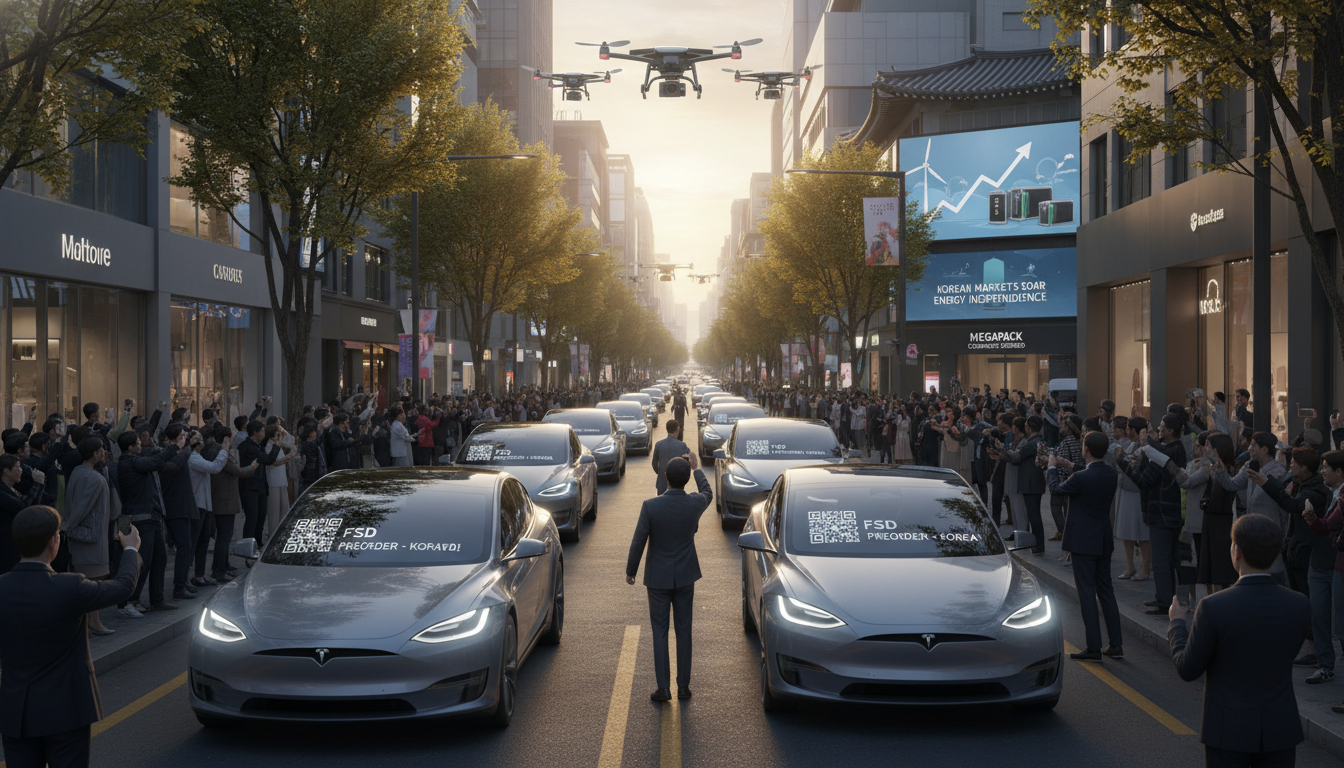
A video demonstrating supervised (Level 2) FSD, including urban driving and parking in Korea, has been released on Tesla Korea’s official X account.
The demonstration covered a roughly 6.1km course: starting from Jamwon Hangang Park parking lot → passing through complex sections such as Sinsa Jung and Garosugil → returning to Jamwon Hangang Park.
In the video, the vehicle naturally performed signal recognition, lane changes, pedestrian response, and parking, while the driver retained control.
At the same time, real-time occupancy displays of Superchargers on Google Maps have been opened to general users, accelerating the opening of the infrastructure.
On the Tesla Energy side, news has emerged about the expansion of the Texas Megapack production hub, heightening expectations for energy transition momentum and profitability.
Garosugil Real-Life Driving: Dissecting the Technical Points
In a section where lane clarity is low and illegal parking is common, visual-based judgments effectively operated to avoid center-line encroachment, control deceleration timing, and recognize approaching pedestrians.
The strength of the vision-centered E2E inference lies in bypassing situations that were previously resolved by LiDAR relying on maps, such as narrow alleys, disrupted lanes, and unusual signage, through “situational understanding.”
Particularly in Garosugil—a typical edge case with high density of motorcycles, delivery bikes, and pedestrians—the key lies in multi-object prediction that simultaneously considers vehicle width, distance to pedestrians, and the risks of doors opening on parked vehicles.
The camera resolution and processing headroom based on HW4 have contributed to mediating interactions between pedestrians and vehicles smoothly, optimizing both speed and path concurrently without bias.
However, since the video is a demo, it was conducted under pre-selected routes, specific times, and controlled traffic density, so the general performance needs to be supplemented with actual user feedback.
Who Can Use It Immediately: Checklist of Application Conditions
The vehicle’s VIN must begin with a 5 or 7 (produced in Fremont, USA, or Austin, USA).
The vehicle must be equipped with hardware of HW4.0 or above.
The FSD option must be purchased or activated.
Industry estimates suggest that there are approximately 2,600 vehicles in Korea that meet these conditions, mainly including the Model S, Model X refreshed after 2023, and some Cybertrucks.
Chinese models may require additional OTA, wireless communication, and safety certification processes, so the timeline may differ.
Legal and Regulatory Checklist: What Is Allowed and What Is Prohibited
Currently, only supervised (Level 2) driver assistance is permitted in Korea, where the driver must remain vigilant and ready to intervene at all times.
Extended hands-off driving is not recommended under the Road Traffic Act due to the risk of dangerous driving, and the system requires periodic load checks (torque, camera monitoring, etc.).
Fully autonomous driving (without driver intervention) is not possible under current legislation, and unmanned services such as robo-taxis require separate legal, pilot project, and administrative approvals.
FTA benefits apply only to tariffs and customs clearance and do not exempt domestic certification procedures related to automobile safety, radio transmission, or encryption OTA.
Therefore, the Korean version of the commercial robo-taxi will follow a mid-term agenda of sandbox systems → special permits → widespread implementation.
Tesla Energy and Supercharger Update: Changes in Infrastructure Competitiveness
With real-time Supercharger occupancy information now available to general users on Google Maps, the opportunity cost for charging non-Tesla electric vehicles and waiting times can be reduced.
Reduced congestion is expected to improve the efficiency of charging infrastructure operations, and increased platform traffic may open up opportunities for expanded services such as payment integration and navigation linkage.
If partnerships are established with domestic mapping services (KakaoMap and Naver Map), user experience is expected to improve significantly.
The expansion of Megapack production addresses demand for urban grid BESS, and after installation, a long-term revenue model can accumulate through maintenance, software optimization, and electricity trading (VPP).
Note that the Megapack specifications distinguish between ‘MWh (energy capacity)’ and ‘MW (output)’, and since production quantities are sometimes reported in a mix of GW and GWh, caution is needed in interpreting the figures.
Economic and Industrial Impact: Connecting to Fundamentals
Supervised FSD may not directly increase vehicle ASPs, but by boosting subscription ARPU and the proportion of software sales, it can improve productivity and margins.
Korea’s well-maintained roads and signage systems may accelerate data convergence for model training, and enhanced data network effects could lead to faster increases in local scenario adaptability compared to competitors.
In a period when the global economy is emerging from high interest rates, an increased proportion of high-growth software sales is favorable for valuation defense, and as inflation eases, consumer subscription conversion rates may improve.
The growing demand for energy transition policies and grid stabilization means that Megapack and VPP can play a defensive role in performance even amid automotive market downturns.
As Hyundai, Kia, and domestic ICT companies adhere to a ‘sensor fusion + high-precision mapping’ approach, if Tesla’s vision-centered E2E approach proves effective in actual urban settings, there could be pressure to realign technological strategies.
Key Points Other Media Have Overlooked (Decision Drivers)
Korean-specific edge cases significantly influence learning performance.
Factors such as motorcycle lane infiltration, implicit yielding at alley intersections, slow driving without explicit merging signals, and time-based rules in bus-only lanes favor visual understanding over rule-based systems, though early on they may be conservatively avoided, slowing user-perceived speed improvements.
Insurance and liability structures are critical to the pace of business.
Depending on whether accident liability lies with the driver or the manufacturer/software, insurance premium tables and FSD subscription prices will vary, ultimately affecting adoption rates.
Pricing strategies are key.
The Korean market tends to prefer monthly subscriptions over lump-sum payments, and given patterns such as family or secondary vehicle usage, monthly subscription fees in the range of 120,000 to 200,000 KRW may form a psychological barrier.
Mapping partnerships can change the perception of quality.
Real-time integration of road construction, bus-only lanes, and event controls from partners like Kakao and Naver can reduce sudden stops and frequent route re-planning, thereby boosting driver confidence.
Clarifying the facts:
Even in the United States, Tesla FSD is classified as supervised (Level 2), and there is currently no FDA-approved unmanned robo-taxi commercial service by Tesla.
Risks and Key Checkpoints
Regulatory uncertainty.
If the pace of legal and institutional reforms for transitioning to Level 3 is slow, the period of supervised operation may extend, leading to a gap between user expectations and actual experiences.
Urban complexity.
In unpredictable situations in densely populated areas such as Garosugil, Gangnam, and Hongdae, overly cautious evasive maneuvers could lower the perceived quality.
Hardware differences.
The perceived performance may vary depending on whether the vehicle is equipped with HW4, the presence or absence of radar, or the state of camera calibration.
Numerical communication.
Since the production and capacity figures for Megapack often mix MW, MWh, GW, and GWh, it is necessary to check the official report’s base units.
Timeline Outlook and Checkpoints
Short term (1–3 months):
Key factors include the release of feedback from a limited number of supervised FSD users, expansion of urban courses beyond Garosugil, and verification of the domestic applicability of Google Maps occupancy information.
Medium term (3–12 months):
Key factors include data integration with domestic mapping companies, launch of specialized insurance policies, announcement of monthly subscription rates, and the roadmap for certification and deployment for Chinese Model Y.
Long term (12+ months):
Potential game changers include Level 3 pilot projects, city sandbox trials for robo-taxis, and integration of VPP with vehicles (optimizing charging times and reducing electricity costs) in conjunction with energy transition.
Practical Tips for Actual Use (for Early Owners)
Initially, operate the system in conditions with clear daytime, good weather, and moderate traffic to build up learning data.
Always remain prepared for manual intervention in cases with high risk of door opening on roadside vehicles, jaywalking pedestrians, or counter-flow motorcycles.
Regularly check the cleanliness of the camera lenses, tire pressure, and calibration status to improve the perceived performance.
Document event logs and provide feedback to accelerate improvements through reproducibility in the same routes.
< Summary >
Tesla’s supervised FSD has released a real-life urban driving video (in Garosugil), sending a signal that commercialization is imminent.
The system currently available is limited to vehicles equipped with HW4 that have a VIN starting with 5 or 7 from the USA and that possess the FSD option.
Legally, only Level 2 driver assistance is allowed, and fully autonomous driving or robo-taxi services require separate regulatory reforms.
The opening of Supercharger occupancy information on Google Maps and the expansion of Megapack underline the momentum in infrastructure and energy transition.
Data network effects, insurance/pricing strategies, and integration with domestic mapping services will be key in driving adoption, while an increase in the proportion of software sales during periods of easing inflation and high interest rates will be advantageous for productivity and margin improvements.
[Related Articles…]
Robo-Taxi Regulatory Roadmap and Prospects for Pilot Projects in Korea
Tesla Megapack: Impact on the Power Market and VPP Business
*Source: [ 오늘의 테슬라 뉴스 ]
– 한국 FSD 드디어 열린다! 테슬라가 공개한 ‘가로수길 실주행 영상’… 이게 진짜다!
● Tesla FSD Invasion, Power Wars, Governance Shock
Tesla FSD Lands in Korea: AI Era “Power = Currency” War, Europe’s Regulatory Turning Point, Delaware Aftershock – A Comprehensive Investment Insight
This article covers the detailed conditions for the application of FSD vehicles in Korea, the core issues in the draft UNECE regulations in Europe along with the trend of citizen petitions, Kapasi’s evaluation of FSD and the improvement points of 14.2, the power bottleneck in the AI era and the growth path of Tesla ESS, and even the corporate governance shifts following the Delaware court ruling.
We summarize which investment strategies could be effective amid the changing global economic structure, energy market transition, and the interest rate/inflation environment in a news format, highlighting the core essence often overlooked elsewhere.
Today’s Key News Briefing
– The expansion of FSD application in Korea has begun.
– However, there are restrictions such as VIN starting with 5 or 7, HW4 equipped, and vehicles that have purchased the FSD option.
– In Europe, the UNECE discussions are underway, with “online learning restrictions during operation” being the key issue.
– In China, cases of high perception performance even in foggy environments have been shared.
– Andrei Kapasi gave a high evaluation of v13, and Elon Musk hinted at brake improvements in 14.2.
– As the consensus that “power is currency” grows in the AI era, the demand for ESS is surging alongside Tesla’s Megapack expansion.
– Following the Delaware ruling, discussions on relocating corporate headquarters/legal domicile are intensifying, making governance issues an emerging investment variable.
Details of Korea FSD Launch: Why a “Restricted Start” is More Important
This application is not for every Tesla in Korea, but primarily for US-made vehicles with VIN starting with 5 or 7, equipped with HW4, and that have purchased the FSD option.
New purchases include Model S, Model X, and Cybertruck, and demand elasticity is expected for the premium lineup.
Even though it is a limited rollout, its symbolic significance is high.
In Korea, a stronghold of internal combustion engines, the regulatory gate opens first, and the “early experience – political learning effect” is likely to spread in the global economic competition for technical standards.
The introduction in Korea will serve as a benchmark for other countries’ regulatory authorities and trigger faster policy discussions in Europe and Asia.
Universal Strategy: Generalization Rather Than Custom Maps is the Answer
From the beginning, Tesla designed its autonomous driving with FSD to be applicable to any country and city.
A vision-centric (camera) approach that minimizes dependence on specialized maps and sensors accelerates the pace of international expansion.
While FSD in the United States covers urban and highway environments broadly, it adopts a scale strategy different from Waymo’s model of operating in a confined area with limited driverless scenarios.
In other words, instead of perfecting a “robotaxi in a single city,” the focus is on “generalizing on a continent,” which is the key to long-term dominance.
Gateway to the European Market: The Essence of Regulation is “Learning” and “Safety Systems”
In Europe, under the discussions of the UNECE (United Nations Economic Commission for Europe), there is consideration to treat autonomous driving safety standards similar to the safety management systems used in aviation.
The core issue is about online learning during operation, real-road and virtual testing, continuous monitoring, and a common approval framework among countries.
The key point is to allow machine learning during the development phase but strictly limit cases where the user’s vehicle learns or changes its decision logic during operation.
At the same time, dissatisfaction expressed through petitions and content among European citizens with the claim that “regulation stifles innovation” is increasing policy pressure.
The policy timeline remains open for further discussion in each session, and the introduction in Korea could serve as a strong reference point that stimulates Europe’s “policy paradox.”
China and Global Performance Snapshot
Even in the partially approved version in China, FSD has demonstrated earlier detection of scenarios by humans in foggy conditions.
It captures targets with low visibility, such as trucks ahead, through vision-based inference, showcasing the advantage of data scalability in a purely camera-based approach.
Autonomous driving is moving beyond convenience functions to realize significant public health benefits by reducing accidents.
Statistics from Waymo also report that serious accidents and incidents involving airbag deployments are significantly reduced compared to human driving.
Kapasi’s Evaluation and the 14.2 Preview: “Safety is OK, Convenience is Upgraded”
Andrei Kapasi shared that even with v13 based on HW3, there was “nothing to criticize” regarding handling complex urban scenarios.
In the pursuit of a long-term stability target converging at 99.999% at the team level, it can be interpreted that in terms of everyday one-hour driving segments, the performance has crossed a critical point.
Elon Musk has hinted that version 14.2 will feature updates to reduce convenience issues such as the “residual braking” which overly reacts to falling leaves and false hazards.
In the AI Era, Power is “Currency”: Data Center Bottlenecks and ESS Fundamentals
In the AI boom cycle, the bottleneck has shifted from chips to power.
Even when data centers are completed, cases are emerging where power supply issues cause shutdowns, marking a stage where the real bottleneck in the energy market is shaking the global economy.
China is leading the United States in power generation growth due to its expansion in solar and new energy, raising concerns that gaps in power infrastructure could translate into gaps in AI competitiveness.
ESS mitigates the volatility of renewable energy and, when combined with thermal power or nuclear plants, effectively boosts the usable output of generation assets through peak shifting.
With falling battery prices, the diversification of revenue sources (frequency regulation, peak shaving, demand response, capitalizing on wholesale price spreads) structurally increases demand.
Tesla is well-positioned to simultaneously improve volume and gross margin with its Megapack expansion, making it one of the most leveraged players in the power = currency paradigm.
Interest rates and inflation directly affect project IRRs.
Thus, the transition in monetary policy is a checkpoint that enhances the beta of investment strategies in ESS and grid infrastructure.
The Backlash in Delaware: Governance Risks and the Signal of “Delaware Departure”
Following the cancellation of Tesla’s compensation plan ruling, discussions regarding relocating the legal domicile of some major technology and crypto companies have emerged in the market.
Prediction markets show flows expecting a change in the ruling or system reforms in the range of 60–70%.
While the answer is not yet clear, it is evident that governance and legal domicile risks could be reflected in the pricing as a valuation discount factor.
Investors need to examine both regulatory risks and the direction of governance.
Investment Strategy Checklist (from a Global Economy and Energy Market Perspective)
– Benefit from Korea’s FSD introduction: watch for HW4 and premium trim demand, and correlations tied to maps, data, and semiconductor cycles.
– European regulatory calendar: follow the progress of UNECE, the final wording on “online learning restrictions during operation,” and the approval tracks for each country.
– ESS value chain: opportunities lie not only in Megapacks (systems) but also in companies involved in BMS, thermal management, PCS, power software, and EPC for construction.
– Power wholesale and retail spreads: early markets with high profitability include regions with soaring peak prices and congested transmission networks.
– Macro variables: a shift to lower interest rates will improve green infrastructure IRRs, and easing inflation benefits battery cost stability.
Key Points Often Overlooked Elsewhere
– Korea’s FSD is not just a “technology demonstration” but a “narrative shift in politics and regulation.”
As consumer experience accumulates, the risk premium set by regulatory authorities in Europe and Asia could change, and the pace of approval itself may alter.
– Europe’s “online learning restrictions during operation” may be reasonable from a safety framework perspective, but they could weaken the data network effects of a global model.
How Tesla designs the optimal split between OTA updates, centralized learning, and field deployment will be crucial.
– In the era of power = currency, ESS is not merely a power plant but an infrastructure that “shifts time.”
The greater the time-value arbitrage, the more profitability improves, and the degree to which policies allow stacking of revenue sources will create margin differences between companies.
– The Delaware issue is not a short-term matter but a signal of “jurisdictional arbitration” in corporate governance amid multi-sovereign competition.
< Summary >
Korea’s FSD start is limited but has far-reaching implications for global regulation and policy.
Europe faces the hurdle of “online learning restrictions during operation” and other safety framework issues, while citizen petitions are accelerating policy momentum.
With Kapasi’s praise and the anticipated convenience upgrades in 14.2, user experience is expected to further improve.
The bottleneck in the AI era is power, ESS is the solution, and Tesla’s Megapack expansion represents a structural growth story.
The fallout from the Delaware ruling has highlighted governance and jurisdiction risks, and an investment strategy that diversifies across the ESS and autonomous driving value chains while watching the regulatory calendar and the interest rate/inflation environment is reasonable.
[Related Articles…]
Tesla FSD Lands in Korea, Regulatory Hurdles and Investment Points
AI Power Crisis and ESS, Megapack Investment Checklist
*Source: [ 허니잼의 테슬라와 일론 ]
– 테슬라 한국 FSD 진출!! 이는 한국에 국한된 경사가 아닙니다! 미래 AI 시대의 새로운 패권을 준비하는 테슬라 / 일론을 공격한 델라웨어가 난리 난 이유
● Dividends Backfire, Insurance Shock, AI Chip Goldrush
2026 Investment Strategy: Core Summary – The Stock Market, Interest Rates, Inflation, Exchange Rate Scenarios, and the Essence of the AI Supercycle Illustrated with Practical Cases of Samsung Electronics, Celltrion, and Alteogen
This article covers the detailed practical aspects of the 5 billion → Samsung Electronics dividend strategy, mental management methods to withstand four trading days at the lower circuit breaker, the tangible costs of dividends on health insurance premiums and taxes, the structural growth points of the Alteogen–Keytruda SC conversion, the three macro scenarios of interest rates, inflation, and exchange rates for 2026 along with stock market positioning, and even an investment roadmap connecting the AI semiconductor cycle.
Specifically, it also summarizes “the cost of maintaining conviction,” “ways to resist the lure of leverage,” and “the paradoxical cash flow risks caused by dividend income,” which are rarely covered elsewhere.
News-Style Summary: An Investment Story Interpreted by Numbers and Actions
After achieving a ten-bagger with Celltrion, a large sum of capital was allocated to Samsung Electronics preferred stocks to secure a dividend flow.
Despite receiving a high dividend including a special dividend, an increase in dividend income led to a simultaneous rise in health insurance premiums and comprehensive income tax, creating a paradox.
Although the stock price fell into the 50,000 won range experiencing a -30% drop, the holding strategy was maintained based on the AI cycle and the rebound in the semiconductor industry.
Alteogen’s structural growth story was confirmed with the conversion to SC formulation of Keytruda and the change in contract with global big pharmas (from non-exclusive to exclusive), and even though the entry was late, it settled with around a 30% return.
The past experience of the delisting of Genexel served as an opportunity to internalize risks related to “concentrated investment, leverage, and chasing themes.”
Case Study 1: Samsung Electronics Preferred Stock — Coexistence of Dividends and Volatility
Position: Approximately 70,000 shares purchased in line with the special dividend timing.
Cash Flow: Dividend income accumulated to an annual cash flow of around 3% to 4%, but the increase in dividend income also led to an additional burden of around 1 million won per month in health insurance premiums and an increase in comprehensive income tax.
Stock Price Cycle: Although it temporarily dropped by -30%, with the demand for AI servers, HBM, and DDR5, it rebounded with an estimated total return including dividends in the 30% range.
Significance: The strategy of combining mega-cap stocks with preferred stock dividends offers the advantages of “cash flow stability” and “volatility defense,” but the reduction in net cash flow due to taxes and insurance premiums must be taken into account.
Case Study 2: Alteogen — Accelerated Transformation through Technology Pivot and SC Formulation
Turning Point: Pivoting from biosimilars to SC formulation technology.
Contract Structure: The revaluation was triggered by a change in the contract with a global big pharma firm from non-exclusive to exclusive.
Core Rationale: In the phase of defending against patent expirations as seen with Keytruda, the transition to SC formulation becomes the top priority for sales and marketing, and the adoption speed directly impacts sales.
Investment Perspective: Instead of chasing “10-baggers,” a strategic reallocation of time and capital toward a “sure 2-bagger” is more rational as the scale of capital increases.
Case Study 3: The Assetization of Failure — Lessons from the Genexel Delisting Experience
Incident: Investing in a backdoor-listed company that later got delisted.
Lesson: Avoid blindly trusting institutional trends, refrain from excessive leverage, and recognizing that chasing thematic surges without proper risk management is a no-go.
Mentality: One must decide for oneself which is more painful: selling at break-even out of instinct or regretting it after a surge post-disposal.
Investment Philosophy: Conviction, Time, Mentality
Main Maxim: The only way to avoid mistakes is to not invest. However, that is the greatest mistake.
Strategy: Hold good assets for a long time until they rise. Institutionalize self-conviction (through records, reading, and organizing memorable quotes) to navigate volatile periods.
Action Guidelines: Manage cash holding anxiety, the instinct to break even, and the lure of surging stocks with a “checklist.”
2026 Macro Scenario: The Impact of Interest Rates, Inflation, and Exchange Rates on Your Portfolio
Scenario A: Soft Landing — Gradual decline in interest rates, easing inflation, and stabilization of the won–dollar exchange rate.
This scenario benefits semiconductors, AI infrastructure, and software platforms, and even dividend stocks can recover their multiples.
Scenario B: Stubborn Inflation — Prolonged high interest rates, rising real interest rates, and expanded exchange rate volatility.
Preference will shift toward quality growth stocks, big tech with strong cash generation, and nationally representative export companies.
Scenario C: Economic Recession — Sharp decline in demand, downward revision of earnings forecasts, and increased preference for safe-haven assets in exchange rates.
Increase the allocation to hedges such as cash, short-term bonds, high-quality dividend stocks, and gold, while adopting a phased approach for cyclical stocks.
Key Point: In any scenario, the numerical basis for maintaining one’s conviction must be updated.
Recalculate earnings estimates, supply chains, pricing power, exchange rate sensitivity, and valuation bands on a quarterly basis.
AI Trends and the Semiconductor Supercycle: Why Samsung Electronics Remains Logical
Data Center Investment: With the spread of generative AI, simultaneous shifts towards HBM, HBW stacking, CXL, and DDR5 are underway.
On-Device AI: Local inference on smartphones and PCs increases the demand for DRAM capacity and the adoption of high-bandwidth memory.
Memory Recovery: In phases of price cycle rebounds following inventory normalization, top-tier companies maximize their operational leverage.
Investment Implication: Regardless of stock market volatility, AI Capex is likely to be structurally long-term, and its performance remains sensitive to interest rate fluctuations.
Key Points Rarely Covered by Other Media
1) The Cost of Maintaining Conviction: The cost of enduring both the ‘explicit cash flow’ from dividends and the ‘potential losses’ from declining stock prices is significant.
To reduce this cost, standardize the ‘loss tolerance bands’ for each stock along with a ‘psychological defense routine’ (reading, recording, and walking).
2) The Paradox of Dividend Income: Dividends are good, but considering the comprehensive taxation of dividend income, which increases health insurance premiums and taxes, the net cash flow might decrease.
Don’t just look at the dividend yield; calculate the ‘after-tax yield’ and changes in insurance premiums as well.
3) The Illusion of Leverage: While a 10-bagger may seem easy compared to a 2-bagger, combining leverage with event risk can result in irrecoverable losses.
As the scale increases, the “easy 2-bagger” strategy is generally more advantageous.
Practical Checklist: An Actionable Guide
Macro: Set threshold values for interest rate, inflation, and exchange rate indicators, and automatically adjust the valuation discount rate.
Stocks: Standardize comparisons based on earnings sensitivity, product mix, inventory levels, contract structures (from non-exclusive to exclusive), and regulatory risks.
Position: Document loss tolerance bands, intervals for staggered purchases, cash buffer targets, and concentration limits for a single stock.
Taxes & Insurance: Run simulations on the expected annual dividend income and its impact on comprehensive income tax and health insurance premiums.
Mentality: Prepare an “affirmation text” on an A4 sheet to read during volatile periods, and keep it visible on your smartphone or desktop at all times.
Sector-Specific 2026 Positioning Hints
Semiconductors/AI: Increase the allocation to top-tier memory, foundry, and packaging companies, AI server supply chain stocks, and on-device AI beneficiaries.
Biotech: Prioritize companies with track records in technology transfer and clear revenue recognition rather than early-stage new drugs.
Dividend Stocks: Select companies that combine preferred stocks, aggressive share repurchases, and consistent dividend policies.
Risk Hedge: Adjust the proportion of hedges like gold, short-term bonds, and dollars flexibly in anticipation of an economic recession.
Conclusion: “Long Time + Numerical Basis + Psychological System” Creates Winning Odds
Ultimately, the stock market is a game of time.
By updating your conviction with numbers and supporting your mentality with a system, your portfolio can withstand the turbulence caused by interest rates, inflation, and exchange rates.
The cases of Samsung Electronics, Alteogen, and Celltrion clearly illustrate how the principle of “holding good assets for a long time” works even amidst real-world taxes, insurance premiums, and volatility.
Key Investment Takeaways
1) Dividends must be calculated based on after-tax yields and health insurance premiums to ascertain true returns.
2) The AI supercycle is a structural trend characterized by the simultaneous expansion of memory and on-device technologies.
3) In biotech, approach companies with clear technology transfer records and revenue recognition transparency first.
4) Leverage is the greatest variable that can derail a “sure 2-bagger” strategy.
5) Adjust the valuation of the same stock differently according to the three scenarios of interest rate, inflation, and exchange rate.
Risk Disclaimer
All investments carry the risk of principal loss.
The cases described in this article do not constitute investment advice and require judgments based on each individual’s financial situation, tax environment, and risk tolerance.
< Summary >
The Samsung Electronics preferred stock dividend strategy is effective for cash flow stability, but it is essential to verify the after-tax yield considering taxes and health insurance premiums.
Alteogen’s conversion to SC formulation and changes in contract structure provide a robust mid-to-long-term growth story.
Resist the temptations of leverage and chasing themes, and implement a “sure 2-bagger” strategy in conjunction with a psychological support system.
Adjust the positioning of semiconductor, biotech, and dividend stocks according to the three scenarios of interest rates, inflation, and exchange rates in 2026 to maintain direction amidst stock market volatility.
[Related Articles…]
- Comprehensive KOSPI Strategy by Interest Rate Scenarios after the Fed Pivot
- Designing a Semiconductor Portfolio to Survive the AI Supercycle
*Source: [ Jun’s economy lab ]
– 셀트리온 50억 이후 삼성전자로 30억 벌었습니다(ft.윤버핏 2부)