● Tariff Timebomb, Dollar Calmed, Korea Gears Up to Build US Warships
[Immediate Analysis] Core Summary of the US-Korea Tariff Negotiations Joint Fact Sheet: Exchange Rate Stability Signal, 15% Mutual Tariff Rule, Possibility of US Shipbuilding in Korea, Agricultural and Livestock Non-Tariff Barrier Relaxation, Nuclear Power & Nuclear-Powered Submarine Issues Overview
Key Points to Check in This Post
- Signal to resolve exchange rate uncertainty and key points of the short-term KRW-USD exchange rate outlook.
- 15% mutual tariffs and MFN: the practical application scenario when the Korea-US FTA conflicts with these.
- How the annual USD 20 billion investment cap and the mechanism to stabilize the foreign exchange market work in practice.
- The opportunity for the shipbuilding, defense, and supply chains presented by the “possibility of US vessels being built in Korea”.
- The scope of the relaxation of non-tariff barriers on agricultural and livestock products (US Desk) and its impact on the domestic market.
- A reality check on legal and alliance issues regarding private-sector uranium enrichment, spent nuclear fuel reprocessing, and nuclear-powered submarines.
News at a Glance: What Was Announced/Agreed
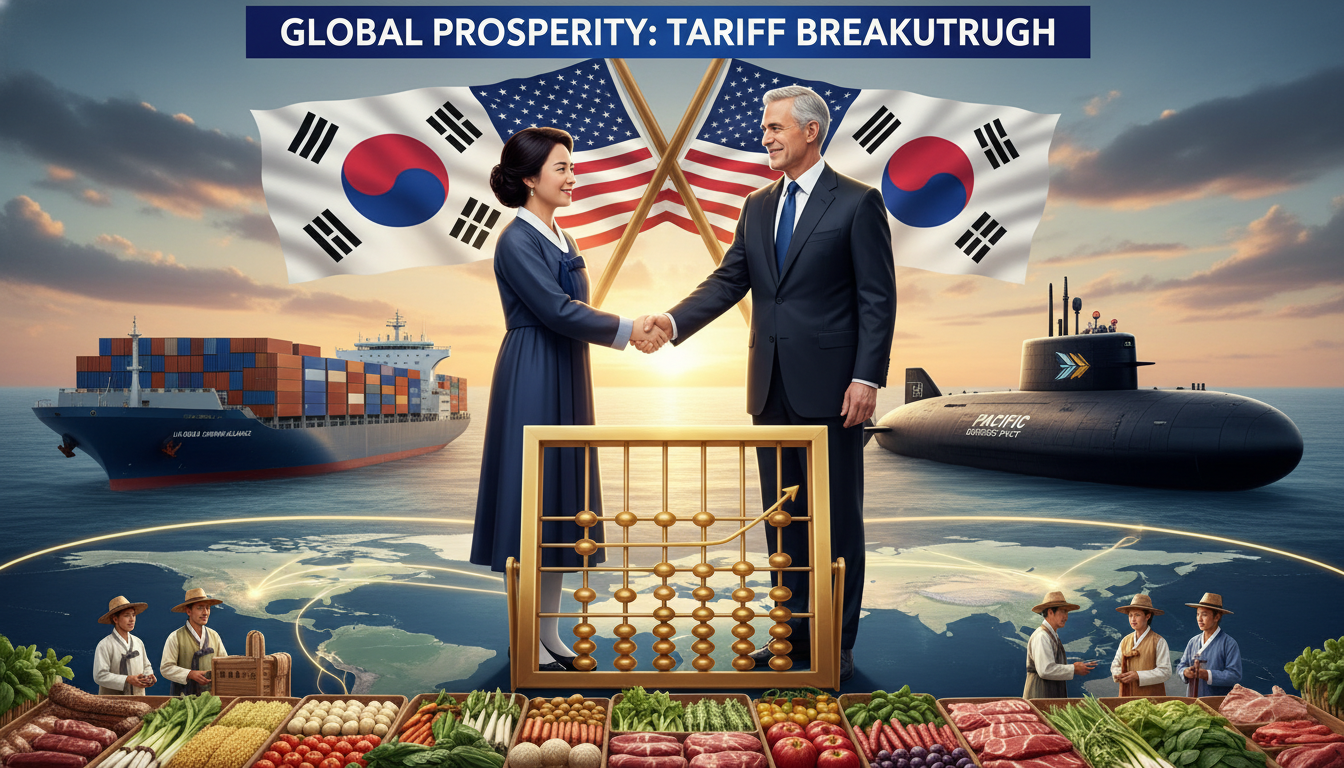
- Mutual Tariff and Trade Principles: A phrase was presented that can be interpreted to mean that “the higher rate” may apply among MFN (Most Favored Nation) or 15% mutual tariffs and high tariff rates on a product-by-product basis.
- Investment and FX Stability: Guidance specifying an annual cap of USD 20 billion for investment into the US was included, along with language indicating that potential impacts on foreign exchange market stability were discussed and coordinated in advance between the two countries.
- Agricultural, Livestock & Food Non-Tariff Barriers: It confirms the maintenance of market access for US meat, cheese, etc., and includes cooperation to ease non-tariff barriers, such as the establishment of a specialized “US Desk” for issues on the approval of US horticultural products.
- Shipbuilding & Marine: It welcomes Korea’s contribution to enhancing US commercial and military vessel capabilities, and includes language on “the potential construction of US vessels in the ROK,” with expanded cooperation in maintenance and repairs.
- Nuclear Power & Nuclear-Powered Submarines: It mentions support for the peaceful use of private-sector uranium enrichment and reprocessing of spent nuclear fuel, as well as discussions to seek approval and fuel procurement for Korea’s nuclear-powered submarine construction, noting that further details depend on additional negotiations.
- Market Reaction: Uncertainty that had grown due to delayed announcements has been reduced, and the Korean won reacted with short-term strength.
Exchange Rate & Financial Markets: Uncertainty Resolution and a Short-Term ‘Strong-to-Neutral’ Range
- Key Points: The annual cap of USD 20 billion and the “foreign exchange market stability” phrase serve as an excellent safety net from a policy communication perspective. They help keep the short-term exchange rate from hitting the upper limit.
- Mechanism: The investment funding is likely to come primarily from “market liquidity shock-minimizing sources” such as returns from operating foreign assets. If necessary, the Bank of Korea can reduce exchange rate volatility through fine adjustments (using forward exchange, NDF, stabilization of treasury bonds, etc.).
- Indicators to Watch: 1M/3M NDF, KRW-USD basis, foreign currency loan-deposit ratio, foreign positions in government bond futures, US CPI & labor indicators. If multiple domestic and international events coincide, there is a possibility of re-testing the upper end of the range.
- Scenarios:
- Base: Adherence to the USD 20 billion cap + stable NDF → Gradual strength within a box range.
- Risks: Temporary widening of weakness if high tariff impacts on products such as agricultural goods and automobiles, or a rebound in US interest rates occur.
- Upside: If US growth slows down and the Fed signals easing → Expansion of the lower end of the strength range.
Tariff & Trade Structure: Priority of the 15% Rule, MFN, and Korea-US FTA
- Structure Summary: The conflict between “Korea-US FTA (principally duty-free) vs. MFN vs. 15% mutual tariffs vs. product-specific high tariffs (e.g., 25% for automobiles)” is framed so that “the higher rate” might be applied.
- Implications:
- The practical benefits of the FTA could be partially nullified (if the 15% or product-specific high tariff takes precedence).
- However, if MFN or the FTA is more advantageous than the product-specific high tariff, then the lower rate might be applied, meaning the benefits will vary by product.
- Sector-Specific Impacts (from a trade negotiation perspective):
- Automobiles: Keep monitoring the possibility of product-specific high tariffs. Companies increasing the proportion of production and procurement in North America can have a relative defense.
- Semiconductors: Key is the comparison of tariff rates and subsidy conditions with Taiwan and Japan. Equipment and materials are sensitive to USMCA rules of origin.
- Pharmaceuticals: Beneficiaries if there is an expansion in the scope of MFN or mutual recognition of regulations.
- Consumer Goods: Sensitive to distribution margins and exchange rates. Key factors include pricing pass-through ability and inventory management capabilities.
Agricultural, Livestock & Food: The ‘US Desk’ Is About Thinning the Non-Tariff Barriers, Not Opening Borders Fully
- Summary: Measures such as harmonizing import hygiene standards, labeling, GMO/biotech regulatory approval periods, etc., are intended to reduce “time, procedures, and uncertainty.”
- Domestic Impact: There may be import pressure leading to increased imports of items like meat and cheese, which might trigger price competition and serve as a mild disinflationary factor for consumer prices.
- Industry Response: Positioning premium Korean beef, K-cheese, and fermented foods distinctly, hedging costs (through futures for feed and dairy products), and exploring joint ventures for import distribution.
Shipbuilding, Defense & Supply Chain: ‘US Vessels in the ROK’ Changes the Game
- Why It Matters: Although the US has seen a surge in demand for commercial and military vessels, its domestic shipbuilding infrastructure is lacking. Korea, on the other hand, possesses world-class capabilities in production, quality, and delivery.
- Interpretation of the Language: The phrase “including the potential construction of US vessels in the ROK” suggests that accompanying policy and legal measures (e.g., modifications to the Jones Act, Buy American provisions) are required for it to materialize. However, with the global economic outlook trending towards “supply chain decoupling and enhanced national defense,” the possibility remains substantial.
- Opportunities:
- A portfolio that includes both commercial and military ship orders.
- A chance for Korean shipyards to transition toward defense and integrate technology domestically (integrated systems for warship/submarine construction, reactor containment, and protection systems).
- Strengthening advantages in delivery and cost through 4th Industrial Revolution capabilities (digital twins, AI process optimization, smart yards, robotic welding).
- Checkpoints: U.S. congressional approval, alignment among US unions and labor stakeholders, compliance with security and ITAR regulations, adherence to cybersecurity frameworks (NIST).
Nuclear Power & Nuclear-Powered Submarines: A Legal and Alliance Reality Check
- Fact Sheet Language: It expresses support for the peaceful use of private-sector uranium enrichment and spent nuclear fuel reprocessing, and mentions that Korea will pursue discussions on approval and fuel procurement for constructing nuclear-powered submarines.
- Reality Check:
- Under the Korea-US 123 Agreement (nuclear cooperation agreement), uranium enrichment and reprocessing are subject to stringent requirements such as “prior consent, designated facilities, and monitoring.” Rather than radical relaxation, a step-by-step model involving research and fuel supply (such as fuel leasing and return, or participation in a HALEU consortium) is more likely.
- Nuclear-powered submarines, similar to AUKUS, involve specialized security and technology collaboration, along with congressional approval, issues concerning low-enriched/highly enriched fuel, security, and thermal nuclear design, making a “long-term and phased” project more realistic.
- Positioning for Korean Companies: There is potential for quick profitability in adjacent markets through SMR components, heat exchangers, pumps, instrumentation and control, dry storage of spent nuclear fuel, and marine nuclear power (barge-type).
Policy, Corporate & Investor Checklist
- Consistency of Official Text: Check whether the English and Korean versions from the White House and the President’s Office match on tariff rates, exceptions, and priority clauses.
- Product-Specific Tariff Map: Detailed lines for automobiles, agricultural & livestock, pharmaceuticals, batteries, semiconductors, and shipbuilding.
- Foreign Exchange Liquidity: The actual execution speed of the USD 20 billion cap, responses in the NDF and basis spreads, and the foreign currency LCR.
- Legal & Regulatory Timeline: Timelines for Jones Act exceptions, ITAR, follow-up agreements on the 123 Agreement, and environmental & labor provisions.
- Supply Chain Investment: The optimal allocation between North American localization versus innovations in productivity at Korean headquarters.
- Stock Market Sector Strategy:
- Beneficiaries: Large shipbuilders, defense systems, nuclear power value chains (SMR, valves, heat exchangers), food import and distribution.
- Caution: Sectors exposed to product-specific high tariffs such as automobiles and components, and domestic imports sensitive to a weak currency.
‘Core Details’ Not Covered by Other YouTube/News Outlets
- Practical Aspects of the FX Stability Mechanism: Focusing on “returns from operating foreign assets” for funding makes sterilization easier without expanding the base currency. The structure is favorable if exchange rate volatility is absorbed through NDF and treasury bond operations.
- Pitfalls of the 15% Mutual Tariff Rule: If “the higher rate takes precedence,” the benefits of the FTA may vanish for certain products. The ability of tariffs to be passed on and local production rates become critical to corporate performance.
- Implications of ‘US vessels in the ROK’: It is not just about receiving orders, but it could also grant access to a digital thread in defense (integrating design, production, and maintenance data). Over the long term, this could amplify Korea’s soft power in defense.
- The Reality of Agricultural and Livestock Market Liberalization: The “US Desk” is about reducing approval time and procedural uncertainties rather than fully opening the market. Although domestic impact is mild, there is a high possibility of increased price competition in certain items (cheese, beef).
- Nuclear Power & Submarine Issues: A phased approach under the constraints of legal and alliance frameworks, moving from fuel leasing → manufacturing cooperation → partial localization, is more realistic. In the short term, performance improvements are more likely to come from SMRs, maintenance, and waste management.
Short-Term Action Points (Exchange Rate Outlook & Investment Strategy)
- Exchange Rate Outlook: In an environment with reduced uncertainty, the upper range is expected to ease, although the possibility of retesting the upper end if US inflation and employment heat up should not be ruled out.
- Corporations: Reassess localization in North America, reexamine contract clauses on tariff pass-through, optimize the structure of dollar revenues versus Korean won costs, and secure import channels for agricultural and livestock products.
- Investors: Increase exposure to shipbuilding, defense, and nuclear power value chains; monitor timing for forex hedging through NDF spreads and basis; and pay attention to stocks in the agricultural and food import/distribution sectors.
- Policy Makers: Disclose the calendar for executing US-bound investments, strengthen communication regarding exchange rates, enhance support and quality certification for farmers transitioning industries, and fast-track security certifications related to shipbuilding and defense.
- With an annual cap of USD 20 billion and the FX stability language, short-term exchange rate uncertainty has been reduced.
- The structure among 15% mutual tariffs, MFN, and product-specific high tariffs—where “the higher rate takes precedence”—could weaken FTA benefits for certain products.
- The possibility of US vessels being built in Korea presents a major opportunity in terms of restructuring shipbuilding, defense, and supply chains.
- In agriculture and livestock, the key is the relaxation of non-tariff barriers rather than full market liberalization.
- Developments in nuclear power and nuclear-powered submarine issues are likely to progress in phases, following legal and alliance procedures.
- Strategically, it is beneficial to increase exposure to shipbuilding, defense, and nuclear power value chains while being cautious with automobiles and certain domestic imported goods.
[Related Articles…]
- US-Korea Tariff Negotiations and the Exchange Rate Outlook: What NDF & Basis Are Indicating
- Restructuring of the Shipbuilding & Nuclear Power Supply Chain: Scenarios for Korean Shipyards in US Defense Orders
*Source: [ 경제 읽어주는 남자(김광석TV) ]
– [LIVE] 한미 관세협상 공동 팩트시트 분석 : 환율 불안 해소 될까? [즉시분석]