● Epstein Bombshell, Volatility Panic, Nvidia D-Day, Retail Bloodbath, Meta Vindicated, Bitcoin Slips
US Senate ‘Epstein Files’ Unveiled, Nvidia Earnings Under Scrutiny · Target Underperformance · Meta’s Final FTC Victory; Read Today’s Stock Market, AI Trends, Interest Rate, Inflation, and Political Risks All at Once
In today’s article, we cover the political risk from the US Senate’s “Epstein Files” unveiling after a five-day surge in volatility (VIX), stock market positioning ahead of Nvidia’s earnings, the divergent earnings of Target and Lowe’s indicating consumer trends, the regulatory risk shift following Meta’s final victory in its FTC lawsuit, and signals from Bitcoin ETF outflows and shrinking dollar liquidity.
In particular, it addresses aspects that are rarely mentioned elsewhere, such as “the pathway through which political scandals impact risk premiums and multiples” and “how Nvidia’s option and delta hedge positioning amplifies intraday volatility.”
Global economy, interest rates, inflation, stock market, and AI trend keywords are seamlessly integrated, so simply following the flow will clarify today’s market context.
1) Today’s Market Briefing: Modest Opening, Awaiting Nvidia Earnings
The Nasdaq, S&P 500, and Dow opened modestly.
In the early session, Nvidia showed a technical rebound that recovered the previous day’s decline, and big tech stocks like Google and Microsoft held firm amidst mixed performance.
The energy sector showed relative strength, while semiconductor stocks experienced an exaggerated rebound in declines due to concerns over Nvidia’s earnings.
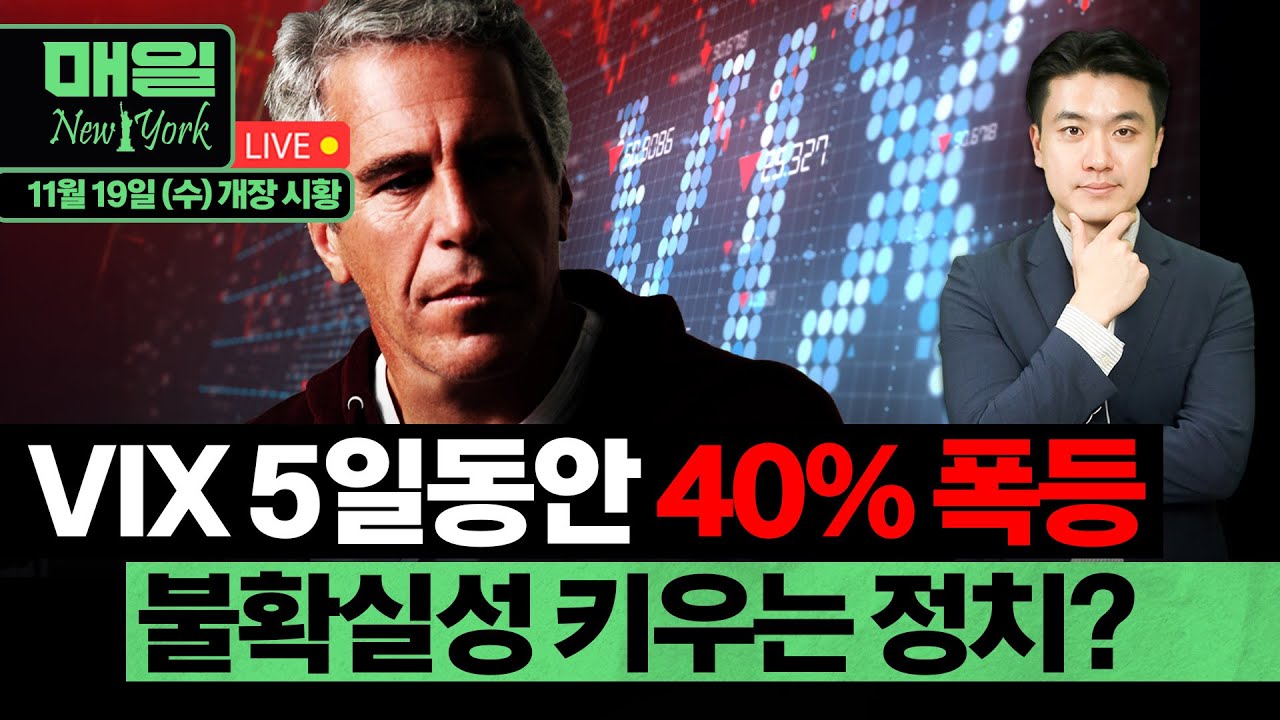
The VIX has recently surged by about 38% over five days before easing off during the session, with volatility premium still high.
Investor sentiment indicators (fear and greed) have dropped to the ‘extreme fear’ zone, increasing the possibility of short-covering and rebalancing inflows.
2) US Political Risk: ‘Epstein Files’ Unveiling Approved, Reestablishing Volatility Premium
The Senate unanimously passed the bill to release the “Epstein-related files,” leaving only the President’s signature pending.
In addition to the more than 20,000 pages of documents already released, the additional evidence such as visitor logs and wiretap records could have significant ramifications for the market.
In politics, concerns over government shutdowns, tariff policies, inflation, and affordability crises have intensified fears of internal divisions and erosion of support bases.
Market pathway: Political scandal → Increased policy uncertainty → Re-emergence of risk premium → VIX stiff upward → Pressure on multiples (especially for high-PER growth stocks).
Quick Point: Although the event itself does not alter the real economy, delays in monetary, fiscal, and regulatory decision-making are immediately reflected in the stock market discount rates.
3) Federal Reserve & FOMC: Increased Probability of a December Rate Cut, Key Points from the Minutes
The release of the FOMC meeting minutes is a key to understanding the path for December rates, the pace of QT (quantitative tightening), and the balance between growth and inflation in the economy.
As the probability of a rate cut in December has been re-elevated to around 50%, duration and growth stocks are once again favored.
Even as more Fed officials speak in favor of cuts, there remains caution regarding the conviction in a downward inflation path and the pace of easing financial conditions.
Investment point: Betting on lower rates is advantageous for long-term bonds and quality growth stocks, though the increased data dependency may lead to a volatile rally.
4) Earnings Check: Nvidia’s Big Event, Target Underperforming vs. Lowe’s Holding Up
Nvidia: The earnings announcement is scheduled after market close, generating both expectations and apprehension.
Even if the consensus is exceeded, the key issue will be “how much better it is,” and guidance, order backlog, and detailed disclosures in HPC/AI CapEx will determine the direction of the leading stock.
Options market point: In the case of a large gamma event, the delta hedge demand could further amplify intraday volatility.
Target: Reporting its fourth consecutive quarter of sales decline, Target exhibited weakness in discretionary spending in apparel and home furnishings, while a reallocation toward essential spending on groceries and household items was observed.
Lowe’s: Although it performed relatively better than Home Depot, broader macro headwinds such as housing turnover rates, mortgage rates, and a slowdown in DIY demand persist.
Interpretation: The long-term inflation and deteriorating affordability have entrenched a polarization between ‘essential vs. discretionary’ consumption.
5) Big Tech & Regulation: Meta’s FTC Antitrust Case Final Dismissal Resolves Structural Risks
With the FTC’s antitrust lawsuit ultimately dismissed, Meta will continue to hold on to Instagram and WhatsApp.
The risk of a multi-billion-dollar devaluation in the event of a forced split has now disappeared, raising expectations for a partial recovery from the multiple discount.
However, despite its bold AI infrastructure investments, clarity in performance remains a checkpoint, and the refinement of monetization for its $3.3 billion revenue platform in advertising is critical.
Hardware trend: In a bid to preempt the AR form factor, Ray-Ban collaborated on smart glasses, and differentiation strategies against Apple, Google, and Samsung could serve as a catalyst for future revaluation.
6) Crypto & Liquidity: Bitcoin Battling Around $90K, ETF Outflows and Shrinking Dollar Liquidity Signal
In the spot ETF market, about $3 billion was withdrawn in November, with specific days witnessing net outflows of over $500 million.
The price attempted another recovery after falling below $90K but is currently restrained at the top by the global contraction in dollar liquidity.
Scenario: A possibility of a short-term test around $80K versus a mid-to-long term rally reignited by the end of QT and a transition to renewed liquidity.
Strategy: Reduce leverage, increase cash holdings, and pursue a split approach focusing mainly on spot positions while monitoring signals from on-chain and ETF flow transitions as a cue for low-price buying.
7) Fact-checking the AI Bubble Debate: Earnings-Driven Rally Played a Larger Role
Year-to-date, the technology and communication sectors have shown overwhelming gains, with simultaneous EPS growth and multiple expansion.
A significant portion of the annual returns for the S&P 500 is explained by EPS growth, while the contribution from pure multiple expansion was limited.
Conclusion: Rather than the entire market being a bubble, there exist segments of overextension; AI trend leaders with sustained earnings momentum continue to differentiate themselves.
8) Consumer & Affordability Crunch: Food and Housing Costs Weigh on Discretionary Spending
Groceries have risen by approximately 28% compared to 2020, and the average house price has jumped from $300K to the $400K range, worsening affordability.
Low-income households are reducing discretionary spending on items like apparel, electronics, and hobbies due to a higher proportion of income spent on essentials.
Retail investment perspective: Retailers with strong pricing power in essential consumption, private labels, and an in-house supply chain have a relative advantage.
9) Reading the ‘Paper & Signature’ Economy and Culture in the US: How Regulatory and Contractual Infrastructure Affects the Pace of Digital Transformation
The United States has a strong culture of document- and record-based practices rooted in common law, and the acceptance of electronic signatures varies by state.
Due to the lack of an integrated authentication system, paper and handwritten signatures still function as the “gold standard” for contracts.
Business point: Identity verification (IDV), electronic signature, e-notary, and KYC/AML solutions are structurally growing sectors, with anticipated benefits from digital transformation in finance, real estate, and insurance.
10) Today’s Key News Summary
- Market: Modest opening, awaiting Nvidia earnings, strength in the energy sector, and VIX rising sharply before taking a breather.
- Politics: The Senate’s approval of the “Epstein Files” unveiling re-highlights the premium on policy uncertainty.
- Federal Reserve: Minutes release imminent, rate cut expectations re-elevated, and a data-dependent rally.
- Earnings: Target underperforms while Lowe’s holds up; a shift toward essential consumption amid weakening discretionary spending.
- Big Tech: Meta’s final FTC victory creates room for multiple re-rating as regulatory risks subside.
- Crypto: Spot ETF outflows and shrinking dollar liquidity cluster around the $90K level for Bitcoin.
- AI: The earnings-driven component is significant, with only parts of the market showing signs of overextension.
11) Key Insights Not Often Mentioned Elsewhere
- Scandal → Policy Delay → Risk Premium: While a political scandal does not directly shake the fundamentals, delays in fiscal, tariff, and regulatory schedules immediately reflect in discount rates and multiples.
- The ‘Market Microstructure’ of Nvidia’s D-day: In a large gamma event, option delta hedge demand can excessively amplify intraday fear and exuberance.
- Structural Rebalancing of Consumption: Retailers that hold advantages in essential consumption, private labels, and economies of scale are key alpha sources in an environment of entrenched inflation.
- Repricing of Regulatory Risk Premium: As seen in the case of Meta, the “resolution of the maximum risk” can trigger a multiple re-rating without any fundamental changes.
- Liquidity Path and Crypto: QT → shrinking dollar liquidity → ETF outflows → cap on the price ceiling; conversely, assets within the risk assets and AI/semiconductor CapEx chain are the most responsive when QT ends.
12) Practical Investment Checklist
- Interest Rates: Prepare for expanded volatility around the minutes release by balancing duration and quality growth allocations.
- AI/Semiconductors: Prioritize earnings and guidance, focusing on top-tier companies with clear order backlogs and CapEx visibility.
- Retail: Favor companies with strong defenses in essential consumption, robust private labels, efficient inventory turnover, and pricing power.
- Big Tech: Identify opportunities in stocks that are poised for a multiple re-rating as regulatory risks are alleviated.
- Crypto: Adopt a split approach focusing mainly on spot positions; expand exposure only after confirming transitions in ETF flows and on-chain activity recovery.
- Risk Management: Reduce leverage ahead of significant events, and switch to fundamentally sound blue chips during phases of heightened volatility.
< Summary >
The Senate’s approval to unveil the “Epstein Files” has sparked political risk that is driving up the risk premium, with the VIX surging before taking a breather.
Ahead of Nvidia’s earnings, option positioning is amplifying volatility, and future leading stock performance will depend on guidance, order backlogs, and specifics in HPC/AI CapEx.
Target’s underperformance versus Lowe’s strength reaffirms the shift toward essential consumption amid the challenges posed by inflation and deteriorating affordability.
Meta’s final victory in its FTC case paves the way for a multiple re-rating as the regulatory discount is eased.
Bitcoin is battling around the $90K level amid ETF outflows and shrinking dollar liquidity, though a mid-to-long term conversion in liquidity could reignite a rally.
[Related Articles…]
- US Presidential Risks and VIX Surge, Mapping Stock Market Volatility
- Post-Nvidia Earnings: Examining AI Trends and the Semiconductor Cycle
*Source: [ Maeil Business Newspaper ]
– 美상원, 엡스타인 파일 공개 가결ㅣ타겟, 예상 밑돈 실적 주가하락ㅣ메타, FTC 소송 최종 승소ㅣ홍키자의 매일뉴욕