● Saudi GPU Gold Rush, Musk Nvidia AI Alliance, Tesla Robot Takeover
Elon Musk, Jensen Huang, and Saudi Arabia’s ‘AI Alliance’ Activated and Tesla’s 10-Year Roadmap Transformation
This article concisely summarizes the reality of the massive Saudi AI data center with around 600,000 GPUs, the strategic significance of the xAI-NVIDIA-Saudi triangular alliance, the latest status of Tesla’s robo-taxi/FSD, the economic impact of the humanoid robot Optimus, and perspectives on the global economy, inflation, interest rates, supply chains, and investment strategies.
It quickly and accurately pinpoints what has just begun and how investments and industrial structures may be reconfigured.
[Breaking Summary] Launch of the xAI-NVIDIA-Saudi ‘AI Factory’ Alliance
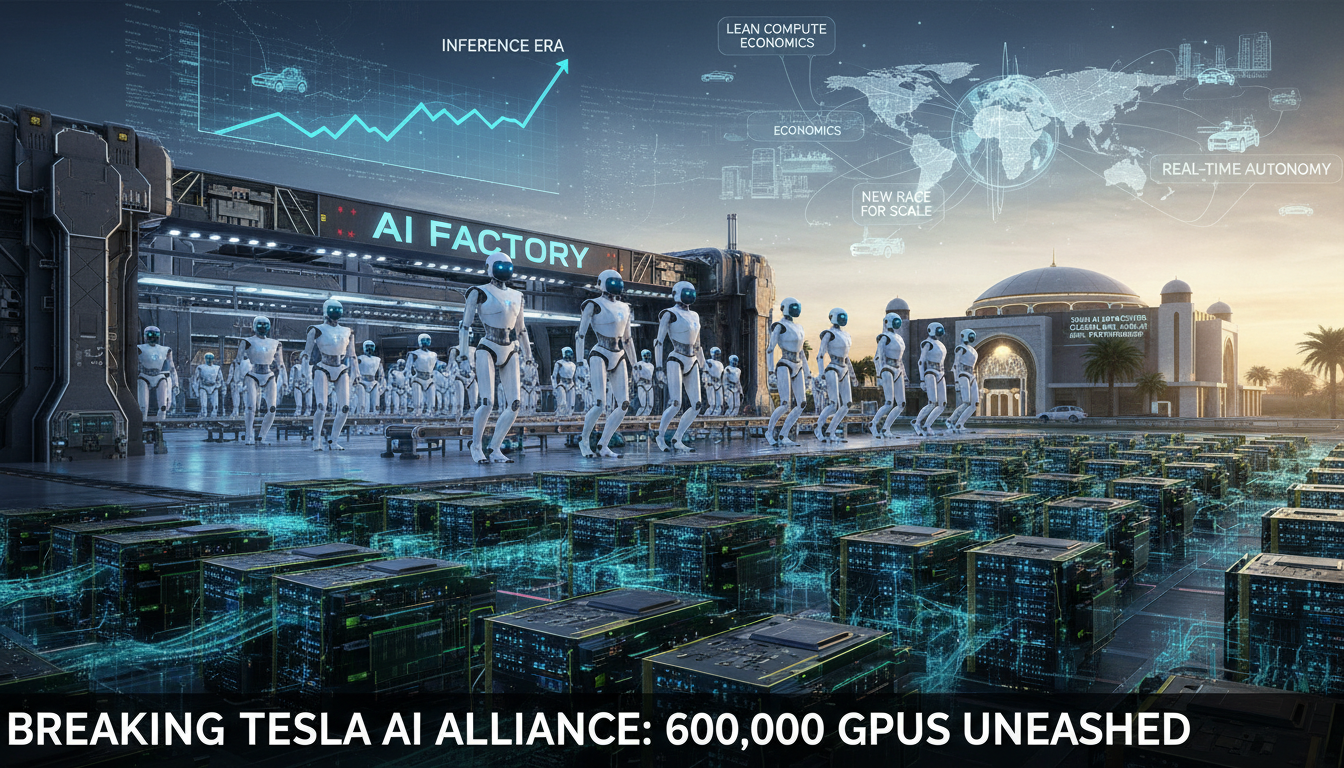
According to reports, Saudi Arabia has revealed plans to build a national-scale, massive AI data center and deploy about 600,000 NVIDIA GPUs.
The first major customer mentioned is Elon Musk’s xAI, and local events reportedly featured Musk, Jensen Huang, American officials, and Crown Prince Mohammed bin Salman together.
Musk and Jensen Huang emphasized a paradigm shift across industries, stating that “AI is becoming the infrastructure” and referring to the concept as an “AI Factory.”
This project is interpreted as a model in which power, land, capital, and supply chains—difficult to resolve quickly in Silicon Valley—are addressed collectively at the national level.
What is an AI Factory: From the Age of Search to the Era of Generation
Jensen Huang explained that while traditional computing was “search-based,” generative AI is all about “real-time generation.”
Since even the same question can yield different results depending on context, AI factories—real-time learning and inference models distributed across the globe—have become necessary.
From this perspective, artificial intelligence is elevated to the status of infrastructure like electricity and logistics, becoming a common foundation used by every industry.
This could lead to a global economic restructuring toward a Fourth Industrial Revolution centered on data, power, and semiconductors.
Scale in Numbers: Realistic Calculations of Power, Capital, and Chips
- GPU Scale Estimate: Assuming 600,000 GPUs of H100/H200 class, an IT load of around 0.4-0.6 GW is expected based on TDP.
- Total Power: Including cooling, networking, and power losses (assuming PUE of 1.2-1.4), approximately 0.5-0.8 GW is required.
- Capital Expenditure (CapEx): When including GPU prices, high-speed networks, buildings, substations, cooling, and storage, the total project cost is estimated to be in the hundreds of millions of dollars.
- Supply Chain: The global supply of bottleneck components such as high-bandwidth memory (HBM), NVLink switches, and optical modules is a crucial variable.
These numbers are a conservative back-calculation given the limited public data, and actual specifications, composition, and timing may vary.
Tesla Section: How FSD, Robo-Taxi, and Optimus Connect
Robo-taxi field reviews increasingly evaluate the service as smoother and safer compared to human drivers, and since FSD v14, detailed improvements in driving quality such as U-turns and lane changes have been reported.
As operations expand, practical fare items like “cleaning fees” have begun to be implemented, and the possibility of no-show fees is being discussed.
In China, Model Y waiting times have increased to 4-13 weeks, signaling that a “virtually sold-out” situation is emerging for the 2025 production targets.
Musk declared regarding the humanoid robot that “the bots currently on sale are at a toy level,” pledging that Tesla would be the first to create a “useful humanoid robot.”
The key cycle is that the large model trained by xAI becomes the “brain” for Optimus, the Saudi AI factory serves as the massive training “ground,” and Tesla takes charge of the “body, sensors, actuators, and manufacturing,” creating a virtuous cycle.
The Future of Jobs and Currency: Choice Labor, Prosperous Economy?
Musk and Jensen Huang shared the view that “in the long run, work becomes a choice.”
As AI and robotics replace and expand the realm of labor, human work might resemble more of a matter of personal taste or hobby.
Musk even mentioned the potential “weakening of the meaning of money,” though physical limitations (energy, resources, space) would still remain, he concluded.
Policy-wise, major overhauls in social safety nets, redistribution, and education systems will be needed, which in turn act as mid-to-long-term variables for inflation and interest rate trajectories.
Global Economic Impact: Inflation, Interest Rates, Supply Chains, and Investment Strategies
Inflation: With a surge in demand for power and components for AI data centers, structural upward pressure may emerge on electric bills, industrial land, cooling water, and construction costs.
Interest Rates: Although large-scale capital investment cycles may initially be indifferent to rising interest rates, long-term productivity improvements could create disinflationary pressures.
Supply Chain: Bottlenecks in HBM, advanced packaging, optical transceivers, and power equipment (transformers) are expected to intensify, making them key pillars for investment strategies.
Geopolitics: The shift in the Middle East from “oil to power and AI computing” could alter the status of resource-rich nations, potentially leading to a “sovereign AI” alliance structure.
Investment Strategy: It is necessary to comprehensively review the entire value chain—from GPUs to power infrastructure, cooling, industrial real estate, power semiconductors, optical communication, MLOps software, and robotics actuators.
Policy and Regulatory Checkpoints
- Export Controls: Potential regulatory changes regarding the supply of advanced GPUs to the Middle East.
- Power Policy: Priority for power allocation to large-scale data centers, pricing structures, and policies linking to renewable energy.
- Water Usage: Costs and environmental regulations regarding cooling water/desalinated seawater in desert climates.
- Privacy and Sovereign Cloud: Clashes in data governance among different nations.
Key Points Often Overlooked by Others
The ‘Refinery Metaphor’ of Power, Chips, and Capital: Saudi Arabia’s AI data center is akin to an “AI refinery” that transposes the logic of oil refineries into power, data, and models.
Instead of crude oil, power and data are input to produce “intelligence (model weights)” as a refined product, which then becomes a universal production factor across all industries.
AI OPEX Shock: As models grow larger, inference costs (OPEX) directly impact profitability.
Therefore, factors such as power prices, PUE, accelerator efficiency, KV switching, and model pruning/compression are emerging as fundamental variables in corporate value.
Dojo vs. NVIDIA Role Division: While Tesla is strengthening its own training infrastructure (Dojo), it concurrently leverages external large-scale factories (xAI-Saudi) to secure the “option of scale.”
This dual-track is beneficial for product launch speed, cost optimization, and mitigating supply chain risks.
The True Bottleneck in Robotics: Beyond the software brain, the supply chains for mass-producible actuators, gearboxes, and high-reliability sensors are decisive.
If Tesla can significantly reduce costs through automation processes and in-house components, a “maximum TAM” scenario surpassing even smartphones becomes a reality.
Scenario Planning: Optimistic, Neutral, Pessimistic
- Optimistic: A sharp drop in large model training costs between 2026 and 2028, mass deployment of Optimus piloting, urban expansion of robo-taxi services, and stabilized OPEX through power purchase agreements (PPAs).
- Neutral: Despite chip and HBM bottlenecks and regulatory hurdles slowing down construction, phased completions lead to expanded FSD-approved regions and commercialization from industrial robots onward.
- Pessimistic: Export controls, delays in power supply, and persistently high interest rates reduce CapEx, while surging inference costs deteriorate unit economics and push back commercialization timelines.
Today’s Action Checklist
- Power Infrastructure Play: Monitor beneficiaries in transmission/substations, transformers, GIS, cooling, and ESS.
- HBM and Advanced Packaging: Check capacity expansion plans and ASP trends.
- Robotics Components: Track cost curves of gearboxes, motors, torque sensors, and vision modules.
- MLOps and Prompt/Agent Stack: Review enterprise adoption rates and LTV/COGS structures.
- Policy Risks: Keep an eye on inflation, interest rate trajectories, power policies, and issues in data governance.
Fact Memo
This summary is based on local reports and interview statements.
Details such as GPU models, supply schedules, and power contracts are subject to change until officially confirmed.
Investment decisions are recommended to be made based on the latest official disclosures, company guidance, and policy variables.
< Summary >
The massive AI factory combining Saudi Arabia, NVIDIA, and xAI aims to achieve ‘mass production of intelligence’ by bundling power, chips, and capital at the national level.
This project is connected to Tesla’s FSD, robo-taxi, and humanoid Optimus, fostering a virtuous cycle of model training, robot production, and service expansion.
On the global economic front, while short-term pressures on inflation, interest rates, and supply chains are expected, long-term productivity improvements could ease these pressures.
The essence lies in improved unit economics through power pricing, HBM, cooling, networking, and regulations, necessitating a realignment of investment strategies accordingly.
[Related Articles…]
- The Essence of Saudi Arabia’s ‘AI Refinery’: Dissecting the Power, Capital, and Chip Triangular Alliance
- The Cost Curve of Humanoid Robots: Determined by Actuators and Sensors
*Source: [ 오늘의 테슬라 뉴스 ]
– 속보! 일론 머스크·젠슨황·사우디가 손잡았다… 60만개 GPU ‘AI 동맹’ 발표! 테슬라 미래가 바뀌는 이유는?
● AI Bubble Dead, Nvidia Cash King, Tesla Poised to Dominate Inference
Signal of the End of the AI Bubble and the Dawn of the ‘Inference Era’: Nvidia’s Performance, xAI-Saudi-Arabia-Space Data Center, and Tesla’s Turn
The following text includes all of the following:How Nvidia’s data center performance ended the controversy over the AI bubble.What the 500MW AI compute partnership between xAI, Nvidia, and Saudi Arabia signifies for the next-generation infrastructure landscape.The physics, economics, and practical challenges of space data centers as mentioned by Elon Musk.The era of “real-world AI” in which the focus shifts from training to inference, and Tesla’s economic advantage.The essence rarely covered in the news: the shift from CAPEX to OPEX and the total demand effect of AI productivity.A comprehensive overview including an investor checklist, timeline, and risk scenarios.
Today’s Key News Summary
- At the US-Saudi Investment Forum, reports stated that the Saudi Crown Prince, Jensen Huang, and Elon Musk discussed AI infrastructure and a “real-world AI” vision.
- Nvidia announced that its data center revenue has continuously increased on a quarterly basis and that its GAAP/Non-GAAP total margins have remained above 70%.
- xAI and Saudi Arabia revealed a next-generation partnership to design, build, and operate hyperscale GPU data centers at low cost.
- xAI and Nvidia disclosed plans to collaborate on a 500MW AI compute project.
- Elon Musk mentioned the possibility of space data centers, outlining a blueprint that connects radiative cooling, solar power, and SpaceX’s orbital assets.
- Jensen Huang explained, using radiation and case studies, that AI does not substitute jobs but instead drastically increases productivity to expand total demand.
What Nvidia’s Performance Demonstrated: Profitable Demand, Not a Bubble
- Point 1. Qualitative improvement in data center revenue.
Compared to the initial focus on training, inference demand is rapidly integrating, and the customer mix is diversifying.
This is a sign that the customer base is broadening from the dependency on CAPEX by select big tech companies to OPEX-based revenue from AI-as-a-service. - Point 2. Sustained total margins of 70%+.
The combination of high-value GPUs, networking, and the software stack secures a robust price-cost spread.
Despite bottlenecks in components like HBM and the pursuit by competitors, the platform power remains intact. - Point 3. Normalized growth rate vs. structured growth.
While the rapid surge of over 260% YoY has moderated to around 50–60%, this phase is seen not as a bubble collapse but as a period of “structural growth centered on profitability.” - Macro linkage.
Even as global economic interest rate outlooks and easing inflation persist, data center CAPEX is expected to continue over the long term, premised on supply chain constraints.
The productivity revolution of the Fourth Industrial Revolution underpins the cycle of capital expenditure in industrial facilities.
xAI, Saudi Arabia, and Nvidia: 500MW Compute and the ‘Desert-Style’ Hyperscale
- Scale.
A capacity of 500MW is considerable even as a single national project and is likely to undergo continuous expansion.
Saudi Arabia’s solar insolation, land availability, and low-cost power structure favor low-cost data center operations. - Architecture.
xAI is expected to handle the foundation models and Grok series inference stack; Nvidia, the GPUs, networking, and software; and Saudi Arabia, the land, power, and regulatory support, forming a triangular alignment. - Economics.
Compared to training, inference is much more sensitive to power and latency, making QPS (queries per second) per MW and power cost decisive factors.
Low-cost power in the Saudi model directly minimizes inference OPEX.
Space Data Centers: Possibilities in Physics, Challenges in Engineering
- Logic of radiative cooling.
In space, the vacuum prevents convection, making radiative heat transfer, as governed by the Stefan–Boltzmann law, the key.
Designs that elevate GPU temperatures to reduce heat-dissipating surface area are theoretically valid, potentially lowering the proportion of cooling hardware relative to ground-based systems. - Jensen Huang quote point.
The context in which approximately 1.95 tons out of a 2-ton supercomputer rack is devoted to cooling indicates that in space, if the cooling method changes, there is significant room for system mass optimization. - Practical challenges.
Issues such as bit flips and component degradation due to radiation, radiator area/mass and launch costs, orbital maintenance and service costs, and management of laws, frequencies, and orbital debris present significant hurdles.
Inference workloads demanding low latency are advantageous on terrestrial edges, while space centers are more suited to high-density training/deployment that does not require low latency. - The SpaceX variable.
Experience in operating large-scale satellite constellations and solar power generation modules gives SpaceX an edge through vertical integration in power, communication, and launch operations.
Combined with Tesla’s energy storage and xAI’s model stack, it is possible to achieve a technology-business integration.
From Training to Inference: Why Tesla Takes Center Stage in the Next Cycle
- Paradigm shift.
Early AI was a CAPEX game focused on training larger models where GPUs reigned.
From now on, it is an OPEX game in the real world, where inference efficiency and cost per unit determine profitability. - Tesla’s advantage.
Following HW4, the anticipated HW5 is expected for inference chips; vehicle-edge inference will distribute data center costs, integrating real-world revenue models from robo-taxis and humanoid robots.
The unique scale of road-driving data accelerates the automation pipeline, and the vertical integration of model-chip-fleet forms the basis of cost competitiveness. - Economics.
Key performance indicators are QPS per Watt and QPS per Dollar for the same service.
Tesla processes inference locally on its vehicles as edge devices, thereby reducing network costs and latency while enhancing data privacy.
Productivity and Employment: ‘Augmentation’ Rather Than ‘Substitution’
- Radiation and case studies.
The reason why the number of doctors did not decrease but even increased after the introduction of AI-driven video analysis is that the productivity per doctor surged, thereby enhancing patient accessibility. - Historical recurrence.
Technological shocks, like those brought by steam, electricity, computers, and the internet, have traditionally followed a cycle: improved total productivity → lower prices/higher quality → expanded demand → job reallocation. - Macro connections.
If the AI revolution boosts the potential growth rate of the global economy, the structure of inflation may change, potentially exerting new downward pressure on interest rate forecasts.
However, expenditures on power and data center investment cycles are expected to continue in the midterm, with regional differences in electricity rates and regulations likely to widen profitability gaps.
Points Not Covered in the News: True Variables in the Next Cycle
- The transition from CAPEX to OPEX.
Investment points are shifting from “how many GPUs were purchased” to “the inference cost and usage (sticky demand).”
A company’s value is determined by how well the lifetime value (LTV) of each user is maintained relative to inference costs. - Data gravity and regulatory gravity.
Compute is drawn to where the data accumulates.
Data governance and power policies by country are effectively becoming measures of “national AI power.” - Geopolitics of power.
Saudi-style solar power, North American hydro/wind power, and the cooling premiums in Northern Europe will differentiate inference OPEX. - Bottlenecks in HBM and networking.
The expansion rate of HBM suppliers and high-bandwidth networks (InfiniBand/Ethernet) will determine the growth ceiling. - Quality/safety standards.
In real-world AI, safety standards become entry barriers.
The pace of regulatory certification for FSD and robotics will determine market share.
Investor Checklist
- Nvidia: Inference ratio within data center revenue, monetization of software (Nemo/Enterprise), and the supply chain for HBM and networking.
- Tesla: FSD subscription rate, accident rate per mileage, deployment of HW5, timeline for robo-taxi commercialization, and integration of energy storage with data centers.
- xAI: Commercialization revenue model for Grok, phased expansion plans for power/capacity with Saudi Arabia.
- Power/Infrastructure: PUE (Power Usage Effectiveness) and WUE (Water Usage Effectiveness), long-term power purchase agreements (LT PPA), costs of transitioning cooling technologies, and regional incentives.
- Regulations: Data sovereignty, regulations on edge inference, and timelines for robo-taxi/robot certifications.
12–36 Month Roadmap Guide
- 0–12 months: Explosive growth in inference demand, power/HBM bottlenecks, and refinement of new data center pipelines.
- 12–24 months: Expansion of robo-taxi pilots, dissemination of edge inference chips, and the internalization of AI service OPEX in enterprise applications.
- 24–36 months: Initial commercial deployment of humanoids for business tasks and the spread of nation-wide AI services (in health, education, and public sectors).
Risks and Scenarios
- Supply Chain: Inference expansion could be delayed if bottlenecks in HBM/CoWoS intensify.
- Power/Policy: A surge in electricity prices or stricter supply regulations could increase data center OPEX.
- Geopolitics: Export controls, Middle Eastern geopolitical risks, and policy shifts in US-Saudi projects.
- Technology: The challenges of radiation and maintenance in space data centers, and workload constraints due to latency issues.
- Demand: Commercialization of inference traffic may be delayed if limitations in model quality reduce LTV.
The Implication of This Forum: Why ‘Tesla’s Turn’ Is Coming
- We are at the threshold of transitioning from an era of “growing the brain with GPUs” to one of “using the brain to make money.”
- The victor on this cusp will be the player who can lower inference costs and scale in real-world operations.
- Nvidia remains essential, while the xAI-Saudi alliance promises ultra-low-cost infrastructure.
- Tesla, with its edge inference, fleet data, and vertical integration, is prepared to execute a real-world revenue model.
< Summary >
Nvidia’s performance has ended the AI bubble controversy with its revenue and margins, confirming structural demand.
The xAI-Nvidia-Saudi 500MW partnership targets an inference OPEX innovation based on low-cost power.
Space data centers entail both physical possibilities and engineering challenges, resembling long-term call options.
As the paradigm shifts from training to inference, Tesla’s strength in edge computing and vertical integration comes to the fore.
Key terms include power, HBM/network, regulatory standards, inference cost relative to LTV, and the total demand effect of productivity.
[Related Articles…]
*Source: [ 허니잼의 테슬라와 일론 ]
– 테슬라가 주인공이 되는 시점은 ‘추론과 현실’이 중심이 되는 바로 다음 AI 확장 순간입니다. AI 버블의 허상이 파괴된 하루! 다음 단계 AI 시대가 펼쳐진다!● Nvidia Revenues Explode, AI GPU Mania Sparks Global Power Crunch
Breaking Analysis: Nvidia Q3 Revenue Soars by 62%, Data Center Revenue at $51.2 Billion Confirms ‘Earnings Surprise’
AI bubble theory verified with numbers, compiling all points that can be confirmed numerically.
This article includes Q3 performance figures, Q4 guidance, data center cycle structure, the true meaning behind sold-out GPUs, and even the ripple effects on Korea’s semiconductor, power, and capital markets.
In particular, it separately organizes essential variables such as “power grid bottlenecks, over 90% pre-leasing, depreciation cycles, and system-level pricing strategies” that are rarely covered in other news.
It also connects how global economic outlook and factors like interest rates, inflation, and a strong dollar intertwine with Nvidia and the semiconductor cycle, enabling immediate assessment.
[News Summary] Nvidia Q3 Performance in Figures
- Revenue: $57.01 billion.
- Up +62% year-over-year. Up +22% quarter-over-quarter.
- Earnings per Share (EPS) of $1.30, exceeding the consensus of $1.25.
- Data Center revenue: $51.2 billion. Up +66% year-over-year.
- Gross Margin (GM) of 73.6%.
- Q4 Guidance: Revenue of approximately $65 billion, operating expenses of around $5 billion, with a gross margin target of 75%.
- Jensen Huang: “Blackwell shipments have surged, and cloud GPUs are sold out.”
The key aspect this quarter is that both the “numbers and direction” were confirmed.
Revenue, earnings, margins, and guidance have all been raised, and demand is summarized by the remark that “both training and inference are increasing exponentially.”
Data Centers Have Changed the Game: A Shift in Cycle Dynamics
Data center revenue is driving the overall performance.
It recorded a 66% year-over-year growth, demonstrating that AI server investments are concurrently expanding in both cloud and enterprise sectors.
The traditional data center is rapidly transitioning to an AI workload data center.
Regions with pre-leasing rates exceeding 90% are increasing, establishing a system where supply is “sold in advance” even before completion.
This structure enhances resilience against economic fluctuations and increases visibility.
The four major infrastructure bottlenecks—power, cooling, space, and location—have become the new criteria for decision-making.
Ultimately, capital expenditure is turning into a system battle of “GPU + high-bandwidth memory (HBM) + packaging (CoWoS) + power/cooling.”
Interpreting Management’s Message: The True Meaning of “Sold-Out GPUs”
Sold-out status is not merely a sign of supply shortage.
- Quality of Demand: Both training and inference are accelerating. An increasing proportion of inference signifies sustained demand.
- Software Lock-In: Transitioning to system-level supply with CUDA, NVLink, NVSwitch, and bundled systems improves pricing power.
- Refresh Cycle: With advanced model development and enhanced computational efficiency, there are signs of establishing an 18 to 24-month refresh cycle.
This supports both recurring revenue and protection of gross margins.
Bubble Theory Fact-Check: How Is It Different from the Dotcom Era?
The essence of the Dotcom bubble was that “stock prices outpaced earnings.”
In Nvidia’s case, “earnings growth is far steeper than the stock price increase.”
The AI ecosystem already generates substantial actual cash flow through vertical integration from hardware, software, cloud, apps, to services.
It has low dependency on external financing, and M7’s strong cash flow enables cyclical investments in the ecosystem.
Cyclical investments are being interpreted as a “cluster competitive advantage” rather than a “bubble.”
Connection to Global Macro Factors: Interest Rates, Inflation, and a Strong Dollar
With the global economic outlook, if we enter the post-peak phase of interest rates, capex visibility for hyperscalers will improve further.
Easing inflation and a moderating strong dollar are favorable for emerging market capital expenditures and supply chain diversification.
Conversely, if the strong dollar reasserts itself, the cost of financing for some customers will increase, resulting in lower elasticity in small to mid-sized demand.
Data center locations distributed across the U.S., the Middle East, and Asia are highly sensitive to energy prices and regulatory/subsidy policies.
Implications for Korean Investors: Semiconductor Cycle and Supply Chains
- HBM: A tight supply is expected to continue, centered on SK Hynix. Increased per-unit memory will drive improvements in ASP and mix.
- Packaging: Along with TSMC’s CoWoS expansion, there is an opportunity for leverage among domestic backend process and advanced substrate companies.
- Power/Cooling: Beneficiaries include solutions such as immersion cooling, water cooling, and high-density rack solutions. Improvements in domestic power infrastructure and data center permitting policies are expected to align accordingly.
- Equipment/Materials: Ripple effects extend to power semiconductors for AI servers, copper/clad laminates, optical modules, and cables.
- Exchange Rate: A phase of a strong dollar is short-term favorable for Won-denominated performance, although foreign investor flows will focus more on interest rates and dollar trends.
Checklist to Confirm During the Earnings Call
- Blackwell shipment and order status along with pricing strategies (proportion of system bundles).
- The speed at which inference workloads are being monetized and enterprise channel pipeline.
- Supply constraints: lead times for CoWoS, HBM, substrates.
- Geographic spread of CAPEX and responses to power grid constraints.
- Adaptations in SKU mix and regional growth rates in response to Chinese regulations.
- The basis for sustaining a 75% gross margin guidance.
Risks and Safeguards
- Risks: Power grid bottlenecks, supply chain constraints (HBM/CoWoS), adjustments in CAPEX by specific customers, regulatory risks, intensifying competition (AMD/custom accelerators), and a resurgence of a strong dollar.
- Safeguards: Pre-leasing structure, software ecosystem lock-in, system bundle margins, shortened product refresh cycles, and geographical spread of CAPEX.
Market Impact: Intersection of Stocks, Bonds, and Commodities
Given the increased weight of AI in the U.S. stock market, Nvidia’s performance heightens the earnings sensitivity of the S&P 500.
Stabilized downward bond yields provide leverage for hyperscaler CAPEX.
Prices of commodities like copper, aluminum, and power are highly correlated with the data center construction cycle.
Domestically, the KOSPI semiconductor cycle is likely to be reassessed.
Investors should monitor growth stock valuations and value chain margin spreads while keeping an eye on the interplay of interest rates, inflation, and a strong dollar.
What Other YouTube/News Outlets Often Miss
- The power grid is the real bottleneck. One reason for pre-leasing over 90% before completion is the confirmed power connection. A confirmed power connection equals confirmed demand.
- It is not the “chip” but a system-level bundle pricing strategy that underpins gross margins. NVLink, NVSwitch, and software are central to margin protection.
- Depreciation/refresh cycles have shortened to 18–24 months, which favors recurring revenue streams.
- The structural expansion of inference workloads has shifted a one-dimensional training cycle into a “constant demand” cycle. The cost of serving a model creates a virtuous cycle generating new demand.
- Data center address costs are dominated by OpEx (power and cooling) rather than CapEx. Systems that win the power efficiency TCO battle strengthen customer lock-in.
Timeline and Key Points to Watch
- Q4: Whether the gross margin nears 75% and early signals from Blackwell lamps.
- First half of 2025: Visibility into increased HBM and CoWoS capacity expansion and changes in lead times.
- 2025–2026: The commencement of regional mega campuses (500MW+), and the segmentation of power and cooling investments.
Investment Idea Map (From a Value Chain Perspective)
- Accelerators/Systems: Centered on Nvidia, with competitors including AMD and custom accelerators.
- Memory: Increased HBM content with expanded long-term supply agreements.
- Packaging/Substrate: Beneficiaries from expansions in CoWoS, ABF, and FC-BGA.
- Power/Cooling: UPS, switchgear, and high-density rack solutions including water and immersion cooling.
- Communication/Optics: Optical modules, DAC/AOC, and switch fabrics.
- Software/Services: MLOps, model ops, and enterprise AI turnkey solutions.
Summary: ‘Numbers’ Have Outpaced the Story
Nvidia has raised its revenue, earnings, and guidance simultaneously, with data center revenue proving to be the key driver in numbers.
Bubble concerns are valid only when “earnings fail to catch up with stock prices,” but currently, earnings are outpacing stock prices.
While the combination of interest rates, inflation, and a strong dollar in the global outlook creates volatility, the structural reassessment of the semiconductor cycle is underway.
Ultimately, the key factors are the power grid, supply chain, and system-level competitive strengths.
< Summary >
- Q3 revenue of $57.01 billion, EPS of $1.30, and data center revenue of $51.2 billion confirming an earnings surprise.
- Q4 guidance: Revenue of $65 billion, with a gross margin target of 75%.
- Sold-out GPUs, Blackwell lamps, and expanding inference demand are structural momentum drivers.
- Power grid, pre-leasing, and system bundle margins are the real key variables.
- Korea stands to benefit in the HBM, packaging, power/cooling, and optical value chains.
- While managing risks, keep an eye on macro variables (interest rates, inflation, strong dollar).
[Related Articles…]
Nvidia Blackwell Upgrade Checklist
Data Center Power Crisis and HBM Investment Strategy
*Source: [ 경제 읽어주는 남자(김광석TV) ]
– [속보] 엔비디아 매출 62% 증가 어닝서프라이즈 실적발표 : 데이터센터 매출액 예상치 상회 – “‘AI거품론’이 거품이었다” [즉시분석]