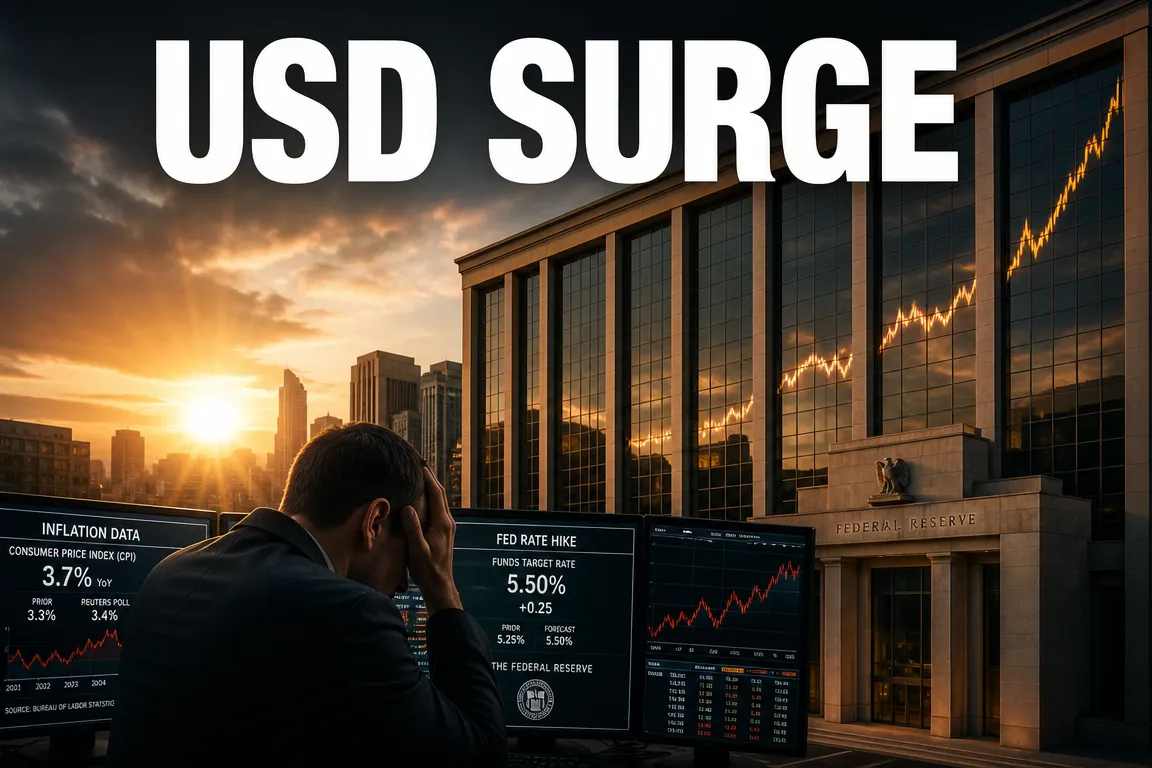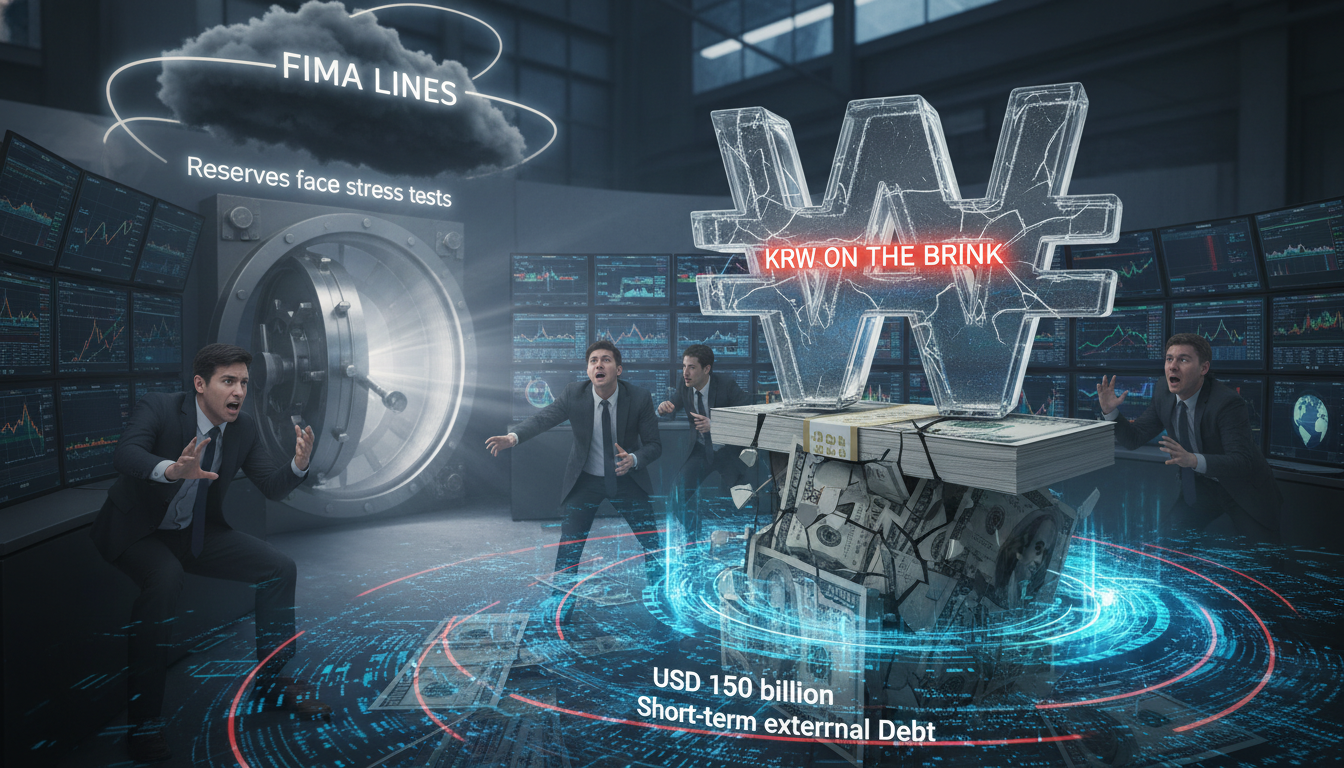
● Korea FX Time Bomb, 150bn Short-Term Debt, Swap Vacuum, 2026 Dollar Tsunami
South Korea’s Foreign Exchange Structure Alert: $150 Billion in Short-Term External Debt, Currency Swap Gap, Post-2026 Exchange Rate Outlook, and Individual Responses
This article covers a detailed breakdown of the numbers, the real liquidity of foreign reserves, the institutional limitations of currency swaps, scenarios of U.S. investment outflows after 2026, and even hedge strategies involving dollars, gold, and hedging for individuals.
It highlights key issues such as “liquidity speed and haircut risks,” “the usability of the U.S. FIMA repo,” “vulnerable points in domestic banks’ foreign currency LCR,” and “KRW basis and NDF squeezes” that other YouTube channels or news outlets tend to overlook.
News Summary
- Short-term external debt is estimated at around $150 billion, and there is a warning that direct U.S. investment outflows of $20 billion per year could additionally occur from 2026 onward.
- Out of the approximately $420 billion in foreign reserves, the cash-equivalent portion is only around 4–5%, and much of the rest is held in marketable securities (such as U.S. Treasuries and agency MBS), which require time and possibly a price haircut when quickly liquidated in volatile conditions.
- The standing currency swap with the U.S. is not institutionally available, so it cannot be relied upon. There is a possibility of a temporary swap during crises, but it is not guaranteed.
- According to IMF/BIS standards, South Korea falls into a gray area of “borderline sufficient–insufficient,” and its high trade dependence leaves it vulnerable to extended transmission paths of external shocks.
- The suggestion for individuals is to strengthen their financial resilience with a dollar liquidity buffer, gold, U.S. short-term bonds, and currency hedging products.
The Numbers Behind South Korea’s Foreign Exchange Structure
-
Foreign Reserves and Liquidity
Foreign reserves are known to be around $420 billion.
The cash equivalent portion (cash and deposits) is estimated at around 4–5%, amounting to roughly $18–20 billion.
The remainder is largely composed of marketable securities (U.S. Treasuries, U.S. government agency bonds/agency MBS, etc.).
In times of rapid interest rate hikes, converting bonds quickly into cash can entail price discounts and settlement delays. -
Short-Term External Debt and Floating External Debt
Short-term external debt (based on original maturity) is mentioned to be about $150 billion.
If interpreted statistically as “maturities within one year remaining,” the figure could become even larger by including long-term debt with maturities within one year.
The Greenspan-Gaito-Delli rule advocates for “foreign reserves ≥ external debt due within one year” as a safety threshold.
The IMF ARA (adequacy) indicator recommends a ratio of around 100% after factoring in structural variables, and South Korea is evaluated on the borderline between sufficient and insufficient depending on the metric. -
U.S. Investment Outflow Structure
There is a cumulative growth in U.S. investment (manufacturing and R&D) centered on policy and industrial cooperation.
If a net outflow of around $20 billion per year continues, foreign currency liquidity pressures could intensify in years when current account surpluses and investment income cannot offset these outflows. -
Linkage between Trade Dependence and Exchange Rate Outlook
South Korea has a high reliance on global supply chains and energy imports.
Its exchange rate is highly sensitive to external factors such as oil prices, freight rates, and semiconductor market conditions.
The higher the uncertainty in economic outlooks, the stronger the preference for safe-haven currencies, which consequently amplifies KRW volatility.
The Reality and Misunderstandings of Currency Swaps
-
Standing vs. Temporary
The U.S. Federal Reserve’s standing swap lines operate with a few advanced currency areas (ECB, BoJ, BoE, SNB, BoC).
South Korea is not, in principle, an eligible counterparty for a standing swap, though there have been precedents of temporary lines being opened during global financial stress (in 2008 and 2020).
Before considering “political will,” one must first acknowledge the “institutional design” hurdles. -
Geopolitics and Bargaining Power
Temporary swap lines are primarily aimed at protecting the U.S. financial system, and they are more likely to be opened if geopolitical interests and alignments are favorable.
Therefore, currency swaps should be seen not as an “objectives to be acquired” but rather as a “bonus to be utilized if available.” -
Realistic Alternatives
To strengthen dollar settlement capabilities, it is necessary to enhance the potential use of the U.S. Treasury’s FIMA repo.
FIMA repos allow for the immediate procurement of dollars using U.S. Treasuries as collateral, offering advantages in terms of liquidity speed and price compared to agency MBS.
In short, it is essential to increase the proportion of “run on U.S. Treasuries” within foreign reserves and maximize the collateral eligibility to design a system that can draw dollars through repo during crises.
Key Risks That Market and Media Tend to Overlook
-
Liquidity Speed and Haircut
Selling bonds to convert them into dollars involves T+ settlement, market liquidity issues, and widening spreads.
Apart from the approximately 5% that is cash-equivalent, it is realistic to view the rest in terms that “time equals cost.” -
Extended Risk of Agency MBS
During periods of rising interest rates, prepayment speeds may slow down, increasing durations and price volatility.
In times of crisis, liquidating MBS could result in steeper price discounts than U.S. Treasuries. -
Vulnerable Areas in Domestic Banks’ Foreign Currency LCR (Liquidity Coverage Ratio)
While regulatory requirements might be met during normal periods, if corporate short-term dollar demand surges, the cost for banks and their foreign currency branches to procure dollars could spike sharply.
At that time, a significant widening of the KRW/USD basis may occur, and if a “short cover” situation overlaps in the swap and NDF markets, it could trigger a rapid appreciation in the exchange rate. -
Seasonality in Energy Settlement
During periods of surging oil prices and peak gas settlements in winter, corporate dollar settlements become concentrated.
Even with a current account surplus, a “mistimed” settlement can lead to short-term liquidity shortages. -
Proportion of KRW-Denominated Bonds Held by Non-Residents
As non-residents hold an increasing portion of KRW bonds, during risk-off phases, the unwinding of currency hedges could trigger KRW depreciation, which in turn leads to further unwindings in a vicious cycle.
2025–2026 Scenarios and Exchange Rate Outlook Triggers
-
Base Scenario
If U.S. inflation eases gradually, the Fed implements modest rate cuts, and the semiconductor market recovers, KRW volatility is likely to moderate.
If oil prices remain in the $70–$90 range, the current account can be defended, and the exchange rate is likely to fluctuate within a wide band. -
Stress Scenario
If oil prices and freight rates surge, U.S. interest rates rise again, and geopolitical risks simultaneously emerge, sharp short-term dollar demand and widened spreads for foreign currency procurement will coincide.
If U.S. investment and dividend outflows also occur concurrently, there will be strong upward pressure on the exchange rate. -
Favorable Scenario
If the Fed shifts to a more accommodative stance, the Chinese economy bottoms out, and the semiconductor boom continues to intensify simultaneously, net inflows of foreign equities and bonds will likely recover.
The KRW will be strong, though volatility will remain due to the normalization of basis spreads. -
Points to Watch (Triggers)
Keep an eye on whether U.S. CPI/PCE service prices and oil prices/freight rates are changing, the outstanding balances of FIMA repos and reverse repos, the seasonality of South Korea’s current account and dividend outflows, the CP/repo spreads at foreign currency branches in domestic banks, and whether NDF trading volumes are surging.
These triggers are directly linked to the exchange rate outlook and the fundamental strength of the South Korean economy.
Policy Recommendations (Prioritized for Implementation)
-
Enhance the ‘Repo Eligibility’ of Foreign Reserves
Increase the proportion of “run on U.S. Treasuries,” manage collateral effectively, and design the use of FIMA repo lines to boost the ability to obtain dollars quickly. -
Strengthen Portfolio Transparency and Governance
Gradually expand the public disclosure of detailed duration and liquidity information for bonds, MBS, and deposits.
Establish a permanent monitoring board consisting of the National Assembly and external experts to detect risks early on. -
Restructure Short-Term External Debt
Continuously monitor foreign currency LCR/NSFR, provide incentives for corporates to extend short-term borrowings to longer maturities, and monitor the foreign currency branches’ dependence on short-term wholesale funding. -
Hedge Energy Settlements
Institutionalize hedging guidelines for public enterprises and large importers during periods of surging oil prices to disperse concentrated dollar demand during settlement peaks. -
Diversify Swap Arrangements and Practice Crisis Response
Assume that a standing swap with the U.S. is unlikely, keep open the possibility of temporary swaps, but make “withstanding without a swap” the default option.
Include scenarios such as “delays in liquidating MBS” and “NDF squeezes” in regular crisis simulation exercises.
Checklist for Individual Investors (In Practice)
-
Dollar Liquidity Buffer
Prepare for spikes in the exchange rate by holding 20–30% of your living expenses for 6–12 months in dollar deposits, U.S. short-term bonds, or USD MMFs. -
Gold and Safe Assets
Allocate 5–10% in gold to serve as a hedge against currency and geopolitical risks.
Grouping gold, dollars, and short-term bonds into a “crisis basket” can help build financial resilience. -
Choices in Currency Hedging
While global stocks are often better off unhedged for the long term, consider incorporating partially hedged ETFs if short-term volatility protection is needed. -
Caution Against Overly High Expected Returns
Be wary of assumptions like the Nasdaq rising by 35% each year.
Long-term expected returns are generally distributed in the high single digits to low double digits, which is a more reasonable assumption. -
Ten Data Points to Monitor
Regularly review the KRW/USD NDF spread, KRW basis, CP rates at foreign currency branches, disclosures of foreign currency LCR, trends in the current account, oil prices/refined margins, semiconductor export values, patterns in dividend remittance seasons, trends in FIMA repo usage, and the volatility of U.S. Treasuries (MOVE index).
Fact-Checking and Explanation of Figures
-
Short-Term External Debt
There is a difference between “original maturity” and “remaining maturity.”
A conservative approach is to consider the figure based on the remaining maturity (amount due within one year). -
Liquidity of Foreign Reserves
Even if the cash-equivalent portion is low, if U.S. Treasuries can be promptly used as collateral for repos, the effective liquidity improves.
However, if the proportion of MBS is high, repos or sales might be less favorable in a crisis. -
IMF ARA and BIS
The simple “twice rule” is not everything.
The ARA takes into account multiple factors including short-term external debt, portfolio outflows, the breadth of currencies, and export volatility. -
Yield Common Sense
The long-term average annual return on U.S. stocks is historically around 8–10%.
After periods of repeated high returns, mean reversion may occur.
Checklist for Using in Exchange Rate Outlooks Today
- Is oil priced above $90?
- Are U.S. service prices in the CPI/PCE slowing down?
- Has South Korea’s current account returned to a surplus trend?
- Do the dividend remittance peaks in March–May and September–October coincide with exchange rate movements?
- Are the procurement spreads at foreign currency branches and NDF trading volumes surging?
- Is there any news regarding FIMA repos?
Just by monitoring these six factors, one can get a clear picture of the strength of the South Korean economy and the direction of foreign exchange risks.
< Summary >
- The combination of $150 billion in short-term external debt and U.S. investment outflows will increase liquidity pressures.
- The key to foreign reserves is not the “size” but “how quickly and with minimal loss they can be converted into dollars.”
- A standing currency swap line is an uncertain hope; a portfolio centered on FIMA repos and U.S. Treasuries is a realistic solution.
- Surges in oil prices, U.S. inflation, dividend seasons, basis spreads, and NDF volumes act as triggers for sharp exchange rate movements.
- Individuals should boost their defenses with a dollar liquidity buffer, gold, short-term bonds, and partial currency hedges.
[Related Articles…]
- Institutional Limitations and Alternatives for the Korea-U.S. Currency Swap: Supplementing with FIMA Repo
- 2026 Exchange Rate Outlook Scenario: The Three Paths Shaped by Oil, Dividends, and Basis
This article is for informational purposes and does not constitute investment advice.
It is recommended to make decisions based on individual judgment and responsibility.
*Source: [ 경제 읽어주는 남자(김광석TV) ]
– 한국 외환 구조가 심상치 않다. 단기 외채 1,500억 달러의 경고… “IMF를 막는 건 숫자가 아니라 준비다” | 경읽남과 토론합시다 | 김대종 교수 3편
● Private Cops Take Over
The Economics of Privatized American Policing: ‘Signature Republic,’ Amber Alerts, and the Rise of AI Security
America’s shift to private security over traditional policing is neatly laid out in terms of figures and structure.
It delves into the real reasons behind the ‘paper republic’ that insists on physical signatures and the bottlenecks in the transition to digital IDs.
It explores how Amber Alerts plug the gaps in a decentralized public safety system while also examining it from a data and algorithm perspective.
It outlines how AI and robotics are reshaping physical security and where to look from an investment standpoint.
It separately explains a perspective that is rarely mentioned in other news: “Insurance and reinsurance drive security demand,” as well as “a signature culture = a mechanism for shifting liability.”
[News Summary] Privatized American Policing in Numbers
In the United States, there are about 800,000 police officers and around 1.6 million private security personnel, marking a shift in the center of security manpower toward the private sector.
The average size of a police station is approximately 44 personnel, and many departments consist of just 2–3 members.
The U.S. private security market is estimated to be around $24.4 billion in 2024 and is projected to grow at an average annual rate of 6% to reach $39.2 billion by 2030.
While the starting hourly wage for police officers is estimated to be over $60, the hourly wage for private guards in New York is around $27, highlighting a significant disparity in personnel costs.
Since 2020, even amid debates such as “Defund the Police,” the demand for private security continues to rise.
Incidents such as the major cash vault robbery in Los Angeles have revealed vulnerabilities in private security.
The U.S., with its common law tradition, is a document-centric culture, and due to the fragmented electronic signature legislation by state, dependence on paper and handwritten signatures remains high.
The Amber Alert system, issued in cases of child abductions or life-threatening situations, is a national system that simultaneously broadcasts alerts via mobile phones, radios, and highway electronic signs.
Why America Chooses Private Security: Structural, Cultural, and Economic Logic
-
Decentralization of budgets and lack of standardization.
Budgets for public safety are layered across federal, state, county, and city levels, and the weak central standard leads to varying local responses.
Municipalities with tight budgets often choose to “contract private security” over “increasing police staffing.” -
Wage disparities and organizational rigidity.
The comprehensive costs for police, including pensions and benefits, are structurally high, and the challenges associated with recruitment, training, oversight, and labor risks are significant.
Outsourcing to the private sector offers cost flexibility and rapid deployment. -
Property rights and a self-help culture.
The contract culture of “my building, my responsibility” is strong, leading shopping centers, hospitals, schools, and campuses to enter into independent security contracts.
Affluent areas have gated communities and constant security, while vulnerable areas depend on public police, deepening inequality. -
The global economic environment and demand elasticity.
Inflation has led to an increase in theft and organized retail crime, while companies face growing pressure to prevent losses.
During periods of high interest rates, commercial real estate vacancies expand, increasing the demand for vacancy management, night security, and remote monitoring.
Although security is a cyclical industry, basic safety demands are less sensitive to the economic cycle, and thus, security investments are often seen as defensive.
Limitations of Private Security: Flaws Revealed by ‘Incidents’ and Paths for Improvement
-
Vulnerabilities exposed by incidents.
Incidents such as the major cash vault robbery in Los Angeles demonstrate that despite multiple alarms, gaps in response, integration, and accountability can occur.
Internal risks, inadequate training, and equipment disparities can amplify the scale of incidents. -
The gray area of insurance, liability, and regulation.
Physical security is directly tied to insurance policies, and in outsourced structures, liability disputes can drag on for extended periods.
Lack of standardization and the proliferation of certifications lead to quality variances. -
The path for improvement = Data, AI, and integration.
Integrating data from cameras, access control systems, alarms, body cameras, radios, GPS, and license plate recognition (LPR) is key to automating situational awareness and dispatch command.
Simulations (digital twins), optimization of patrol routes, filtering of false alarms, and evidence chain management are core areas for improvement.
Why America Still Clings to ‘Paper and Signatures’
-
A legacy of common law and document-driven accountability.
In the Anglo-American legal system, contracts, property rights, and dispute resolutions rely heavily on records and evidence.
A signature is the crucial device that confirms “intent + legal responsibility.” -
Fragmentation of state-by-state electronic signature regulations.
While the federal ESIGN Act and state UETA recognize electronic signatures, documents such as real estate contracts, wills, notarizations, and promissory notes in some states still require paper.
Despite the growth of remote online notarization (ROM/RON), there is no nationally unified standard. -
Absence of a nationwide digital ID.
The SSN is not a form of identification, and driver’s licenses vary by state in format and verification process, preventing a unified online identity verification.
Thus, banks, hospitals, and insurance companies prefer paper and handwritten signatures as “the safest option.” -
Industrial opportunities and AI applications.
eKYC/AML, mobile driver’s licenses (mDL), biometric authentication, forgery detection, signature similarity verification, and automated document classification are being rapidly introduced.
RegTech and IDV companies are expanding into finance, healthcare, and public sectors.
Amber Alerts: The Nationwide “Simultaneous” Button for a Decentralized Public Safety System
-
How it works.
In situations of child abduction or life-threatening danger, police, the FBI, and state governments coordinate to instantly broadcast alerts via mobile phones, radio, TV, and highway electronic signs.
It overrides “Do Not Disturb” modes to ensure immediate notification regardless of time or place. -
Compensating for the paradox of decentralization.
Given the United States’ characteristic of inter-state and inter-county travel within an hour or two, early pursuit is critical for saving lives.
The Amber Alert provides a hyper-connected alert layer that transcends the decentralized system. -
Limitations and improvements.
Frequent alerts can lead to alert fatigue, and excessively broad regional coverage may worsen the signal-to-noise ratio.
Efforts are expanding to use AI to dynamically optimize geofences and transmission ranges by combining time, route, and vehicle characteristics (color, model, LPR).
As the system extends to include Silver Alerts (for missing elderly or those with dementia), addressing privacy concerns and minimizing false reports will be key challenges.
AI and Robotics Reshaping Physical Security: Technology and the Future of Jobs
-
Computer vision and edge AI.
Detection of weapons, suspicious behavior, crowd flow monitoring, POS-linked retail shrink analysis, and intrusion pattern prediction are becoming more advanced.
The integration of edge cameras with cloud VMS reduces latency and minimizes false alarms. -
Autonomous equipment and remote security.
Patrolling robots, drones, and remote speakers enable a small workforce to cover multiple sites.
Global Security Operations Centers (GSOC) and Physical Security Information Management (PSIM) systems automate the linkage between events, dispatch, and evidence. -
Innovations in identity and access control.
Mobile IDs, QR/NFC badges, as well as multi-factor authentication combining facial, fingerprint, and vein recognition are converging, with visitor and contractor access managed through SaaS.
Standards are quickly being established in coworking spaces, logistics centers, and data centers. -
Transformation of jobs.
While simple guard duties may diminish, the demand for roles in control centers, data analysis, field technicians, and security operators (Ops) increases.
The introduction of AI changes the “quality” and wage structure of jobs and fuels the need for education and standardized qualifications.
Investment Checklist: Essential Factors When Evaluating the Security Industry
-
Demand cycle and macro factors.
The increase in theft during inflationary periods and expanding vacancies in commercial real estate during high interest rate phases stimulate security demand.
Even in global economic uncertainty, safety budgets are firmly defensive. -
Contract structure.
Key factors include long-term maintenance, recurring revenue (MRR), customer diversification, the balance of public versus private sectors, and insurance-linked discount structures.
The bundling of SaaS and equipment (OPEX + CAPEX) affects margins and churn rates. -
Technological capabilities and regulatory compliance.
Examine algorithm accuracy, false alarm rates, compliance with privacy regulations, evidence management systems (chain of custody), and certification and audit histories. -
Risks.
Closely scrutinize regulatory changes, dependency on a single large customer, labor disputes, a chain of liabilities in major incidents, and data breach risks.
Key Points Rarely Addressed Elsewhere
-
Insurance and reinsurance dictate security demand.
Insurance policies for shopping malls, logistics, and retail essentially ‘force’ a specific security level, with deductibles and insurance premiums surging in case of non-compliance.
Ultimately, security investment becomes part of “insurance optimization.” -
Commercial real estate vacancy rates go hand-in-hand with security budgets.
Increases in vacancies, bankruptcies, and after-hours operations promote the adoption of security guards, remote monitoring, and patrolling robots. -
Avoidance of public pensions and organizational rigidity is a hidden driver of privatization.
Local governments attempt to shift from long-term fixed wage and pension structures to variable costs. -
The ‘signature culture’ acts as an automated mechanism for liability allocation.
Paper and handwritten signatures simplify evidence and liability attribution during disputes, thereby diffusing and fragmenting risk. -
The interoperability standards of Amber Alerts set the stage for next-generation digital ID and public alert systems.
Integration of geographical, communication, vehicular, and identity data in real-life situations may establish norms for future nationwide digital identity infrastructure.
Outlook: Checkpoints for 2025
-
As interest rates ease, the recovery of commercial real estate will drive security investments toward a “qualitative upgrade.”
Budgets will shift from hardware expansion to AI-driven monitoring and integrated software. -
If state-by-state regulations on electronic signatures and remote notarization are relaxed, the pace of digital workflow transitions in healthcare, finance, and real estate will quicken.
A ‘trust framework’ bundling digital IDs and biometric authentication is set to gain momentum. -
Both Amber and Silver Alerts will reinforce algorithmic optimization along with privacy safeguards.
Intelligent filters that reduce alert fatigue are likely to become commonplace. -
In terms of employment, the shift from security guards to control, analysis, and field roles will expand.
Reskilling and the standardization of qualification systems will be key determinants of competitiveness.
< Summary >America has shifted its public safety structure to a private security system due to budget decentralization, wage disparities, and a do-it-yourself culture.
The private security market is projected to grow from $24.4 billion in 2024 to $39.2 billion by 2030, with AI, robotics, and integrated monitoring driving the growth.
America’s reliance on paper and handwritten signatures is the result of a blend of common law traditions, fragmented state regulations, and the absence of a nationwide digital ID.
Amber Alerts provide a nationwide simultaneous alert layer that compensates for decentralized public safety, though algorithmic optimization and privacy remain challenges.
Investments should focus on insurance, contract structures, technological accuracy, regulatory compliance, and customer diversification.
At the intersection of the global economy, inflation, interest rates, investments, and employment, the security industry appears poised for defensive yet structural growth.
[Related Articles…]
- US Security Industry Investment Checklist
- Guide to Electronic Signatures and the Transition to Digital IDs
*Source: [ Maeil Business Newspaper ]
– 경찰력 부족이 만든 ‘미국식 치안 민영화’ | 홍키자의 美쿡 | 홍성용 특파원
● Shin Ramyun Fever, K-Content Wave Shakes Pyongyang
South Korean Consumption Code Shaking Pyongyang: Spreading Shin Ramyun, K-Content, and ‘Trust’, Changes in the North’s Internal Market and the AI Variable
Key Points Included in Today’s Article
Based on actual testimonies, this article summarizes the latest status on how Shin Ramyun and South Korean TV/platform content are spreading in the North to an almost addictive level.
The hints given to economic outlooks by market prices, unofficial exchange rates, and changes in consumer preferences have been reinterpreted through numerical data and distribution channels.
It explains how the gap in bank trust and payment infrastructure translates into a ‘trust premium’ and suggests a method to interpret it in conjunction with future signals from inflation, exchange rates, and interest rates.
It examines the ‘censorship-evading digital transformation’ scenario that emerges when content distribution is combined with AI, low-earth orbit (LEO) satellites, and on-device models.
The core that other media do not mention: it presents a mechanism where the ‘brand premium’ in the North and offline recommendation algorithms change demand more quickly than exchange rates.
News Summary: Testimony-Based Situation Update
• According to testimony from the Aoji Nuna channel on November 18, South Korean content and South Korean-style product preference are spreading across the entire North, including Pyongyang.
• Demand for Shin Ramyun is particularly strong, and there is testimony that top directives such as “It looks cool on South Korean TV, so try making it” have been circulated internally (the veracity cannot be independently verified and is treated as local testimony).
• Defectors entering South Korea were most surprised by South Korea’s elevator operations (with odd and even floor separations), the subway system, and the trust-based financial system where “your money is safe in the bank.”
• Similar to the anecdote of a Pyongyang Naengmyeon restaurant, there are points where the everyday culture of South Koreans is misaligned with internal perceptions in the North.
Change in Consumption Code 1: Signals from Shin Ramyun and Market Prices
Shin Ramyun functions as a symbol of the “South Korean lifestyle” in North Korean street markets, and when supply is cut off, the premium on alternative ramyun quickly skyrockets.
This premium does not merely reflect culinary preference; it encapsulates information about quality, brand trust, and safety.
After the resumption of trade between the North and China, the trend in the logistics volume of ramyun (HS 1902) has been observed to move in tandem with market prices, indicating both a recovery in internal consumption and inflationary pressures.
From an investment perspective, it is noteworthy that the ‘brand-dependent’ demand for ramyun, convenience foods, and seasonings tends to be defensive even during economic downturns across Asia.
Change in Consumption Code 2: Penetration of South Korean TV and Platform Content
Offline transmission via USB, microSD, and Chinese smartphones remains a key channel.
Like platform recommendations, person-to-person networks act as an “offline recommendation algorithm,” driving the explosive spread of hit content.
This structure moves demand faster than official exchange rates or statistics, triggering changes in the market basket mix and premiums.
The Economics of Trust: Gaps in Banking, Payment, and Transactions
At the core of defector testimonies is the shock experienced from a “system where money is safeguarded when deposited.”
A trustworthy deposit and payment infrastructure lowers transaction costs and fosters long-term investment and insurance demand, thereby stabilizing inflation expectations.
Conversely, when trust is weak, there is a shift towards tangible assets and goods, which amplifies exchange rate volatility and upward pressure on prices.
This gap widens the disparity in the perceived standard of living between the North and the South, creating a virtuous cycle that further reinforces brand and quality preferences.
Supply Chain and Trade Routes: Where Does It Come In?
Both legal and illegal routes are mixed.
The China–Dandong/Duman River axis and coastal small-boat routes are mentioned as the main channels, and market prices and exchange rates react sensitively depending on the intensity of border control.
During the phase of resumed trade between the North and China, as the share of essential commodities and food products increases, there has been a repeated phenomenon of rising short-term inflationary pressures along with improved internal consumer sentiment.
AI and the Fourth Industrial Revolution Variable: The Rise of Censorship-Evading Digital Transformation
On-device AI (lightweight LLM, subtitle generation, compression codec) operates even on low-spec smartphones, increasing the efficiency of K-content consumption in low-bandwidth environments.
Text-to-speech (TTS) and automatic summarization models enable the consumption of ‘audio summaries’ that reduce exposure to risk.
While the spread of low-earth orbit (LEO) satellites increases the risk of unauthorized access, it can simultaneously drastically narrow the information gap.
In the short term, offline carriers (USB, SD) and close-range transmissions dominate, while in the long term, a hybrid combining satellite and mesh networks is likely.
Connecting with Macroeconomic Keywords: How to Interpret Inflation, Exchange Rates, Interest Rates, and Economic Downturns
The sharp surge in market prices for food and essential goods is a direct signal of internal inflationary pressures.
When the unofficial exchange rate leans toward the dollar, the premium on imported essential goods expands, and the “scarcity price” for external brands like Shin Ramyun rises sharply.
If the interest rate cycles in Korea and China and the pace of normalizing trade logistics at the North–China border align, the influx of essential goods could increase, thereby cushioning internal prices.
During global economic downturns, a slowdown in domestic demand in China may constrain market supply, potentially increasing price volatility.
While none of these variables directly affect Korea’s economic outlook, they have an indirect impact through the demand cycles of border trade and logistics companies as well as food and content export companies.
Policy and Risk Radar
Content distribution will contract in the short term if anti-socialist crackdowns are intensified.
However, the resilience of offline networks and the proliferation of small storage media tend to maintain dissemination channels in the long term.
External sanctions and border blockades have repeatedly been confirmed as factors that amplify exchange rate volatility and inflation in essential goods.
Three Key Points That Are Rarely Addressed Elsewhere
1) The brand premium moves faster than exchange rates: trust and quality expectations shift first, followed by prices and exchange rates.
2) Offline recommendation algorithms: the network effect of a ‘person-to-person-intermediary’ chain creates spread as powerful as platform recommendations.
3) On-device AI is a game changer: when summarization, subtitles, and compression combine, the utility of content increases non-linearly relative to censorship risks.
Data and Metrics Checklist
• Monthly trends in North–China trade statistics (HS 1902 for ramyun, seasonings, and processed foods).
• Variations in logistics freight rates and customs clearance times near the Kaesong Industrial Complex and Dandong.
• Changes in satellite nightlight data (a proxy for power and activity levels).
• The direction of the unofficial exchange rate (won to dollar) and prices of a basket of key market items.
• Estimates of the influx of Chinese smartphones (low-cost 4G) and prices of storage media.
Investment and Industry Watching Points (General Perspective)
Defensive consumer goods: the brand-dependent demand for products such as ramyun, convenience foods, and seasonings is likely to remain stable regardless of economic cycles.
Content exports: the export of Hallyu IP and formats continues in emerging markets in Asia, with the expansion of models that combine low-cost streaming and offline distribution.
Caution: due to significant risks related to sanctions and regulatory compliance issues, direct business with the North should prioritize legal risk assessments.
On-site Nuances: The Economics of Cultural Shock
Elevators distinguishing odd and even floors, subways, and trust in banks symbolize the accumulation of a “time-saving system.”
Saving time directly translates to productivity, and productivity leads to disparities in real income.
This disparity is the most fundamental reason behind the continued demand for “South Korean-style” practices.
< Summary >
Testimonies continue to suggest that the preference for Shin Ramyun and K-content is rapidly spreading through offline networks within the North.
Changes in market prices, unofficial exchange rates, and brand premiums are immediate indicators of internal inflation and consumption cycles.
The trust gap in bank and payment infrastructure exacerbates the perceived disparity in living standards, thereby reinforcing the South Korean consumption code.
The combination of on-device AI and LEO can accelerate the “censorship-evading digital transformation.”
Investors must simultaneously monitor the structural demand for food and content exports, cross-border logistics, and regulatory risks.
[Related Articles…]
The Impact of Resumed North–China Trade on South Korean Ramyun Exports
*Source: [ 달란트투자 ]
– “저도 직접 봤어요” 요즘 평양 전역에 싹다 퍼졌다 한국의 이것에 완전히 중독됐다 | 아오지누나 1부