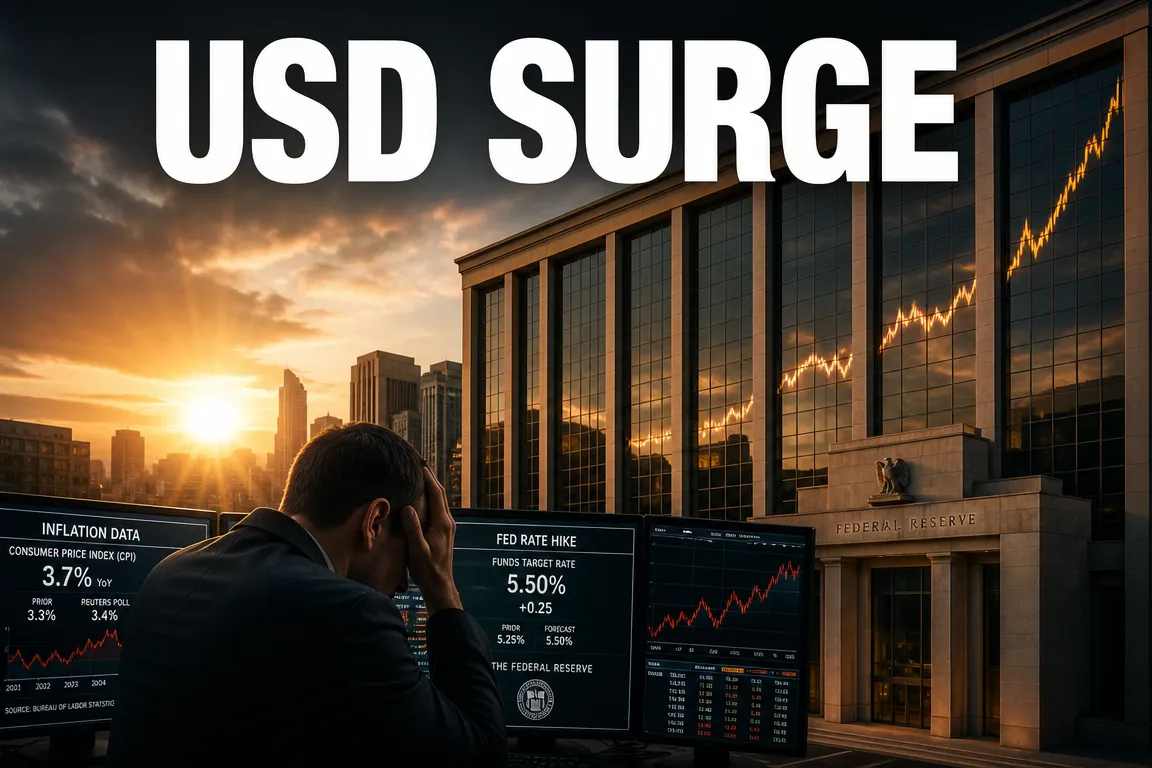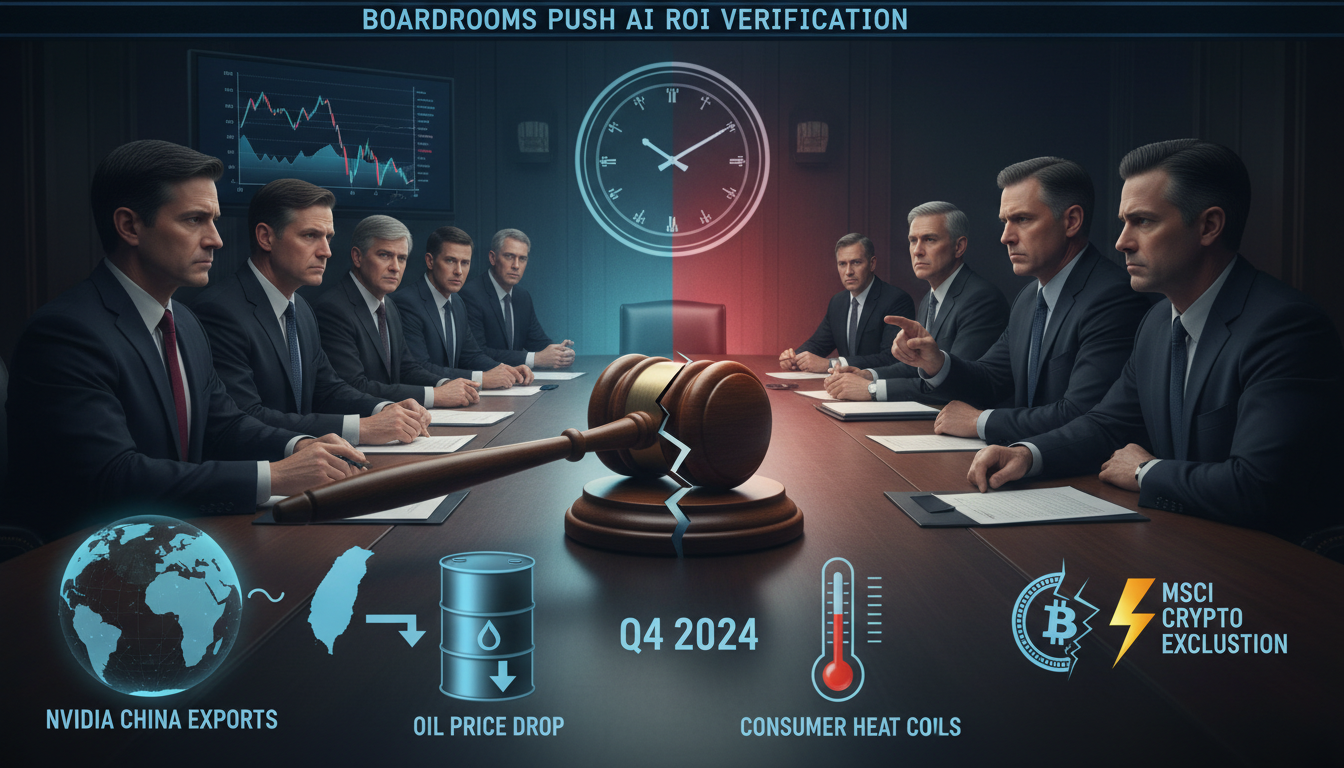
● Fed Pivot Sparks December Rate Frenzy, AI ROI Doubts, Nvidia China Export Shock, Oil Crash Deflates Inflation
With a single remark from the New York Fed President, bets on a “December rate cut” surge, a reality check on AI ROI, an Nvidia–China export scenario, and inflationary effects from a sharp drop in international oil prices all summarized at once
This article covers the Fed signaling a rate cut and changes in December FOMC bets, the transition of the AI investment cycle into a ‘ROI verification stage’, the ripple effects of Nvidia’s scenario to ease exports to China, the impact of a sharp drop in international oil prices on inflation and the dollar–bond market, as well as updates on consumer sentiment and fiscal policy.
In particular, it delves deeper than others into the signals that “the Fed’s policy focus has shifted from inflation to employment,” the point that “AI infrastructure debt risk” is becoming a new barometer of market volatility, and why the timing of “falling oil prices → slowdown in service prices” is important.
[News Briefing] 10 Key Issues on Wall Street
- New York Fed President Randall Quarles remarked, “There is room for adjustment for further cuts.” Immediately after his comments, the probability of a December rate cut surged into the 70% range, reversing the mood in the stock market.
- Interest rate-sensitive consumer stocks (Starbucks, McDonald’s, Home Depot, etc.) remain resilient. However, weekly results still show negative territory with residual volatility.
- Expectations for the U.S. fiscal and tax package (tips, overtime pay, auto interest deductions, medical cost relief, etc.). However, risks remain with the fiscal “bill” and data distortion (due to the shutdown impact).
- Consumer sentiment fell in November, and 5-year expected inflation eased to 3.4%, reinforcing the Fed’s rationale for a rate cut.
- A sharp drop in international oil prices (WTI in the high $50s) is expected to alleviate the geopolitical premium, affecting inflation easing and dollar strength adjustments.
- The ROI debate around MS Copilot is spreading. Some companies have reduced or terminated usage and switched to Google. Microsoft is defending by expanding its SMB low-cost plan and references.
- Google’s GeminAI 3 receives high praise, bolstering its annual stock performance. It highlights a story of infrastructure cost efficiency by leveraging TPU.
- Nvidia saw an after-hours rebound following reports that it might ease export restrictions on mid-range AI chips (H10) to China. However, the key risk remains ‘undecided.’
- Cryptocurrency is weak. Bitcoin’s sharp drop has increased the volatility of related stocks. Individual strategies for mining and holding stocks are necessary.
- Mixed performance among individual stocks: Gap (brand revitalization), Ross Stores (value-driven consumer), and Intuit (tax season effect) are strong. Elastic (concerns over slowing growth), Oracle (AI infrastructure debt burden), and Albermar (signals of lithium overproduction) are weak.
Fed and Interest Rates: Focus Shifting from ‘Inflation’ to ‘Employment’
Fed President Williams indicated, “Current rates are still somewhat restrictive, and an adjustment toward neutrality may be necessary.”
This suggests that the policy focus is partially shifting from price levels to employment stability, signaling that the “bad indicator = quick cut” trade could be reactivated.
Market reaction was immediate, with U.S. Treasury yields falling and interest rate-sensitive consumer sectors remaining resilient.
The key is to check if indicators such as PPI and employment data will reinforce the “rate cut rationale” by the time of the December FOMC.
Portfolio points: For the short term (1–4 weeks), trade on rate cut beneficiaries in consumer, housing-related (mortgage, home remodeling) and small-to-mid cap growth stocks; for the medium term (3–6 months), a strategy of extending bond duration and rebalancing quality tech stocks is effective.
SEO Keywords reflected: Interest Rate, Inflation, Fed, Recession, Stock Market.
Fiscal Policy: ‘Direct Cash in Your Pocket’ Deductions vs. Data Distortion Risks
The proposed tax package is structured to directly increase disposable income through measures like tips, overtime pay, auto interest deductions, and medical cost relief.
Short-term beneficiaries include retail, distribution, automobile, and hospital chains.
Note: Due to the carryover effects from the shutdown, Q4/end-of-year indicators may be noisy, so it is more reasonable to look at the boost effects in 2025–26 rather than overreacting to a “data shock.”
The insurance sector faces a valuation discount factor due to uncertainties in the extension of Obamacare subsidies.
The Reality of AI: ‘The Pilot Is Over, ROI Is the Answer’
Companies are reconsidering the cost-benefit of adopting generative AI such as MS Copilot.
There have been examples of usage reductions, cancellations, and switches to Google, suggesting that ARPU (average revenue per user) pressure may be reflected in IT budgets in 2025.
Microsoft is defending with strategies such as a low-cost SMB plan and expanded references, as well as diversifying with a partner model (Entropic).
Google is differentiating by highlighting Gemini AI 3’s performance and cost efficiency in its TPU-based infrastructure.
Investment perspective: In 2025, cash flow will distinguish winners more than the ‘model’.
- Infrastructure beneficiaries: HBM memory, high-bandwidth networking, CoWoS packaging, AI server ODM.
- Risks: AI infrastructure debt expansion of second- and third-tier operators, cloud margin pressure, and slowed adoption due to unmet customer ROI.
Nvidia x China: The Secondary Effects of the ‘Mid-Range Chip’ Easing Scenario
While high-end regulations at the H200 level remain, there is an expectation that if mid-range H10 chips are allowed, pent-up demand in China could immediately translate into sales.
The key is that the decision is still ‘undecided,’ and policy risks will dominate the headlines.
Secondary effect checklist: Demand elasticity in HBM (memory), CoWoS (packaging), optical/networking (Broadcom, etc.), power/cooling infrastructure, and AI server ODM (Taiwan).
Considering the risk of policy reversal and cycle volatility, it is necessary to adjust exposure on an event-driven basis.
A Sharp Drop in International Oil Prices: The Link Between Inflation Mitigation and ‘Dollar–Bond’ Dynamics
With WTI pushed into the high $50s, energy-related inflationary pressures are easing.
The lagged effect of service price (transportation, aviation, logistics) slowdown suggests the possibility for a decline in inflation indicators in Q1.
Combined with a weaker dollar and falling long-term U.S. Treasury yields (narrowing term premium), this supports a scenario of “soft landing – gradual rate cuts.”
Strategy: Maintain a defensive stance in the energy sector while selectively leveraging margin improvements in consumer/industrial segments and cost of goods sold momentum in aviation, freight, and chemicals.
Consumer Sentiment: ‘Poor Today vs. Less Poor Tomorrow’
Although consumer sentiment has contracted, the 5-year expected inflation rate easing to 3.4% reinforces the Fed’s rationale for a rate cut.
The stock market prefers the paradox of “lower current scores but quicker rate cuts.”
This is the same context in which value retail (Ross), brand recovery (Gap), and tax/fintech (Intuit) are performing strongly.
Crypto and the ‘Carry’ Idea: Volatility in Stocks, Preferred Shares for Rates
A sharp drop in Bitcoin has increased volatility for mining and holding stocks.
Rather than common stocks with less visible cash flow, alternatives such as high-coupon preferred stocks, convertible preferreds, and collateralized bonds are being discussed defensively.
Key checks: Collateral assets, coverage ratio, call option/refinancing clauses, and refinancing schedules.
Corporate Scanner: Winners and Losers This Week
- Gap: Improved inventory and discount rates due to K-culture collaborations, a signal of brand power recovery.
- Ross Stores: Rising off-price channel market share amid price fatigue.
- Intuit: As tax season begins, the stability of subscription-based revenue is highlighted.
- Elastic: Sensitive to delays due to comments on ‘slowed cloud growth’ in its guidance.
- Oracle: Increasing CDS and borrowing costs due to financing AI data center CAPEX with debt. It is noted as a ‘market indicator’ for AI bubble risk.
- Albermar: Concerns over further downside in lithium prices due to signals of increased production in China.
6 Key Points Often Overlooked Elsewhere
- The essence of the policy pivot: The Fed’s shift from a focus on ‘prices < employment’ creates a rationale for a return to neutrality, conditionally opening the door for a rate cut.
- The challenge for AI in 2025: Instead of technology alone, key factors such as contract renewal rates, ARPU, and quantifiable ROI in reduced work hours will determine success. Budgets will shift from PoC to full-scale operations, becoming more stringent.
- The shadow of debt: Second- and third-tier cloud/AI infrastructure businesses become the center of volatility in the later stages of the leverage cycle. Monitor Oracle’s CDS as the ‘AI risk bible.’
- The lag between oil prices and service prices: Rather than focusing solely on gasoline, pay attention to the 2–3 month lag in transportation, aviation, and logistics prices to interpret the PPI→CPI pathway.
- The true beneficiary of easing export restrictions to China: Beyond Nvidia itself, the entire chain of HBM, packaging, networking, and power is leveraged. Bottlenecks in the supply chain may reemerge.
- Beware of data noise: With carryover and seasonal adjustment distortions from the shutdown, Q4 indicators are difficult to interpret. Focus on trends and revised figures rather than headlines.
Investment Checklist: 1–4 Weeks vs. 3–6 Months
- 1–4 weeks: Trade on rebounds in interest rate-sensitive consumer and housing-linked stocks, selectively choose small-to-mid cap growth stocks, underweight energy, and partially extend bond duration.
- 3–6 months: Invest in quality growth stocks (cash flow/margin defense), focus on core components in the AI value chain such as HBM, networking, and packaging, and adopt a K-shaped bifurcation strategy for retail focusing on value and premium segments.
- Risk management: Set limits on exposure to themes linked to crypto volatility, watch for event-driven volatility from policy headlines (export restrictions/fiscal proposals), and monitor the expansion of AI infrastructure debt.
This Week’s Calendar Points
- PPI/Price Indicators: Check whether the rationale for a rate cut is reinforced.
- Corporate Commentary: Monitor ROI on AI adoption, IT budget guidance for 2025, and shifts in hiring/CAPEX plans.
- Simultaneous monitoring of oil, the dollar, and Treasuries: These factors are directly related to the inflation path and valuation discounts (multiples).
< Summary >Bets on a “December rate cut” have revived following remarks from the Fed, and interest rate-sensitive sectors have rebounded.
AI has shifted into a phase of “pilot over, ROI verification,” introducing new variables such as ARPU pressure and AI infrastructure debt risk.
Although there is potential in easing export restrictions to China for Nvidia, the key remains ‘undecided,’ with secondary beneficiaries in the HBM, packaging, and networking chain.
The sharp drop in oil prices is favorable for easing inflation, as well as the dollar and bonds, and declining consumer sentiment combined with expectations of lower inflation reinforce the Fed’s rationale for a cut.
Differentiate between short- and medium-term strategies by selectively holding rate cut beneficiaries, quality growth stocks, and core parts of the AI value chain.
[Related Articles…]
- Checklist for Monitoring Interest Rates, Bonds, and the Stock Market after the Fed Pivot
- AI Investment 2025: A Practical Portfolio Guide Focused on ROI
*Source: [ Jun’s economy lab ]
– [ 어젯밤 미국은?] 뉴욕증시 구원자로 등판한 연준 2인자…“금리 추가인하 여지 있다”
● Fed’s 25-Year Deadlock, Powell Holds Markets Hostage
December FOMC, the 25-Year ‘Fed Split’ Main Game: A 6-to-6 Possibility and Powell’s Decision Dividing the Market
This article quickly summarizes the essential points you need to know, including the actual handling method of a 6-to-6 tie scenario, the extent of Chairman Powell’s influence, vote calculations based on the mapping of individual members’ stances, and asset-specific strategies for US equities, bonds, the dollar, crypto, and the AI rally.
In particular, it also summarizes the secondary effects on the market of the “rules for tie votes” and the “statement, dot plot, and dissent notation” which other media rarely mention.
News Briefing: Signals that Shook the Market, Developments So Far
Recently, although the market’s attention has been focused on the sustainability of the AI rally and bubble debates, a single word from the Fed (Federal Reserve) continues to have a major impact on the financial markets.
Following the bearish stance of Director Lisa Cook, US equities rebounded as hopes for a December rate cut were reignited by Vice President Jefferson’s remarks suggesting “it’s not an AI bubble” and New York Fed President Williams’s dovish comments.
According to Nick Timiraos, the December FOMC is expected to witness a rare “deep split” vote battle, which could be the most intense showdown in 25 years.
The key diagnosis is simple.
If Powell does not strongly push for it, a rate cut will be difficult to achieve, indicating how evenly split the votes are.
Voting Battle Map: Who is for a Cut and Who is for a Hold
According to recent remarks, the market’s approximate classification is as follows.
The group leaning toward a rate cut includes President Williams and some directors.
On the hold side, President Schmidt, Director Lisa Cook, Vice Chairman Michael Barr, and President Goolsby share concerns that the slowdown in inflation has stalled.
President Collins, Vice President Jefferson, and Chairman Powell are maintaining a moderate stance close to the center.
In conclusion, with an approximately 4-3-5 split among the cut, moderate, and hold camps, a shift of one or two votes and Powell’s decision are likely to determine the final outcome.
Key Points (Things Other Media Rarely Mention)
First, in the event of a 6-to-6 tie, a “casting vote” does not legally exist.
FOMC decisions require a majority, and in the case of a tie, the proposal is not approved.
That is, if there is an equal number for a rate cut vote, the default becomes “no change,” effectively resulting in a hold.
Second, because December is a Summary of Economic Projections (SEP) meeting, internal splits can lead to a wider dispersion in the dot plot, balanced language in the statement (e.g., “progress on inflation” vs. “additional assurance needed”), and an increase in dissenting votes, which can have secondary impacts on the market.
Third, the very existence of divisions can tighten financial conditions.
When opinions diverge, the uncertainty premium regarding future policy paths increases, and bond market volatility, along with fluctuations in the dollar/foreign exchange, may occur.
Fourth, even if Powell’s “adjusting power” appears to have weakened, his “indirect authority” in fine-tuning market expectations through the statement draft, press conference, and macro narrative remains powerful.
Scenario Matrix: Policy Decisions and Asset Market Impacts
Scenario A) 25bp cut + limited split.
Condition: Confirmation of recent disinflation and successful persuasion of the moderate camp.
Asset Impact: A decline in 2-year yields, a drop across short to long durations but with the possibility of a steepening curve.
It favors AI and high-beta growth stocks in US equities, a weaker dollar, eased emerging market currencies, and a preference for risky crypto assets.
Scenario B) Hold (tie or by a fraction) + hawkish language.
Condition: Emphasis on concerns over a re-heating of inflation, with a significant split leading to a failure to obtain a majority.
Asset Impact: A rise in short-term yields, tightened financial conditions, and pressure on AI rally stocks, starting with those lacking earnings momentum.
In US equities, a rotation of styles is expected, led by defensive and quality stocks, along with a resurgence in the strong dollar and increased crypto volatility.
Scenario C) 25bp cut + hawkish guidance (emphasizing “one-off”).
Condition: An “insurance-type” cut for risk management purposes, with the dot plot lowering the probability of additional cuts.
Asset Impact: Short-term benefits followed by a neutralization.
For equities, fundamentals will prevail after fact-checking through earnings and cash flow; bonds would favor the 2-to-5-year segment, and the dollar is expected to be mixed.
AI Rally vs. Interest Rates: What is the Real Driver?
The AI rally requires both a decline in discount rates and an improvement in earnings/cash flow at the same time.
Rate cuts lower the denominator, which is favorable for valuations, but if inflation concerns are reinforced, volatility in long-term rates could increase, thereby shrinking the premium.
The key factors are the actual capital expenditure on data centers, the speed at which models/services are monetized, and whether the bottlenecks in the AI infrastructure supply chain are alleviated.
In other words, while interest rate variables remain important in the global economic context, validating earnings levels is now what determines the sustainability of the rally.
Checklist: Events, Data, Wording
Data: Core PCE, detailed CPI (housing, services), wage/employment elasticity, and ISM services price index.
Wording: Whether the statement includes the phrase “further progress on inflation,” the degree of “data dependence” in Powell’s press conference, and the evaluation of “financial conditions.”
Notation: Vote counts and dissent lists serve as independent signals.
A higher number of dissents increases the uncertainty premium regarding the future path.
Asset-Specific Strategy Guide (Summary)
US Equities: In the event of a rate cut, increase exposure to growth/AI; in the event of a hold with hawkish messaging, prepare to rotate into quality/cash flow and defensive stocks.
Bonds: Favor durations of 2 to 5 years in a rate cut/insurance-type cut scenario, and consider a barbell strategy to manage volatility in a hold scenario.
Dollar/Foreign Exchange: A rate cut could result in a weaker dollar; however, if the dot plot is hawkish, mixed outcomes are possible.
For EM currencies, managing volatility is key.
Crypto: In an environment of increasing policy uncertainty, focus on managing volatility and gradually allocate risk budget.
Summary: The “Real Variable” in This Meeting is Not the Vote Count but the Consistency of the Message
More than the decision itself, the degree of division and the consistency in the messaging across the dot plot, statement, and press conference determine financial conditions.
While a 6-to-6 tie is “dramatic,” remember that without a majority, a change is legally impossible, effectively resulting in a hold.
In a period where the narratives about the Fed, interest rates, and inflation are being reshaped, the sensitivity of US equities and the global economy is increasingly driven by “policy credibility” rather than “interest rate levels.”
< Summary >
The December FOMC is expected to feature an intense split not seen in 25 years, and the possibility of a 6-to-6 tie cannot be ruled out.
Legally, there is no casting vote, so a tie effectively results in a hold.
Not only the decision itself, but also the scale of dissents, dispersion of the dot plot, and consistency in the wording between the statement and the press conference dictate financial conditions.
It is logical to favor growth/AI in the event of a rate cut, or prepare to rotate into quality/defensive stocks in the event of a hold with hawkish messaging.
[Related Articles…]
Three Signals the Fed Split Sends to the Bond Market
The Essence of the AI Rally: Earnings Over Interest Rates
*Source: [ Maeil Business Newspaper ]
– [홍장원의 불앤베어] 25년만에 최악의 연준 분열. 6대 6 시나리오도 불가능하지 않다
*Source: Maeil Business Newspaper
[홍장원의 불앤베어] 비트코인 죽느냐 사느냐, 내년 1월 15일 결판나나
● Bitcoin’s Fate Hangs in the Balance as January Deadline Approaches
Is Bitcoin’s Fate Decided on January 15th? The Real Reason Behind the Massive Liquidations on October 10th with the MSCI Announcement and Investment Strategy
This article includes the hidden catalyst of the massive liquidations on October 10th (synergy of U.S. tariffs and MSCI notice), the practical impact of MSCI’s index exclusion discussions on the cryptocurrency and Bitcoin market, potential scenarios and investment strategies around the final decision on January 15th, and risk hedging measures.
In particular, it offers an in-depth analysis focused on ‘the structural impact of index adjustments on the market’ and ‘the timeline of passive funds,’ which are not widely covered by other media.
Key Summary (News-Type)
During the market plunge on October 10th.Alongside Trump’s mention of tariffs on China.MSCI announced an extension of consultations on the index application to companies holding digital assets.The MSCI document (local time, 4:34 pm) formalized discussions stating that “companies with more than 50% of their total assets in digital assets could be excluded from the MSCI Global Investable Index.”At the same time, approximately $18 billion in forced liquidation occurred in the crypto market, intensifying the drop in Bitcoin prices.MSCI’s final decision is set for January 15th, and changes could be reflected in the index by February.Should index exclusion become a reality, immediate outflows of passive funds (initial estimate about $2.8 billion) and resulting stock sell-offs are expected.Consequently, the entire Bitcoin and cryptocurrency market could face increased volatility.
Event Summary — What Happened on October 10th?
Trump’s tariff remarks weakened investor sentiment towards global risk assets.On the same day, MSCI released a document at 8:34 pm GMT (4:34 pm New York) announcing a review of the inclusion criteria for companies holding digital assets in the index.MSCI specified that it is considering excluding companies where digital assets constitute more than 50% of their total assets from the global index.The announcement quickly led to large institutional investors’ swift position adjustments and panic selling, resulting in massive liquidations (around $18 billion) in the Bitcoin market.The liquidations were amplified as leveraged positions across futures, margin, and derivatives markets were forced to liquidate simultaneously.
Main Points and Significance of the MSCI Document
Summary of MSCI’s proposal.Considering excluding companies with digital assets as their main business from the index.Criteria: Targeting companies holding more than 50% of their total assets in digital assets.Extended consultation period and final decision date: January 15th.Index change implementation date: Next year’s February index rebalance.
Implications and Influence.Index exclusion directly leads to automatic selling by passive ETFs and index funds.If index exclusion becomes reality, massive stock sell-offs are likely in affected companies (e.g., firms with business models holding Bitcoin).Selling in the stock market would impact these companies’ ability to raise capital (issuing new shares, CB) and their capacity to purchase Bitcoin.Ultimately, it could become downward pressure on Bitcoin demand over the medium to long term.
Which Companies Could Be Targeted?
Representative examples: Companies that develop financial strategies by holding Bitcoin as their main asset.Examples: MicroStrategy, Bitcoin mining companies, and large holding firms.These companies essentially have mixed roles as both ‘companies’ and ‘Bitcoin funds.’MSCI’s logic suggests it could view these mixed structures as ‘similar to investment funds,’ providing grounds for index exclusion.
Why Can’t Tariff Announcements Alone Explain the October 10th Liquidation Incident?
Tariff announcements were indeed a risk factor, but.The more severe drop in the crypto market compared to the stock market was due to the MSCI document being released simultaneously.MSCI’s announcement immediately created structural uncertainty regarding ‘index inclusion status.’Many institutions and passive managers reacted sensitively to changes in index composition, and their sell orders spilled into the crypto derivatives market, triggering liquidations.Additionally, the crypto derivatives market’s high leverage and concentrated positioning can lead to rapid chain liquidations.
Direct Impact of MSCI Decision on Cryptocurrency and Bitcoin
Short Term.Increased volatility due to uncertainty.Additional drops in related stocks and Bitcoin prices possible due to concerns over passive fund outflows.Medium Term.Funding costs rise for companies if excluded from the index.Bitcoin purchase strategies using stock issuance or CB (convertible bonds) could be hampered.Long Term.Impact on the adoption speed of cryptocurrencies by institutions.If index inclusion rules are tightened, it may decelerate traditional financial investments related to Bitcoin.
Market Reaction and Saylor’s Rebuttal Following the MSCI Announcement
Michael Saylor of MicroStrategy disputed that the company is not a fund or a holding company but operates a software and Bitcoin-based financial structure as an ‘operating company.’Saylor’s argument: Unlike mere asset holding, the company utilizes Bitcoin as ‘productive capital’ for structuring and operating.However, MSCI’s discussion focuses on analyzing ‘actual index inclusion criteria.’If the rules change, companies’ definitional judgments won’t easily reverse market trading flows.
The Most Important Points Not Covered by Other Reports (Exclusive Insights of This Article)
1) The ‘Timing Effect’ of Index Exclusion — Liquidity focus during rebalance and trading close times.More than the announcement of index changes, the concentration of sell and restructuring orders occurs at the time changes are reflected in the index (rebalance date, index implementation date).If algorithmic/hedge fund aggressive trading takes advantage of this timeline, the market could experience a bigger shock.
2) Cross margin issues in derivatives/margin markets.Fear of index exclusion leads to stock sell-offs of related companies, reducing investment firms’ stock collateral positions.This transitions to increased margin requirements in crypto-related derivatives, accelerating liquidation.
3) The ‘chain links’ effect of passive funds.MSCI is independently used as a benchmark by many ETFs and institutional portfolios.Hence, index exclusion immediately triggers numerous passive funds’ rebalancing orders.When this volume pours in at the same time, the market shock exponentially amplifies in a nonlinear manner.
4) The potential collapse of funding loops for companies (new share issuance → Bitcoin purchase).If index exclusion turns stock prices bearish.Raising funds via new shares/CB becomes difficult.Eventually, the additional Bitcoin purchase strategy itself fails, leading to structural bad news on the demand side.
Market Outlook and Investment Strategies by Scenario (Key Points Before and After January 15th)
Scenario A — MSCI adopts the ‘exclusion’ rule.Probability (expected): Medium.Immediate effects: Outflow of passive funds from related companies (initial estimate billions-$ billions).Bitcoin: Short-term downward pressure, increased volatility.Investment strategy: Recommend reducing leverage, securing cash, hedging through options, and shorting ETFs.Scenario B — MSCI grants deferrals or exceptions (e.g., clarifies operating company criteria).Probability (expected): Medium to low.Immediate effects: Reduction in uncertainty, potential short-term rally.Investment strategy: Gradual increase in exposure (focusing on spot), consider selling options when volatility reduces.Scenario C — MSCI concludes to maintain ‘inclusion’ (recognizing company activities).Probability (expected): Low to medium.Immediate effects: Strong positive factor, continued influx of passive funds.Bitcoin: Improvement in demand over the mid to long term, initiation of upward price phase.Investment strategy: Strategic buying (dollar-cost averaging), consider leveraging based on institutional entry.
Practical Checklist — For Individual and Institutional Investors
Position check.Reduce leverage and margin positions.Set limit and stop-loss orders for automatic protection during steep drops.Hedging.Limit downside risk using put options or inverse products.Portfolio management.Limit exposure to Bitcoin and cryptocurrencies to an appropriate portion of total assets.Maintain cash and spot positions for liquidity purposes.Monitoring.Real-time check on MSCI announcements, rebalance schedules, and related ETF/index operator announcements.Monitor trends of market makers and liquidity providers.
Regulatory and Market Structural Considerations
MSCI’s decision extends beyond simple inclusion, addressing ‘how traditional finance classifies cryptocurrencies.’Rule changes by traditional index businesses fundamentally alter institutional capital flow.Thus, it affects the speed of institutional integration into the crypto market (ETFs, custodial services by banks, etc.).Investors should consistently account for policy and regulatory risks.
Conclusion — Lessons and Practical Message from January 15th
MSCI’s consultation deadline (January 15) signifies more than a simple date.The decision may restructure passive fund flows.It connects directly to instant market liquidity and liquidation risks.Investors should regard this period as an ‘uncertainty premium.’Focus on risk management (reducing leverage, hedging, ensuring liquidity).Conversely, if MSCI makes flexible decisions, it can bring significant positives through renewed institutional demand.
< Summary >MSCI reassesses the index inclusion rules for companies holding digital assets.The final result on January 15th could determine the market direction of cryptocurrencies.The large liquidation on October 10th resulted from the simultaneous exposure of Trump’s tariff announcement and the MSCI document.Realizing index exclusion would amplify downward pressure on Bitcoin through passive selling, fund outflows, and weakened company capability to buy Bitcoin.Investors should manage risks through leverage reduction, option hedging, and liquidity securing.On the other hand, MSCI recognizing company activities could see positive potential from expanded institutional demand.
[Related Articles…]The Impact of MSCI’s Index Policies on CryptocurrenciesBitcoin & Exchange Liquidation Risk Analysis