● FSD Frenzy, Parking Data Goldmine
Korean FSD, field videos revealing successful navigation through actual roads, Yonsan intersections, and even parking towers are being unveiled one after another. It encompasses technical explanations, regulatory checklists, economic and investment impacts, and even the essential core points overlooked by other media such as “parking infrastructure data” and “insurance rate changes”.
This article includes the timeline for domestic FSD activation, examples of Korean difficulty-level road sections, explanations of how vision-based AI operates, Level 2 supervisory regulatory fact-checks, glocal data strategies, and investment strategy points that will affect the global economy and tech stocks.
It also separately outlines key aspects such as the value of data from non-road areas like parking towers and large marts, changes in insurance rates, and the possibility of Korea becoming a verification hub for Asia.
Today’s Key Headlines
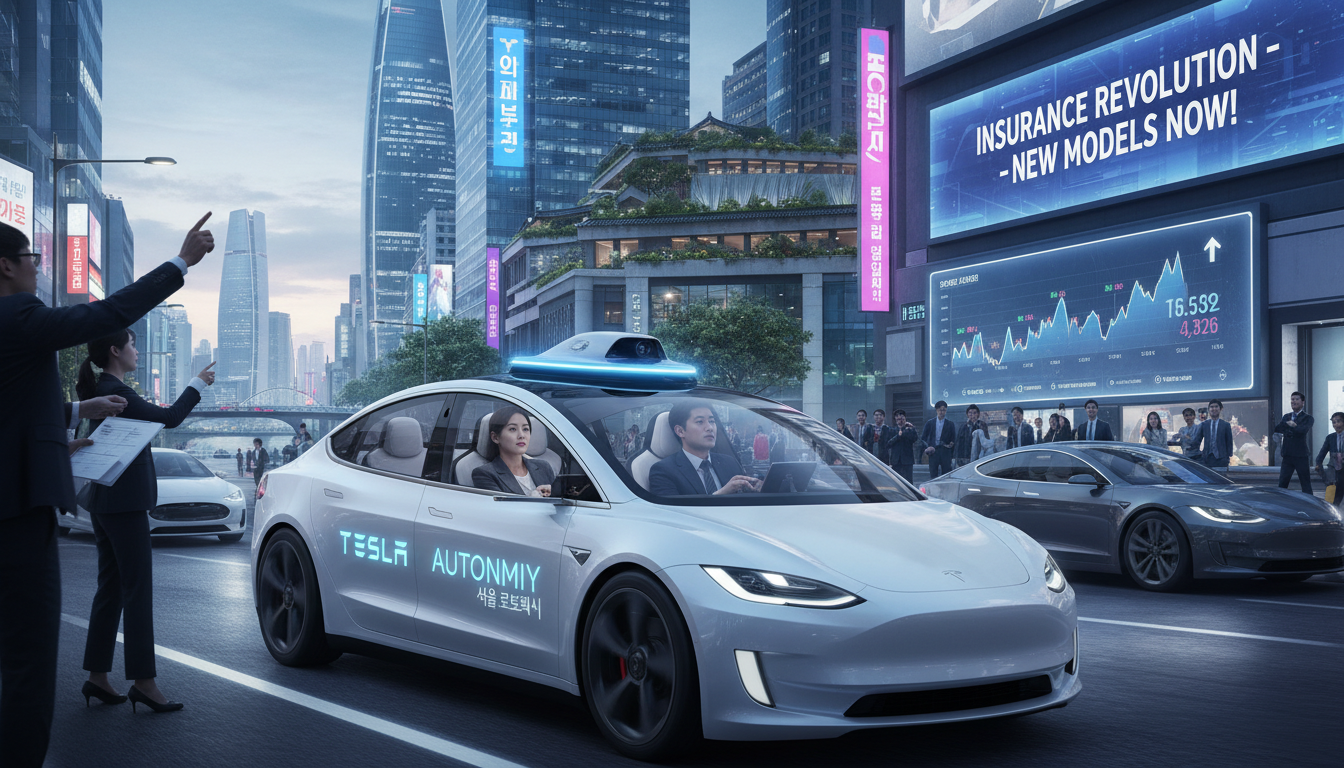
Some Tesla vehicles in Korea have had cases of FSD Supervisor (v14.1.4) activation widely shared in the community.
Successful real-world driving videos have been confirmed in challenging sections such as Incheon-Songdo, Busan Yonsan intersections, hotel parking towers, and automatic reverse parking at large marts.
Currently, this appears to be a limited rollout, likely serving as a pilot before a full-scale deployment.
Being a Level 2 supervisory system, legal responsibility remains with the driver, and hands-on driving supervision is essential.
It is presumed to be built close to the U.S. v14.2 release, and the accumulated global learning data has enabled immediate performance on Korean roads.
Timeline: Announcement → Signal → Activation
In early July, Elon Musk left a response hinting at support for Korean FSD.
At the end of September, the government’s public service advertisement on autonomous driving safety was aired, which has been interpreted as a precursor sign.
On November 11th, Tesla Korea announced, “The next destination is Korea.”
Around November 23rd, numerous screenshots of the FSD Supervisor v14.1.4 activation and real-world driving videos were posted in the community.
Field Cases: “Yonsan Intersections, Parking Towers, and Large Marts”
Passing through Yonsan intersections.
In a challenging section featuring six or more branches, left/right turn signals, and frequent intrusions by buses and taxis, the vehicle maintained its lane and controlled speed and angle naturally during turns.
Escaping from a hotel parking tower.
Within a closed structure where GPS is virtually ineffective, the system recognized wall-mounted arrow signs to choose a path, descending from the 4th floor to an exit on the 1st floor.
This demonstrates the maturity of a purely vision-based process, independent of maps or LiDAR.
Automatic reverse parking at a large mart.
The vehicle autonomously located an empty spot, calculated the necessary angle, and aligned itself in reverse.
This has been praised for its significant impact on everyday usability.
Cautionary example.
There have been reports of curb (corner) contact noise.
Due to significant variations in curb height/shape and lane marking thickness/color on Korean roads, conservative usage is recommended during the initial phase.
Why Did It Work Immediately in Korea: Technical Background
With occupancy detection and end-to-end vision learning, the system probabilistically learns interaction patterns among pedestrians, bicycles, construction vehicles, signs, and curbs.
It appears that policies trained on extremely challenging data from places like New York have been transferred via transfer learning to Korean urban areas.
Utilizing 360-degree camera coverage and real-time inference, it compensates for driver blind spots while finely adjusting deceleration, waiting, and merging timings.
The key lies in a reduced reliance on maps.
As visual understanding of signs, lane markings, and boundaries improves, the system delivers immediate driving performance on unfamiliar roads.
Regulatory, Safety, and Insurance Checklist (Level 2 Supervised)
Legal Classification.
The FSD Supervisor is classified as Level 2, meaning that control responsibility lies with the driver.
Continuous hand-on driving and forward monitoring are required.
Usage Prohibition/Precautions.
In conditions such as heavy rain, heavy snow, fog, construction zones, areas where lane markings vanish, or irregular intersections, drivers must be prepared to intervene.
In narrow alleys, sharp curves, or sections with high curbs, a conservative approach to vehicle width perception is advised.
Insurance and Accident Handling.
The current domestic standard is centered on driver fault, and if functionality changes due to OTA updates, insurance companies or repair technicians may request log verification.
Major insurers are likely to readjust discount and surcharge criteria for driver assistance usage.
Data and Privacy.
Transparency regarding the overseas transmission, anonymization level, and retention period of driving data is critical.
It is necessary to ensure consistency between domestic privacy laws and global regulations.
The Most Important Points the Media Hasn’t Addressed Yet
Parking infrastructure data is a gold mine.
Korea has an extremely dense network of large malls, mixed-use complexes, and hotel parking towers.
Vision-based off-street (non-road) data is as valuable as that for robo-taxis, and accurate exit sign recognition, ramp navigation, and low-speed rotation control will be key capabilities for local monetization.
Trigger for Rate Innovation.
As driving logs and the quality metrics of emergency braking and lane-keeping accumulate, innovation in usage-based insurance (UBI) and manufacturer insurance rates will accelerate.
FSD usage frequency and intervention rates may become indicators for premium calculations.
The Issue of Standards.
Variations in curb shape and color, as well as lane marking thickness and materials, compromise recognition stability.
Revising KS/road sign standards to be ‘vision-friendly’ would improve both safety and productivity.
Korea as the APAC Verification Hub.
While the U.S. benefits from abundant data and Europe faces high regulatory challenges, Korea encapsulates Asian-type complexities with dense urban areas, mixed-use complexes, narrow alleys, and the coexistence of two-wheelers.
The policies learned here can potentially be extended to major cities in Japan and Southeast Asia.
Local Service Model.
As a stage preceding robo-taxis, subscription-based microservices such as “autonomous entry and exit at mall pickup zones” could be rapidly commercialized.
Economic and Market Ripple Effects: Tech Stocks, Productivity, and Investment Strategies
Productivity.
Reducing the time spent on urban driving and parking lowers total costs for households and logistics, thereby contributing to real productivity improvements.
In the medium to long term, this can act as a factor in alleviating inflationary pressures.
Interest Rates and Capital Expenditure.
Even in the transitional phase before full autonomy, there will be increased investment cycles in in-vehicle AI computing, data centers, and map/simulation infrastructure.
In an environment of rising interest rates, value chain companies with robust cash flows are likely to benefit.
Tech Stocks.
Companies producing camera modules, automotive SoCs, HBM memory, power semiconductors, OTA security, and parking sensor materials may see resilient demand.
Domestically, this also connects to memory and packaging, automotive thermal management, and secondary battery BMS stabilization solutions.
Global Economy.
Improvements in urban mobility can spur commercial district revitalization and nighttime economic activity, and when combined with robotics and last-mile logistics, they may alter the employment structure in the service sector.
As the pace of autonomous driving commercialization varies by region, a rebalancing of the global value chain is anticipated.
Investment Strategies.
In the short term, it is a trading segment highly sensitive to news flow regarding the expansion of pilot countries.
In the medium term, forming a basket of companies leveraged by increases in data and inference infrastructure as well as in-vehicle compute capacity is a viable strategy.
In the long term, the platform premium could be revalued through software subscriptions, insurance, and mobility services.
Investment Checkpoints and Risks
Key Points.
Focus on the roadmap for enhancing vision models, OTA frequency, and the commercial packaging of urban and parking features.
Regulatory compliance, insurance partnerships, and transparency in data governance are also crucial.
Risks.
Variables include accident issues and recalls, tightening regulations, the performance of competitors’ LiDAR-integrated approaches, and margin pressures due to rising costs.
Stock price volatility is exceedingly sensitive to news, necessitating careful position management.
User Practical Guide (Early Korean Beta Operation Tips)
Activation Conditions.
Ensure you update to the latest software and confirm your consent to use the FSD Supervisor.
Allow sufficient driving time after calibration.
Usage Tips.
Reduce speed before entering urban areas or parking towers, and be prepared to intervene in alleys with curbs and many two-wheelers.
In construction zones with cluttered or deteriorated signs and surfaces, it is recommended to temporarily disable the system and drive manually.
Logging.
Recording abnormal behavior along with drive reports, videos, and timestamps can accelerate improvement.
Key Points to Watch in the Upcoming Roadmap
Deployment Scope.
The focus will be on expanding to Model 3 and Y, and on gradually unblocking flags specific to urban areas, time zones, and functions.
Build Updates.
Anticipate the domestic implementation of the overseas v14.2 series, improvements in off-road (parking and ramp) quality, and refined interactions with two-wheelers.
Servicization.
Paid feature bundles such as parking subscriptions, autonomous entry into pickup zones, and navigation independent of maps may emerge.
< Summary >
In Korea, the FSD Supervisor has been activated on a limited basis, and its performance has been confirmed in challenging scenarios such as Yonsan intersections, parking towers, and large mart parking.
The immediate effectiveness on Korean roads is due to vision-based generalization capabilities learned from extremely challenging data in places like New York.
Since it is a Level 2 supervisory system, the responsibility remains with the driver, and a conservative approach is advised during initial operations, especially near curbs and in construction zones.
Economically, improvements in productivity and increased demand for tech stocks are anticipated, while issues regarding insurance, standards, and data governance emerge as new growth opportunities.
Korea has a strong potential to become a verification hub that represents Asian complexities.
[Related Articles…]
FSD Supervisor: Korea’s Commercialization Signal and the Potential for Insurance Rate Innovation
The Economics of Parking Infrastructure Transformed by AI Vision Models
*Source: [ 오늘의 테슬라 뉴스 ]
– 한국 FSD 드디어 켜졌다! 연산교차로 주행 성공, 이제 진짜 시작된다!
● Driverless Tsunami, Regulators’ Last Stand
Tesla FSD ‘Unsupervised’ Signal Captured, Accelerating Global Expansion and Investment Variables Overview
In this article, everything is covered: the ‘unsupervised autonomous driving’ path in the code, the official FSD rollout in Korea and performance on Busan’s real roads, the large-scale rollout of US v14.2 and preview of v14.3, the AI3·AI4·AI5·AI6 chip roadmap, progressing regulations in the Netherlands and Nevada, surging sales in Norway, licensing issues, and the ripple effects on the stock market and the global economy.
In particular, the key points overlooked by other media, “cost curve collapse driven by data dominance” and “regulation as the final bottleneck,” have been separately summarized.
It is structured from an investment perspective, enabling analysis of impacts on inflation, interest rates, and the stock market.
1) Detecting ‘Unsupervised Autonomous Driving’ in the Code: Meaning and Interpretation
According to the original text, a route labeled ‘unsupervised’ was discovered in Tesla’s FSD code around the Bay Area and near Palo Alto.
The discoverer presumed it to be an internal test route, and there is a possibility that it is a performance/safety verification route in preparation for the unsupervised robotaxi launch by the end of the year.
The ‘unsupervised’ label can be interpreted on two levels in terms of regulation and operation.
First, technically, it may indicate that a model/policy capable of driving without driver intervention is being validated within a specific geographic area (geo-fence).
Second, since the actual launch of a commercial ‘driverless’ service is bottlenecked by regional regulatory approvals, and the requirements of insurance and remote monitoring, the code signal is closer to “operational readiness.”
The key point is that the current bottleneck is not the model quality but the regulatory and operational system.
2) Global Rollout Status: Updates in Korea, the United States, and Norway
Official rollout in Korea.
According to the original text, FSD v14.1.4 has been deployed on HW4-based Model S produced in the United States, making Korea the seventh FSD country.
Videos and cases demonstrating stable driving on the Busan Yonsan complex intersection and within a narrow 4-story parking tower were shared.
Data on the statistics screen indicated that approximately 100 km were driven in 100% autonomous mode, with slight manual intervention due to preferred parking placement.
US v14.2 Rollout.
Deployment has begun on 50% of HW4 vehicles, and some limitations in stop sign recognition have been observed.
Musk hinted that v14.3 will improve the “human-like” driving feel.
Surging demand in Norway.
The original text mentions daily sales of around 500 units, suggesting a potential daily demand scale of about 5,000 units in proportion to Korea’s population.
The demand elasticity in a country leading in EV adoption, combined with expectations for autonomous driving commercialization, will induce changes in EV inventory clearance and price elasticity.
3) Robotaxi Deployment and Regulation: Keys in Nevada and the Netherlands
US Pilot.
According to the original text, robotaxi tracking data indicates 29 units in Austin and 59 in the Bay Area, with plans to expand to 100 units by the end of the year.
Nevada.
News has emerged that Nevada DMV has completed self-certification, with only the commercial ride-hailing approval process remaining (source in the original text).
Upon approval, meaningful revenue data from commercial services may be accumulated for the first time.
Netherlands (RDW).
Tesla’s official European channel requested a supportive message for FSD, while the RDW demanded a cessation of excessive contact, reflecting opposing positions.
According to the original text, a decision on national approval is expected in February 2026, which holds symbolic importance as a gateway country for European expansion.
4) Tesla Chip Roadmap and Model Lightweighting: AI3 → AI4 → AI5 → AI6
AI4 Performance Metrics.
Based on the original text, AI4 is described as capable of “understanding and processing” 1 million pixels within 1ms.
This implies a perception-decision loop that is hundreds of times faster than the average human reaction time (about 273ms).
AI5 and AI6 Roadmap.
It is stated that AI5 is virtually in the final stage, and AI6, with a clear focus on humanoid applications, aims to multiply FSD’s stability.
AI3 Support Strategy.
Tesla is pursuing backward compatibility on AI3 (HW3) by employing model lightweighting techniques to slim down and quantize the AI4 model.
The strategic idea is “to enter the market with peak performance and then later support lower-spec systems.”
5) Licensing Debate and Industrial Restructuring: The ‘Dinosaur’ Analogy
Musk has proposed FSD licenses to multiple OEMs, but actual responses have been minimal, with some mentioning discussions only reaching the level of “small-scale pilots in five years” (according to the original text).
Melirus Research has presented a “strong buy” view on Tesla, forecasting that when autonomous driving is deployed, the existing industry will be restructured “gradually, and then all at once.”
The key argument is that when data dominance and a software revenue model combine, the legacy high fixed-cost structure and dealer channels will reach their profitability limits.
Economies of scale create a flywheel from “driving data – model quality – increased users – reinvestment of revenue.”
6) Investment Perspective: Global Economic and Stock Market Impacts
Productivity and Inflation.
The commercialization of autonomous driving could structurally lower costs in logistics and ride-hailing services, thereby reducing service prices and easing inflation in the medium term.
However, in the short term, investments in charging, data centers, and chip supply will increase the capital expenditure (CapEx) cycle, intensifying volatility in interest rate-sensitive sectors.
Capital Markets.
The stock market will undergo a repricing at the crossroads of data, semiconductors, power devices (IGBT, SiC), memory, foundries, and insurance.
Reductions in autonomous driving insurance premiums and increases in free cash flow could drive valuations upward.
Policy and Regulation.
The EU approval timeline, commercial permits in Nevada/California, and alignment with local regulations in China remain the final bottlenecks.
US–China tech tensions and tariff policies pose risks by exacerbating fluctuations in supply chain margins.
Scenarios.
Base scenario: Expansion of commercialization in North America in 2025–2026, partial EU adoption, and an increase in FSD add-on revenue ARPU.
Upside: Successful large-scale backward compatibility of AI3, urban expansion of robotaxi services, and bundling of insurance and energy.
Downside: Major accidents or regulatory delays, intensified chip/power semiconductor bottlenecks, and reduced demand due to a macroeconomic downturn.
7) Key Points Overlooked by Other Media: Redefining the Cost Curve and Bottlenecks
Cost Curve Collapse Driven by Data Dominance.
Tesla can immediately convert its existing production vehicles (Model Y) into a full robotaxi fleet, allowing for a scale-up speed far superior to competitors who gradually build dedicated platforms.
When driver labor costs are eliminated and the total cost per mile falls below a critical threshold, demand will accelerate sharply on the upper end of the S-curve.
Regulation as the Final Bottleneck.
Although features may progress from v14.2 to v14.3 with increased speed, actual revenue is unlocked by the triad of “permit – insurance – remote monitoring” on a city-by-city basis.
Therefore, investors should not only monitor model performance reports but also see “approval pipelines” and “actual insurance premium reductions” as triggers.
Residual Value and Revaluation of Insurance.
The accumulation of autonomous driving safety improvements will enhance the residual value of used cars and reduce insurance premiums, thereby improving financial structures.
This is advantageous for cash flow defense even in a high interest rate regime.
8) Ready-to-Use Checklist: Key Points to Watch Next
Product.
Whether v14.3 improves stop sign recognition, unprotected left turns, and navigation through narrow spaces.
The trends in FSD autonomous driving percentage and instances of disengagement/manual intervention.
Chip.
Sampling and tape-out disclosure for AI5, beta timeline for AI3 backward compatibility, and the supply status of memory/power semiconductors.
Regulation.
The timing of the commercial approval in Nevada, the expansion of cities in California/Texas, and the RDW timeline (February 2026).
Market.
The speed of new orders in Norway and Korea, the take rate for options (FSD/insurance/energy), and pricing policies and margins.
Competition.
Expansion of Waymo’s coverage, visibility in OEM–Tesla licensing negotiations, and the deployment of robotaxi services by major Chinese tech companies.
News at a Glance
The appearance of an ‘unsupervised’ route in the code has increased signals for readiness for driverless operations (as per the original text).
Korea has deployed v14.1.4 on HW4 vehicles, with Busan complex intersection and parking tower examples being shared.
In the United States, v14.2 is rapidly spreading across 50% of HW4 vehicles, while v14.3 promises “human-like” driving.
Nevada is waiting solely for commercial approval, and the Netherlands is set for a national approval decision in February 2026.
The roadmap from AI4 → AI5 → AI6 and the push for backward compatibility with AI3 are expected to accelerate fleet expansion.
Musk mentioned that while FSD licensing was offered, OEM responses have been tepid, suggesting accelerated industrial restructuring.
Surging sales in Norway are interpreted as a signal of entering the upper portion of the S-curve, emerging as a variable in both the stock market and the global economy.
Risks and Cautions
This article is based on the latest claims and observations presented in the original text, and some content may be in pre-official announcement stages by regulatory authorities in various countries.
Investment decisions should be made independently, taking into account uncertainties such as stock market volatility, regulatory approvals, and safety issues.
< Summary >
The ‘unsupervised’ label in the code indicates that regulation, rather than technology, remains the final bottleneck.
The rollout in Korea and the rapid spread of v14.2 in the United States, along with the preview of v14.3, have accelerated progress toward commercialization.
The AI5/AI6 roadmap and backward compatibility with AI3 are key levers for fleet expansion and profitability improvement.
Commercial approval in Nevada and the RDW timeline in the Netherlands are gateway factors for expansion in Europe and the United States.
Delays in licensing heighten legacy risks, while data dominance is dismantling the cost curve.
In the medium term, improved productivity will help to ease inflation, though short-term CapEx increases heighten sensitivity to interest rates.
[Related Articles…]
Tesla FSD Global Expansion and Robo-Taxi Economics
The Future of Autonomous Driving Unlocked by AI5 and AI6 Chips
*Source: [ 허니잼의 테슬라와 일론 ]
– 테슬라 코드 속 발견된 “무감독 자율주행”! 멜리우스 리서치, 테슬라 반드시 매수 / 전세계 FSD 준비 속 네덜란드 정부와 갈등? / 벌써 시작된 AI6칩 준비!