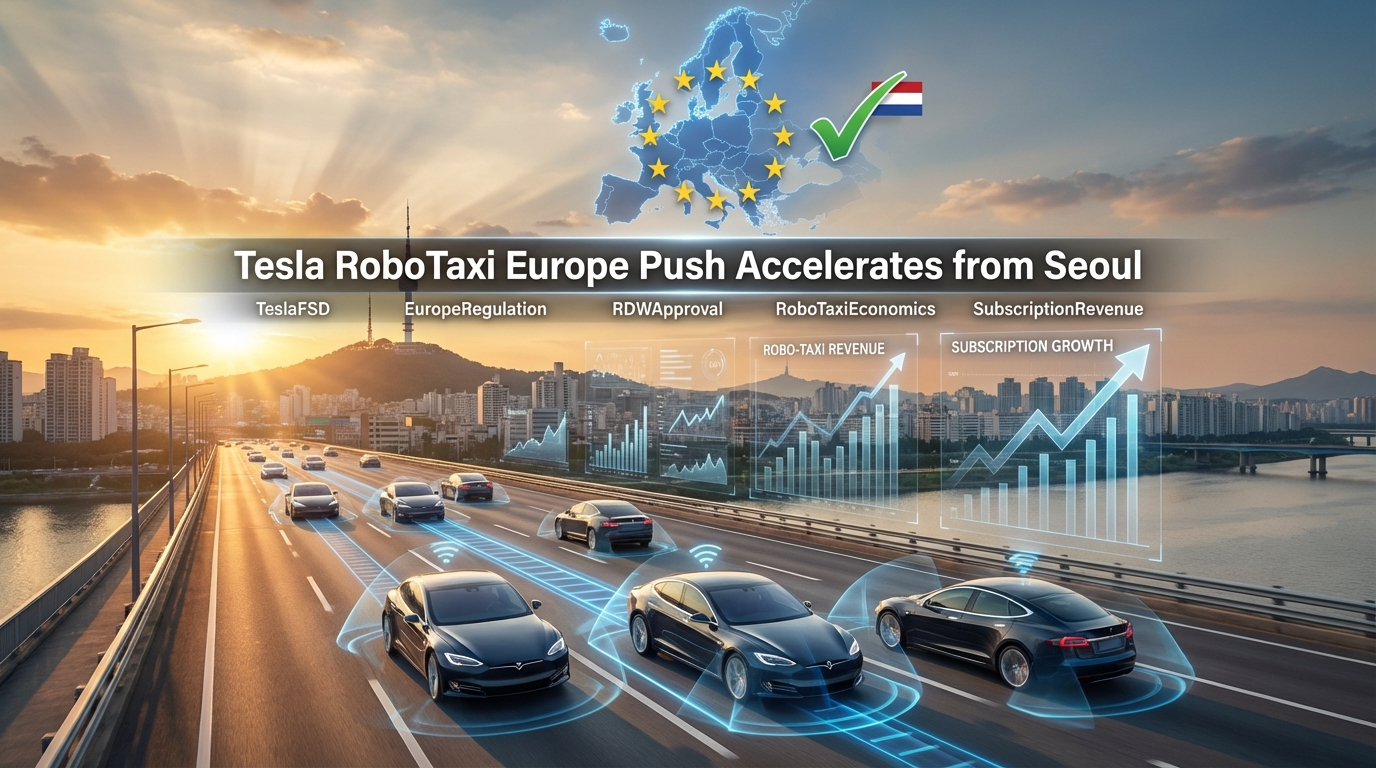
● Driverless Goldrush, RDW 2026 Tipping Point
FSD Stability Proven by Seoul, Europe Takes Action: A Comprehensive Overview of the 2026 RDW Variable and Robo-Taxi Economics
Today’s article covers FSD stability confirmed by on-site evaluations from conservative Korean media, the background behind Europe’s FSD rider-long pilot, the 2026 RDW approval variable, the true meaning of version 14.2.1, the economics of 2-seater robo-taxis demonstrated by Waymo ride data, and even how subscription-based software acts as a growth driver amid global economic and interest rate cycles.
The reason to read this now is that it is not merely a “technology demonstration” but rather a global turning point in which autonomous driving is transforming actual revenue models and regulatory frameworks.
News Briefing: Today’s Key Points at a Glance
In urban test drives in Korea, Tesla’s FSD was evaluated as “smooth, safe, and precise in maintaining speed limits and lane keeping.”
FSD v14.2.1 has been deployed to HW4 vehicles, and additional driver attention monitoring messages in low-visibility environments have been added to provide extra safety margins in preparation for mass rollout.
In Europe (Italy, France, Germany), FSD rider-long has commenced for the general public; although not an approval, it is interpreted as a trust-building step aimed at both the public and regulatory authorities.
According to Waymo’s public data, 90% of robo-taxi rides are for “2 or fewer passengers,” which supports the cost and supply speed efficiency of the 2-seater Cybercap strategy.
The 2026 approval process with the Dutch RDW is emerging as a turning point for European expansion, and the high margins from subscription-based software revenues could potentially reshape Tesla’s revenue structure.
Stability Confirmed in Seoul’s Cityscape: Why It Matters
The fact that a reporter from a conservative daily newspaper accompanied the test drive enhances its credibility.
The evaluation that it handled Seoul’s complex intersections, roundabouts, and underground parking lots steadily demonstrates the adaptability of vision-based AI rather than reliance on maps.
Expressions such as “smoother than a model taxi” and “more accurate than a novice driver” suggest that the model has been tuned with a defensive driving policy.
From a global economic perspective, the removal of negative stigma in Korea becomes an important reference in Asian data collection and policy discussions.
As evaluations accumulate in countries with high urban complexity, the risk premium in other regulatory jurisdictions will diminish.
FSD 14.2.1 Update: Conservative Tuning for Broad Rollout
The deployment has been limited to HW4 vehicles (the latest computing and camera-equipped models) to minimize performance variance.
Key aspects of version 14.2 – urban interpretation, entry and merging maneuvers, and speed adjustments – have been refined even more smoothly.
When camera visibility is low, additional driver attention monitoring messages have been added, which may increase warning frequency in rain, nighttime, and underground conditions.
This is interpreted as securing extra safety margins at the expense of inconvenience, serving as a preemptive measure for a “supervised mass rollout.”
Positive evaluations are accumulating in the US, Canada, Korea, and Australia; while the timeline for transitioning to unsupervised operation appears to be accelerating, alignment of regulatory and liability frameworks remains crucial.
The True Purpose of Europe’s “Rider-Long”: A Battle of Public Opinion and Data Before Approval
In Italy, France, and Germany, citizens experience actual driving firsthand from the front passenger seat.
Due to legal liability, Tesla employees hold the steering wheel, but the algorithm handles most situations on display.
Europe has a regulatory culture that prioritizes accountability and standards over simple benefits.
There is a strong psychological aspect aimed at securing experiential trust and altering the wording of risk assessments by regulatory bodies.
Given that the 2026 RDW decision could catalyze expansion across Europe, the current rollout of test experiences is an optimized social experiment prior to formal approval.
Regulatory Roadmap Checklist: RDW, UNECE, and Data
RDW (the Netherlands) holds significant influence in EU vehicle type approvals, and its endorsement facilitates smoother regional expansion.
Compliance with UNECE R157 (ALKS), R79 (lane keeping), cybersecurity and OTA standards, and GDPR is required to simultaneously meet data governance and liability/supervision frameworks.
Expansion of urban ALKS, strengthened driver monitoring, and transparency of Event Data Recorders (EDR) are key issues.
If Tesla preemptively demonstrates “risk-averse driving” and incident response protocols through citizen experiences, the regulatory risk premium will diminish.
The Numbers Behind Robo-Taxi Demand: Why 2-Seater Is the Answer
According to Waymo data, 71% of rides are for 1 person and 15% for 2 people, totaling 90% of rides for 2 or fewer passengers.
The fact that most demand can be met by small vehicle platforms is an overwhelming advantage in terms of cost, energy efficiency, and urban turnover rates.
Tesla’s 2-seater Cybercap strategy is a rational solution when considering manufacturing speed, CAPEX efficiency, and supply chain stability.
The remaining 9% of multi-passenger demand is absorbed by the existing 3/Y, forming a “dual portfolio” that simultaneously minimizes costs and maximizes coverage.
Business Model Impact: Subscription and Software Margins Reshape the Structure
Vehicle sales are sensitive to interest rates and inflation, but FSD subscriptions yield increasing operating leverage as the installed base grows.
Due to the nature of software, gross margins are typically estimated around 80%, and upon European approval, revenues will increase linearly as the product of “regional ARPU × number of vehicles × subscription rate.”
Although European urban areas have strong public transportation, the cost-effectiveness of robo-taxis resonates with price-sensitive demand for last-mile, nighttime, and suburban travel.
Even if vehicle financing costs fluctuate due to global economic changes and interest rate policies, software subscriptions evolve into a “defensive cash cow.”
The core of the AI trend is the “data network effect,” and as the data pool expands through test drives and rider-long experiences in each region, model performance and trust improve nonlinearly.
Global Map: Where and How Mature Are They?
North America is experiencing rapid expansion of supervised FSD and an explosion of user data.
Australia and New Zealand have favorable stability evaluations, and Korea is surpassing the trust threshold with positive reviews from conservative media.
Europe has entered the citizen experience phase, while in China only limited testing issues are observed.
Simultaneous maturity worldwide results in shorter model update cycles and enhanced capability to handle region-specific edge cases.
Key Points Other News Outlets Mention Less
- “Enhanced low-visibility warnings” are not merely inconveniences but a proactive response to European approval requirements.
- The 2-seater strategy represents a balance of the “cost-demand-regulation” trinity, simultaneously optimizing supply chain and CAPEX efficiency.
- The rider-long is not marketing but rather the collection of experiential data aimed at changing the wording in regulatory reports.
- With European approval, subscription revenues will serve as defensive cash flow during periods of sticky interest rates.
- The symbolism of the Seoul test drive is highly likely to be repurposed as a benchmark case in regulatory dialogues within Asia.
Short- and Medium-Term Timeline Observation Points
Short-term: Stabilization of 14.2.x and maintaining conservative warning and supervision policies, along with possible differentiation in regional guideline wording.
Medium-term: Expansion of cities participating in Europe’s rider-long and potential announcements of risk-sharing models with public institutions and insurance companies.
2026: Possibilities include pilot commercial subscription models before and after the RDW decision, limited robo-taxi operations in urban areas, and disclosure of data transparency frameworks.
Policy and Risk Checklist
- Regulations: Compliance with UNECE standards, GDPR data sovereignty, and clarification of accident liability allocation.
- Technology: Performance of vision models in adverse weather, failsafe measures in low-visibility conditions, and precision of driver monitoring.
- Economics: The impact of global economic slowdown, inflation, and changes in interest rate policies on vehicle sales and subscription conversion rates.
- Society: Public acceptance, insurance premium incentives, and complementary policies with public transportation.
< Summary >The urban test drive in Seoul demonstrated FSD’s smooth and safe driving, enhancing trust in Asia.
Version 14.2.1 features conservative safety tuning in anticipation of mass rollout, with the enhancement of low-visibility warnings as a key element.
Europe’s rider-long serves as a strategy to secure public opinion and collect data prior to approval, with the 2026 RDW decision marking a turning point.
Waymo ride data supports the economics of 2-seater robo-taxis, while Tesla optimally covers demand with its 2-seater + 3/Y portfolio.
Upon European approval, the high margins from subscription-based software could reshape Tesla’s revenue structure, becoming a defensive growth pillar even amidst global economic and interest rate fluctuations.
[Related Articles…]
*Source: [ 오늘의 테슬라 뉴스 ]
– 중앙일보까지 인정한 FSD… 서울에서 확인된 안정성, 이제 유럽이 본격적으로 움직인다!
● Tesla FSD Conquest, Spain Greenlights Robo-Vans, Starlink Cuts Costs
Tesla FSD Breaks Through European Regulations with ‘On-Site Experience’: Nationwide Approval in Spain, Robo-Van and Cyber-Cap Strategies, Waze Market Share Data, Korean Examples, and Synergies with SpaceX All in One
Tesla FSD has begun its ‘on-site experience’ in major European countries, with Spain approving testing nationwide.
Reasons behind preparing for the robo-van and the cyber-cap (focused on 2-passenger rides), the business model indicated by Waze’s market share data, FSD driving etiquette spotted in Korea, FSD v14’s logic allowing ‘text confirmation,’ Sweden’s Nakashi approval and union conflicts, and even the synergy with Starlink and SpaceX are all covered together.
Notably, the key points that are not well-addressed elsewhere include: Tesla’s “citizen experience → public opinion → regulatory change” playbook, the profitability structure of the robo-van, the expansion of dynamic DMS (driver monitoring system) into insurance/liability frameworks, Spain’s cost threshold in its framework, and the structure through which SpaceX-Starlink indirectly lowers FSD’s operating costs.
Breaking Through European Regulations: The Significance of the ‘Let People Try It’ Strategy
- In Italy, France, and Germany, Tesla employees take the driver’s seat while participants experience FSD performance from the passenger seat.
- The key is an approach that creates public opinion through citizen participation.
- It prioritizes firsthand experience over lobbying, exposing “the reality of the technology” simultaneously to the public and policymakers.
- Expected effect: Mitigate misunderstandings and fears, and promote a positive cycle where regulatory bodies bolster safety grounds with citizen-derived experience data.
- Side effect: Enrich road environment data in Europe and validate privacy and mapping data compliance models on-site.
- Risk management: Ensured safety through measures such as employee accompaniment, restricted courses, and real-time log data collection.
Nationwide FSD Test Approval in Spain: A Shift in Regulatory Framework
- Spain has updated its autonomous driving test approval system to allow simultaneous testing of multiple vehicles (10 or more) nationwide.
- The requirement for an in-car safety driver has shifted to an ‘optional’ status, while remote monitoring personnel are now mandatory.
- This signals the formal incorporation of a remote control model akin to robo-taxis into the regulatory framework, serving as a bridge to a phase that fundamentally lowers cost structures by eliminating safety personnel.
- Currently, Tesla is reported to have received approvals for 19 test vehicles.
- Implication: Spain is likely to become the fastest regulatory hub for the commercialization of robo-taxis in Europe.
Why ‘Robo-Van’: Demand Structure Revealed by the Data
- According to rideshare data from Waze, 90% of rides involve two or fewer passengers.
- There are even cases of zero-passenger (unmanned delivery), confirming the structurally high demand for ‘logistics and last-mile’ services.
- Thus, Tesla is adopting a phased strategy: first deploying a cyber-cap (robo-taxi) centered on 2-passenger demand, and then expanding into a robo-van for mass transit and delivery with multi-passenger capability.
- Robo-Van key points:
- It rapidly dilutes fixed costs per unit with a low labor cost structure (predicated on automation) and high utilization rates.
- It maximizes kWh productivity through optimization for last-mile, night-time, and multi-stop grouped delivery.
- It allows for CAPEX recovery through shared battery packs and modular platform designs.
- Combined with FSD, Dojo, and FleetOS, dynamic routing enhances ‘maintenance cost competitiveness.’
Cyber-Cap (2-Passenger) First, Then Robo-Van: The Equation of Unit Cost and Market Share
- The cyber-cap is expected to enter production in April next year, directly addressing the data showing that 90% of the demand is for two or fewer passengers.
- The 2-passenger model is advantageous in terms of vehicle size, cost, and energy efficiency, making it ideal for quickly securing initial market share.
- Afterwards, expanding into robo-vans can cover not only mass transit alternatives but also logistics, dramatically enlarging the overall addressable market.
- Strategic effect: A flywheel of lower unit cost → rapid diffusion → extensive data accumulation → performance improvement → strengthened regulatory trust is generated.
Waze vs Tesla: Market Share and Cost Structure
- In San Francisco, Waze reportedly captured about 10% market share approximately two and a half years after launching its service.
- Industry estimates suggest that Tesla’s vehicle manufacturing costs and operating expenses could be significantly lower than competitors due to its dedicated vehicle structure and in-house manufacturing capabilities.
- Assumption: If eliminating safety drivers and allowing remote monitoring for multiple vehicles are permitted, the cost per driving km could gradually decrease, leading to a virtuous cycle of price cuts → increased demand → accelerated market share.
- Conclusion: If Waze’s 10% represents a ‘floor data,’ Tesla’s scenario of high market share in Europe and the U.S. becomes more realistic once regulatory compliance is secured.
- However, since each city is different and the speeds of regulatory, insurance, and infrastructure implementations vary, regional volatility must be taken into account.
FSD in Korea: ‘Driving Like a Human Among Humans’ Observed on Real Roads
- Videos shared by domestic users show numerous instances where complex scenarios such as recognizing hand signals, yielding to pedestrians, and close-proximity driving with large vehicles are smoothly handled.
- Interactions like “the machine stops first and the person nods in acknowledgment” signal positive indicators in terms of safety and driving etiquette.
- From a regulatory standpoint, while full unmanned (Level 4) commercialization requires further institutional reforms, it is significant that productivity benefits are already being realized in the supervised advanced mode.
FSD v14’s ‘Text Confirmation’ Permission: The Next Step Indicated by Dynamic DMS
- In the latest version, the allowance for a driver to look at their phone while driving varies depending on the driving context.
- For example: In high-risk situations such as parking lots or complex intersections, an immediate warning is issued, while in simple driving segments, merely checking a text is permitted, demonstrating dynamic management.
- This transitional logic reduces the ‘burden on the driver’ while maintaining safety, and can serve as the basis for designing future insurance and liability frameworks (determining who is responsible and when).
- Some speculate that v15 could further ease the requirement for driver intervention; however, this assumption will depend on future regulatory approvals and performance data.
Sweden’s Nakashi Approval and Union Conflicts: Dual Signals of Local Variables
- Sweden’s Nakashi has approved Tesla’s application for FSD testing in urban areas.
- Meanwhile, prolonged conflicts with local unions persist, with reports emerging about issues related to license plate deliveries and mail services.
- Interpretation: The simultaneous progression of regulatory (local government) technical testing approvals and labor issues on a parallel track could act as constants in the European expansion process.
- Companies must build public safety credibility while separately managing local labor and supply chain challenges.
Starlink’s Humanity and SpaceX’s Cost Innovation: The Invisible Connection with FSD
- Starlink has provided free services in regions affected by natural disasters, with recent cases contributing to mitigation efforts such as during the Indonesian floods.
- In terms of payload, SpaceX has secured overwhelming logistics competitiveness with reusable launch vehicles, continually updating records such as the 30 successful reuses of the same first-stage booster.
- Implication: The decrease in unit costs of low Earth orbit communication networks reduces the costs of mapping, OTA, and V2X data distribution, indirectly lowering the operating costs of autonomous driving.
- With increased launch frequency, improved global data backhaul and latency, and enhanced real-time communication between vehicles and the cloud, a ‘digital transformation’ flywheel is activated.
Macroeconomic Impact: Productivity Shock, Alleviated Inflation Pressures, and Implications for Interest Rate Trajectories
- Autonomous robo-taxis and robo-vans structurally reduce mobility and logistics costs, thereby lowering service prices.
- The deflation of unit costs in mobility and delivery creates downward pressure on the ‘perceived price level’ and can help lower long-term inflation expectations.
- As working hours are redistributed and overall urban fluidity increases, productivity in the service sector rises, potentially positively impacting the global economy’s potential growth rate.
- From a policy perspective, since there will be gaps until safety, insurance, and liability systems are fully established, the combination of interest rates and regulations is likely to evolve asymmetrically between regions.
- Investment perspective:
- Short term (3–6 months): Accelerated data accumulation centered around European experiential events and Spain, leading to public opinion and pilot expansion.
- Mid term (6–12 months): Initial mass production and urban pilot testing of the 2-passenger cyber-cap, with observation of declining operating cost trends.
- Long term (12–24 months): Pilot operations of the robo-van, penetration into supplementary markets for last-mile and public transit, and accompanying innovations in insurance and financial products.
The 5 Most Critical Points Often Overlooked Elsewhere
- The “European playbook” of citizen experience → public opinion formation → regulatory change represents a strategic asset that can be exported between countries.
- The robo-van is not merely an adjunct to the robo-taxi; it represents the ‘core revenue axis’ created by the 0–2 passenger demand structure. Last-mile, night-time, and multi-drop operations are the key margin segments.
- Dynamic DMS, beyond being a safety feature, could evolve into a ‘risk pricing engine’ that automates future insurance premium and liability segmentation.
- The Spanish framework establishes a constant in remote monitoring that paves the way for the elimination of in-car safety driver costs, expediting the breakeven (BEP) achievement for each city.
- SpaceX-Starlink serves as the backend that continuously drives down the total cost of ownership (TCO) per vehicle through hidden COGS reductions (data, synchronization, map updates).
Checklist by the Numbers
- Europe: Number of cities hosting experience events, test drive counts, citizen satisfaction indicators, and frequency of queries/responses with regulatory bodies.
- Spain: Number of approved test cities, number of vehicles operating simultaneously, ratio of remote monitoring personnel per vehicle, and accident/intervention indicators.
- Costs: Electricity cost per km, insurance cost per vehicle, maintenance cycle, and vehicle utilization rate.
- Demand: Proportion of calls with two or fewer passengers, proportion of unmanned deliveries, and elasticity during peak/off-peak hours.
- Macroeconomics: Mobility and delivery price indices, urban congestion levels, productivity in the service sector, and changes in inflationary contributions.
Cautions and Outlook
- Some schedules, performance targets, and levels of automation may vary depending on regulatory approval, real-road data, and assessments from the insurance industry.
- Given the significant differences in road standards, culture, and labor issues between cities, the pace of commercialization is likely to progress in a ‘stepwise’ manner by region.
- Nevertheless, the simultaneous movement of the regulatory framework (Spain) and citizen experiences (in three European countries) marks the core highlight of the current phase.
- Citizen participation events for FSD have started in three European countries, and Spain has approved a nationwide test framework.
- The expansion from a 2-passenger cyber-cap to a robo-van is a cost and demand optimization strategy based on Waze data (90% for two or fewer passengers).
- FSD v14’s dynamic DMS serves as a transitional solution for safety and liability distribution, heralding innovations in operating and insurance cost structures.
- Sweden’s Nakashi approval and union conflicts reflect concurrent management of ‘technology-labor’ issues.
- The cost innovations from Starlink and SpaceX indirectly lower the backend costs of FSD, contributing to long-term productivity improvements and inflation mitigation.
[Related Articles…]
- How Tesla’s Robo-Taxi Is Changing Mobility Economics
- Changes in the European Regulatory Landscape Following Spain’s FSD Approval
*Source: [ 허니잼의 테슬라와 일론 ]
– [테슬라] 유럽 FSD 경험한다! 스페인은 ‘FSD 승인’! 독특한 유럽 규제 돌파 전략 / “로보밴”도 온다!!
● Shopify’s Checkout Coup, Amazon on Edge
The Next ‘Absolute Infrastructure’ Contender After Amazon: Shopify’s Real Power and a Comprehensive 2025 Strategy Overview
This article covers everything from Amazon’s and Shopify’s distinct infrastructure strategies, a revenue model that gains as transaction volumes increase, commerce operations transformed by AI, a roadmap for European and B2B expansion, to key metrics from an investor’s perspective.
It provides an in-depth exploration of less commonly discussed topics such as the “checkout network effect,” the “app ecosystem revenue structure,” and the “advertising and data network.”
It is designed to help you understand the 2025 version of Shopify’s strategy by connecting it to major keywords like global economic outlook, interest rates, inflation, digital transformation, and artificial intelligence.
Headline Briefing
Key Point 1) Shopify has evolved from merely being a “store creation tool” to establishing itself as a commerce OS that integrates payments, logistics, marketing, and offline POS.
Key Point 2) The model lays a revenue floor with subscriptions and gears up revenue growth through Merchant Solutions that add fees as transaction volumes increase.
Key Point 3) AI tools such as “Shopify Magic” and the operational assistant “Sidekick” automate product page creation, design, demand forecasting, and price optimization.
Key Point 4) The “checkout network,” centered on Shop Pay and the Shop App, not only drives conversion rates but also extends into data-driven advertising and finance.
Key Point 5) The risks include intensified competition, rising transaction-based costs, dependency on small business owners, and AI investment expenses.
Why is Shopify Regaining Attention Now?
The accelerated shift to omni-channel, where offline and online are tied together in real time, directly translates into the demand for a standardized commerce OS.
As expectations grow that interest rates and inflation are past their peaks, both entrepreneurship and consumer spending are revitalized, leading to more resilient transaction volumes.
While Amazon is a “marketplace,” Shopify leaves “asset-rich brands and data” in the hands of sellers.
With its expansion into DTC brands, major retail companies, and B2B, its positioning has shifted to that of a “commerce infrastructure.”
Dissecting the Business Model: Dual Engines of Subscription and Transaction-Based Revenue
Subscriptions (monthly fees) provide themes, inventory and order management, basic analytics, and access to the app store, creating a predictable revenue floor.
Merchant Solutions—incorporating payments (Shopify Payments/Shop Pay), currency exchange, shipping integrations, offline POS, BNPL, finance, and advertising—automatically boost revenue as transactions increase.
The app store fosters a developer ecosystem and generates revenue through marketplace fees and payment integrations.
The key is the structural alignment where “seller growth = Shopify growth.”
AI Transformation: The Real Impact of Operational Automation
Shopify Magic: Automatically generates product descriptions, images, email copy, and collection pages in seconds.
AI Design Assist: Enhances launch speed by recommending layouts, colors, and sections while maintaining brand tone.
Sidekick (the operational assistant): Answers questions like “Why did the return rate increase last month?” using data, and suggests pricing and promotions.
Agentic Commerce: Connected via API with external shopping bots, a request such as “Recommend straight-fit jeans” quickly gets converted into traffic and orders for a Shopify store.
Checkout Network: The Real Momentum Overlooked by Others
Shop Pay enables one to two-click payments using stored payment and address data, significantly boosting conversion rates compared to standard checkout procedures.
The Shop App acts as a hub that consolidates purchase history, delivery tracking, and reordering to foster repeat purchases.
As this identity and payment network grows, the precision of advertising targeting (Shopify Audiences) and finance (Shopify Capital) improves, thereby strengthening the entire pipeline.
Omni-Channel and Global Expansion
POS Go and Tap to Pay enable real-time synchronization of offline sales and online inventory, even covering pop-up stores and event sales.
With Markets/Markets Pro, customs duties, VAT, local currencies, and local payments are automated, simplifying cross-border sales in Europe and Asia.
B2B functionalities provide price lists, payment terms, and a quotation/order portal to support the expansion of wholesale sales.
Payments, Finance, and Advertising: Diversifying Infrastructure Revenue
Shopify Payments generates revenue through transaction fees, currency exchange, and add-on services, and secures global coverage via partner payment networks (e.g., based on Stripe).
Shop Pay Installments offers BNPL options and distributes risk management with partners to ensure scalability.
Shopify Capital accelerates store growth and generates revenue by providing revenue data-based upfront financing.
Shopify Audiences defends against rising advertising CAC by improving performance through privacy-compliant, cohort-based methodologies.
Logistics: Enhancing Efficiency with an Asset-Light Strategy
It maintains a light fulfillment asset approach while focusing on orchestration that integrates 3PL partners, label, and returns solutions.
The key is standardizing the experience—managing everything from last-mile selection, costs, to promised delivery dates—through the store dashboard.
Current Figures (Based on Q3 2025, Outlook)
Revenue continues to grow at double-digit year-over-year rates, with transaction-based revenue predominating.
Gross Merchandise Volume (GMV) has expanded steadily, reflecting seasonal trends and promotional effects compared to the first half of the year.
Shopify Payments penetration has increased alongside the expansion of medium to large stores, strengthening fee leverage.
Cash flow remains positive and is being reinvested in AI, international expansion, and B2B initiatives.
Competitive Landscape: Amazon, BigCommerce, and In-House Solutions
Amazon has strengths in traffic and logistics, but its control over brand data and customer ownership is limited.
Shopify differentiates itself by enabling stores to own their assets and build long-term LTV.
Despite coexistence issues with Buy with Prime, Shop Pay competes on conversion rates even on external stores, expanding the network.
It holds advantages over platforms like BigCommerce, Wix, and Salesforce Commerce Cloud in terms of the breadth of the app ecosystem, checkout conversion rates, and POS integration.
Case Snapshots
Brands such as Skims, Sephora, and Charlotte Tilbury have adopted Shopify for online-offline inventory synchronization and global DTC expansion.
With every new store opening, subscription fees, online payment fees, and offline POS sales occur concurrently, demonstrating a structural leveraging effect.
Risk Assessment
Expanding transaction-based services comes with increased processing costs, which can enhance margin volatility.
The entry of Amazon, Apple Pay, and various payment/commerce startups intensifies the pressure for service differentiation.
An ecosystem centered around small businesses is sensitive to economic slowdowns, inflation, and changes in interest rates.
Investments in AI and the advancement of data infrastructure will entail short-term cost increases.
Investment Checkpoints (7 Actionable Points)
1) Trends in Shopify Payments penetration and the pace of Shop Pay adoption outside of Shopify.
2) The direction of the take rate relative to GMV growth.
3) Actual usage rates of AI features and productivity improvement metrics per store.
4) Changes in the proportion of cross-border sales in Europe and Asia.
5) Adoption rates of B2B functionalities and whether the average transaction value is rising.
6) Improvements in advertising and Audiences performance, and the impact on reducing CAC.
7) The balance between reinvestment and profitability as reflected in cash flow/operating margins.
Core Points Rarely Discussed Elsewhere
Checkout Network Effect: The Shop App and Shop Pay essentially establish a “commerce login” standard, simultaneously boosting repeat purchases and advertising efficiency.
App Store Economics: As the app basket per store expands, ancillary revenue from subscriptions and payment integration increases synergistically.
Data Advantage in the Privacy Era: Proprietary payment and purchase data serve as a crucial asset for advertising and financial precision in an environment of third-party cookie deprecation.
Agentic Commerce Turning Point: Once large language model shopping bots become a standard interface, traffic will gravitate toward the platform that sets the API standard first.
Outlook for 2025-2026: Scenarios
If a gradual interest rate cut materializes, GMV could become more resilient due to a resurgence in entrepreneurship and a rebound in high-priced categories.
Stabilization of inflation and normalization of logistics costs may improve store margins, thereby enabling greater investment in advertising and expansion.
The full-scale commercialization of AI agents has immense potential to not only automate customer support and merchandising, but also transform the speed of new product launches.
One-Line Guide: Who Benefits the Most
DTC and omni-retailers who focus on building brand equity and LTV, medium to large stores aiming for global expansion, and businesses involved in both B2B and B2C stand to benefit the most.
Checklist: Practical Application Tips
Prioritize the adoption of Shop Pay and Tap to Pay to boost conversion rates and offline retrieval.
Use AI Magic to reduce product content creation time and automate routine A/B testing.
Leverage Markets Pro to automate European taxes and customs duties, thereby shortening the cross-border launch lead time.
Utilize Audiences to invest strategically in high-intent segments and protect CAC.
Open up B2B price lists and payment terms to build a multi-engine approach between retail and wholesale.
Conclusion
Shopify is not merely a store creation tool, but a commerce infrastructure unified by payments, data, and AI.
Despite macro volatility, there is potential for multiple re-rating in segments where the checkout network, AI automation, and global/B2B expansion operate simultaneously.
< Summary >
Shopify is a commerce OS comprised of subscription and transaction-based revenues, with a Shop Pay‑centric checkout network creating a competitive edge in conversion and data.
AI tools like Magic and Sidekick automate operations, while POS, Markets, and B2B expand channels and regions.
Although risks include intensifying competition, variable cost structures, economic sensitivity, and AI investment expenses, network effects and data assets underpin long‑term value.
Key investment and operational pointers include Payments penetration, take rate, AI utilization, cross‑border/B2B growth, and improvements in advertising efficiency.
[Related Articles…]
The Conversion Advantage Created by Shopify’s Checkout Network
The 2026 Commerce Operations Scenario Transformed by AI Agents
*Source: [ Maeil Business Newspaper ]
– [어바웃 뉴욕] 요즘 시대 절대 인프라 “아마존 다음은 쇼피파이?” | 길금희 특파원