● Google’s AI Revolution Titan of Tech, Game Changer
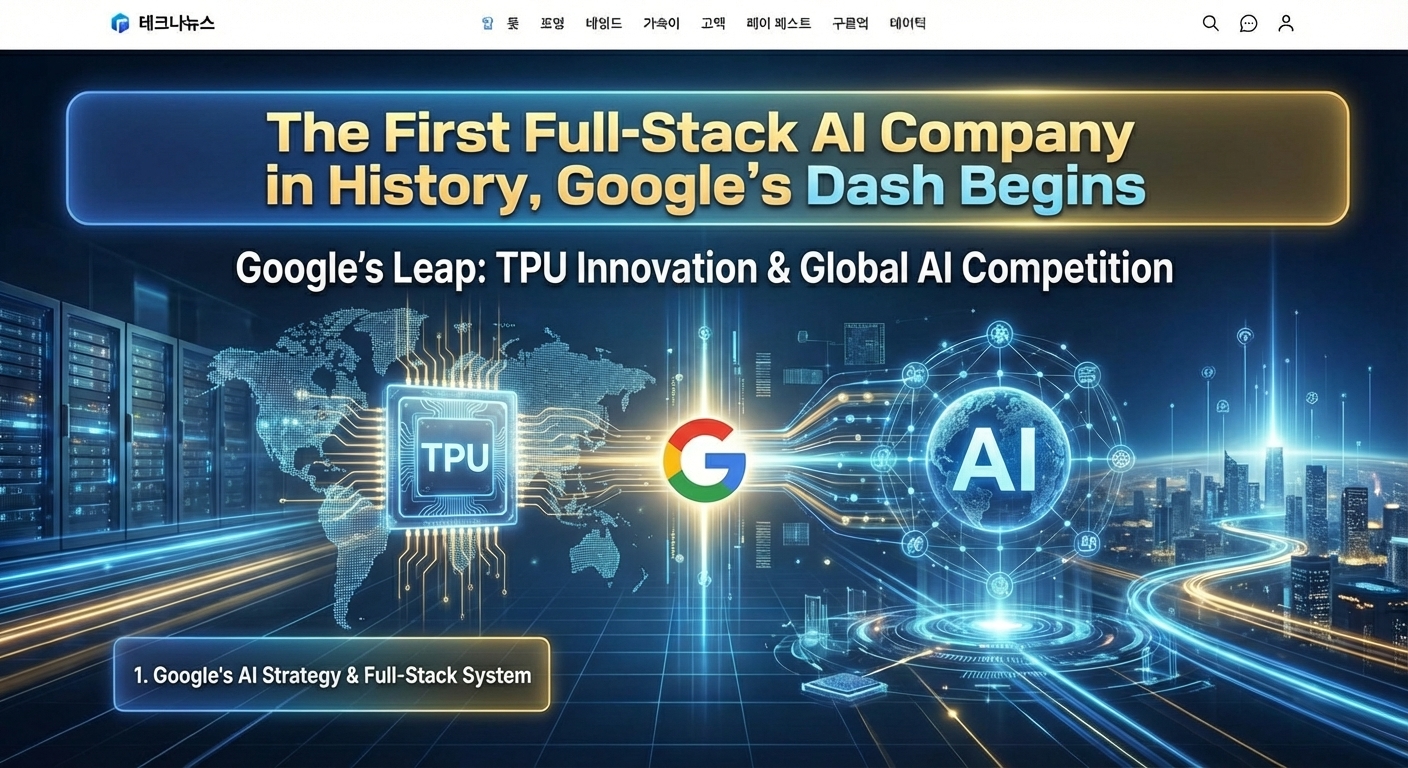
Google, First Full-Stack AI Company: TPU Innovation and Global Competitive Landscape
1. Google’s AI Innovation Strategy and Full-Stack System Development
Google’s latest AI technology, Gemini 3.0, showcases remarkable performance, marking Google’s leap into the history books as the first full-stack AI company that encompasses hardware, software, cloud, and AI apps.
The new product demonstrates superior performance compared to existing GPT and other AI models, resulting from Google’s maximization of AI model computation speed through its own developed TPU (Tensor Processing Unit).
Google has been building a competitive innovation ecosystem by integrating AI accelerators, cloud, foundation models, and AI apps, all of which are key to AI technology advancement.
This integrated strategy is expected to break down the barriers that traditional semiconductor, software, and cloud companies have operated under separately, resulting in overwhelming advantages in cost efficiency and performance.
2. Cutting-Edge TPU Technology and the Ironwood Generation
Since its unveiling in 2016, Google’s TPU has seen significant performance upgrades with each version.
The recently adopted seventh-generation accelerator, “Ironwood,” for Gemini 3.0 boasts a computational speed of 4.6 petaflops and is equipped with 192GB HBM3 memory, showcasing performance on par with Nvidia’s latest accelerators.
Google has begun to sell its self-developed TPU to external customers, marking an important innovation point that companies like Meta and Anthropic have already shown interest in.
In particular, solving the GPU supply shortage and the potential for cost savings of 40% to 80% compared to Nvidia GPUs are significant advantages from both AI technology and economic outlook perspectives.
3. Global AI Competitive Landscape and Rivalry with Nvidia
With the introduction of Google’s TPU technology, the competitive landscape within the AI ecosystem is reshaping between Google and Nvidia.
While Nvidia has long maintained a GPU-based AI model training method, the adoption of Google’s proprietary chips and TPU extends beyond mere individual chip performance competition to strengthen competitiveness across the entire AI value chain.
Google is innovating in AI models, recruitment, and app software, maximizing application and cost efficiency in large data centers, positioning itself to vie for the top spot in the global AI market.
However, the long-term competitive dynamics between Nvidia’s CUDA ecosystem and existing AI platforms are predicted to see both parties maintaining their respective strengths in competition for the time being.
4. Connection to the Economy and the Fourth Industrial Revolution
Google’s expansion of TPU technology is not limited to mere technological innovation.
It is expected to draw a significant line in the global economy and the ongoing Fourth Industrial Revolution.
Cost efficiency, cloud transition, and large-scale data centers based on AI technology can act as pivotal factors that dramatically improve corporate productivity and operational efficiency.
Moreover, these technological changes are set to establish new standards for future investments, economic growth models, and global AI competition.
5. Key Points for Readers to Focus On
Google’s leap to becoming a full-stack AI company represents a turning point that alters innovation and competitive dynamics across the entire AI ecosystem.
• Cutting-edge technology of the TPU as an AI accelerator and the introduction of the Ironwood generation lead the way in innovation in cost and performance.
• Google has implemented an integrated strategy covering hardware, software, cloud, and AI apps, previously unseen in the industry.
• The competition with Nvidia is expected to have significant repercussions on the advancement of AI technology and global economic outlook.
• The commencement of external sales of Google’s TPU makes major players like Meta and Anthropic consider new options for AI hardware.
• These changes will have a direct impact on the era of the Fourth Industrial Revolution and shifts in the global economy, marking key elements to closely watch in the fields of AI technology and economic outlook.
Summary
Google has reborn as the first full-stack AI company with the introduction of Gemini 3.0 and the latest TPU technology “Ironwood,” achieving integrated innovation from hardware to software, cloud, and AI apps. This technology is set to reshape the competitive landscape with Nvidia and act as an essential variable in the global economy and Fourth Industrial Revolution era.
[Related Articles…]
Google, The Future of TPU Innovation
AI Technology Development and Global Economic Change
*Source: [ 티타임즈TV ]
– 역사상 첫 풀스택 AI 기업, 구글의 질주가 시작된다
● Retirement Rebellion Midlife Survival in the Age of AI
Preparation for Middle Age, Retirement Extension, and Coping with the AI Era – Economic Forecast and Key Insights of the Fourth Industrial Revolution
Socioeconomic Changes Induced by Retirement Extension
The economy and retirement extension are not merely age-related issues, but they are changing the entire paradigm of our lives.
Today, the retirement age of 65 has emerged as an important task that requires preparation for middle age alongside changes in the industrial landscape.
As economic forecasting experts analyze, retirement extension impacts not only the stable supply of monthly income but also family structures, the timing of children’s employment and marriage, and overall social dynamics.
Moreover, the increase in consumption, rising medical costs, and physical decline that the middle-aged will experience will act as sensitive economic variables.
New Challenges and Opportunities Brought by the Fourth Industrial Revolution and AI Trends
The core of the Fourth Industrial Revolution, AI trends, is revolutionizing existing industrial structures and creating productivity gaps.
The emergence of generative AI tools like ChatGPT presents new work methods and efficiency demands, posing a challenge to the middle-aged to “learn, even if it’s late.”
From the perspective of economic forecasting, the use of AI has become a key factor in enhancing individual competitiveness.
In particular, acquiring new skills and deepening existing experience for those over middle age are emphasized as vital survival strategies for the future.
Furthermore, the advancement of the Fourth Industrial Revolution coincides with the retirement age extension, signaling a restructuring of the labor market.
Essential Elements for Middle Age Preparation – Physical Health, Financial Management, and Continuous Learning
Experts in economic forecasting highlight three key elements for preparing for middle age.
First, physical health.
As one can attest from experience, maintaining physical fitness and managing health is essential to face retirement extension, differently from youth.
Second, financial and consumption management.
Thorough financial planning is needed to prepare for the additional living expenses and medical costs that come with retirement extension.
Third, continuous learning.
As developments in AI and the Fourth Industrial Revolution make it difficult to cope with existing knowledge alone, adopting the mindset of “learn, even if it’s late” is necessary to acquire new technologies and knowledge.
Physical Health, Well-Being, and Organization – Survival Strategies for the Future
Preparation for middle age involves not only economic aspects but also the management of physical and mental health.
Especially, physical fitness and health must be secured as the foundation for survival in a social system characterized by retirement extension.
Moreover, the concept of organizing goes beyond merely tidying up belongings; it is a process that enhances mental well-being and a sense of accomplishment in daily life.
Through organization, we can reassess our capabilities and experiences and create opportunities for self-reflection through new relationships with unfamiliar individuals.
Retirement Preparation and Self-Improvement – Coexistence with AI and Creating New Careers
With the changes brought by retirement extension, middle-aged individuals are faced with the challenge of preparing for second and third careers.
This change is an inevitable phenomenon following economic forecasts and the trajectory of the Fourth Industrial Revolution, where AI trends and technology acquisition become core competitive elements.
Based on new learning and experiences, various options such as career transitions, part-time work, or even entrepreneurship are becoming available.
In particular, strategies that leverage existing expertise and harness AI and digital literacy will significantly enhance the future value of middle-aged individuals.
[Related Articles…]The Societal Changes Brought by Retirement Extension
Survival Strategies for the Middle-Aged in the Era of AI Innovation
*Source: [ 지식인사이드 ]
– 중년은 기승전 ‘이것’ 입니다. 노후를 바꿀 중년의 준비물ㅣ지식인초대석 EP.84 (이호선 교수 2부)
● Economic Turmoil Sparks Market Chaos
Impact of AI Observability on the Overall Economy – Key Strategies of Decision Tracking, Behavior Monitoring, and Outcome Alignment
Key Points of AI Observability
When AI agents autonomously think and make decisions, observability technologies to trace and manage unexpected ‘rogue’ behaviors become essential.
This article elaborates on the three important pillars of AI Observability: decision tracking, behavior monitoring, and outcome alignment, and explores how they impact global economics and the AI trends in the Fourth Industrial Revolution.
In particular, it focuses on the transparency and reliability that this technology provides in risk management, market trend forecasting, and investment strategy development across the economy.
Additionally, it offers specific information on detailed logs of decision-making processes and methods for re-analyzing the behavior patterns of AI agents that are not covered by other media.
1. Decision Tracking: The Key to Transparent AI Decision-Making
The decision tracking function, which records the decisions made by AI agents from start to finish, includes
- Capturing input and initial context information
- Step-by-step logging of the intermediate decision-making process
- Compiling the entire timeline leading to the outcomes
This process provides clear evidence of decision-making factors when setting economic forecasts and investment strategies amid uncertainties in the global economy, contributing to financial stability and market trend analysis.
2. Behavior Monitoring: AI Pattern Analysis and Anomaly Detection
Behavior monitoring checks the internal state and reasoning process of AI agents in real-time, allowing for
- Detection of repetitive loops and potential anomalous behaviors in the algorithms
- Analysis of unintended behavioral patterns and risk assessment
- Identification of improvement points through real-time feedback
which enables quick responses in case of anomalies.
This plays a significant role in promoting overall economic growth and market stability, as well as facilitating sophisticated AI system operations in the Fourth Industrial Revolution.
3. Outcome Alignment: Evaluating Consistency Between AI Results and Intentions
Outcome alignment verifies how well the results derived by AI agents match the initial inputs and intended objectives.
- Analyzing correlations between inputs and results
- Assessing alignment with intentions
- Providing feedback and adjustments to agent behaviors if necessary
Through this process, a foundation for transparent and reliable AI operations is established, which is crucial data for investment strategy and economic forecasting.
4. The Connection Between Observability and the Overall Economy
The detailed technology of Observability goes beyond simple monitoring,
- Contributing to ensuring economic stability and managing financial market risks
- Increasing the precision of global economic and market trend forecasts
- Supporting effective investment strategy development
- Contributing to the creation of innovative business models and AI trends in the Fourth Industrial Revolution
which are positioned as foundational technologies for key economic-related SEO keywords such as global economy, economic forecast, market trends, and investment strategies.
In particular, AI Observability plays a critical role in preventing sudden errors or unpredictable behaviors in production environments, thereby enhancing system reliability and reinforcing market stability.
5. Additional Tips for Readers: Distinguishing Observability from Traditional Monitoring
There are significant differences between Observability and traditional monitoring.
- Traditional monitoring: Focuses on key signals like CPU load, token count, and error rates
- Observability: Records all data as structured events, including the decision-making process of AI, the context of behaviors, and outcome alignment
This distinction greatly aids in ensuring transparency in AI-based systems and enables rapid root cause analysis when issues arise.
Moreover, this technology is a key element that must be understood in the context of AI use cases and risk management for future economic forecasts.
Through this in-depth analysis from various perspectives, readers will find it easier to understand the intricacies of complex AI systems.
[Related Articles…]Future of Economic ForecastingAI Technology Innovation
*Source: [ IBM Technology ]
– Rogue AI Agents: How AI Observability Builds Autonomous Trust