● Krugman Bombshell, Bitcoin Trump Trade Implosion
Krugman’s ‘Bitcoin = Trump Trade’ Debate Summary: A Comprehensive Read on Approval Decline, Regulatory Premium, and Macro (Inflation, Interest Rates, Dollar, Liquidity)
News-style overview with only the key points, including the regulatory premium mechanism that actually influences the price, a checklist, and even quantitative indicators not mentioned elsewhere.
The debate over the concomitance of Bitcoin and Trump’s approval ratings, the power of ETF funds and liquidity, the direction of inflation, interest rates, the dollar, on-chain/microstructure indicators, and election-policy risk scenarios — all are included.
1) News Summary: ‘Trump Trade’ vs ‘Macro’
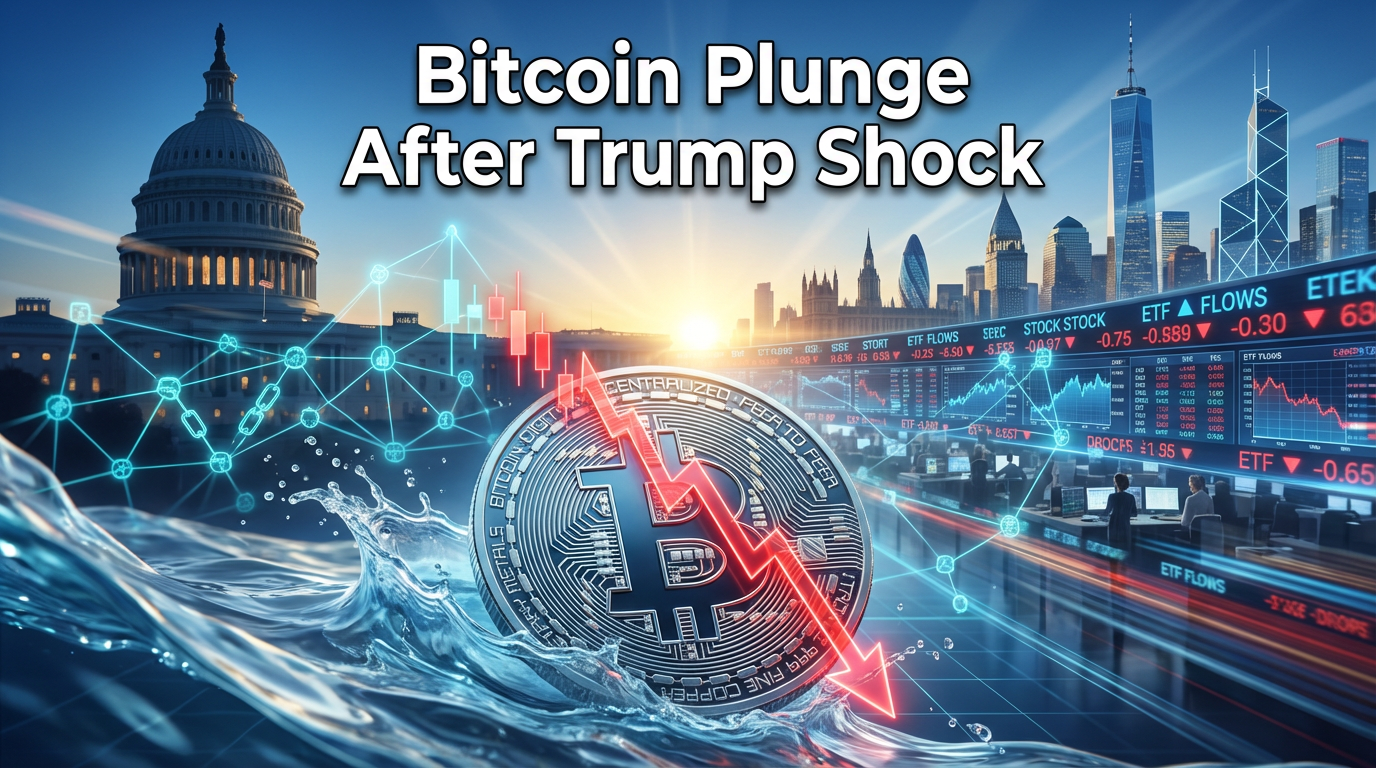
Paul Krugman recently defined Bitcoin’s price in his column as “largely a Trump trade.”
According to the original article, a recent survey suggested that as Trump’s net approval declined, Bitcoin adjustments followed suit.
The logic is simple.
When re-election prospects are strong, expectations of regulatory easing create a premium, and when approval ratings waver, that premium turns into a discount.
However, Bitcoin is more influenced by macro factors such as halving events, global liquidity, interest rates, and ETF funds.
In conclusion, Bitcoin has become an asset influenced by both “policy expectations” and the “macro environment.”
2) Data Check: The ‘True’ Correlation Between Approval Ratings and Price is Limited
In the short term, Trump-related headlines and price fluctuations may appear to coincide.
However, the correlation is sensitive to timing and samples, and other factors (interest rates, the dollar, risk asset appetite) often provide greater explanatory power.
Therefore, simplistic interpretations like “political headlines → immediate direction” carry significant risk.
When assessing market reactions, one should consider the “overreaction/underreaction” of prices relative to the news.
3) The Mechanism Behind the Creation of Regulatory Premium/Discount
The pathways through which policy expectations are transmitted to prices are as follows.
- Regulatory Direction Signals: Appointments in the White House, Congress, SEC/CFTC, progress/delays in cryptocurrency legislation (e.g., digital asset market structure).
- Market Accessibility: Approval and fund inflows of spot ETFs, smooth bank-exchange onramps, and the extent of KYC enhancements.
- Enforcement Intensity: News of sanctions/settlements against stablecoin issuers and exchanges.
- Taxation Issues: Strengthening of transaction taxes and reporting requirements reduces turnover, burdening prices.
If expectations are favorable, lower transaction costs and uncertainty increase the multiple; if unfavorable, a discount is applied.
4) The Macro Forces That Truly Impact Price: Inflation, Interest Rates, Dollar, Liquidity
Moderating inflation and expectations of lower interest rates encourage a broad multiple expansion across risk assets.
A strong dollar tends to absorb global liquidity, weakening Bitcoin demand.
An increase in real interest rates (10-year TIPS) puts pressure on non-yielding assets.
ETF fund inflows and outflows directly influence daily supply and demand.
When risk appetite in the U.S. stock market increases, crypto beta tends to rise alongside.
5) On-Chain, Mining, and Microstructure: Detailed Variables Determining Price Elasticity
Hash rate and miner selling pressure: During periods of declining hash prices, non-neutral selling from miners increases, capping the upside.
Funding rate/futures basis: Overheating can pose a correction risk, while a shift to negative may leave room for a short-cover rally.
Option skew/IV: A larger downside put premium weakens shock absorption, and widened IV can quickly contract after an event.
Net issuance of stablecoins: An increase signals new liquidity inflow, whereas a decrease indicates slowing demand.
On-chain realized price and long-term holder cost basis: These are effective for identifying support/resistance transition zones.
6) Three Scenarios: The Tug-of-War Between Policy and Macro
- Scenario A: Persistent weak approval ratings, heightened regulatory risks.
Combined with ETF net outflows, a strong dollar, and rising real interest rates, the outlook is neutral to slightly bearish.
Prices are likely to reconfirm the on-chain cost basis. - Scenario B: A rebound in approval ratings, restoring pro-crypto expectations.
If U.S. congressional and enforcement risks ease, a narrowing spread and ETF reflows could result in a resilient rebound. - Scenario C: Macro factors overshadow everything.
If expectations of lower inflation and interest rates strengthen, they could overwhelm political variables and lead to a synchronized rally in risk assets.
7) A Practical Checklist (Leading and Coincident Indicators)
- Macro: 10-year TIPS real interest rate, DXY dollar index, 90-day correlation of Bitcoin with high-beta U.S. stocks/Nasdaq.
- Supply/Demand: Daily net inflows of spot ETFs, CME futures open interest ratio, global trading volume.
- Liquidity: Net issuance of USDT/USDC, changes in exchange stablecoin balances.
- Derivatives: Perpetual futures funding rate, futures-spot basis, options 25Δ skew.
- Policy: Major cryptocurrency legislation schedule, the intensity of statements by the SEC/CFTC/Department of the Treasury, frequency of sanction/settlement news.
- Politics: Changes in average public opinion polls and the price responsiveness ratio (whether there is overreaction or underreaction relative to news).
8) The ‘Most Important Content’ Rarely Mentioned on Other YouTube Channels/News Outlets
To quantify the regulatory premium for trading, one must track the “U.S. vs offshore” price and supply/demand spreads.
Create a simple index with the following five indicators and score them.
- The spot price basis between U.S. exchanges (Coinbase) and offshore exchanges (Binance). A higher U.S. price signals increased pro-regulation/pro-friendly expectations.
- The spread between GBTC/spot ETFs and their net asset values. A narrowing discount signals a recovery in institutional demand.
- The trend in USDC dominance (U.S.-regulated stablecoins). An increase indicates improvement in onramps and restored regulatory confidence.
- CME Bitcoin futures open interest ratio. An increase in institutional/U.S. participation reflects policy expectations.
- The ratio of option IV to the S&P 500 VIX. A lower crypto-specific risk premium suggests that institutional demand is absorbing risk.
If these five are normalized between 0 and 1 and summed, they can be used to create a “Policy Risk Premium Index,” which can also serve as a contrarian signal at extreme values.
9) Common Market Misconceptions and Risks
The simultaneity of headlines and prices may be the result of a shared factor (such as interest rates or the dollar) rather than direct causation.
Due to data lags, the timing of public opinion poll releases and price reactions may not align.
Be wary when the volatile movements of meme coins and altcoins exaggerate Bitcoin’s sentiment, which can affect beta interpretation.
Election events tend to initially increase volatility rather than determining direction.
10) Conclusion: ‘Political Premium’ Exists, but Final Direction is Determined by Macro Factors
Policy and political variables adjust the multiple, but the underlying trend is set by the combination of inflation, interest rates, the dollar, and liquidity.
In the short term, public opinion polls and regulatory headlines shake the premium/discount, while ETF funds and global liquidity determine the direction over the medium term.
By using the checklist and quantitative indicators to filter out noise, and by clearly defining position sizes and stop-loss/hedge rules according to scenarios, one can manage the risks.
< Summary >
- Krugman defined Bitcoin as a “Trump trade” by linking weak approval ratings with price corrections.
- However, the key drivers of price are macro factors such as inflation, interest rates, the dollar, and liquidity, while policy affects the multiple.
- Monitor the regulatory premium by quantifying it with the U.S. vs offshore spread, ETF spread, USDC dominance, CME share, and options IV/VIX ratio.
- By combining macro, supply/demand, and policy signals through the checklist, you can reduce the risk of overreaction.
[Related Articles…]
- 5 Signals to Decipher Bitcoin’s Regulatory Premium
- The Decisive Impact of Inflation, Interest Rates, the Dollar, and Liquidity on Cryptocurrencies
*Source: [ Maeil Business Newspaper ]
– 트럼프 미워하는 크루그먼이 비트코인 하락 예상하는 이유 | 불앤베어 포커스
● Trump Abandons Japan, Korea Cashes In
Comprehensive Overview of the “Game Change” Scenario for Korea Amid Japan’s Security and Economic Shifts Triggered by the Trump Variable
This article focuses on three core points.
First, it lays out a detailed scenario of how Trump’s foreign security remarks could trigger a series of effects on Japan’s defense strategy, exchange rate, and stock market.
Second, it explains why the strategic changes within Japan’s conservative camp, centered around Sanae Takaiichi, could yield a “cooperation premium” for Korea.
Third, it presents a checklist that Korean companies can immediately use at the intersection of defense, semiconductors, and artificial intelligence in the Fourth Industrial Revolution.
News at a Glance: Today’s Main Headlines
– Trump Variable Resurfaces.
As the possibility of increasing US-Japan defense cost-sharing and the intensification of a “self-first” stance grows, a strategic realignment in Japan has become inevitable.
– Heightened Tensions among Japan’s Conservative Hardliners.
There are observations that the roadmap for strengthening “counterattack capability” pushed by key conservative figures such as Sanae Takaiichi may be reexamined.
– Markets React Starting with the Exchange Rate.
If the yen’s weakness deepens, short-term volatility in the Korean won and stock market is expected, while medium-term signals indicate mixed benefits from supply chain restructuring.
– The Emergence of a “New Growth Pillar” Overlapping AI and Defense Industries.
The possibility of redesigned cooperation among Korea, the US, and Japan in the fields of AI reconnaissance, electronic warfare, and intelligent missiles has increased.
Issue 1: The True Meaning of the Statement “Trump is Abandoning Japan”
– Contextual Overview.
Trump’s style of foreign policy can be summarized as involving increased costs and conditional provision of “alliance = security services.”
Thus, the essence of “abandoning” is not symbolic, but rather a rapid renegotiation of costs and conditions.
– Direct Impact on Japan.
This could lead to pressure to increase US military base fees in Japan, reinforced conditions for access to missiles and intelligence assets, and changes in regulations regarding reliance on specific equipment.
– Indirect Impact on Korea.
While Japan takes a breather with cost and regulation adjustments in the integrated operational framework of Korea, the US, and Japan, Korea may find opportunities to expand its role in the fields of information, AI, and software.
Issue 2: The Japanese F-15J “Counterattack Capability” Controversy, Facts and Interpretations
– Fact Check.
Japan has already officially pursued the enhancement of its “counterattack capability” through F-15J upgrades (F-15JSI) and the purchase of Tomahawk missiles.
Therefore, the assertion that it lacks any offensive means is inaccurate.
– The Key is Speed and Conditions.
If external introduction conditions, technology transfers, pricing, and operational regulations change due to the Trump variable, schedules could be delayed or priorities shifted.
– An Opportunity Opens for Korea.
Korea can expand its partnership in “non-platform” areas such as long-range guided weapon software, electronic warfare, and target identification AI.
Issue 3: The Interpretation that “Japan is Lowering Its Profile to Korea” from an Economic and Security Perspective
– The Current State of Economic Security.
Supply chains for semiconductors, batteries, rare earths, and equipment/materials are directly tied to national strategies.
Smoother South Korea–Japan cooperation helps lower both China risk diversification costs and expenses related to complying with US technological standards.
– Why Korea’s Leverage is Increasing.
Korea’s production capacity and process technology in AI, high-performance semiconductors, memory, and PIM have become essential pillars.
Global competitiveness requires the integration of Japan’s materials and equipment, Korea’s memory and foundry segments, and US design and standards.
Japan’s Economic Concerns in Numbers: GDP, Exchange Rate, Interest Rates
– Long-term Decline in GDP Share.
The US share of Japan’s nominal GDP peaked in the mid-1990s and has since decreased due to the yen’s weakness and sluggish growth.
This is not solely a “shrinkage in scale” but also an effect of reduced value when measured in yen.
– The Interest Rate and Exchange Rate Dilemma.
If the BOJ delays ending its easing and normalization, the yen’s weakness may worsen; if it happens too quickly, growth and demand could be destabilized.
A prolonged weak yen may pressure Korean exports on price competitiveness, yet Korea could also seize opportunities in the competition over shifting production and investment to the US.
Market Impact: The “Three-Stage Ripple Effect” on the Stock Market, Exchange Rate, and Bonds
– Stage 1: Headline Risk.
When Trump’s remarks surface, rapid fluctuations in the yen, a flight to safe-haven assets, and short-term volatility in both the Korean won and stock market are likely.
– Stage 2: Policy Pricing.
Renegotiations of alliance costs and the reimposition of tariffs and regulations will be factored in, leading to differentiation among stocks related to automobiles, batteries, and the semiconductor chain.
– Stage 3: Structural Change.
AI, defense, and cybersecurity sectors are expected to see multipliers expand due to policy benefits, while manufacturers heavily reliant on internal combustion engines may experience a compression of multiples due to cost and regulatory burdens.
AI Trends: The Militarization of the “Sensor–Data–Decision” Pipeline and Its Dual Military-Civilian Applications
– Sensors.
AI is used to integrate data from SAR satellites, EO/IR, and underwater acoustic sensors to enhance real-time targeting and anomaly detection.
– Data.
Standardizing data lakes among allies and establishing secure cloud infrastructures are key, with significant opportunities for Korea’s CSPs and GPU farms to participate.
– Decision.
Autonomous drone swarms, optimized electronic warfare, and intelligent interception/guidance offer excess profits to players with algorithmic advantages.
– Dual Impact on Military and Civil Sectors.
These technologies spin off into border surveillance, port and nuclear security, and smart factory defect detection, making the rate of AI adoption a critical competitiveness factor.
A Point Often Overlooked by Other News: The Economics of Conditions
– “Access rights” are more important than the equipment itself.
The quality of deterrence ultimately depends on who uses the allied equipment, when they use it, and under what regulations.
– AI algorithms are the new core of combat power.
Which country controls the model training data and edge computing infrastructure will effectively reduce battlefield TTL.
– Korea’s comparative advantage lies in “speed and integration.”
The integrated capability connecting semiconductors, cloud, and AI software turns policy change gaps into opportunities.
Scenario-Based Checkpoints: The Three Aspects of Trump Volatility
– Scenario A: Cost Increase + Regulatory Strengthening.
Japan adjusts its timeline, while Korea increases its share of cooperation in information and AI.
Deepening yen weakness leads to increased volatility in the Korean won.
– Scenario B: Reallocation of Roles within the Alliance.
Korea’s role in the data, cyber, and space segments among Korea, the US, and Japan grows.
Domestic AI, cloud, and cybersecurity stocks earn a premium.
– Scenario C: Reimposition of Tariffs and Regulations.
The automotive and battery chain suffers short-term impacts.
Shifts in production and joint ventures in the US become the line of defense.
Action Checklist for Investors and Companies
– Exchange Rates.
During periods of intensified yen weakness, examine stocks that benefit from substituting Japanese exports and favorable import cost dynamics in Korea.
Rebalance exposure in sectors sensitive to KRW–yen cross exchange rates.
– Interest Rates.
Monitor US short- and long-term interest rates alongside signals of BOJ normalization simultaneously.
Manage duration in anticipation of policy-sensitive stocks.
– Supply Chain.
Preempt data and AI quality management standards in the triangular cooperation of Japanese materials and equipment, Korean fabs, and US design.
– AI and Defense.
Review the order pipeline related to electronic warfare, ISR, cyber defense, and defense cloud.
– Risk Management.
Prepare a checklist and implement a hedging strategy in anticipation of tariff and regulatory news flows.
Policy and Diplomacy Watchpoints
– Check whether economic security language and provisions for data and cyber cooperation are increasing in South Korea–Japan presidential diplomacy.
– Observe whether the proportion of AI, electronic warfare, and ISR is growing in Japan’s defense budget execution.
– It is essential to track sponsor bills in the US Congress and Administration related to alliance costs, tariffs, and semiconductor standards.
Conclusion: The Timing of a “Strategic Speed Battle” for Korea
– “Remarks” are variables, while “conditions” are essential.
In periods when alliance access rights and data standards are being redesigned, speed equates to competitiveness.
– Korea can expand its playing field with its integrated capabilities.
Even amidst global economic turmoil, those who institutionalize opportunities first at the intersection of AI, semiconductors, and defense will emerge as winners.
< Summary >
– The Trump variable creates opportunities for Japan to renegotiate costs and conditions, and for Korea to expand its role in the areas of AI and information.
– While Japan’s “counterattack capability” is progressing, its speed and conditions are key, enabling Korea to secure a cooperation premium in the resulting gap.
– The market responds first in terms of exchange rates, followed by the stock market and policy pricing, with AI, defense, and cyber emerging as structurally beneficiary sectors.
[Related Articles…]
How Trump’s Tariff and Alliance Renegotiations Affect Korean Semiconductors and Exchange Rates
*Source: [ 달란트투자 ]
– “그렇게 기세등등하더니..” 트럼프 폭탄 발언에 아수라장 된 일본 상황|조한범 박사 4부