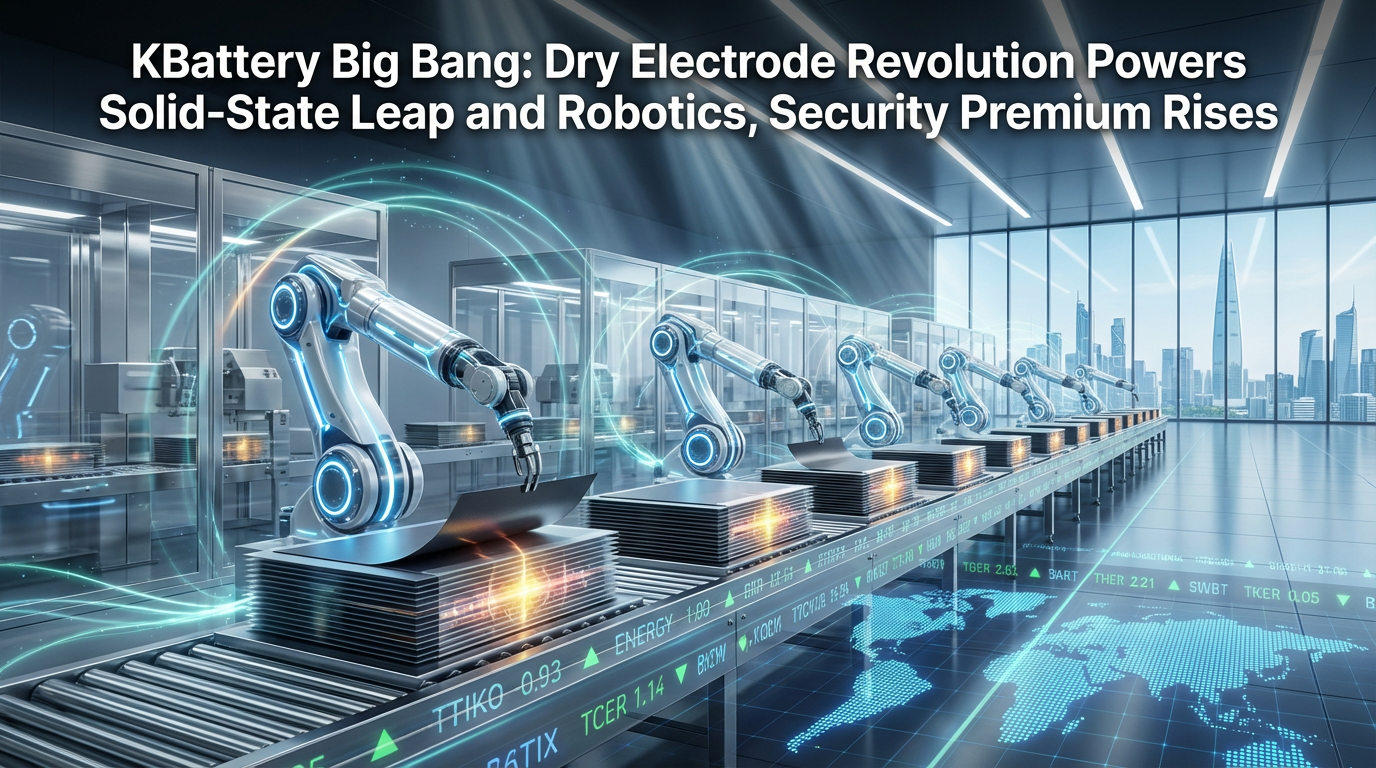
● Battery Arms Race, Dry Electrode Goldrush
K Battery Key Update: Commercialization of Dry Electrode, Triple Demand in Robots, ESS, and EV, and the Security Premium in Korea-China Competition Summarized at Once
Today’s article covers the selection of battery form factors suitable for robots, the real-world performance and production yield issues of Tesla’s 4680, investment points for the three K-Battery cell makers and the three major material companies, the separator strategies that will survive in the era of all-solid-state batteries, and the essence of the dry electrode race that has caught industry attention.
In addition, it separately highlights the true battlegrounds of “security premium” and “manufacturing process bottlenecks,” which most news outlets overlook.
Let’s take along an investment checklist that connects global economic outlook, interest rates, exchange rates, supply chain, and stock market trends—all in one go.
Which is the Answer for Battery Form Factors in the Robotic Era?
Key Summary: Robots have different hardware shapes, making it difficult to standardize a single form factor.
For humanoid types, pouch cells are favored due to their flexibility in shape transformation to utilize the torso and joint spaces.
For industrial and mobile robots, where impact and heat management are critical on the field, prismatic and cylindrical cells offer durability and serviceability as strong advantages.
The conclusion is that a multi-form factor coexistence is necessary, and since demand is tripling with robots, EVs, and ESS, manufacturers must diversify their portfolios.
Tesla 4680: Advantages of ‘Large Cells’ and the Reality Check
Main Point: Tesla is advancing the 4680 by mounting it on the Cybertruck, but the initially expected dramatic performance improvements have not been confirmed in the market.
The industry noted an initial yield issue in the 40% range, and while some improvement signals have been mentioned recently, the core challenge remains the manufacturing difficulty of large cells.
The most important point is the scope of application of dry electrodes.
Currently, dry processing is mostly applied to the anode, and the key is the stable mass production of dry electrode cathodes.
Although the advantages of using large cells (simplified pack, structural efficiency) are clear, management of heat, safety, and yield is key to profitability.
K-Battery: The Current Positions of the Three Cell Makers and the Three Major Material Companies
Cell: LG Energy Solution is leading in terms of global investment and patent portfolios, and is simultaneously investing in multiple next-generation tracks.
Samsung SDI and SK On maintain their positions through their strengths in high-nickel technology and premium customer and platform responsiveness.
Materials: Companies such as EcoPro (high-nickel precursor and cathode), L&F (high-nickel cathode), and POSCO FUTURE M (cathode and anode value chain) have established long-term pipelines with big-tech OEMs.
As the barriers to entry in the battery pack industry increase, a restructuring centered on top companies is accelerating.
Even with All-Solid-State, Separators Will Not Disappear
Early commercialization of all-solid-state batteries is likely to be applied to expensive, luxury EVs, so coexistence with conventional lithium-ion batteries is inevitable for a long time.
Therefore, the separator industry will not immediately vanish and is diversifying its portfolio through advanced coating, ceramic coating, and entry into solid electrolytes.
Message: Do not be overly swayed by headline-grabbing new technologies; the original advice to check for actual mass production transitions and financial figures remains valid.
Dry Electrode Race: Why is Everyone Converging on This?
Advantages: Eliminates the need for NMP solvent, making it eco-friendly and cost-saving, advantageous for implementing thick electrodes, and offers potential improvements in energy density and line efficiency.
Real-life Challenges: Achieving uniformity, adhesion, and shrinkage control in dry electrode cathodes is difficult, and as the electrode thickness increases, calendaring uniformity and micro-crack management become bottlenecks.
Key Players: According to the original text, this is an area led by cell makers, with Tesla and LG Energy Solution in the leading tracks and a commercialization roadmap mentioned for 2028.
Investment Points: Monitor the CAPEX for line conversion, in-house production of binders (PTFE, PVDF) and electrode roll-to-roll equipment, and the speed of the yield curve.
Validation Metrics: Key timings include when manufacturing costs per kWh (COGS), line throughput, electrode thickness/tapping density, and long-cycle/high-temperature endurance data are disclosed.
Korea-China Battery Competition: Tech Specs vs. Security Premium
Position: Korea has an advantage in high-nickel (Ni 80%+), China leads in LFP, and China has rapidly caught up in mid-nickel technology.
Quotation from an Original Survey: In a company survey, the battery competitiveness index showed Korea at 100 compared to China’s 108.
However, the game does not end with specs alone.
Due to IRA, origin rules, and national security concerns, there is expanding demand for “non-Chinese supply,” and this “security premium” becomes an opportunity for Korea.
As demand expands beyond EVs to include drones, robots, autonomous driving, military, and aerial mobility, there is a preference for non-Chinese supply chains.
The challenges of in-house production in Europe (line ramp-ups, yields, and capital intensity) underscore the manufacturing competitiveness of Korea.
Robots, ESS, EV: Schedule of Triple Demand
Robots: In the era of physical AI operating 24/7, safety, cycle life, and module serviceability are key, and mixed form factors are inevitable.
ESS: Due to strengthened safety regulations, there is growing demand for LFP and flame-retardant coatings, and project financing interest rates and exchange rates determine order competitiveness.
EV: Tesla’s standards and charging protocols are driving the market, and a mixed strategy of high-nickel and LFP is likely to continue.
Investment Checklist: Connected to Economic Outlook, Interest Rates, Exchange Rates, and Supply Chain
- Interest Rates: Capital-intensive CAPEX industries are highly sensitive to discount rates. In a declining interest rate environment, news of production line ramp-ups and valuation re-ratings can coincide.
- Exchange Rates: Fluctuations in the KRW/USD exchange rate have a direct impact on export ASPs and raw material (lithium, nickel, cobalt) payment costs. Check the disclosures on currency hedging.
- Supply Chain: Verify the coverage ratio of IRA requirements, origin rules, and long-term off-take contracts (lithium, nickel sulfate, electrolytes, separators).
- Stock Market: Rather than headline tech news, the timing of mass production transition, yield, operating rate, and the speed of COGS/kWh reduction determine stock trends.
- Risks: New technologies such as dry electrodes and all-solid-state batteries have long commercialization lead times. Continue monitoring if these are reflected in quarterly performance and proceed with caution.
Real Points That the Industry Rarely Discusses
Manufacturing bottlenecks occur in the “end processes.”
The key to dry electrodes lies not in coating but in achieving uniform calendaring and tapping density, and controlling gas and thermal behavior in thick electrodes.
The survival strategy for separator companies depends on their coating technology and migration to a hybrid of solid electrolytes and separators.
The security premium supports price and margins.
In an era where politics and regulations are as important as technological gaps, a “non-Chinese supply” itself becomes a franchise value.
For robot batteries, “pack engineering” is the battleground rather than “cell specs.”
Safety, serviceability, BMS software, and thermal management design increase the switching cost of suppliers and lead to long-term contracts.
On-Site Check Points
- Dry Electrode Cathodes: The disclosure of the timeline from sample → pilot → customer certification → mass production, and how well the timeline aligns.
- Yield Curve: The speed of reduction in scrap rates along with the line operating rate, and the plans to resolve bottlenecks in each process.
- Material Value Chain: The progress of vertical integration in high-nickel precursors, lithium refining, electrolytes, and separator coating.
- Diversification of Customers: The status of long-term contracts with OEMs in North America and Europe, and the acquisition of new references in robots and ESS.
- Financial Linkage: The sequence between improvements in cost per kWh, inventory turnover, and EBITDA improvements in line with CAPEX spending.
< Summary >
With the tripling demand from robots, ESS, and EVs, a coexistence strategy for form factors is the key.
Tesla 4680’s success hinges on the manufacturing challenges of large cells and the application of dry electrodes to cathodes, which are critical variables for performance and profitability.
K-Battery’s strength in high-nickel technology, manufacturing competitiveness, and the “security premium” create a significant opportunity to capture non-Chinese supply chain demand.
Even with the advent of all-solid-state batteries, separators will evolve through advanced coatings and solid electrolyte integration to survive.
Invest with a focus on the actual improvements in yield, operating rates, and COGS, while monitoring interest rates, exchange rates, and supply chain regulations.
[Related Articles…]
K Battery Dry Electrode Commercialization Roadmap Key Check
All-Solid-State Battery 2028 Timeline and Separator Business Transformation
*Source: [ Jun’s economy lab ]
– K배터리, 이 회사에 주목하세요(강희종 작가 2부)
● Powell Panic, Santa Jeopardy, AI Clash
Powell’s One Statement, Santa Rally, and the AI Showdown: A Comprehensive Overview of Five Variables That Will Change the December Market
This article covers the scenarios for Jerome Powell’s speech, market reactions, what Black Friday and Cyber Monday consumer data say about economic strength, the risks suggested by MinerBini’s short positions, the traffic surge between ChatGPT vs. Google Gemini and the beneficiaries of AI semiconductors, as well as the often overlooked “year-end liquidity” variable.
It organizes how the Fed’s interest rate message and the inflation trajectory affect the U.S. stock market into a checklist that investors can immediately apply.
1) News at a Glance: Key Issues for the First Week of December
• Powell’s speech (scheduled for early December local time at the Stanford Hoover Institution event) is a direct-impact variable.
• As it is just before the full FOMC meeting, the market could overreact on hints or prevention of an “interest rate cut.”
• Initial estimates for Black Friday and Cyber Monday indicate growth compared to the previous year, confirming the spending power of asset holders.
• Trader Mark MinorBini revealed that he maintained his short position on the S&P 500 at the end of October, thus reaffirming his risk management principles.
• In generative AI, signs of skyrocketing user engagement such as increased session duration and app downloads for Google Gemini are observed, indicating that the AI semiconductor competition between NVIDIA and Google’s TPU is heating up.
2) Powell’s One Statement That Could Change the Santa Rally: Four Scenarios
• Scenario A (Moderate-Dovish): “Inflation is easing, and policy adjustments may be made depending on the data.”
→ Decline in 2-year yields, weaker dollar, and a strengthened Santa rally for high-risk assets/big tech.
→ Sensitive sectors: semiconductors, software, small to mid-cap growth stocks.
• Scenario B (Neutral): “Data dependent, there is still a long way to go.”
→ Reduced volatility, a range-bound market.
→ After the event is digested, differences in performance/guidance by sector will emerge.
• Scenario C (Hawkish): “There is a warning of re-ignited inflation, and discussing an interest rate cut is premature.”
→ Rebound in 2-year yields and the dollar, weakness in long-term bonds, adjustment in growth stocks, and a shift of funds towards defensive stocks.
• Scenario D (No Comment): Avoids mentioning interest rates.
→ The market will search for clues in the nuance of his wording, facial expressions, and Q&A, resulting in increased intraday volatility.
Checkpoint: 2-year Treasury yield (key to the expectation of an interest rate cut), the Fed’s dot plot trajectory, the gap between the year-end S&P 500 equal-weighted index vs. the market cap-weighted index, and whether the VIX is overextended below 12.
Core Keywords: Fed, interest rate cut, inflation, U.S. stock market.
3) What Consumer Data Indicates: A ‘K-Shaped’ Economy and Durability
• According to payment and retail estimates, total sales on Black Friday show a positive year-over-year trend, and online sales data suggests a near double-digit growth (with some estimates mentioning around $11.8 billion online).
• Once Cyber Monday results, particularly driven by Amazon, are confirmed, the resilience of Q4 consumer spending will become clearer.
• Asset holders (real estate/stocks) are driving the top end of consumption, while lower- to middle-income groups continue to rely on credit and BNPL (buy now, pay later), consistent with the K-shaped pattern.
• Conclusion: Although there are signals of consumer slowdown in some segments, it is too early to declare a recession at a macro level.
• Investor Perspective: Within the retail sector, performance differences will widen across stocks as online/offline and high-end/value dynamics diverge.
4) The Implication of MinorBini’s Short Positions: Principles Over Direction
• After entering a short position on the S&P 500 (ETF: SPY) on October 29, he elevated his stop-loss to close to break-even, creating a “zero-loss structure.”
• Implication 1: It is risk management (trailing stops and loss restrictions), not directional predictions, that shapes the profit curve.
• Implication 2: Even if the market rebounds, as long as the risk (break-even) is secured, one can extend the bet, highlighting the “option value” concept.
• Implication 3: Shorting the index can also be used as a tactical move to capture relative gains during sector or style rotations (e.g., from growth to value stocks or vice versa).
5) The Landscape of Generative AI: ChatGPT vs. Google Gemini, and the AI Semiconductor Frontier
• Traffic analysis shows a sharp increase in session duration per visit and app downloads for Google Gemini.
• For consumers, conversational performance, multimodality, and agent functionalities determine session time, while in the enterprise sector, security, cost, and integration (Workspace/Vertex/Cloud) are key competitive factors.
• On the infrastructure side: NVIDIA’s accelerators and CUDA ecosystem remain the standard, but Google’s TPU and custom ASIC are catching up with cloud-specific “dedicated AI stacks” accelerating this trend.
• Inference Cost Efficiency: Model optimization, compression, and on-device (mobile/PC) expansion lower costs and could trigger explosive increases in AI usage.
• AI Semiconductor Supply Chain: HBM (High Bandwidth Memory), CoWoS packaging capacity, and power/cooling infrastructure are the bottlenecks in growth.
• Investment Check: Plans for data center power expansion, packaging capacity, memory price cycles, and cloud CAPEX guidance serve as leading indicators.
6) The “Real” Core That Other YouTube/News Outlets Often Overlook
• Year-End Liquidity Seasonality: The balance of RRP (Reverse Repurchase Agreements), the trajectory of the Treasury General Account (TGA), and the mix of coupon and short-term Treasury issuances directly affect short-term interest rates and stock valuations.
• Key Point: If the RRP declines and TGA remains stable, liquidity in the financial system could gradually improve, favoring risk assets.
• The Resumption of Buybacks: With the end of the blackout period for Q3 results, corporate share repurchases may reinitiate in December, adding downward pressure during trading.
• Option Positioning: In a low-volatility period at year-end, if dealers’ gamma positions are positive, sudden volatility spikes may be absorbed, creating a “gradual upward” trend.
• Treasury Demand: The Treasury’s refunding schedule and the issuance mix of short- and long-term debt determine the path of long-term interest rates, which is critical to growth stock valuations (DCF).
• The Hidden Constraint of AI: The pace at which power grids, substations, and cooling infrastructure are expanded determines the upper limit for data center AI capacity expansion.
• Conclusion: A Santa rally is most likely when “Powell’s wording” + “liquidity seasonality” + “the resumption of buybacks” all work together.
7) Strategic Guide: A Ready-to-Use Checklist
• Macro: 2-year yields, Dollar Index, 10-year real yields, break-even rates, and the implied interest rate cut path from interest rate futures.
• Market: S&P 500 equal-weighted/market cap-weighted spread, small cap Russell 2000 vs. Nasdaq, and VIX levels between 12~14.
• Liquidity: RRP/TGA, Treasury auction demand, corporate buyback announcements, and option gamma positions.
• Sectors: Beneficiaries in AI semiconductors (accelerators, HBM, packaging), cloud CAPEX, online retail, and a balanced approach with defensive stocks (consumer staples/utilities).
• Risks: A shift to a hawkish Powell stance, a re-ignited inflation, surging oil prices/supply shocks, and geopolitical events.
Data and Issue Reference Notes
• Black Friday/Cyber Monday figures are a mixture of preliminary estimates and may differ from the final numbers.
• Kevin Hasset’s comments in the interview are at the level of mentioning the next Fed leadership and are separate from any official procedures.
• This document is for informational purposes only, and the responsibility for any investment decision lies with the individual investor.
< Summary >
• If Powell issues an interest rate cut signal, the probability of a year-end rally increases; a hawkish stance, however, would trigger more volatility.
• Consumer spending is resilient in a ‘K-shaped’ pattern, so it is premature to declare a recession.
• MinorBini’s short positions are a textbook case of risk management, where stop losses and trailing stops are more crucial than directional bets.
• In the AI realm, Gemini is surging, and inference costs and power infrastructure will dictate growth speed.
• The key to a Santa rally lies in the conjunction of “Powell’s wording,” “liquidity seasonality,” and the resumption of corporate buybacks.
[Related Articles…]
The Next Contenders in AI Semiconductors After NVIDIA
*Source: [ Maeil Business Newspaper ]
– [홍장원의 불앤베어] 파월 한마디에 산타랠리 여부가 달려있다.