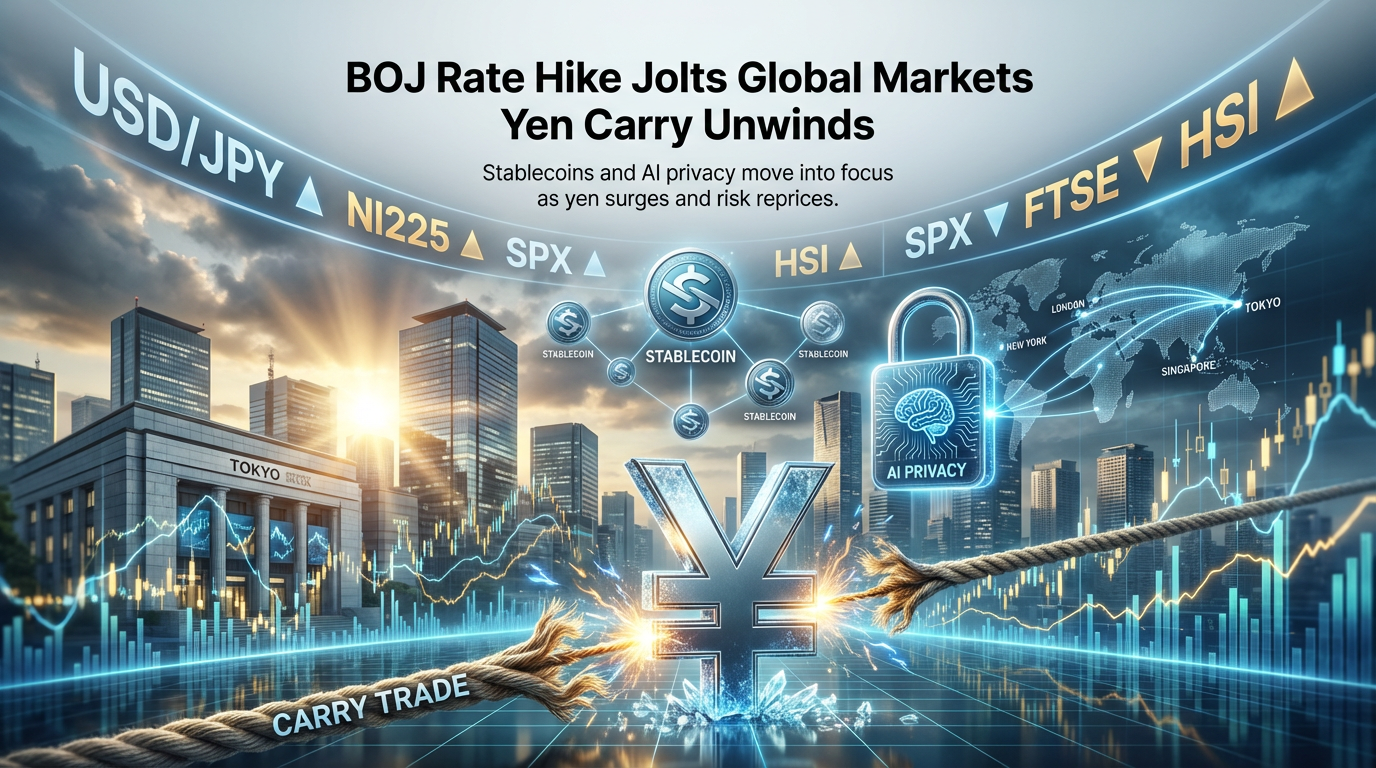
● BOJ Shock, Yen Squeeze Reignites, Dollar Slides, Liquidity Spikes
BOJ 0.75% Interest Rate Hike Scenario Instant Analysis: Reactivation of Yen Carry Trade Unwinding, Exchange Rate Direction Shift, Return of Risky Liquidity
This article summarizes the BOJ’s intentions, the neutral rate roadmap, the actual trigger for yen carry trade liquidation, the impacts on the Dollar Index and the won-dollar exchange rate, changes in the supply and demand of stocks, bonds, and alternative assets, and even a debate over a second “Plaza-style” exchange rate adjustment—all at once.It also specifically highlights market microstructure points rarely addressed elsewhere such as cross-currency basis, adjustments in the hedging ratios of Japanese life insurers, and refinancing thresholds of J-REITs.It encompasses key words like interest rates, exchange rates, inflation, and liquidity from an economic outlook perspective, and is organized so that you can immediately apply a portfolio checklist.
Key Checkpoints (3-Minute Summary)
- Point 1. The BOJ’s discussion of additional rate hikes is part of a process of “pivoting to the neutral rate (1–1.5%).”
- Point 2. Conditions such as headline inflation above 2%, wages rising in the 4% range, and improvements in employment and housing transactions create a favorable environment for a rate hike.
- Point 3. If a hike occurs, it may reignite the unwinding of the yen carry trade, and we could see a scenario with a weakening Dollar Index, a stronger yen, and downward pressure on the won-dollar exchange rate.
- Point 4. When Japanese tightening (gradual) overlaps with U.S. easing (gradual) in a liquidity environment, global “risky liquidity” and recurring spikes in volatility might occur.
- Point 5. Hidden variables include the JPY cross-currency basis, upward adjustments in the hedging ratios of Japanese life insurers, and the refinancing threshold of J-REITs.
Why Is Japan Considering Further Rate Hikes Now?
- Prices/Wages. Headline inflation has been in the high 2% range, persistently above the target (2%), and wage increases, particularly in large corporations, have been confirmed at around 4%.
- Macroeconomic Conditions. Although the growth rate is not “high growth,” consensus expects positive growth.
- Financial Stability/Policy Space. Exiting negative interest rates aims to restore policy room to re-ease if the economy slows down.
- Exchange Rate/External Signal. An excessively weak yen burdens import prices, real wages, and consumer price levels, and official communication has shifted to emphasize the necessity of exchange rate stability while respecting BOJ’s independence.
Policy Track: Pivoting to a Neutral Rate of 1–1.5%
- The termination of negative interest rates in 2024 marks not a “shift from easing to tightening” but rather the first step from an “abnormal to a normalized” state.
- There is a high probability of a pivot phase where the rate gradually moves toward the neutral zone (1–1.5%).
- While the U.S. moves toward a rate cut cycle, Japan is moving toward additional hikes/normalization, which should narrow the U.S.–Japan rate gap by 2025–2026.
- This “narrowing gap” is a key variable for the yen-dollar exchange rate and global liquidity.
The Mechanism of Yen Carry Trade and Its Unwinding
- Carry Accumulation. It involved borrowing low-yielding JPY and investing in higher-yielding USD/other assets to capture the spread.
- Unwinding Trigger. The simultaneous occurrence of a BOJ rate hike, expectations of a narrowing U.S.–Japan rate gap, a sharp rebound in the yen, a surge in volatility, and rising hedging costs increases the pressure to unwind positions.
- Key Indicators. Monitor the USD/JPY spot rate alongside the 3M risk reversal, the JPY cross-currency basis (especially 3M/1Y), IMM JPY positions, the hedging ratios of Japanese life insurers, and the supply/demand in TONA futures and government bond futures.
- Impacts. A rapid unwinding can generate a dollar short squeeze accompanied by a stronger yen, retract carry money that had flowed into emerging markets, and amplify volatility in risky assets.
Impacts on Exchange Rates, Bonds, and Equities (News-Style Summary)
- Dollar Index (DXY). Given that the basket includes a high weight for the yen, a hawkish BOJ serves as a factor for a weaker DXY.
- Won-Dollar Exchange Rate. In an environment of a weaker dollar and stronger yen, there is considerable downward pressure on the won-dollar rate. However, in situations of global risk-off sentiment, the won may temporarily weaken, making the path non-linear.
- Bonds. The response of Japanese 10-year JGB yields may show increased rigidity on the upside. A narrowing U.S.–Japan gap could make U.S. Treasuries relatively attractive, but if “reverse fund flows” from Japan increase, short-term U.S. rate volatility could also rise.
- Equities.
1) Japanese export stocks may face headwinds from a strong yen; domestic stocks or wage beneficiaries provide relative defense.
2) Korean/Taiwanese IT stocks remain favorable in a scenario of a weaker dollar and expansive global liquidity over the medium to long term, though short-term volatility could be unavoidable if carry trade unwinding accelerates.
3) Financial stocks require selectivity as the sweet spot for net interest margins may have passed, and refinancing costs for REITs/leverage positions should be carefully evaluated.
Global Liquidity and the ‘Second Plaza’ Debate
- Tariffs → Exchange Rates. Even after an increase in tariffs, if exchange rates offset the impact on export prices, the next battleground becomes exchange rate adjustments.
- There is evidence of movements where countries, not through multilateral consensus but through individual and informal signals, attempt to steer exchange rate trajectories.
- Japanese rate normalization may ease yen weakness, thereby reducing secondary inflation pressures globally, and if coupled with a gradual acceptance of a weaker U.S. dollar, a liquidity rally favorable to risk assets could intensify.
- However, given the coexistence of rallies and sharp declines characteristic of “risky liquidity,” preparation for event-driven volatility spikes is necessary.
Scenario-Based Outlook (Probabilities for Reference)
- Base Scenario: Following a 0.75% hike, dependent on data.
• USD/JPY may attempt a decline within a 5–10 yen range.
• The DXY could gradually weaken.
• The won-dollar rate might find resistance at higher levels, trading downward within a range. - Hawkish Scenario: A rapid approach toward a neutral rate close to 1%.
• Accelerated yen carry trade unwinding.
• A sharp widening of the cross-currency basis.
• A sudden spike in volatility in risk assets.
• Short-term pressure on emerging market currencies. - Dovish Scenario: Holding steady or a slight pause in hikes.
• Resumption of carry accumulation.
• Attempted reemergence of USD strength/yen weakness.
• Possibility of the won-dollar rate retesting higher levels.
Portfolio Action Checklist
- Exchange Rates. For won investors, managing won/yen cross volatility is crucial during periods of yen strength. Consider partial currency hedging and tail-risk protection through options.
- Bond Duration. While gradual purchases of U.S. Treasuries to balance the narrowing U.S.–Japan rate gap can be effective, caution is necessary during periods of heightened rate volatility originating in Japan.
- Equities.
• Japan: For export giants facing a strong yen, maintain neutral or underweight positions, while selectively increasing exposure to domestic beneficiaries such as wage or construction stocks.
• Korea/Taiwan: Continue with a trend-following strategy for major AI/semiconductor stocks, while maintaining cash or hedges to guard against event-driven volatility.
• Financials: Exercise selectivity as the window for net interest margin expansion may have passed, and closely monitor refinancing costs for REITs/leverage assets. - Alternatives/Real Estate. For J-REITs or highly leveraged assets, monitor refinancing thresholds in the 0.75–1.0% rate range. Verify cash flow coverage and rollover schedules with precise numbers.
Hidden Key Points (Aspects Rarely Addressed Elsewhere)
- Cross-Currency Basis. If BOJ hikes and yen carry trade unwinding occur concurrently, the expansion of the JPY basis could spike USD funding costs, subtly creating a “gear lock” in global dollar liquidity and forcing deleveraging.
- Hedging Ratios of Japanese Life Insurers. As rate normalization progresses, life insurers are likely to increase their hedging of foreign bonds, thereby intensifying USD selling/JPY buying pressure. This trend is gradual but persistent.
- J-REIT/Leverage Thresholds. The 0.75–1.0% policy rate range can trigger cash flow stress on some leveraged structures. Examine dividend payout ratios, borrowing maturities, and spread reset clauses in detail.
- Systematic Trading Triggers. CTAs may rapidly reverse positions if the USD/JPY trend is overturned. If volatility-targeting funds reduce their VaR, simultaneous deleveraging could ensue.
- Impact on Korea. As the movements of the yen and won become more synchronized, Korean export earnings and the cross-effects on travel/retail (due to a recovery in Japanese consumption) might change. A conservative selection centered on items with strong demand and pricing power is advised.
Data Calendar/Key Points to Watch
- Japan: Tokyo CPI lead indicators, updates on wage negotiations (Spring), BOJ minutes/key opinions, and TONA/government bond auction demand.
- Global: U.S. PCE/employment data, trendlines of the Dollar Index, JPY basis, IMM positions, semiconductor inventories/ASPs.
- Policy Tone. Keep an eye on comments regarding exchange rates from the Ministry of Finance and any changes in the emphasis of “data-dependent” language in BOJ communications.
Risk Balance
- Downside Risks. A reemergence of a slowdown in Japanese growth, weakening Chinese demand, or a rebound in energy prices could necessitate a reassessment of the pace of rate hikes.
- Upside Risks. Persistent U.S. inflation leading to a delay in easing by the Fed could reignite dollar strength, which in turn might postpone the scenario of yen strength and carry trade unwinding.
Connection to AI/4th Industrial Trends
- A weaker dollar and an environment of expanded global liquidity are favorable for the capex cycles in AI and semiconductor sectors.
- However, given that event-driven volatility from yen carry trade unwinding could be recurrent, a “core-satellite” portfolio construction focused on large AI names with visible cash flows and strong control over supply chains is recommended.
- For components with high currency sensitivity such as HBM, equipment, and materials, simultaneously monitor hedging and order backlog.
< Summary >
- Japan is gradually hiking rates in pursuit of restoring the neutral rate (1–1.5%), with the 0.75% scenario drawing attention.
- In the event of a rate hike, the most likely path is that the narrowing U.S.–Japan rate gap will trigger yen carry trade unwinding, leading to a weaker DXY, a stronger yen, and downward pressure on the won-dollar exchange rate.
- The key factors are market microstructure elements such as the basis, the hedging by life insurers, and refinancing thresholds.
- With the coexistence of liquidity rallies and volatility spikes, hedging exchange rate risks, diversifying bond durations, and selectively choosing internal beneficiaries along with event hedging are necessary.
[Related Articles…]
- Transition to a Weaker Dollar and 2026 Exchange Rate Scenario
- The Relationship Between Liquidity Rallies and AI Semiconductors
*Source: [ 경제 읽어주는 남자(김광석TV) ]
– 일본은행 금리인상(0.5%→0.75%) 가능성 고조. 엔케리 청산 공포 다시오나? [즉시분석]
● ZK Weaponizes Privacy, Stablecoins Seize Mainstream
How Coins Survive in Macroeconomic Shocks: ZK, Stablecoins, Programmable Trust (Key Points from Scroll Interview)
Today’s article covers the true meaning of the “essential technology” ZK that determines coin survival, why stablecoins have become the gateway to the mainstream, and even the strategies of Scroll’s gasless, privacy, dual-yield stablecoin USX and super app Garden.
It also summarizes how cryptocurrencies react to macroeconomic events, why the recovery correlation of altcoins has broken down, and the investment framework where price is merely a “lagging indicator”.
We separately address the impact of “regulatory-grade solvency proofs implemented through ZK attestation” and the “gasless UX” that are rarely covered on other channels.
An At-a-Glance Summary (News Format)
- The essence of market shocks: Cryptocurrencies are becoming mainstream assets as they become interconnected with geopolitical and macroeconomic risks like gold and oil.
- Change in recovery patterns: Bitcoin, Ethereum, and Solana rebounded quickly, but the long-tail cycle into altcoins has weakened.
- Surge in stablecoin demand: With volatility fatigue growing, funds are flowing into assets that maintain utility in payments and DeFi while avoiding price fluctuations.
- Redefinition of ZK: It simultaneously resolves privacy and scaling issues, standardizing “programmable trust” and “verifiability”.
- Scroll Roadmap: It unfolds simultaneously the ZK privacy solution Cloak, gasless, privacy-enhanced, dual-yield stablecoin USX, and the onboarding super app Garden.
Interpreting Market Crashes and Bounces and Associated Risks
The recent drastic market drop was due to a combination of factors, including panic reactions to policy issues such as tariff announcements and liquidity variables at centralized exchanges.
While major coins like Ethereum sharply dropped from around 4.4 to 3.4 before quickly recovering to around 4.1, altcoins lagged in their loss recovery, temporarily breaking the “major gains → alt cycle” correlation.
As a result, the preference for stablecoins increased, and demand expanded for on-chain access that minimizes exposure to volatility.
Why Stablecoins Have Become the Gateway to the Mainstream
Institutions and corporations are choosing stablecoins, which can handle payments and accounting, over NFTs and meme coins.
Consumers also want to maintain utility in DeFi and payments while avoiding volatility.
Amid macroeconomic uncertainty, inflation, and changes in interest rate paths, stablecoins have established themselves as an on-chain entry for risk-managed participation.
This expands the intersection of the global economic outlook and digital assets, reinforcing the structure whereby macroeconomic signals quickly transfer to crypto.
‘Programmable Trust’ and ‘Verifiability’ Created by ZK
ZK is a technology that allows for proving a fact (true/false) without revealing any data.
From a privacy perspective, it protects the transactions and strategies of individuals and institutions while allowing selective disclosure for lawful inspection when required by regulations.
From a scaling standpoint, it processes massive transactions quickly and inexpensively, with a separate proof network continuously verifying all actions.
Scroll standardizes this as “programmable trust (ensuring all participants adhere to the same rules)” and “verifiability (allowing anyone to check afterward)”.
In conclusion, ZK is an essential infrastructure that simultaneously solves security, privacy, and cost issues that have hindered mass adoption.
Scroll’s Product Roadmap: Cloak · USX · Garden
1) Cloak (Privacy)
A ZK privacy solution designed so that institutions and traders can hide their strategies and balances while still proving security and existence.
Go to Cloak
2) USX (Next-Generation Stablecoin, NEO Dollar)
Gasless Transfers: On the Scroll network, transferring USX removes the burden of gas fees, eliminating major inconveniences for ordinary users.
Practical Privacy: Balances and transactions are protected by default, with permitted lawful viewing for regulators in a practical model.
Integrated Payments and Yield: Connected with EFI cash to support both deposit yields and payments, it eliminates the choice cost between “depositing vs. using”.
Dual-Yield Strategy: It concurrently employs a first-stage market-neutral off-chain strategy (e.g., targeting approximately 12%, non-guaranteed) and a second-stage automated DeFi strategy.
ZK Attestation: Constantly verifies the soundness of reserves, pegs, and strategies through ZK proofs to implement a “trust without revealing” solvency report.
Go to USX
3) Garden (Onboarding Super App)
Aiming to provide the easiest on-chain entry, it combines traditional fintech UX with blockchain performance.
By linking a virtual bank account (e.g., a European IBAN) with a wallet address, it offers a familiar remittance experience.
It includes an integrated mini app store that allows access to both in-house services and external partner apps directly within the app.
It provides unified access to “real-usage assets” such as USX, tokenized gold, and on-chain FX.
Meme Coins and Short-Term Hype vs. Long-Term Product Building
Short-term marketing efforts, such as the presidential meme coin issues, contribute to mass adoption but often result in significant losses and lack sustainability.
Price is a lagging indicator; in the long run, fundamentals dictate the price.
In a three-tier structure comprising fundamentals, community/narrative, and supply/trend, long-term winners focus on building the first tier (fundamentals).
Example: Euler saw its TVL drop to tens of thousands of dollars after the FTX shock and hacking but focused on product development for 1.5 years to recover to around $1.5 billion.
RWA (Real-World Asset Tokenization) and National-Level Applications
It has announced plans for “real tokenized gold”, which connects physical gold with actual custody.
Products linked to tangible items, such as a “coffee-backed stablecoin” tied to coffee prices, are also in the pipeline.
ZK can extend to attestations at public/national levels such as voting, ID, and supply chain.
This acts as a bridge between digital assets and the real economy, providing both a global economic outlook and a hedge against physical inflation.
Connection with Regulations and Traditional Finance
High-quality regulation creates a “bridge layer” between TradFi and DeFi, facilitating interoperability.
As regulatory frameworks such as the EU MiCA and discussions in the US become more sophisticated, competition will intensify, but the overall expansion of the industry will accelerate.
The “Genius Act” mentioned in the interview appears to be intended for the institutionalization of stablecoins, but actual bill names and contents vary by region, so verification is necessary.
The key point is that stablecoins are being incorporated not as a replacement for the banking system but as an “interoperable” part of it.
Timeline and Operational Status
Scroll’s mainnet has been continuously upgraded without any downtime since its launch at the end of 2023.
USX and Garden are scheduled for release in the first week of November 2025, with pre-deposits currently open.
The roadmap outlines the sequential release of new services/assets in subsequent quarters.
Investment Framework: Price as a ‘Lagging Indicator’
Price is today’s consensus, while fundamentals are tomorrow’s cash flow.
Both institutions and individuals should complement narratives and community signals, but in the long run, technology, products, and operational fundamentals determine performance.
Areas with clear real-use and cash flows, such as stablecoins, payments, and RWAs, are likely to become the defensive core of digital assets.
This article does not constitute investment advice, and returns or timelines are subject to change and are not guaranteed.
Collected ‘Key Points’ Overlooked by Other Channels
- The strategic significance of ZK attestation: A regulatory-grade reporting system that continuously proves the soundness of reserves, pegs, and strategies without exposing data.
- The UX impact of gasless stablecoins: By eliminating the primary friction of onboarding (gas fees/need to hold network tokens), it accelerates the spread of payments and retail adoption.
- Implications of the collapse in the alt cycle: The success formula of major → alt is weakening, leading to a reallocation of capital towards assets centered on real use and cash flows.
- The super app + mini app store model: It combines the concentrated approach of WeChat with the openness of the Play Store, ensuring both ecosystem scalability and a consistent UX.
- Standardizing ‘selective disclosure’ in privacy: Moving beyond the binary of complete anonymity versus full disclosure, it evolves into a practical type of privacy that incorporates lawful audits and supervision.
Risks and Checklist
Regulatory Risk: Requirements differ by jurisdiction, and it is crucial to simultaneously meet privacy and compliance standards.
Yield Strategy Risk: The performance and counterparty risks of the off-chain market-neutral strategy are not guaranteed, making disclosure and monitoring vital.
Infrastructure Risk: The sustainability of the gasless and privacy functionalities to handle large-scale traffic and the continuous security of the proof chain are key factors.
Ecological Risk: The curation and security standards of the mini app store and the management of third-party partners serve as a turning point for user protection.
Observations in the Context of Macroeconomics
Slowing or re-accelerating inflation and changes in interest rate paths could promote the adoption of stablecoin-based payments and commerce.
The greater the macroeconomic volatility, the more the value of non-volatile on-chain utility is highlighted.
In a worsening global economic outlook, repeated rebalancing from volatile assets to on-chain cash-like assets is likely.
In a declining interest rate cycle, the relative attractiveness between DeFi and RWA yield strategies may shift.
Reference Links
Cloak (ZK Privacy Solution): Official Page
USX (Stablecoin): Official Page
< Summary >
Cryptocurrencies are sensitive to macroeconomic events, and mainstream asset-ization is underway.
Due to volatility fatigue, the demand for stablecoins has surged, and institutions are entering via stablecoins.
ZK simultaneously resolves privacy and scaling issues, standardizing “programmable trust” and “verifiability”.
Scroll is expanding real-world usage with Cloak, gasless, privacy-enhanced, dual-yield USX, and the super app Garden.
Since price is a lagging indicator, in the long run, technology, products, and operational fundamentals will dictate performance.
[Related Articles…]
Outlook on Stablecoin Regulation and Payment Innovation
The Future of Finance Opened by ZK Privacy
*Source: [ Jun’s economy lab ]
– 코인이 살아남으려면 이 기술이 반드시 필요합니다(feat.Raza Zaidi Scroll Head of Growth)
● Orbital AI Arms Race
Should We Invest in Chinese Tech Instead of American? A Comprehensive Overview of the Space Data Center That Is Upending the AI Hegemony War and Investment Strategies
What you gain by reading this now is summarized as follows.
- Dissects why Musk’s “space solar AI data center” is a cost-saving card that makes sense in terms of physics and economics.
- Summarizes like a news report the internal Google plan for a space data center, NVIDIA’s orbit GPU ecosystem, and the concrete moves made in Korea, China, and the U.S.
- Separately outlines key risks and profitability variables that other media often overlook, and even provides ready-to-use investment strategies and a checklist.
- Presents positioning under scenarios of the dollar and interest rate fluctuations that are tied to global market volatility.
Headline Briefing: 10 News Points That Shook the Market Today
- Elon Musk stated, “Within the next 5 years, operating a space-based solar-powered AI data center will be cheaper than on the ground.”
- The main argument is that the nearly infinite sunlight and radiative cooling without an atmosphere drastically cut power and cooling costs.
- On the ground, worsening power shortages and regulatory bottlenecks are taking hold. Governments worldwide are seriously discussing data center power regulations. Land and power saturation are pushing up investment costs.
- Big tech companies recognize space as the next-generation infrastructure platform. Google has publicly disclosed its internal project concept for a space data center.
- NVIDIA is being spotlighted as the key semiconductor supplier for space infrastructure, thanks to the increasing demand for onboard AI and pre-processing of orbital data.
- The U.S. private space ecosystem is expanding in listings and fundraising. Satellite communications, Earth observation, and orbit services are diversifying revenue streams.
- In Korea, Hanwha Aerospace, with the transfer of Nuri rocket technology, has announced the era of private-led launch vehicles. Hanwha Systems is establishing a satellite production hub at the Jeju Space Center, and LIG Nex1 has signed a contract for developing geostationary satellites led by the private sector.
- Funds are rapidly flowing into space-themed ETFs. The domestic TIGER K Aerospace & Defense ETF is gaining attention with its high net asset value and strong returns.
- China has declared space as a national strategic axis and reported experiments with space data centers. With an ecosystem combining lunar exploration and communications, speed of comprehensive ecosystem construction is accelerating.
- The investment focus is on the gap in space & AI infrastructure performance and regulatory risks between the U.S. and China. Global stock valuations are increasingly sensitive to the path of the dollar and interest rates.
Why Space Is Advantageous for Data Centers: In the Language of Physics and Costs
- In terms of power. There is no night in space. With no atmosphere or clouds, solar panel efficiency is maximized. Power generation is constant and the yield per panel is high.
- In terms of cooling. Although an absence of atmosphere means convection and conduction cannot be used, radiative cooling allows heat to be released directly into space. This simplifies the structure and reduces both cooling power and equipment costs.
- Compared to on the ground. Ground-based centers face rising power costs, water cooling and land regulations, and delays in grid connections, causing total ownership costs to rapidly increase. Although space has high CAPEX, its OPEX has the potential to be structurally lower.
- However, data transfer and communication latency remain. The high-volume upload/download of training data, latency issues, and spectrum regulations are key to profitability.
Developments in the United States: How Big Tech and Private Space Are Redesigning AI Infrastructure
- Elon Musk. He has outlined a blueprint to reduce power and cooling costs with space-based solar data centers. The integration with SpaceX’s Starlink and optical communication links paves a realistic path forward.
- Google. By exploring a “space-based AI data center” internally, Google is testing the idea of deploying TPU-level computing in low Earth orbit, emphasizing solving power limitations in space.
- NVIDIA. With increasing demand for onboard AI and pre-processing of space data, solutions that offer space-level reliability for GPUs and SoCs are emerging as de facto standards in the early ecosystem of space data centers.
- U.S. private space listings. Companies in satellite communications, Earth observation, and orbital manufacturing/services are securing revenue streams and expanding access to capital markets. Capital is flowing in through space infrastructure ETFs and aerospace & defense ETFs.
Developments in China: Accelerating “Space+AI+Communications” as a National Strategy
- Policy drive. China has declared the space industry as a core national strategic pillar for the next five years, rapidly building an ecosystem that integrates communications, industry, and exploration.
- Space data center experiments. By reportedly demonstrating in-orbit AI computing and data processing, China has been the first to take the initiative in this field.
- Technology stack. Integrating reliable power, thermal management, and communication systems developed for lunar exploration, sample return, and long-duration missions, China plans to combine these with its own satellite communications network to offer marketable services.
- Investment interpretation. As listing channels for Chinese big tech and private space companies expand, domestic capital and policy financing could combine, while U.S.–China technology regulations may impact global market valuations.
Developments in Korea: From R&D to Industrialization
- Hanwha Aerospace. With the transfer of Nuri rocket technology, it has declared a private launch vehicle era, with expectations for diversified revenue streams from commercialized launch services.
- Hanwha Systems. The Jeju Space Center has been completed. This large-scale infrastructure, which handles satellite assembly, manufacturing, and testing in one place, is poised to enable the production of multiple satellites annually. There are plans to expand into satellite communications, Earth observation, and defense satellite services.
- LIG Nex1. It has signed a contract for developing geostationary satellites led by the private sector, and is expected to benefit from increased demand for dual-use defense and civilian satellites.
- Capital market. With domestic space and aerospace & defense-themed ETFs such as the TIGER K Aerospace & Defense ETF, funds are flowing in as these themes become structurally tied to economic growth momentum.
Investment Products and Positioning: Based on Dollar and Interest Rate Scenarios
- In a scenario of a strong dollar and high interest rates: Emphasize space infrastructure shares with high cash flow visibility in sectors like defense and communications to mitigate high CAPEX growth company discount rates, and approach growth stocks in stages.
- In a scenario of a weak dollar and low interest rates: Long-duration premiums for long-term growth stocks increase. In this case, stocks such as space data centers, low Earth orbit communication networks, and AI semiconductor companies that are leveraged will be preferred.
- Utilizing ETFs. Construct a core exposure with domestic TIGER K Aerospace & Defense ETF and international ETFs like ARKX, UFO, or aerospace & defense ETFs, while adding individual stocks based on event-driven strategies.
- Rebalancing rule. In times of global stock market volatility, implementing automatic rebalancing on a quarterly basis—reflecting valuation, price momentum, and regulatory events—can be effective.
Risk Matrix: Addressing the Overlooked Questions by Other Media
- Communication bottleneck. The current commercial Ka/Ku bands typically offer a few Gbps per satellite. The high-volume upload/download for large training datasets can become a bottleneck. Although aiming for 10–100 Gbps with optical (laser) links, the cost and availability relative to ground networks are critical issues.
- Latency. While low Earth orbit (LEO) can achieve latencies of a few tens of milliseconds, geostationary orbit (GEO) can experience round-trip times in the 500ms range. Real-time services are thus limited to LEO, and although large-scale training is less sensitive to latency, data transfer costs remain an issue.
- Space-grade reliability costs. Preventing memory bit flips caused by radiation requires ECC and redundancy, which can reduce effective FLOPS by 20–40%. Component certification and radiation hardening add to the CAPEX.
- Thermal management and mass. Although the principle of radiative cooling is simple, the required radiator area and mass are significant. The economic feasibility will depend on the decrease in launch costs per kilogram.
- Regulations. Spectrum allocation, ITU slot assignments, mandatory debris management, and export controls (especially regarding AI semiconductor sales to China) can directly impact timelines and costs.
- Insurance and liability. Insurance premiums for potential orbital collisions, solar storms, and service disruptions are likely to be high initially, leading to increased revenue volatility.
The Most Important Points Not Mentioned By Other YouTube Channels/News Outlets
- The primary practical use of a space data center is not for “training” but for “proximal pre-processing, storage, and relay.” Uploading and downloading massive training datasets to and from space is currently uneconomical, whereas compressing and filtering Earth observation imagery, radar, or IoT signals directly in orbit can significantly reduce communication costs.
- Even if power costs approach zero, high data transfer costs can erode total cost of ownership (TCO), meaning that the value of space-based power is more proportional to “reduced data size through pre-processing” rather than “computing cost.”
- The cost per kilogram for fully reusable launch vehicles needs to drop into triple-digit dollars for space data center CAPEX to be competitive with ground-based alternatives. Until this cost threshold is met, a hybrid (ground + orbital pre-processing) model is the answer.
- National data sovereignty regulations could extend to space infrastructure. New regulatory frameworks may emerge concerning data paths that exit national boundaries by passing through orbital routes before re-entering.
- Carbon accounting. Although space solar power can contribute to a company’s Scope 2 (power) reduction targets, a standard for recognizing the inherent carbon footprint from launches and manufacturing is needed. Incorporation into ESG scores could alter economic calculations.
Portfolio Action Checklist
- Core. Allocate 40–60% to aerospace & defense infrastructure ETFs to mitigate interest rate sensitivity through high cash flow visibility.
- Growth. Allocate 20–40% to stocks in space data processing, communications, optical links, and AI semiconductors, buying in stages based on events.
- Satellite value chain. Allocate 10–20% to pick-and-choose plays in structural materials, thermal management, power, and laser communication modules.
- Risk hedge. Utilize positions in the dollar and bond duration to shield against interest rate fluctuations. Maintain a 10% cash allocation during periods of high global stock market volatility.
- Check events. Monitor reuse rates of launches, commercialization of optical ground stations, spectrum assignments, CAPEX disclosures from major tech firms, and momentum in Chinese ecosystem listings.
Timeline and Signals
- 6–18 months. Expansion of demonstrations for LEO-based pre-processing, storage, and relay. An increase in commercial PoCs for hybrid ground-space cloud solutions.
- 18–36 months. Commercial expansion of optical ground stations, reduction of backhaul costs through meshed laser links between satellites. Appearance of TCO advantages in specific limited workloads for space processing.
- Beyond 36 months. With further cost reductions per kilogram from reusable launches, pilot projects for modular space data centers may emerge. Potential introduction of intergovernmental data sovereignty regulations.
Korean Investor Perspective: Practical Investment Strategies
- Domestic. Diversify investments across the launch, satellite, and communications value chains led by Hanwha Aerospace, Hanwha Systems, and LIG Nex1, and secure core exposure via the TIGER K Aerospace & Defense ETF.
- Overseas. Divide investments into three baskets—cash flow-driven aerospace & defense, growth-oriented satellite communications & Earth observation, and leveraged AI semiconductor stocks—and rebalance accordingly.
- Macro factors. Gradually increase the weight of the growth basket in a declining interest rate cycle, and raise the proportion of defense & infrastructure stocks when the dollar strengthens. Investment strategies should be flexibly adjusted according to global market volatility.
< Summary >
- The economics of space data centers are a tug-of-war between savings in power and cooling versus the costs of communications and launches.
- In the short term, the primary use is orbital pre-processing, storage, and relay; in the mid-to-long term, reusability in launches and optical links will determine the speed of commercialization.
- The U.S. is advancing with big tech and private space, China is accelerating with a national strategic push, and Korea is entering the stage of private industrialization.
- The key to investment is to build a core with ETFs and target alpha through pick-and-choose investments in AI semiconductors, optical communications, and thermal management.
- Adjust positions flexibly according to the trajectory of the dollar and interest rates.
[Related Articles…]
- Space Economy Investment Roadmap: Real-World Cases of Hybrid Cloud and LEO
- China Tech Reopening 2.0: Reading Policy Drives Through Satellites & Semiconductors
*Source: [ Maeil Business Newspaper ]
– [LIVE] “미국 말고 중국 테크 담을까” 우주 패권 경쟁 현실화 | 길금희 특파원
● Power Crunch Ignites AI Gold Rush, SaaS Reborn, Bitcoin Slow-Buy
Focus on Today’s Essentials: ‘SaaS Revival’ as Indicated by Salesforce’s Performance, Meta’s Major Budget Shift and AI Infrastructure Acceleration, the Palantir-Nvidia-Centerpoint Power OS Project, the ‘No-Fire · No-Hire’ Employment Phase, Robot Executive Order Signals, and Wolf Research’s Bitcoin Buying Strategy
Today’s article contains a decisive signal that the real bottleneck in AI infrastructure has shifted to ‘power.’
It specifically outlines how Salesforce’s performance has refuted the doom of SaaS and identifies the beginning of AI monetization.
The possibility of a U.S. robot executive order, a shift in the employment framework, and the data-backed basis for the gradual Bitcoin buying strategy are also detailed.
It doesn’t miss connecting global economic keywords such as interest rates, inflation, the U.S. Federal Reserve, and recession risks.
Morning Market Opening Check: Mixed Performance in Tech Stocks, Meta Leads with a 4% Surge
The Nasdaq started the day slightly positive in the early session before turning mostly flat, and the S&P 500, Dow, and Russell showed similar patterns.
Reports of Microsoft’s AI software growth slowdown affected sentiment despite the company’s rebuttal, although lower rate expectations partially eased the downside pressure.
Meta surged about 4% with news of cutting its metaverse budget to focus on expanding AI infrastructure, lifting market sentiment.
Nvidia was up about 1%, while Costco and Micron declined, and JP Morgan traded mostly unchanged.
Meta: From the Metaverse to AI Infrastructure, a Reality of Choice and Focus
Meta has shifted from massive investments in the metaverse to reallocating its budget towards expanding AI infrastructure.
Amid rising costs for securing GPUs and expanding data centers, the strategy aims to bolster AI competitiveness through talent recruitment and internal reallocation.
Acquiring AI talent from competitors like Apple and absorbing external expertise from specialized labeling companies are measures taken to respond to the pace race within the ecosystem.
In short, the intent is to reduce cash flow burdens and accelerate the monetization of products, advertisements, and creator tools based on AI.
Palantir x Nvidia x Centerpoint: Kickstarting the Chain Reaction of the Power OS
Palantir, Centerpoint Energy, and Nvidia are jointly launching the ‘Chain Reaction’ project to convert aging power assets into flexible energy sources and aim to stabilize and expand the power grid.
The core is to build a power operating system (grid OS) that meets the booming AI data center demand, thereby opening an industrial software layer used simultaneously by businesses and governments.
According to estimates by Goldman Sachs, data center power demand is expected to increase by about 50% by 2027 and by 165% by 2030.
Ultimately, the bottleneck in AI is not in the algorithms but in power supply and computing resources, necessitating simultaneous investments in SMRs, utilities, renewable energy, and storage devices.
Salesforce’s Strong Performance: Evidence that ‘SaaS is Not Dead’ and AI Monetization is Gaining Ground
Salesforce, centered on CRM, presented robust results that counter the narrative of a SaaS collapse.
Contrary to concerns that the per-seat pricing model would be disrupted in the AI agent era, actual revenues remained solid thanks to AI capabilities, further catalyzing upsell and cross-sell opportunities.
Wall Street estimates that for the justification of $7 trillion in AI data center investments, annual AI revenues of $2 trillion are required by 2030.
This performance is interpreted as an early signal that AI is beginning to transition from being merely a cost center to a revenue driver.
Global Asset Market Capitalization Landscape: Gold Dominates, with Nvidia, Apple, Alphabet, and Bitcoin among the Top-Tier
Gold remains the undisputed number one asset by market capitalization worldwide, benefiting from its role as an inflation hedge and geopolitical risk mitigator.
Nvidia occupies the top position among stocks, while Apple holds a spot in the top three and Alphabet is gradually strengthening its presence through rallies.
Broadcom and Meta follow, and Bitcoin maintains its position among top-tier asset classes, remaining at the center of institutional debates.
U.S. Labor Market: A Phase of ‘No-Fire·No-Hire’ Stagnation
According to Challenger’s report, job cuts in November amounted to 71,321, a slowdown compared to October’s peak, but still remain high compared to the same month since 2022.
ADP also suggested a slowdown in hiring, summarizing that the phase is neither one of massive layoffs nor of over-hiring, but rather a period of ‘low rotation.’
This is simultaneously driven by a decrease in labor supply due to reduced immigration and the increasing adoption of AI and automation.
With job cuts directly attributed to AI amounting to 6,280 in November, companies are gaining extra time for productivity improvements by reducing hiring.
In creative fields such as video production and translation, costs have been dramatically restructured—from hundreds of millions to mere thousands—illustrating a chain reaction of job contraction.
U.S. Robot Executive Order Signals: Possibility of a Shift in Regulatory and Taxation Frameworks
Reports indicate that the next administration is considering issuing an executive order around 2026 to foster the robot industry following AI.
It appears that ‘framework design’ is underway, as evidenced by the Department of Commerce holding successive meetings with robot companies and discussions on launching a robot working group under the Department of Transportation.
If tax incentives and regulatory relaxations become widespread, the diffusion of manufacturing, logistics, and service robots could accelerate, potentially also reflecting expectations for Tesla’s humanoid robot.
In the labor market, rapid automation of simple and repetitive tasks combined with AI assistance for high-wage knowledge work are occurring simultaneously, potentially intensifying a K-shaped wage distribution.
Bitcoin: Wolf Research Advocates “Gradual Buying” Amidst Short-Term Speculation and Capital Inflows
Bitcoin is fluctuating around the $92,000 level, and Wolf Research, while noting weak new capital inflows, describes the current range as conducive to gradual buying.
The firm views the ultimate bottom candidate to be in the $75,000 range but suggests accumulating in portions at current levels.
While the expansion of physical ETF channels improves accessibility from the regulated sector, the speed of capital inflows remains a separate variable.
From a global economic perspective, the interplay between the U.S. Federal Reserve’s interest rate path, real interest rates, and recession probabilities must be taken into account.
Calendar · Consumption: New Jobless Claims, Ultabuty Performance, and K-Shaped Consumption
New jobless claims and Ultabuty’s performance are events that reaffirm the divide between consumption recovery among high-income groups and subdued selective spending.
If the U.S. consumption continues to exhibit K-shaped polarization, the volatility in non-essential consumer categories may further increase.
Key Points Overlooked by Other Media
The next bottleneck in AI is ‘the grid’ rather than ‘chips,’ and the power operating system market, which combines software, power, and capital, is about to open up.
SaaS is transitioning from per-seat pricing to performance- and usage-based billing, and AI agents are instead driving additional revenue through add-on sales structures.
The ‘no-fire·no-hire’ phenomenon in the labor market may show low unemployment rates, but it increases job transition costs, creating a delicate balance between wage negotiation power and productivity investments.
The robot executive order is not merely an industrial policy, but potentially the launch of a ‘legal/institutional OS’ that bundles safety, insurance, liability, and standards, ultimately determining the pace of its spread.
In Bitcoin, it is essential to simultaneously monitor not only ETF inflows but also circulating stablecoin balances, miners’ net positions, and derivative leverage indicators to time the switch between risk-on and risk-off phases.
Portfolio Checklist
- AI Infrastructure: Check the connectivity of the value chain with data center power supply, SMRs, utilities, storage devices, and grid software.
- SaaS/Cloud: Monitor upsell rates driven by AI features, the speed of transition to new billing models, and month-over-month variations in gross margins.
- Labor · Robotics: Assess the CAPEX plans for workforce and equipment transitions in industries sensitive to automation, and the likelihood of benefiting from policy measures.
- Crypto: Base your strategy on cash flow-based accumulation rather than merely price, aligning with events (such as ETFs or policies) and global liquidity factors (interest rates, U.S. Fed actions).
- Macro: Prepare to adjust beta in accordance with updates on the direction of interest rates, inflation trends, and recession probabilities from a global economic perspective.
Risk Factors and Variables
An upswing in interest rates and a rapid increase in real interest rates could pose a headwind for growth stock valuations.
Delays in expanding power infrastructure may defer the realization of returns compared to AI investments.
The pace of regulation in robotics and AI and international competition over setting standards could alter the commercial rollout timeline.
In crypto, managing positions is key as it is sensitive to overheating in derivative leverage and regulatory steps.
Quick News Picks
Meta shifts its focus to AI infrastructure, boosting its stock performance.
The Palantir-Nvidia-Centerpoint Power OS project is activated.
Salesforce’s robust performance reaffirms that ‘SaaS is not dead.’
The U.S. labor market sees a phase of ‘no-fire · no-hire’ stagnation influenced by both AI and reduced immigration.
Potential robot executive orders hint at emerging policy momentum.
Wolf Research advocates gradual Bitcoin buying while suggesting a conservative bottom range.
< Summary >
The key bottleneck in AI is power, and the Palantir-Nvidia-Centerpoint ‘Power OS’ signals the beginning of a solution.
Salesforce’s performance shows that AI is not a threat to SaaS but rather a growth engine.
The U.S. labor market has transitioned to a phase of ‘no-fire · no-hire,’ and robot policies could further alter employment structures.
While Bitcoin is seen as a buying opportunity in a gradual accumulation phase, it is essential to monitor the pace of inflows and global liquidity closely.
[Related Articles…]
Institutional Inflows into Bitcoin and Scenarios Following ETF Approval
Data Center Power Demand Surge and a Rundown of SMR Strategies
*Source: [ Maeil Business Newspaper ]
– 세일즈포스 호실적 “SaaS 안죽었다”ㅣ울프리서치 “비트코인 점진적 매수할 때”ㅣ 美로봇 행정명령, 고용 틀 바꾸나ㅣ홍키자의 매일뉴욕