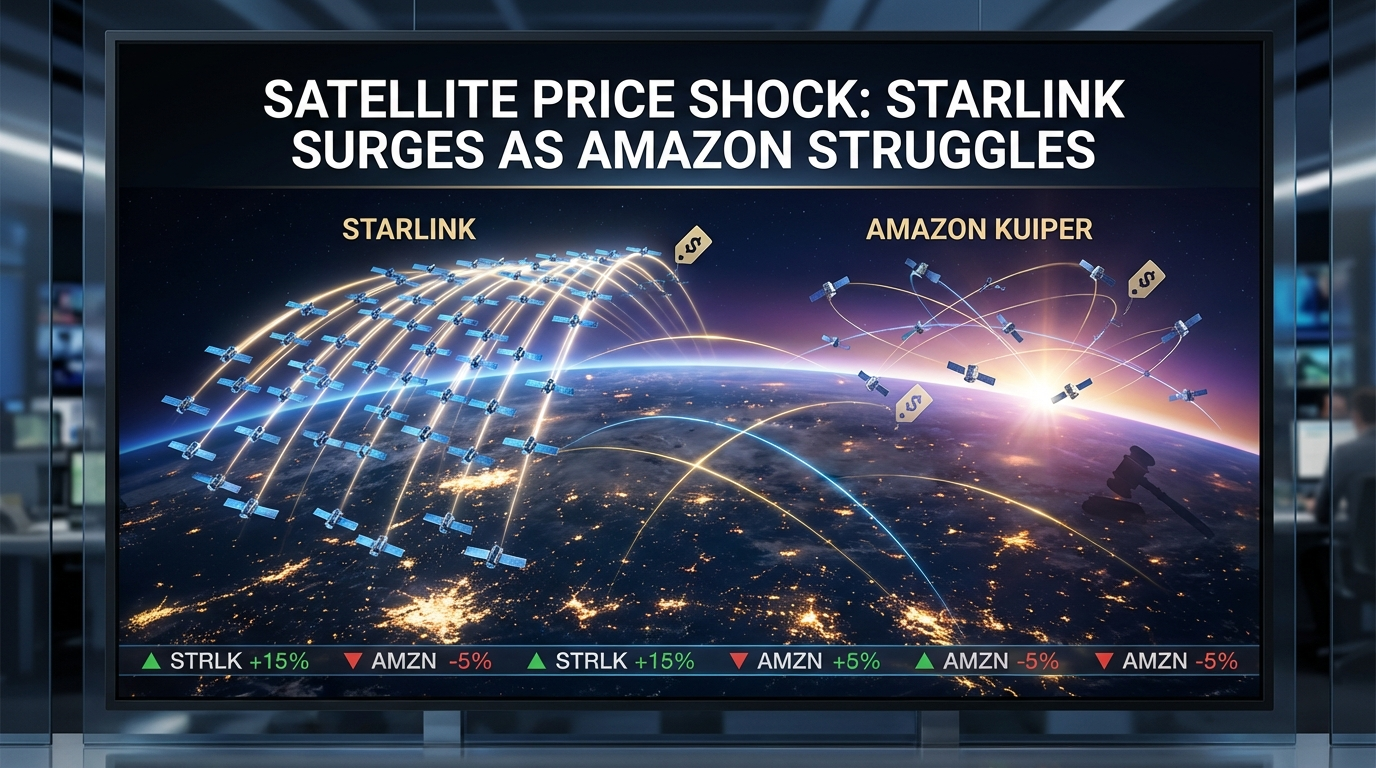

● Starlink Disrupts Work Landscape, Amazon Leo Struggles, Price Hikes Loom
Starlink’s Reality Change in ‘Work from Anywhere’ — Competition (Amazon Leo), Price & Policy Changes, and Future Risks at a Glance
This article includes the following key points:
- Starlink’s market dominance and consumer impact, analyzed through the latest satellite number, performance, and pricing data.
- An assessment of Amazon Leo’s status (number of satellites, rollout schedule) and its realistic competitiveness.
- Trends of other operators (OneWeb, China, EU IRIS²) along with regulatory and astronomical concerns.
- Practical advice urgently needed for users (seasonal users, businesses, rural areas, etc.).
- Core insights not well-covered by other news (launch and vertical integration offering long-term advantages, activation fee risks, ground stations, spectrum factors).
Summary News (Key Points)
SpaceX’s Starlink had launched over 10,000 satellites by 2025, with about 9,000 in operation, providing user terminals that track multiple satellites simultaneously to deliver latency of 20–50ms and download speeds of 100–400Mbps.
Amazon’s Leo has begun enterprise previews but has deployed only 153 satellites, making it insufficient as an immediate consumer alternative.
The market structure gives SpaceX a significant lead due to its ‘launch-manufacture-operate vertical integration’ and rapid launch pace.
Consumers have been disadvantaged by price and policy changes (removal of the pause function, price hikes), and prolonged lack of competition might lead to expanded monetization strategies like activation fees and contract lock-ins.
Detailed Analysis by Category
- Current State of Starlink
- Satellites/Users: Over 10,000 launched by the end of 2025, around 9,000 in operation.
- Performance: Latency 20–50ms, download 100–400Mbps, upload 10–40Mbps (dependent on location, terminal, and time).
- Customers: Approximately 8 million active customers worldwide.
- Cost/Policy: Significant differences by region/plan/terminal (hardware and monthly fees are high in the US).
- Operational Features: Terminals secure connection stability by switching satellites tens of times within seconds, based on “10s of satellites in view.”
- Amazon Leo Status
- Deployment Scale: 153 satellites deployed (at report time).
- Rollout: Consumer expansion predicted in 2026, initially focused on enterprise customers.
- Competitiveness: Offers 1Gbps per second, but lacks adequate satellite density and ground infrastructure for service quality comparison.
- Launch Dependency: Amazon relies on multiple launch partners (including SpaceX) — weaker in launch/operational control compared to SpaceX.
- Other Competitors (OneWeb, China, EU IRIS²)
- OneWeb: Around 650 operational satellites, limited direct consumer sales (mainly government/corporate).
- China (Spacesail/Qianfan): Has set high-target numbers but lacks sufficient satellites and transportation means until 2025.
- IRIS² (Europe): Plans to deploy 290 LEO and 18 MEO satellites by 2030, focusing on limited EU services.
- Regulation/Environmental/Astronomical Issues
- Sky Crowding: Raised concerns on collision, tracking, and light pollution due to rising satellite numbers (astronomy community concern).
- Policy Trend: Increasing discussions on orbit/frequency rights and space debris regulations.
- Lifespan/Removal: Starlink satellites have a lifespan of about 5 years, some control re-entry to burn up in the atmosphere.
Price & User Impact (From a Consumer Perspective)
- Regional Price Discrimination: Monthly fees vary greatly by country demand/competition levels, even for the same hardware (e.g., a few tens of euros in Netherlands vs. a few hundred dollars in the US).
- Risks for Seasonal/Partial Users (Digital Nomads etc.): Weakening of the pause function exposes seasonal users to uncertainties/risks of subscription cancellation→rejoining (slot shortage, potential future activation fees).
- Enterprise/Emergency Demand: Value in satellite internet remains high for disaster response, marine, aviation, remote industries, but enterprises are more sensitive to stability and SLA.
What Will Decide the Future Landscape?
- Launch Cadence: SpaceX secures density quickly by launching tens of satellites weekly.
- Vertical Integration (Manufacture→Launch→Operation): SpaceX’s integrated model provides an advantage in cost, speed, and adaptability.
- Ground Stations, Spectrum, Regulation Rights: The control over ground infrastructure and spectrum affects quality and coverage.
- Bundling & Pricing Strategies: Amazon’s Prime bundling potential is a variable in consumer price wars.
- Technological Generation Transition: The introduction of the 3rd generation Starlink satellites (planned) offers reduced latency and gigabit speeds — reliant on operating a large launch vehicle (Starship).
Checklist for Companies, Governments, Investors
- Companies (Logistics, Shipping, Remote Branches, etc.): Starlink is the most realistic choice currently. However, long-term contracts should reflect potential changes in fees/conditions if rivals emerge (termination/SLA clauses).
- Telecom Operators/ISPs: Must quickly establish cooperation or supplement strategies with satellite networks (hybrid routing, local caching) to maintain competitiveness.
- Investors: SpaceX’s rapid scaling and strong launch capabilities provide long-term dominance, but regulatory, space debris, and competition entry (price war) risks exist.
- Policymakers: Should proactively prepare policies for orbit management, frequency allocation, and minimizing astronomical impact.
The Most Important Insights Hardly Covered by Other Media
- Practical Impact of Vertical Integration: Many articles only compare satellite numbers, but true competitiveness lies in ‘who controls launch-manufacture-operation.’
- SpaceX quickly increases satellite density with its own launch capabilities (Falcon 9/Starship target), maintaining resilience even in regional saturation or adversity.
- Conversely, Amazon’s reliance on launch partners and bottlenecks in satellite production/transport could cause service quality and speed weaknesses in the first few years.
- Potential Monetization for Seasonal Users (Activation Fees, etc.): The removal of Starlink’s pause feature isn’t just a policy change, but a precursor to creating additional revenue streams (activation fees, re-activation queues) targeting ‘seasonal/partial users.’
- Thus, consumer costs might become unfavorable over time if the supply monopoly continues.
- Role of Ground Infrastructure (Ground Stations, Backhaul) and Spectrum Rights: It’s not just about having numerous satellites. The capacity/distribution of ground stations/backhaul transmitting the traffic to the internet determines end-user quality.
- Even if there are abundant satellites geographically, lacking ground infrastructure can reduce perceived quality.
- Potential Transition of Astronomical/Space Environment Risks into Regulatory/Cost: If satellite light pollution and collision risks lead to political/social pressure, new regulations for entrants and increased operational costs (monitoring, evasive maneuvers) could arise.
Practical Recommended Actions
- Individuals (Digital Nomads, Seasonal Users)
- Long-term vacation-like users should consider alternative connection means (local SIM, local broadband) to avoid the risk of subscription cancellation→rejoining.
- Check for ‘rejoining guarantee’ and emergency response options in contracts.
- Companies (Remote Sites, Shipping, Disaster Response, etc.)
- Adopt a multi-provider strategy (Starlink + OneWeb/terrestrial networks) to distribute risk.
- Secure business continuity by specifying SLAs and alternate paths.
- Policy/Regulation Aspect
- Space debris and light pollution mitigation norms must be coordinated internationally.
- Strengthening local consumer protection regulations (activation fees, service cancellation-related) is necessary.
Timeline (Short to Medium-Term Predictions)
- 2026: Amazon Leo’s consumer expansion starts (but initially enterprise-focused due to density shortage).
- 2026–2028: Deployment of some 3rd generation Starlink satellites (predicated on Starship’s practical operation).
- 2026–2030: Some regional and purpose-based competitors like OneWeb/China/IRIS² are beginning to surface, but global consumer alternatives will take years.
- Regulation: Strengthening of astronomy and orbit management regulations is likely (international cooperation, increased costs).
Conclusion — Immediate and Long-term Strategies
- Immediately: Starlink is the most practical alternative for consumers and businesses in terms of quality and coverage.
- However, in the long run, the gradual emergence of competitors like Amazon Leo, price strategy changes, and regulatory/environmental issues will shake the market.
- Consumers should carefully assess contract terms, regional fees, and alternative means, while companies should formulate risk diversification strategies based on multiple paths and SLAs.
Reference Tips (Quickly Applicable Checklist)
- Before Subscription: Compare regional monthly fees and hardware prices.
- Seasonal Users: Check for the presence and assurance of ‘pause’ policies.
- Companies: Include satellite networks in disaster recovery plans, but ensure alternative routes.
- Investors: Focus on launch capabilities, vertical integration, and ground infrastructure acquisition as core indicators.
[Related Articles…]
Starlink’s Changing Remote Work Landscape — Summary of Network, Fees, and Policy Analysis
Amazon Leo’s Entry into the Korean Market and Local Impact Analysis
*Source: https://www.theverge.com/column/837202/starlink-work-from-home