● Power Panic, AI Chip Crunch, TSMC to the Rescue
Big Tech Power Wars, Customized AI Chips, TSMC CoWoS Expansion – This Week’s Key Wall Street Issues Summarized at Once
Key Points to Check in This Article
- It explains why Google and Meta are partnering with NextEra Energy, the true causes of the data center power shortage, and the upgrade points of the PPA strategy.
- It connects why Microsoft chose Broadcom, its strategy to reduce ‘Nvidia dependency’, and how TSMC CoWoS is the key to solving bottlenecks in the semiconductor supply chain.
- It summarizes from an investment viewpoint how the FOMC, interest rate paths, and changes in market sentiment (VIX, Fear & Greed Index) affect the prices of big tech, semiconductors, and power infrastructure assets.
- It bundles a practical checklist covering ‘rising electricity share in the cost structure of AI,’ ‘new bottlenecks created by site, transmission, and packaging,’ and ‘lead times for copper and transformers’ not often covered elsewhere.
Market Briefing: Indices, Sentiment, Liquidity
- According to the original text, the Nasdaq opened mixed with +0.36% early in the session, S&P500 +0.04%, Russell 2000 +0.6%, and Dow -0.17%.
- It was noted that the weekly performance closed with Dow +0.5%, S&P500 +0.3%, and Nasdaq +1.0%.
- Volatility has entered a phase of easing.
- With the VIX coming down to mid-range, the Fear & Greed Index is also seen recovering from ‘extreme fear’ to neutrality.
- Interest rates are the FOMC’s focal point this week.
- In market (FedWatch) commentary, there is mention of about a 90% probability reflecting a 25bp cut, and subsequent meetings are expected to remain unchanged.
- In summary, amid a global economic environment expecting the peak of interest rates and a slowdown in inflation, risk asset sentiment is supported.
Big Tech x Power: Alliance Between NextEra Energy and Google/Meta
- According to the original text, NextEra Energy has signed a large-scale clean power supply and data center joint development partnership with Google and Meta.
- The key is that it is evolving beyond a simple PPA (Power Purchase Agreement) to an integrated design including power generation, storage (ESS), site, transmission, and campus.
- The background is clear.
- As data center expansion outpaces the expansion of transmission and substation infrastructure, the lead time for constructing new power grids is 5–10 years.
- By allying with large utilities that already own networks and sites, they reduce LMP (Locational Marginal Pricing) risk, while securing both power supply stability and construction speed.
- There are also policy variables.
- Even assuming a conservative stance from the government on renewable energy and subsidies, big tech must secure reliable 24/7 power provision, prompting them to diversify their portfolios with renewables, nuclear power, and hydropower.
The Return of Nuclear Power: 24/7 Power for AI Infrastructure
- The original text introduced moves such as Microsoft collaborating with Constellation Energy to restart the Three Mile Island nuclear power plant (target 2028) and Amazon acquiring a site near a Talon Energy nuclear plant.
- It was also mentioned that Google is collaborating with SMR developer Kairos Power aiming for operation by 2030.
- The point is clear.
- Although solar and wind can be complemented by ESS, their variability requires that large-scale AI data centers have 24/7 baseload power.
- Nuclear power, in terms of carbon, capacity, and continuity, is the strongest candidate, and its weight is likely to increase as the core of ‘power internalization’.
- However, risks such as initial investment, regulatory approval, and social acceptance remain.
Broadcom x MS: Reducing Nvidia Dependence with Customized AI Chips and Networking
- According to the original text, a report that Microsoft is in talks to switch its design partner for Azure’s customized network chip from Marvell to Broadcom sparked a reaction in its stock.
- Broadcom is already a joint development partner with Google for TPU 6th and 7th generation, and has been expanding its touchpoints in customized silicon and networking with Meta, OpenAI, ByteDance, Apple, and others.
- Big tech’s strategy remains consistent.
- Although Nvidia offers the highest performance, its high cost and limited supply drive the diversification of portfolios with in-house chips (ASIC, NIC, switches) that lower TCO.
- This is a phase that highlights Broadcom’s value with its strengths in networking, SerDes, and packaging.
- The standard separation of tasks in the foundry process continues, with design by Broadcom and manufacturing by TSMC.
TSMC CoWoS Expansion: Truly Solving the AI Semiconductor Bottleneck
- The original text points out that research houses like Bernstein have raised their price targets for TSMC based on the expansion of CoWoS (advanced packaging) capabilities.
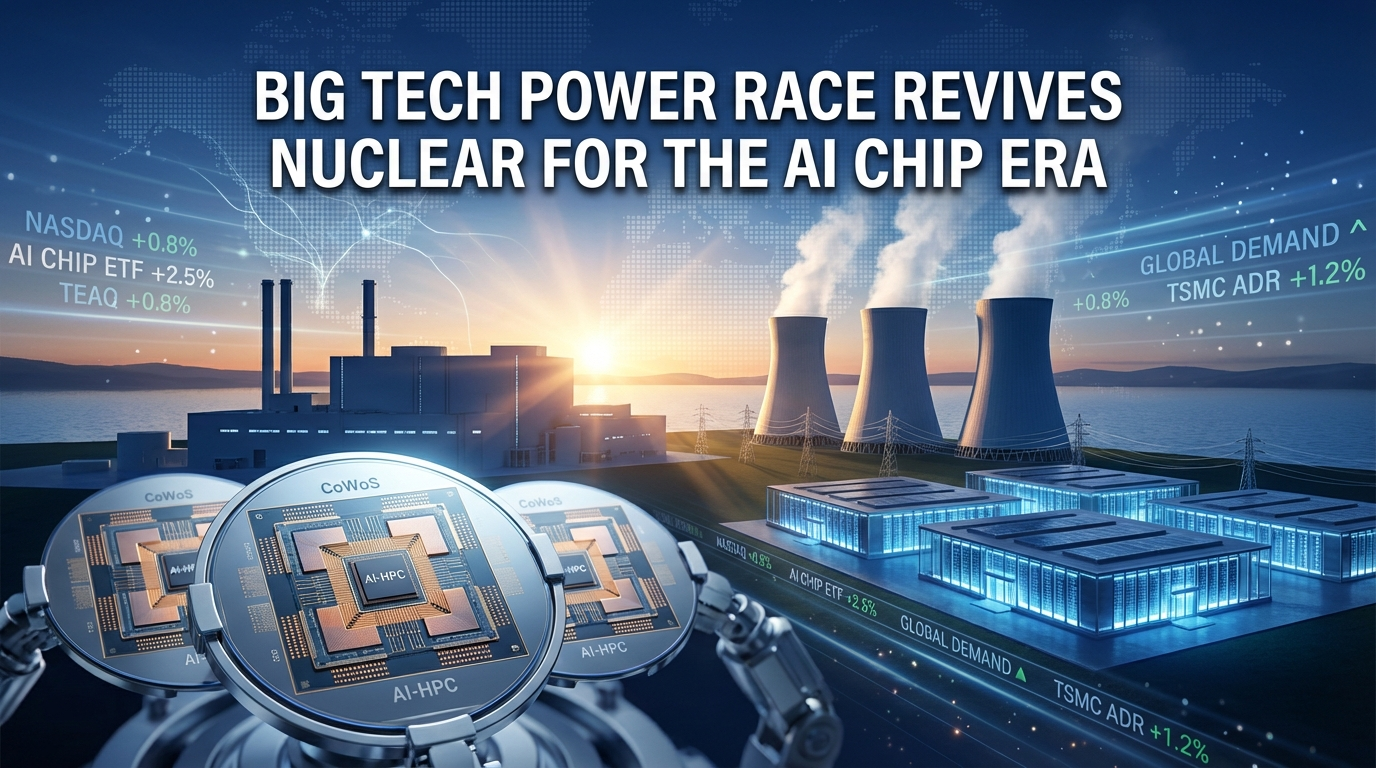
- CoWoS is the process of ultra-precise stacking and wiring of GPUs and HBM on a single substrate, and is at the core of the supply bottleneck for AI accelerators.
- A large-scale expansion until 2026 could ease the structural bottleneck in the semiconductor supply chain, stabilizing AI server delivery and cost.
- The impact is amplified by the fact that even custom chips such as those from OpenAI and Google TPU eventually use TSMC’s production lines.
- In summary, the ‘real lever’ of the semiconductor cycle is advanced processes and packaging, with TSMC CoWoS at its center.
Key Companies and Sector Snapshots
- NextEra Energy: A global leader in renewables, attempting an upgrade through joint data center development beyond PPAs.
- Broadcom: Absorbing big tech demand with customized chips, networking, and packaging IP.
- TSMC: Driven by 3–5nm, CoWoS, and HBM packaging, which are the key motors of its performance.
- Oracle, Synopsys, Broadcom, Costco, Lululemon: According to the original text, these are highlighted as earnings calendar focal points for this week.
- Nuclear-related: Constellation, SMR developers (Newscale, Oculo, etc.) show both expectations and volatility.
Macro and Commodities Points: Bubble Debate and Copper
- The original text presented BofA’s view that ‘this is not an AI bubble’ and noted that although S&P500’s EPS might experience double-digit growth next year, the index’s increase could be around the mid-single digits.
- It also presented the logic for a rise in industrial metals such as copper alongside an upward revision in China’s growth rate.
- The expansion of data centers, transmission networks, HV cables, and transformers stimulates copper demand and lead times.
- Even amid decelerating inflation, certain tangible items may continue to face structural tightness.
Investment Checklist (In Practice)
- Power Infrastructure
- Prioritize utilities with large PPA pipelines and integrated capabilities in transmission and site development.
- Also check LMP volatility, permitting lead times, and ESS-linked strategies.
- Nuclear Power
- Expect benefits from expanding 24/7 power demand.
- However, incorporate risks such as permitting, CapEx, regulation, and social acceptance into the discount rate.
- Semiconductors and AI Infrastructure
- Monitor Broadcom (ASIC, NIC, SerDes), TSMC (CoWoS, advanced processes), the HBM ecosystem, and equipment companies (lithography, etching, packaging) together.
- Data Center REITs and Campus Development
- Check for power availability, site, incoming capacity, cooling methods (air-cooling vs. liquid immersion), and PUE metrics.
- Macro
- Examine how the interest rate path and dollar direction impact valuations, as well as the risks of a reheated inflation.
This Week’s Calendar and Key Points to Watch
- FOMC: The key will be the tone of the dot plot and guidance reflecting the possibility of a 25bp cut.
- Earnings: Pay attention to Oracle, Synopsys (beneficiaries of AI in software and EDA), Broadcom (noting comments on networking and packaging), and Costco and Lululemon (to check consumer resilience).
- Big Tech Power Deals: Watch for additional announcements of PPAs and joint developments.
Key Points Often Not Addressed in Other YouTube Videos or News
- The electricity share in the TCO of AI models is rapidly increasing.
- With the expansion of model size and context window, the inference power ratio escalates rapidly, raising KPIs for electricity cost and supply stability.
- The evolution of PPAs is underway.
- Instead of simply purchasing kWh, they are being redesigned as an ‘integrated procurement’ that includes site, transmission, storage, and load shifting.
- The connection between power and semiconductor bottlenecks.
- The CoWoS expansion plan directly influences GPU delivery times and per-rack power deployment plans in data centers, functioning almost as a macro-leading indicator.
- Site premiums increase.
- Sites that allow for high-power availability, proximity to substations, easy access to water resources and cooling (or are friendly to liquid immersion) are revalued.
- The lead times for copper and large transformers will be prolonged.
- Cumulative demand for transmission network reinforcement and HV cable expansion could repeatedly create bottlenecks in certain equipment and materials.
Risk Checklist
- Policy and Regulation
- Antitrust reviews, energy permits, and environmental regulations could cause delays or structural changes.
- Supply Chain
- If lead times for CoWoS, HBM, and equipment do not improve, delivery times and CapEx could become unstable again.
- Interest Rates and Exchange Rates
- A rebound in interest rates or a resurgence of a strong dollar could trigger valuation adjustments.
Individual Issue Notes
- The original text mentioned issues regarding Netflix’s acquisition of Warner Brothers, regulatory risks, and a downward target price report.
- The feasibility, terms, and antitrust review variables are factors that require continuous monitoring.
< Summary >
- The data center power shortage is evolving PPAs into ‘integrated development contracts,’ expanding the alliance between NextEra Energy and big tech.
- The return of nuclear power for 24/7 power is accelerating, bringing SMR and refurbishment of aging nuclear plants to the forefront.
- Broadcom is absorbing big tech demand with customized chips and networking to reduce Nvidia dependency, while TSMC’s CoWoS solves the bottleneck in production.
- The FOMC’s interest rate path, a slowdown in inflation, and tangible bottlenecks such as copper shape asset prices.
- Investment points include checking the interconnected aspects of utilities (PPA and transmission), nuclear power, semiconductors (CoWoS and HBM), data center REITs, and equipment/materials.
[Related Articles…]
- AI Data Center Power Wars: The Return of PPAs and Nuclear Power
- TSMC CoWoS Expansion is Changing the Semiconductor Cycle
This article is a news-based summary and interpretation based on the original text, and the ultimate responsibility for investment decisions lies with the investor.
*Source: [ Maeil Business Newspaper ]
– 넥스테라에너지, 구글&메타와 파트너십ㅣ브로드컴, MS와 맞춤형 AI칩 개발ㅣTSMC, CoWoS 능력 확대, 목표주가 상향ㅣ홍키자의 매일뉴욕