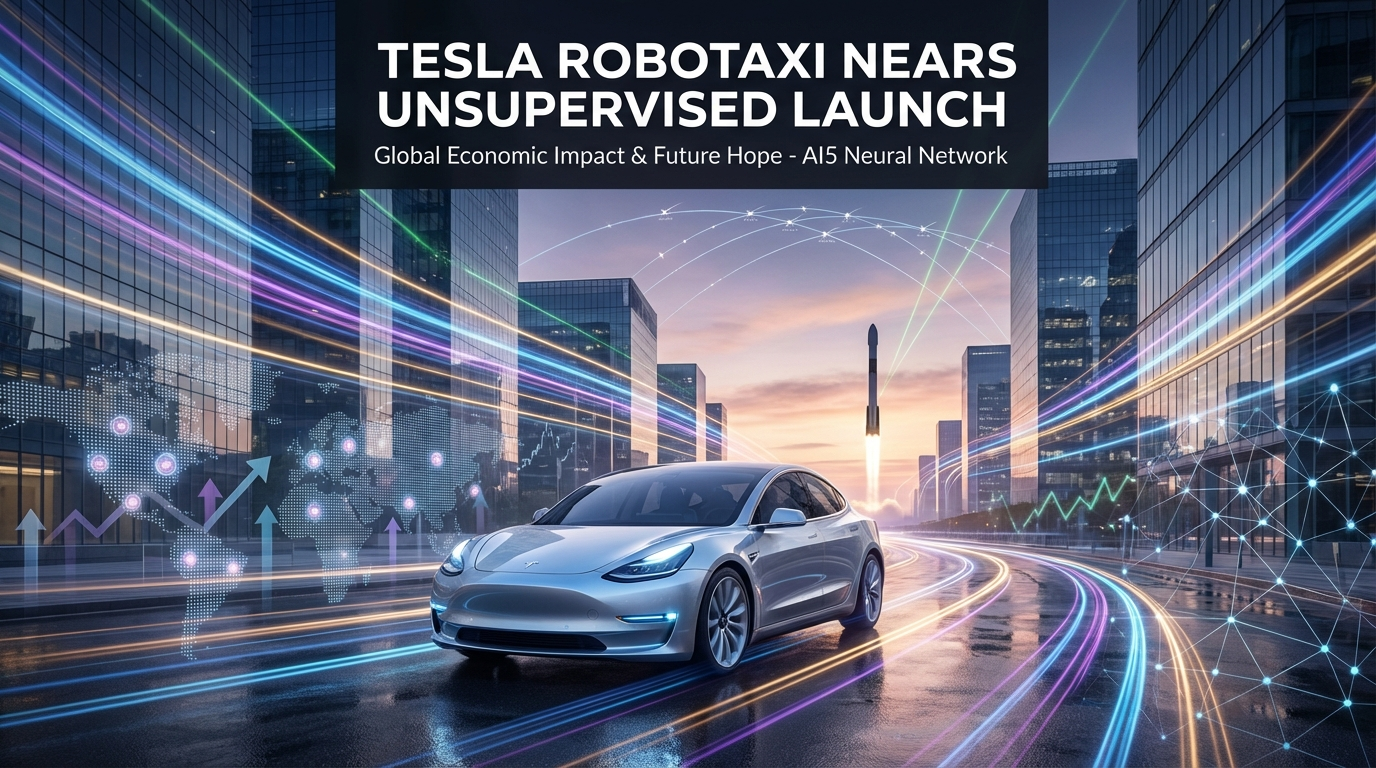
● Tesla’s FSD Nears Driverless Breakthrough, Robocabs Imminent
Tesla FSD “Unsupervised” Threshold Near? Robo-Taxi Pilot Within 3 Weeks, Suggesting Federal Regulatory Unification, and Starlink Patent All in One
The content below covers the unsupervised autonomous driving imminent signal confirmed by Wall Street data, the movement toward federal-level regulatory unification with its economic and interest rate impacts, and the decisive change in connected infrastructure opened by the Tesla-Starlink patent.It summarizes the key points including Musk’s “unmanned robo-taxi in Boston within 3 weeks” remark, its schedule risks, and aspects such as data pipeline bottlenecks and changes in insurance/liability models that ARK and other media have scarcely addressed.
Breaking News Summary
- Wall Street’s Piper Sandler: Issued a report stating that “Tesla FSD is very close to unsupervised autonomous driving.”
- The key basis is data from the FSD Community Tracker. After the v14.1 deployment, the “average distance traveled before human intervention” jumped from about 441 miles to over 9,200 miles, as cited by the quantitative indicator.
- Elon Musk mentioned “an unmanned robo-taxi run in Boston in about 3 weeks.” After validation with a smaller model, a larger model may be deployed one to two months later, according to reports. However, the official permits and schedules are highly subject to change.
- In Europe, FSD Ride-Along (showroom onboard experience) countries have expanded from Italy, France, and Germany to include Denmark and Switzerland. Many cases have seen immediate sell-outs due to soaring demand. Certification systems such as RDW (Netherlands) are variables.
- On the U.S. political front, former President Trump has sent a message stating that “AI needs a unified federal rule,” indicating plans to revise the patchwork of state-level regulations. Autonomous driving is cited as a sector that can benefit immediately.
- Tesla has filed a patent redesigning the vehicle roof structure and communications module to accommodate satellite connectivity, weighing the possibility of Starlink integration.
- A “Charging Passport” feature has been added to the app. It visualizes annual Supercharger usage data on a map and awards landmark and efficiency badges to gamify the EV user experience.
Data Indicates Imminence of “Unsupervised”
- Why is this indicator important?The real-world metric for autonomous driving is the distance a vehicle travels by itself before encountering a situation that would have demanded human intervention to avoid danger.The key point is that it is an engineering indicator based on a safety threshold rather than an emotional evaluation.
- The Meaning of the Numbers:The roughly 20-fold improvement in the average distance before intervention after v14.1 is consistent with evaluations as the largest single jump in four years’ worth of cumulative data.While there was some regression/stabilization in v14.2, v14.2.1 reportedly mitigated side effects such as hard braking considerably.
- Field Examples:An overseas owner shared an unsupervised driving example of about 3,000 miles with v14.2.1 (10% in urban areas, 90% on highways).Although there are limitations due to sample bias and voluntary reporting, it suggests that the “performance trajectory across various road contexts” is on the rise.
- Checkpoints:The greater the urban context, the steeper the difficulty curve.The official transition to “unsupervised” depends not only on averages but also on managing worst-case scenarios (long-tail risks) and obtaining regulatory approvals.
Policy & Regulation: From State Patchwork to Federal Unification?
- The Inefficiency of the Current Structure:Even for the same technology, the permitted ranges differ across states, with conditions such as paid services or mandatory safety attendants varying.This situation increases costs and time wastage in terms of Big Tech and global economic competitiveness.
- Former President Trump’s Message:There was a remark that “AI must have a unified federal rule,” even mentioning the possibility of an executive order.While the implementation timeline and scope remain to be observed, in autonomous driving, “speed of expansion” is key to competitiveness.
- Europe’s Different Approach:Amid difficult certification processes by bodies such as RDW, Tesla is proactively persuading public opinion through public ride-along experiences.This strategy opens a “bottom-up route” that moves from consumer safety perception to regulatory easing through public experience.
Hardware Roadmap and Connected Infrastructure: A400, AI5/AI6, Starlink
- Essence of Musk’s Remarks:After validating with a smaller model, a larger model may be deployed one to two months later, with the vehicle computing “AI5” boasting over 10 times better performance than the current generation, and “AI6” potentially being deployed quickly afterward.As these terms and specifications are based on remarks rather than official documents, the timeline and performance should be interpreted cautiously.
- Why is “Connectivity” the Final Puzzle?To reduce high-difficulty long-tail cases, more field data must be collected, learned from, and deployed quickly.When integrated with satellite connectivity (Starlink), reliability for telemetry/log uploads from communication shadow zones, OTA updates, and real-time evidence collection during incidents is enhanced.
- The Significance of the Patent:The design of the roof structure to minimize wireless interference and the integration of a communications module indicate a design aimed at a “hybrid satellite/cellular connection without exposed external antennas.”This signifies not just an evolution of the vehicle as a standalone product, but a shift towards a networked autonomous driving platform connecting vehicle, cloud, and satellite.
Economic Impact: Revenue Models, Interest Rates, Insurance & Liability, Global Competition
- Changes to Revenue Models:Unsupervised robo-taxis boost the share of software and mobility services revenue, which is higher than the margin on vehicle sales.Increased vehicle utilization changes the depreciative structure, making subscriptions and revenue-sharing models core.
- Interest Rate Environment and Valuations:In a falling interest rate phase, the present value of long-term cash flows increases, and the premium for Big Tech and AI beneficiary stocks is expanded.Conversely, if interest rates rise again or in a credit crunch, vehicle financing and fleet procurement costs will press on profitability.
- Insurance & Liability Structures:The move to unsupervised shifts the weight from driver liability to system/manufacturer liability.The manufacturer’s in-house insurance and risk management capabilities become key for cost competitiveness.
- Global Competition and Regulatory Disparities:If federal regulatory unification becomes a reality, the U.S. may lead in commercialization, while Europe catches up by refining safety and liability regulations, and China is expected to rapidly deploy in regions with favorable regulatory environments.Predictability in regulation is the key to the pace of capital investment and scalable expansion.
The Underappreciated Core Issues
- The bottleneck lies not in the “algorithm” but in the “data range, transmission, and learning pipeline.”A Starlink-like backhaul shortens the learning speed and rollout cycle, reducing the defect correction half-life.
- Accounting for Liability & Insurance:The transition to unsupervised driving affects the estimated reserves for potential quality assurance or litigation.Transparency in safety data directly lowers the cost of capital (CoE).
- Regulatory Unification as a “Mote”:Only players with vertical integration across hardware, software, mapping, and communications can immediately expand nationwide.
- The Hidden Point in the European Strategy:Ride-alongs are not just technology demos, but a campaign to obtain “political and social license.”
- Ecosystem Revenues:Once robo-taxis are established, ancillary revenues from energy (Superchargers, V2G), in-ride advertising/content, insurance, and data markets become multilayered.
European Field: Experience Programs and the Loop of Regulatory Persuasion
- Expansion of Countries:Ride-along experiences have expanded to include Denmark and Switzerland in addition to Italy, France, and Germany, making it available in a total of five countries.
- Demand Signals:Reservations often sell out immediately once opened, and the duration of the experiences continues to expand.
- Strategic Interpretation:A virtuous cycle aimed at consumer safety perception → public opinion formation → accelerated regulatory discussions.It aims to bridge the gap with certification bodies like RDW through public experience.
Feature Update: “Charging Passport” and User Experience
- The app now visualizes a year-long history of Supercharger usage on a map and awards badges (Landmark, Green Saver, Explorer, etc.).
- It aims for a lock-in effect through gamification of not just data but “journey and efficiency.”
- It is being applied sequentially depending on the region, app, and vehicle software versions.
Timeline & Checklist
- 0–3 months: Observe whether the Boston robo-taxi pilot receives official permits and what the actual operating range is, including whether policies of zero human and property damage and publicly disclosed backup operating procedures are in place.
- 3–6 months: Monitor the performance in urban and non-standard environments of subsequent v14.x updates and trends in long-tail incident rates.
- 6–12 months: Keep an eye on the commercial deployment timeline for AI5/AI6 hardware, the disclosure of satellite connectivity options, and the details of U.S. federal regulatory unification.
- Continuous Monitoring: Follow global economic and interest rate trends, changes in insurance premiums (risk premium), and updates to state-level regulatory easing maps.
Investment & Industry Perspective Action Items
- Data: Track the average distance traveled before intervention, rates of severe accidents/near misses, and the frequency/success of OTA updates.
- Regulation: Update the map of federal, state, and city-level permits and the scope of paid boarding on a weekly basis.
- Finance: Monitor the software subscription ratio, insurance loss ratios, Supercharger ARPU, and changes in depreciation recovery periods.
- Competition: Compare the commercialization speeds of players with regional regulatory advantages (e.g., Tesla in the U.S., municipality-specific companies in China).
- Piper Sandler evaluated the imminence of unsupervised driving based on data showing that the “average distance traveled before intervention” improved roughly 20 times after FSD v14.1.
- Former President Trump’s indication of federal regulatory unification is a policy variable that could determine the speed of autonomous driving commercialization.
- Tesla’s Starlink-related patent fills the “data pipeline” puzzle, creating an advantage in learning and deployment speed.
- In Europe, public ride-along experiences are being used to pre-persuade public opinion, while the app’s “Charging Passport” reinforces user lock-in.
- Economically, interest rates, insurance/liability, and regulatory predictability dictate valuation and expansion speed.
[Related Articles…]
- Five Effects of U.S. Federal Unification on Autonomous Driving Commercialization
- How Starlink-Tesla Integration Sparks a Revolution in Robo-Taxi Data
*Source: [ 오늘의 테슬라 뉴스 ]
– 속보! 테슬라 “무감독 자율주행” 완성, 3주후 공개! 월가 “테슬라 FSD, 무감독에 매우 가깝다”… 데이터가 보여준 진짜 마지막 퍼즐은?
● SpaceX IPO Goldrush, Orbital Data Centers Supercharge Tesla AI Chip Dominance
SpaceX IPO Imminent Signal and the Scenario of a ‘Space Data Center’ Equipped with Tesla AI Chips
All of my writing contains the real meaning behind the Bloomberg report of SpaceX IPO rumors, the connection between the space data center and Tesla AI5/AI6 chips, the collapse of launch costs and exploding demand ushered in by Starship, the “agent-based mobility” created by FSD × Grok integration, the rationale behind Piper Sandler’s $500 price target, the battery price decline and the robo-taxi unit cost structure, as well as the macroeconomic impacts of the battle between Elon and EU regulations.
It not only lists simple news but also summarizes where money and technology are flowing from a global economic perspective.
Today’s Key Points
- Bloomberg: Reports confirming SpaceX’s preparation for a 2026 IPO and a rumored $1.5 trillion valuation have been reconfirmed.
- Musk denied reports of an “additional $80 billion fundraising,” but the necessity of an IPO has grown in conjunction with investments in a space data center.
- The space data center is highly likely to drive demand for Tesla AI5/AI6 chips, based on its cooling and power advantages.
- Piper Sandler reconfirmed a $500 price target for Tesla, citing improved safety data from the FSD community tracker.
- Both Waymo and Tesla show strengths in addressing risks overlooked by humans, with the key to robo-taxi competition converging on “regional coverage × cost per mile.”
- Battery prices are in a downward trend in accordance with the learning curve, and signs of Roadster battery adoption have been detected, confirming the resilience of the product roadmap.
- The regulatory battle with the EU presents a variable in the FSD European expansion strategy, but a strategy of bypassing through enhanced consumer experience is ongoing.
News Briefing: What the Market Sees Now
- SpaceX IPO Rumor Rekindled: Bloomberg reported preparations for a 2026 IPO and a target valuation of $1.5 trillion.
- Musk’s Comment: He denied the “additional $80 billion fundraising” report. However, there are reports (from unofficial sources) that recruitment and plans for capital utilization related to the IPO are underway.
- Snapshot of Performance: Recent annual revenues are reported to be approximately $15 billion, with a significant contribution from Starlink (based on reports, not officially confirmed).
- Stock Reaction: Some satellite communication-related companies saw gains immediately after the report.
- Tesla Stock & Research: Piper Sandler reconfirmed a $500 price target for Tesla, citing safety improvements in FSD (about 20 times improvement from version 13 to 14).
Why the IPO Possibility Has Increased: A Combination of Capital Demand and Execution Capability
- Specific Use of Capital: A clear investment plan has been presented involving the construction of a space data center and large-scale chip purchases.
- Execution Capability: Repeated Starship launches and payload expansions can drastically reduce the CAPEX per ton of space infrastructure.
- Revenue Engine: Steady growth in Starlink cash flow will accelerate the combined effect of post-IPO fundraising.
- Talent/Governance: Reports indicate that recruitment for IPO preparations is underway, and internal discussions appear to have made significant progress.
- Timing: Musk has mentioned the importance of a space data center within 3–4 years, aligning the timing of technology and macroeconomic cycles.
Space Data Center × Tesla AI Chips: The Growth Flywheel Created by Capital Circulation
- Physical Advantages: In a vacuum and low-temperature environment with near-unlimited solar power, cooling and power costs are reduced, offering potential improvements in computational efficiency per unit of power.
- Launch Cost Collapse: Starship aims to lower the mass cost compared to Falcon 9 by a single-digit multiplier, allowing for the injection of large racks and modular units.
- Chip Selection: Musk’s emphasis on efficiency suggests that Tesla’s AI5/AI6 chips are likely to be the prime candidates for the space data center.
- Capital Flow: The sequence is designed as follows: SpaceX IPO → massive purchase of Tesla chips with raised funds → re-expansion of Tesla semiconductor/AI investments → accelerated FSD/robotics learning → enhanced SpaceX services through reinvestment.
- Market Impact: This will simultaneously impact the semiconductor supply chain, AI investment sentiment, and tech stock valuations, making “space” a new candidate for the lowest cost point in global competition for AI infrastructure.
- Risks: Challenges such as radiation tolerance, service/maintenance, space debris regulations, and potential bottlenecks in the optical communication “backhaul” remain to be resolved.
Kardashev Scale and the Moon ‘Mass Driver’: From Science Fiction to a CAPEX Model
- From Narrative to Economics: The Kardashev Scale aiming to maximize the use of solar power, in combination with Starship, robotics, and energy storage, is converging into a “cash flow-based infrastructure.”
- Moon Mass Driver: An electromagnetic launcher that propels resources/parts from the Moon’s one-sixth gravity environment into orbit presents a long-term scenario with a cost advantage over Earth-based launches.
- Macroeconomic Perspective: Reduced space logistics costs could lower the marginal costs of AI computation, communication, and material processing, thereby alleviating inflationary pressures. When interest rates and capital costs are low, the NPVs of these projects increase.
Elon vs. EU: The Regulatory War and the Pace of Commercialization
- Issues: Conflicts over freedom of expression, content regulations, and the standards for FSD commercialization in Europe are intensifying.
- Tactics: Musk has chosen “users over politics” and expanded FSD ride-along experiences from Germany, France, and Italy to Denmark and Switzerland.
- Impact: In the short term, regulatory uncertainty may increase the macroeconomic risk premium, but the expansion of consumer experience serves as a lever for policy shifts.
- Investment Point: Regulatory risks can create valuation discounts, yet once resolved, tech stock re-rating can occur rapidly, following familiar patterns.
Autonomous Driving Update: Extreme Edge Cases and the Proof of ‘Safety’
- Tesla FSD: Videos have been shared showing how the system responds by finding avoidance, reversing, or escaping paths in extreme edge cases such as an intoxicated pedestrian intrusion.
- Waymo: By showcasing instances of safe evasive maneuvers just before an accident, Waymo has strengthened its case for reducing accident probability compared to humans.
- Message: As autonomous driving systems reach a certain level of artificial intelligence, they are passing the threshold where they are, on average, “safer than humans.”
- Cost Per Mile Competition: In the era of true robo-taxis, the battle will be fought on cost per mile, where the product of coverage and cost determines market dominance.
- Data: According to community trackers, FSD safety improved by about 20 times when moving from version 13 to 14, with version 14.1 recording the lowest level of interventions, version 14.2 showing a slight increase in interventions during comfort improvements, and version 14.3 anticipated to rebound.
Grok Integration: The Beginning of Agent-Based Mobility
- Natural Language Destination: When a user describes a destination as “this kind of place,” Grok interprets the intent, performs a search, automatically inputs the destination, and connects to FSD driving.
- Significance: Vehicles evolve from merely “executing commands” to “understanding intent and planning actions,” transforming mobility into a physical extension of AI agents.
- Scalability: Combined with maps, commercial district data, and personal schedules, this can open up additional revenue streams such as advertising, bookings, and payments. This is an important new revenue signal from an AI investment perspective.
Battery Price Trends and the Roadster
- Learning Curve: Globally, every time the battery volume doubles, the price per kWh has fallen by an average of 18%.
- Timing: The year 2026 is rumored to be the turning point when the total cost of ownership (TCO) for EVs will widely surpass that of internal combustion vehicles, in line with the expansion of autonomous driving.
- Hiring Signal: Reports indicate that Tesla is recruiting for Roadster battery-related positions, which is expected to revitalize the high-performance model lineup and strengthen branding.
- Ripple Effect: The decline in battery unit costs further reduces the cost per mile for robo-taxis, stimulating demand and enhancing network effects.
The Core Points Overlooked by Other Media
- Capital Flywheel: Cash raised through the SpaceX IPO flows into Tesla AI chip sales, which boost the computational power of space data centers, further accelerating FSD/robotics learning in an internal virtuous cycle.
- Data Gravity Shift: Thanks to Starship, the “lowest cost location” for large-scale model training/inference could shift from Earth to orbit/the Moon, altering power, cooling, security, and regulatory costs.
- Cost-Per-Mile Dominance: Robo-taxi competition is not about showcasing technology but rather about the “cost per mile” battle. The effective service unit, defined by the product of coverage and cost, becomes the key variable in all valuations.
- Key Leading Indicators to Monitor: Watch for Samsung Foundry’s hiring for AI5 production, Starship launch frequency, Starlink ARPU/churn rates, FSD non-US region intervention rates, and spectrum/frequency trades (e.g., EcoStar).
- Regulatory Strategy: While confrontation with the EU poses risks, the strategy of expanding public experience leading to grassroots policy shifts remains the main approach.
Investment Checklist (For Informational Purposes)
- Catalysts: Starship flight performance, IPO confirmation, space data center roadmap, FSD version 14.3 rollout, robo-taxi pilot, further battery price declines.
- Risks: Regulations, safety incidents, radiation/space debris risks, chip yield, and macroeconomic variables (interest rates, inflation, exchange rates).
- Key Metrics to Watch: Cost per mile, FSD interventions per 10 km, net additions to Starlink subscribers, cost per launch, TOPS per watt and cost for AI5/AI6, CAPEX per ton.
- Portfolio Considerations: A strategy that adjusts exposure based on the volatility of tech stocks, macroeconomic cycles, and interest rate trajectories can be effective.
< Summary >
SpaceX’s 2026 IPO rumor is directly linked to its investment in a space data center, with Tesla AI5/AI6 being the most likely chip supplier.
In this scenario, a capital flywheel is created that connects SpaceX → Tesla → AI infrastructure.
Starship reduces the CAPEX for space infrastructure by collapsing launch costs, and the space data center could revolutionize the power and cooling cost structure.
FSD is evolving into “agent-based mobility” through extreme edge case performance and Grok integration, and Piper Sandler has reconfirmed a $500 price target based on improved safety data.
The battery learning curve continues to lower the cost per mile for robo-taxis, and while the regulatory battle with the EU poses a risk, strategies to expand consumer experience are effectively mitigating it.
From a macroeconomic perspective, valuation volatility will be high depending on the path of interest rates and inflation, with the core variable being “coverage × unit cost.”
SEO Reference Keywords: global economy, macroeconomics, inflation, tech stocks, AI investment
[Related Articles…]
Complete Overview of SpaceX IPO Signals
The Economics of Space Data Centers and AI5 Chips
*Source: [ 허니잼의 테슬라와 일론 ]
– [테슬라] 스페이스X 상장 가능성이 높은 이유! 우주 데이터센터에는 테슬라 AI 칩이 사용될 것입니다. / 파이퍼 샌들러, PT $500 재확인! / 격화되는 일론 vs EU 전쟁
● UNFI Crushes Rivals with AI-Powered Fresh Food Takeover
[News] UNFI Accelerates ‘Natural & Fresh’ Restructuring by Seizing Whole Foods: Boosting Supply Chain Efficiency with AI
Key Points for Today
Examines UNFI’s current position at the center of the North American food supply chain with large-scale contracts with big retailers like Whole Foods and Trader Joe’s.
Dissects why the dual-track restructuring of ‘conventional groceries’ versus ‘natural & fresh’, which began in January 2025, is a clever maneuver to simultaneously improve margins and growth potential.
Summarizes hints given by on-shelf demand changes (plant-based, organic, clean label, blood sugar management) and product mix in the distribution strategy.
Presents a concrete roadmap on how fourth industrial revolution technologies, represented by AI, automation, and IoT, are reducing costs and boosting revenues in large-scale food supply chains.
Provides necessary recovery and redundancy strategies and investor-oriented risk checkers after the cybersecurity incident in June.
Additionally, addresses seldom-discussed issues such as opportunities in ‘data & private marketplace’, GLP-1 demand restructuring, and the impact of private label strategies.
Field Sketch: When Shelves Change, the Supply Chain Changes
The speed at which plant-based ready-to-eat meals are replacing traditional junk food in the frozen food section has accelerated.
Organic certified products are now presented as a standard rather than in separate sections, and private brands are reinforcing their eco-friendly positioning.
Due to the trend in blood sugar management, functional foods like apple cider vinegar (ACV) have seen an increased turnover rate, and nut, granola, and dried vegetable snacks are encroaching on the mainstream snack zone.
These demand changes imply that forecasting, supply, storage temperature zones, and picking strategies must be adjusted, highlighting the growing value of UNFI’s strength in ‘detailed regional SKU configuration’.
UNFI Business Structure and Differentiators
UNFI is the largest food wholesale distributor in North America, designing and operating a full-stack supply chain that connects producers, processors, distribution centers, stores, and consumers.
It covers more than 30,000 delivery points ranging from major retailers such as Whole Foods and Trader Joe’s to independent groceries and restaurant chains.
Starting January 2025, its distribution business will be restructured into ‘conventional groceries’ and ‘natural & fresh’, separating stability in volume and high-growth categories.
Conventional groceries generate solid cash flow through mass supply and economies of scale, while natural & fresh targets premium health demand more precisely to boost growth.
The combination of these two pillars allows for optimized inventory turnover, in-depth regional SKU analysis, and tailored picking and delivery SLA designs for different store formats.
Performance and Stock Momentum
In Q3 of the fiscal year 2025, revenue grew over 7% year-over-year, and adjusted operating profit improved by more than 20%, exceeding market expectations.
Q4 revenue reached approximately $7.7 billion, slightly surpassing consensus, and shares surged more than 10% intraday immediately after the announcement.
Investors regard it as a re-rating to a ‘core food supply chain infrastructure’ rather than just a ‘wholesale distributor’.
AI & Fourth Industrial Revolution Implementation Roadmap: Lower Costs, Higher Revenues, Reduced Risks
- AI Demand Forecasting & Assortment Optimization: Automatically recommends SKUs by reflecting regional, weather, event, and consumer trend data, simultaneously reducing waste and stock-outs.
- Dynamic Routing & Fuel Optimization: Integrates truck loading, routes, speed, and refrigerated temperature control with AI, improving fuel costs and hourly delivery volume.
- Warehouse Automation & Robotics: Automates multi-temperature (Wet/Dry/Frozen) picking and reduces picking errors and damage rates through computer vision.
- Cold Chain IoT: Tracks temperature, vibrations, and opening events via sensors, reducing claim costs and maintaining fresh SLA (Freshness Service Level).
- Digitalization of Transactions & Settlements: Transitions from EDI to API, and automates supplier standard, label, and document verification using generative AI to shorten lead times.
- ESG & Scope 3 Data: Quantifies carbon emissions, waste, and return rates to meet retailers’ ESG requirements and creates opportunities for revenue diversification through data services.
Global Economic Outlook and Volatility Variables
As interest rates move past their peak and enter a easing phase, procurement and equipment lease costs decline, improving the ROI for automation CAPEX investments.
Although slowing inflation reduces the tension in price transmission, consumers’ preference for ‘value for money’ persists, benefiting private labels and bulk channels.
External variables such as fuel & transportation cost cycles, tight labor markets, and exchange rates (U.S.–Canada) remain sensitive to margins.
The spread of GLP-1 (weight loss drugs) could lead to a shift towards lighter dietary compositions, which is structurally favorable for the natural & fresh category.
Risk Radar: What to Monitor
- Cybersecurity: In June 2025, hacking incidents led to the shutdown of some systems, reportedly causing regional stock shortages and delivery delays.
- Logistics & Fuel Costs: Fluctuating diesel and ocean freight rates can immediately pressure cost margins, and differences in price transmission speeds contribute to performance volatility.
- Labor & Strike Risks: Staffing challenges during peak seasons and on-site safety issues can simultaneously pressure SLAs and costs.
- Changes in Ordering Patterns: Retailers’ inventory reduction and SKU rationalization trends may lead to changes in revenue mix.
- Working Capital Strain: Due to large inventories and receivables inherent in the business, it is sensitive to shifts in interest rate and credit conditions.
Investment Checklist: Points of Interest for 2025
- Effects of Segment Restructuring: Monitor whether improvements in margins and turnover indicators (stock-out and waste rates) in the natural & fresh segment materialize.
- Stability of Major Customer Contracts: Track updates on volume, SLAs, and contract durations with big accounts like Whole Foods.
- Private Label (PB) & Data Monetization: Keep an eye on the growth drivers behind retailer private labels and UNFI’s data services and new fee structures.
- Automation CAPEX Roadmap: Monitor the extent of robotics deployment in distribution centers, progress in automating refrigerated/freezer areas, and the payback period for investments.
- Security & Recovery Systems: Check whether backup/redundancy measures, zero trust protocols, and integrated breach response protocols with suppliers/customers are being enhanced.
Key Issues Rarely Addressed Elsewhere
- Expansion into Data & Marketplace: Leveraging data from thousands of SKUs and stores could open revenue channels through a ‘private B2B marketplace’ and advertising/retail media (trade marketing).
- Differentiation through SLA: Codifying fresh SLAs (temperature, time, damage rates) at the contractual level and achieving them through a robust technology stack creates a barrier to entry.
- Opportunities in Cold Chain Electrification: Electrification of refrigerated trailers and energy management can simultaneously reduce fuel costs and carbon emissions, directly influencing ESG vendor selection by major retailers.
- SKU Rebalancing in the GLP-1 Era: If SKUs shift towards high-protein, high-fiber ready meals, low-sugar snacks, and dressings, the turnover rate in the natural & fresh segment could further accelerate.
- Narrowing the Digital Gap for Independent Groceries: Offering bundled SaaS solutions for routing and demand forecasting to smaller retailers can serve as seeds for lock-in and high-margin subscription revenue.
Conclusion: The Supply Chain is Strategy, AI is Margin
UNFI has established a structure that secures stability in conventional groceries through economies of scale while maximizing growth potential in natural & fresh through data and AI.
With the easing of global economic conditions such as interest rates and inflation, logistics and equipment investments yield higher ROI, and the spread of health preferences improves the quality of demand.
Although volatility from cybersecurity, fuel, and labor issues persists, strengthening the technology stack and SLA differentiation turns the supply chain itself into a competitive advantage.
The key to 2025 will be whether the segment restructuring is reflected in performance, along with the execution of automation CAPEX and signals from data monetization.
< Summary >UNFI has established itself as a core infrastructure in the North American food supply chain based on contracts with major retailers like Whole Foods.From 2025, it will restructure its business into two tracks—‘conventional groceries’ and ‘natural & fresh’—to separately manage stability and growth.On-shelf demand is shifting towards plant-based, organic, and blood sugar management, prompting a redesign of SKU, cold chain, and picking strategies.AI, robotics, and IoT optimize demand forecasting, routing, warehousing, and cold chain operations to lower costs and boost sales.While managing risks such as security, fuel, and labor, diversification through data, marketplace, private labels, and ESG remains a key challenge.
[Related Articles…]
UNFI Supply Chain Innovation and AI Investment Points
US Retail Supply Chain Cybersecurity Checklist
*Source: [ Maeil Business Newspaper ]
– [어바웃 뉴욕] “홀푸드 등 큰손 고객사 연달아 확보” UNFI의 신선 저력 | 길금희 특파원