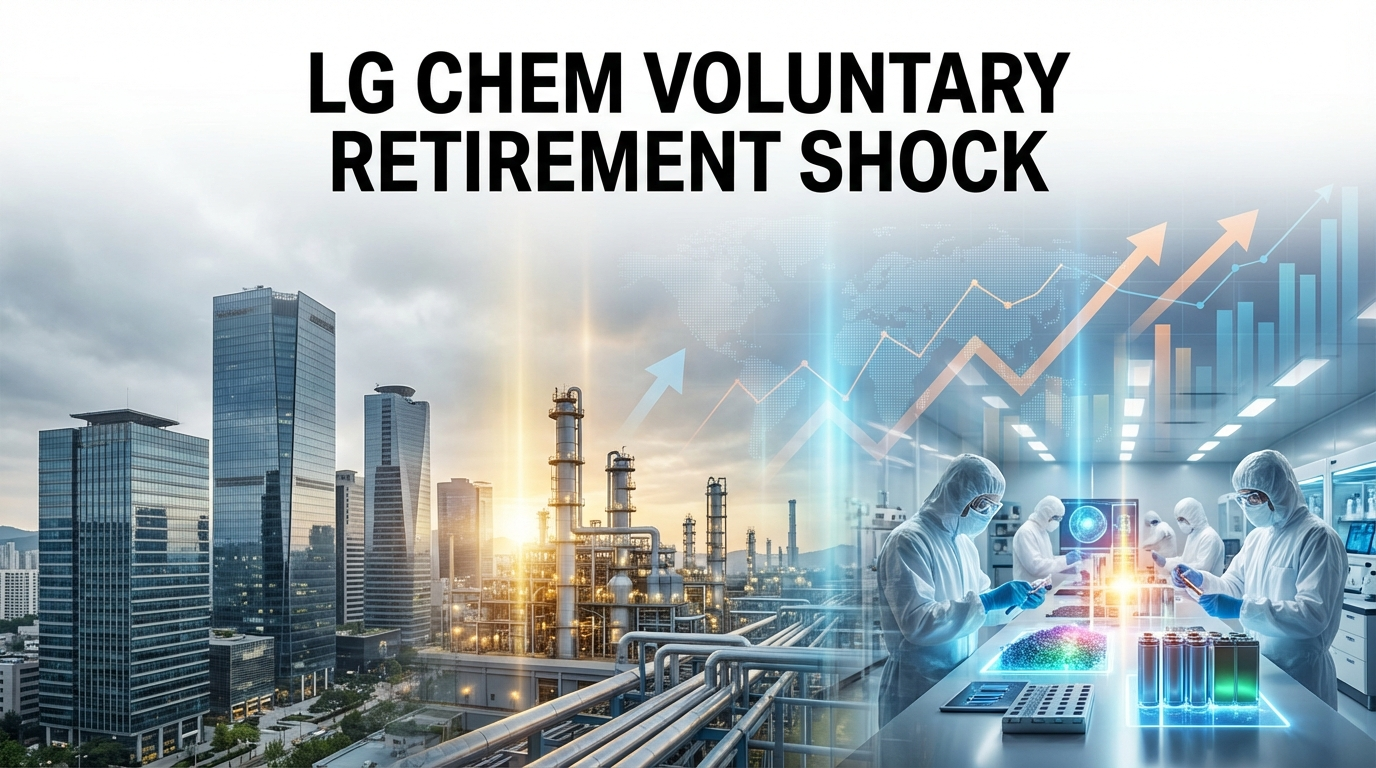

● LG Chem Silent Layoff Shockwave, Petrochem Slump Spills Into Battery Materials
LG Chem Expands “Voluntary Retirement for Those 55 and Older”—Why This Isn’t Just Simple Cost-Cutting but a Signal of “Business Portfolio Reshuffling” (Spreading from Petrochemicals to Advanced Materials)
This article includes the following key points.
– Why LG Chem’s voluntary retirement is being carried out in a “quiet manner,” and what that implies
– The real background behind restructuring spreading beyond the petrochemical downturn into advanced materials (the logic that matters more than the numbers)
– How to interpret the “paradox” of workforce adjustments emerging in future businesses like EV and secondary-battery materials
– A pattern that could spread beyond LG Chem to the broader Korean manufacturing sector (economic slowdown + high interest rates + weakening demand)
– A separate summary of the “single most important point” that other news/YouTube channels don’t explain well
1) News Briefing: What Happened (Fact-Centered Summary)
LG Chem is reported to have recently accepted applications for voluntary retirement from employees in its Advanced Materials division.
The company is said to be employees aged 55 or older, regardless of whether they are office or production workers.
According to industry chatter, the terms include
up to 50 months of salary as a retirement package.
For employees with three years or less remaining until retirement age, it appears the company will make up pay for the remaining period as a form of compensation.
In particular, the key point of this issue is that
it is being processed without an official company-wide announcement, using a method in which each vice president individually sounds out employees.
It is not mandatory, but internally it is reportedly being receive as a “restructuring signal,” and that’s the understand described.
LG Chem also had a precedent of implementing voluntary retirement within the Advanced Materials division last year.
However, this time, attention is greater because it seems less like a “one-off event” and more like a continuous workforce adjustment.
2) Why a “Petrochemical Downturn” Leads to Restructuring in Advanced Materials
On the surface, the starting point is weak petrochemical market conditions.
Petrochemicals are a main cyclical industry that takes an immediate hit from a global economic slowdown and weakening demand.
The problem is that it doesn’t end there.
When cash-generation weakens in petrochemicals, the entire company ends up touching “fixed costs” in other segments to maintain investment capacity.
Especially in an environment where high interest rates persist,
investment itself (facilities, R&D, CAPEX) becomes more burdensome, and as the time value of money rises,
companies tend to prioritize “defending cash flow” over “growth.”
In other words, it’s not “future business = unconditional expansion,”
but rather a phase where even future businesses get reordered in the short term based on profit-and-loss and cash-flow criteria.
3) The “Paradox” of Voluntary Retirement Emerging in Advanced Materials (EV/Secondary-Battery Materials)
Advanced materials are clearly an area LG Chem has a point as a “future growth engine.”
Materials tied to the EV value chain and the secondary battery space are indeed valid industries in the mid-to-long term.
Yet restructuring still appears, typically when the three factors below operate at the same time.
(1) Demand is growing, but the “pace of growth” has slowed
The long-term growth story for EVs may remain intact, but the short-term cycle can dip.
When the “ramp-up (capacity expansion effect)” a company expected is delayed, it tends to adjust costs first.
(2) CAPEX burden has increased
Because the materials industry tends to have a high share of production-line and process investment,
changes in the interest-rate environment hit investment less directly.
In such times, companies often pair “moderating investment speed + reducing fixed costs.”
(3) The “workforce structure” doesn’t match the business structure
As the business becomes more sophisticated, required capabilities change,
and if that gap cannot be fully closed through training, redeployment/reduction can occur.
In particular, voluntary retirement centered on those aged 55+ is used as an option to pursue both “capability-conversion costs” and “organizational slimming” at once.
4) Why This Voluntary Retirement Method Is a “Quiet Restructuring,” and the Market Signal
One of the most important lines in the article is “individual outreach without an official notice.”
This approach usually serves the purposes below.
– Minimizing external risk
It can immediately affect the stock price, bond market perceptions, partner trust, and employer branding.
Especially for large conglomerates, an “official announcement” itself becomes news, so there is a tendency to dampen the shock.
– Minimizing the cost of internal backlash
An official posting instantly creates a “restructuring frame” and spreads anxiety.
Individual contact can be a way to fill target headcount while reducing psychological friction.
– A pre-step to selection and focus (portfolio adjustment)
Companies first reduce labor/fixed costs to build stamina,
and then often follow with business reshuffling (line rationalization, reprioritizing investments, organizational integration, etc.).
5) Industry View: What “Unusual” Really Means
The industry reaction that “repeated voluntary retirement within a year is unusual even among LG affiliates”
is because it tends to lead to an interpretation that company-wide burdens are accumulating, not merely that one segment’s results are weak.
The burdens referred to here are typically bundled as a three-piece set.
Petrochemical downturn + high interest-rate environment + investment (CAPEX) burden
When this combination drags on, “cash-flow management” rises to the top of management priorities.
6) Key Watch Points Going Forward (From Company/Investor/Employee Perspectives)
(1) Whether voluntary retirement is “one-off” or “becoming routine”
It matters whether this is short-term efficiency work in a specific division,
or the beginning of an annual/routine slimming of the organization.
(2) Which teams within advanced materials are affected
Even within advanced materials, there is a big temperature gap between growth lines (expansion underway) and mature lines (margin pressure).
The direction of workforce adjustment reveals what the company sees as “core.”
(3) Tone changes in investment (CAPEX) messaging
In future IR/earnings releases, watch whether phrases like “moderating the pace of investment” appear more often.
This is often a leading signal that appears before the earnings numbers.
(4) Whether it spreads across the broader Korean manufacturing sector
It may look like a company-specific issue now,
but in a period where market conditions, interest rates, and demand are all pressured, similar voluntary retirement programs can spread to other firms.
7) The “Most Important Content” Other News/YouTube Channels Often Miss (Only the Essentials)
Key Point 1) The essence of this voluntary retirement is not “cutting labor costs,” but “buying time.”
It takes time for petrochemicals to recover or for advanced-materials investments to pay off.
To endure that period, the move is largely aimed at lowering fixed costs to stabilize cash flow.
Key Point 2) The “quiet method” likely means internal numbers (targets) have already been set.
Not issuing an official announcement is not necessarily spontaneous; it often happens when the process is more “managed.”
Targets by headcount/organization may be set, then filled through individual outreach.
Key Point 3) Restructuring in advanced materials may not be “abandoning the future,” but “right-sizing the future business.”
Markets tend to think future business equals unconditional expansion,
but in reality, when interest rates, demand, and competition change, even growth industries rework investment speed and cost structures.
Calling this a “business failure” outright can lead to a misread.
Key Point 4) A focus on those aged 55+ is less about “generational replacement” and more about “cost structure and job redesign.”
Senior employees have the major advantage of experience, but costs can rise in terms of wages, job fit, and deployment flexibility.
The faster AI, automation, and smart-factory transitions move, the more frequently these frictions appear.
8) One-Line Conclusion: How Should We Read the LG Chem Issue?
This voluntary retirement looks most realistically like a signal that, as the impact of the “petrochemical downturn” spreads into “advanced materials,”
LG Chem has entered a phase of company-wide structural improvement (reducing fixed costs + reprioritizing investments).
In particular, in a period where high interest rates and a global economic slowdown overlap,
the key point is that even future businesses are required to prove “short-term survival stamina.”
(SEO keywords: global economic slowdown, high interest rates, inflation, semiconductors, secondary batteries)
< Summary >
As signs emerged that LG Chem expanded voluntary retirement to employees aged 55+ even within its Advanced Materials division, restructuring signals have intensified.
With petrochemical weakness and a high-rate environment increasing CAPEX burdens, the situation is being interpreted as a shift where even future businesses reorder cost structures around short-term cash flow.
The “quiet method” without an official notice may be a signal of a managed approach to hit target headcount while reducing external shock.
[Related Posts…]
- Why the Petrochemical Downturn Is Rapidly Cooling and Restructuring Is Spreading Across the Industry
- Secondary-Battery Materials Investment: A Phase Where “Cash Flow” Comes Before “Expansion”
*Source: 서울경제TV