
● Korea 150T Growth War Chest – Samsung HBM4 Blitz – China 1T Surplus Shock – LG Qualcomm On Device Car AI Bomb
From the Government’s KRW 150 Trillion ‘National Growth Fund’ to LG–Qualcomm ‘On-Device In-Vehicle AI’… Three Key Issues Reshaping the Global Economy & AI Landscape Right Now
This article contains three major parts.
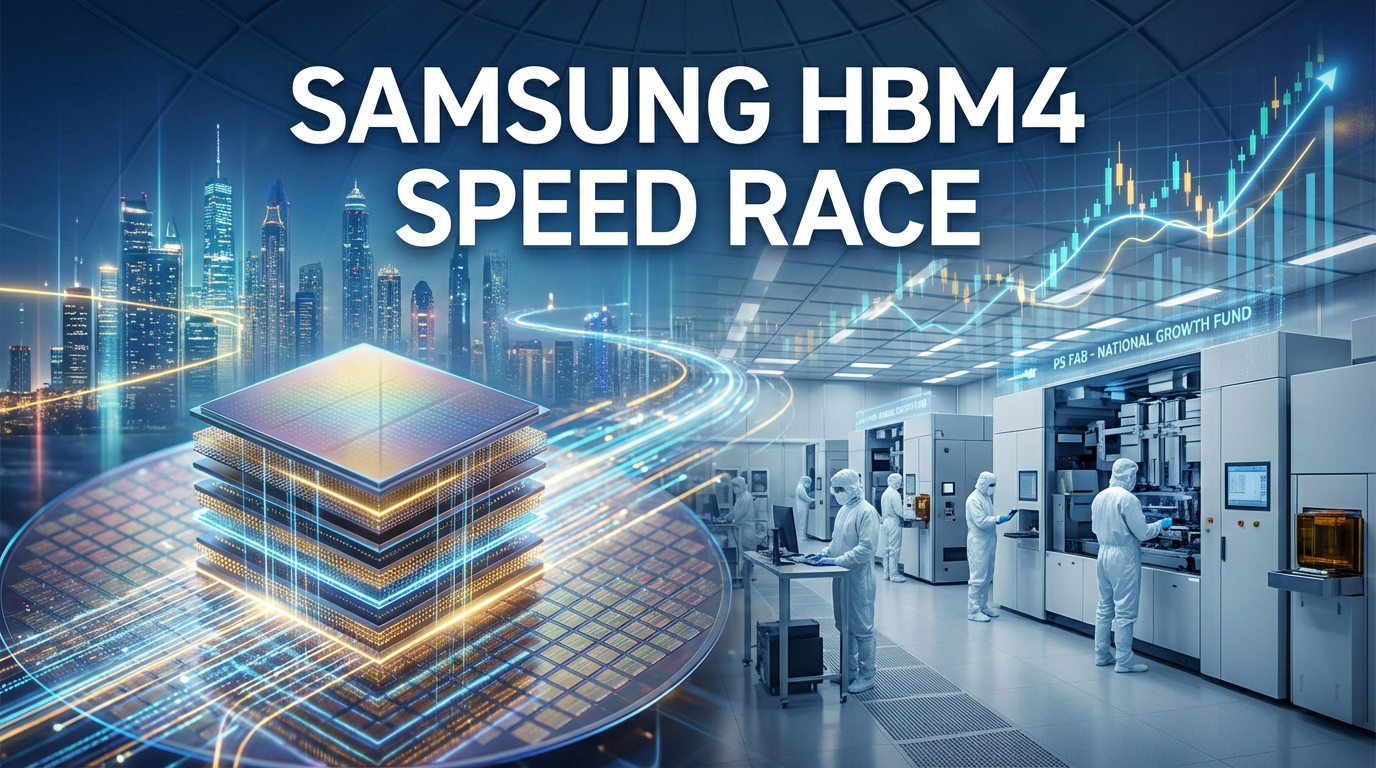
First, how the government’s ‘National Growth Fund (KRW 150 trillion)’ connects to Samsung’s Pyeongtaek P5 (discussions of up to KRW 3 trillion in low-interest loans) and why that accelerates the HBM4 speed race.
Second, why China’s ‘USD 1 trillion’ trade surplus is “not good news but a signal of structural imbalance” (including an IMF warning).
Third, how LG Electronics, joining hands with Qualcomm, unveiled an AIV platform that ‘runs generative AI inside the vehicle,’ and how the next phase after SDV opens up.
1) [Breaking-News Style] Government ‘National Growth Fund’ → Samsung Pyeongtaek P5… The HBM4 Mass-Production Speed Race Begins in Earnest
1-1. What Was Decisive: “Capital That Buys Time”
The government-led ‘National Growth Fund’ is interpreted as a mega-scale policy financing vehicle that will deploy a total of KRW 150 trillion into future industries.
Among this, the possibility is being mentioned that about KRW 2–3 trillion could be provided as low-interest loans to support funding for Samsung Electronics’ Pyeongtaek P5 fab construction.
The key is not “money,” but “time.”
With HBM4, winning means pulling forward the mass-production timeline to match customer timing (especially on the AI GPU side), so policy finance directly translates into delivery-date competitiveness.
1-2. The Meaning of P5: A Forward Base for the HBM4 ‘Mega-Fab’
P5 is being discussed as a key hub for HBM4 production.
It is said that Samsung has ramped up P5 construction in earnest since last month, and mentions suggest the total investment could be at least KRW 60 trillion.
In addition, the point is the flow of accelerating expansion speed by converting parts of P4 (some lines) toward HBM4 as well.
1-3. A Hint from Demand: A 2026–2028 “Peak” Outlook
The industry expects HBM demand could peak from next year through 2028.
Samsung is said to be targeting the 확보 of additional DRAM capacity of over 200,000 wafers per month through this expansion.
This should be read not as simple “capacity expansion,” but as evidence that the pace of AI data-center buildout continues to push HBM supply.
1-4. The Biggest Variable: Passing NVIDIA’s HBM4 Qualification (Qual)
The biggest variable is whether Samsung passes NVIDIA’s HBM4 qualification.
Recently, talk emerged that NVIDIA delivered a positive message to Samsung along the lines of “there will be good news,” and alongside that came observations that Samsung is at a “right-before-mass-production” stage.
If a contract/supply becomes visible, the possibility also opens for Samsung to reverse the dynamic in HBM4 after having lagged in HBM3 (with SK hynix in the lead).
1-5. Earnings Momentum: Semiconductor Operating-Profit “Leverage” Could Switch Back On
A KB Securities 전망 mentions the possibility that “Samsung’s Q4 semiconductor operating profit could increase more than fivefold year-over-year.”
HBM has strong effects from ASP and mix improvement, so once customer certification is cleared, earnings leverage can kick in quickly—this is the important point.
2) [Global Macro] China’s Trade Surplus Breaks ‘USD 1 Trillion’… Not an Achievement but an “Imbalance Warning Light”
2-1. The Number Is Record-Scale: Jan–Nov Surplus of USD 1.0759 Trillion
China’s goods trade surplus from January to November was tallied at USD 1.0759 trillion, and the flow suggests an end-of-year break above ‘USD 1 trillion’ is becoming a foregone conclusion.
On the surface it looks like “exports are doing well,” but markets have started reading it as risk instead.
2-2. The IMF Warning Point: “Not Domestic Demand Recovery, but a Deflation + FX-Illusion”
In line with the IMF Managing Director’s remarks, concerns are being raised that this surplus may be an illusion driven not by a domestic-demand recovery but by deflation and currency depreciation.
There is also mention that the yuan’s value has fallen to its lowest level against the euro in a decade.
A weaker currency can artificially make export price competitiveness look stronger, but it also becomes a trigger that amplifies trade friction.
2-3. Higher Probability of Global Trade Conflict: The Frame of “Undervalued Yuan = De Facto Export Subsidy”
The IMF warns that if China insists on export-led growth, global trade conflicts could intensify.
The U.S. and others can view an undervalued yuan as a “de facto export subsidy,” expanding room for responses such as anti-dumping tariffs.
In other words, China’s ‘USD 1 trillion surplus’ is more realistically interpreted not as proof of a healthy economic constitution, but as an imbalance signal that invites external conflict.
3) [China’s Internal Risks] ‘Hidden Local Government Debt’ + ‘Stronger Political Control’ as a Structure that Erodes Innovation
3-1. Hidden Local-Government Debt: Mentioned at “10 Quadrillion KRW”-Scale… A Fuse for Financial Stress
The risk is highlighted that China’s hidden local-government debt is at a very serious level (with mentions at the scale of “10 quadrillion KRW”).
This is not just debt; it can simultaneously pressure infrastructure, real estate, and finance, potentially becoming a form that drags on growth.
3-2. The Problem with Policy Direction: “Control + Tech Self-Reliance” Takes Priority over Private-Sector Vitalization
A bigger issue is the mentioned flow that the Xi Jinping government prioritizes political control and technological self-reliance over revitalizing the private sector.
Centralization and strengthened nationalism may look mobilizable in the short term, but in the long run they often weaken innovation engines and drive private companies away.
4) [Opportunity/Challenge for Korean Companies] Bio Tailwinds vs EV Offensive Shock
4-1. Opportunity: U.S. ‘Biosecurity Act’ Issue → Potential Spillover Benefits for Korea’s CDMO/Bio
Amid a flow suggesting the U.S. is nearing passage of a Biosecurity Act, mentions indicate Korean companies such as Samsung Biologics and Celltrion could see spillover benefits in the global market.
If value-chain restructuring aimed at reducing reliance on China leads to actual order shifts, the benefit for Korea’s bio sector could become clear.
4-2. Challenge: China’s Global EV Offensive → Pressure on the Domestic Market and Short-Term Shocks like “Withdrawal Rumors”
On the other hand, there is also a sense of concern that China’s global EV offensive could threaten the domestic market and even materialize into short-term shocks such as withdrawal rumors around foreign-owned firms like GM Korea.
Ultimately, Korean companies are in a phase where they must upgrade technological competitiveness, cost structure, and supply chains at the same time.
5) [Core AI Trend] The LG Electronics–Qualcomm Alliance: Unveiling an AIV Platform that Runs ‘Generative AI Inside the Vehicle’
5-1. Planned Reveal at CES 2026: After SDV Comes AIV (AI-Based Vehicle)
LG Electronics announced it will unveil a generative-AI-based vehicle platform in partnership with Qualcomm, and the first reveal is expected at CES 2026 next January.
LG’s direction is closer to a declaration that it will seize leadership by moving beyond SDV (software-defined vehicles) to AIV (AI-based vehicles).
5-2. Technical Point: “All AI Computation Processed Inside the Vehicle (On-Device/Edge AI)”
The platform is introduced as leveraging high-performance chips (mentioned as Snapdragon-based) to run VLMs (vision-language models), image generation, and LLMs inside the vehicle.
The advantages of this approach are clear.
Communication latency is reduced, personal-data leakage risk is reduced, and it operates stably even in tunnels/offline.
In other words, it moves beyond ‘connected features’ to ‘capabilities where the car itself understands and decides.’
5-3. Group One-Team Strategy: From Displays and Batteries to Vehicle Electronics and Data-Center Infrastructure
In the article’s flow, LG Group’s one-team strategy of consolidating capabilities around vehicle electronics is emphasized.
LG Display secured an international standard certification for automotive cybersecurity, and LG Energy Solution is also mentioned as actively joining the vehicle-electronics push.
In addition, a point is included that LG Electronics is also expanding its presence in the AI data-center infrastructure market.
6) Only the “Truly Important Points” That Other News/YouTube Often Miss—Summarized Separately
6-1. Support for Samsung P5 Is Not ‘Semiconductor Investment,’ but ‘Delivery (Timing) Finance’
The essence of policy finance is not to help CAPEX, but to pull forward HBM4 customer qualification and mass-production timing to “open the market window first.”
In the AI semiconductor race, six months is time that can change not market share but the ecosystem standard.
6-2. China’s USD 1 Trillion Surplus Doesn’t Mean “China Is Strong,” It Gives the World “A Reason to Block Harder”
More than the surplus itself, a surplus coupled with FX, deflation, and weak domestic demand strengthens each country’s logic for tariffs/regulation.
From the perspective of Korean companies, they must manage not only China-bound sales but also pricing pressure from China-driven supply glut at the same time.
6-3. LG–Qualcomm’s ‘In-Vehicle Generative AI’ Is Not Just a Convenience Feature, It’s a Fight Over the “Data Sovereignty” of Automotive Software
On-device AI connects to the issue of “where processing happens and who owns” personal information, driving data, and user behavior data.
The more cloud dependence is reduced, the more negotiating power shifts for automakers/parts suppliers, and in the long run it can even change subscription-based service revenue structures (in-car AI, infotainment, insurance/maintenance).
7) Five Core SEO Economy Keywords Naturally Included in This Article
Inflation
Interest rates
Exchange rates
Global supply chain
Semiconductor investment
< Summary >
Samsung could be more likely to pull forward HBM4 mass-production speed at its Pyeongtaek P5 thanks to discussions around low-interest funding from the government’s ‘National Growth Fund,’ and the key variable is passing NVIDIA’s HBM4 qualification.
China’s USD 1 trillion trade surplus is not good news but an imbalance signal caused by deflation and an exchange-rate illusion, and it could intensify trade conflicts.
LG Electronics, together with Qualcomm, is targeting the post-SDV market with an AIV platform that runs ‘generative AI inside the vehicle,’ and a group-level one-team strategy in vehicle electronics is being strengthened.
[Related Posts…]
The HBM4 War: Why Korea’s Semiconductor Investment Landscape Is Changing
Three Risks Exporters Should Check in a Phase of Rapid FX Volatility
*Source: 서울경제TV