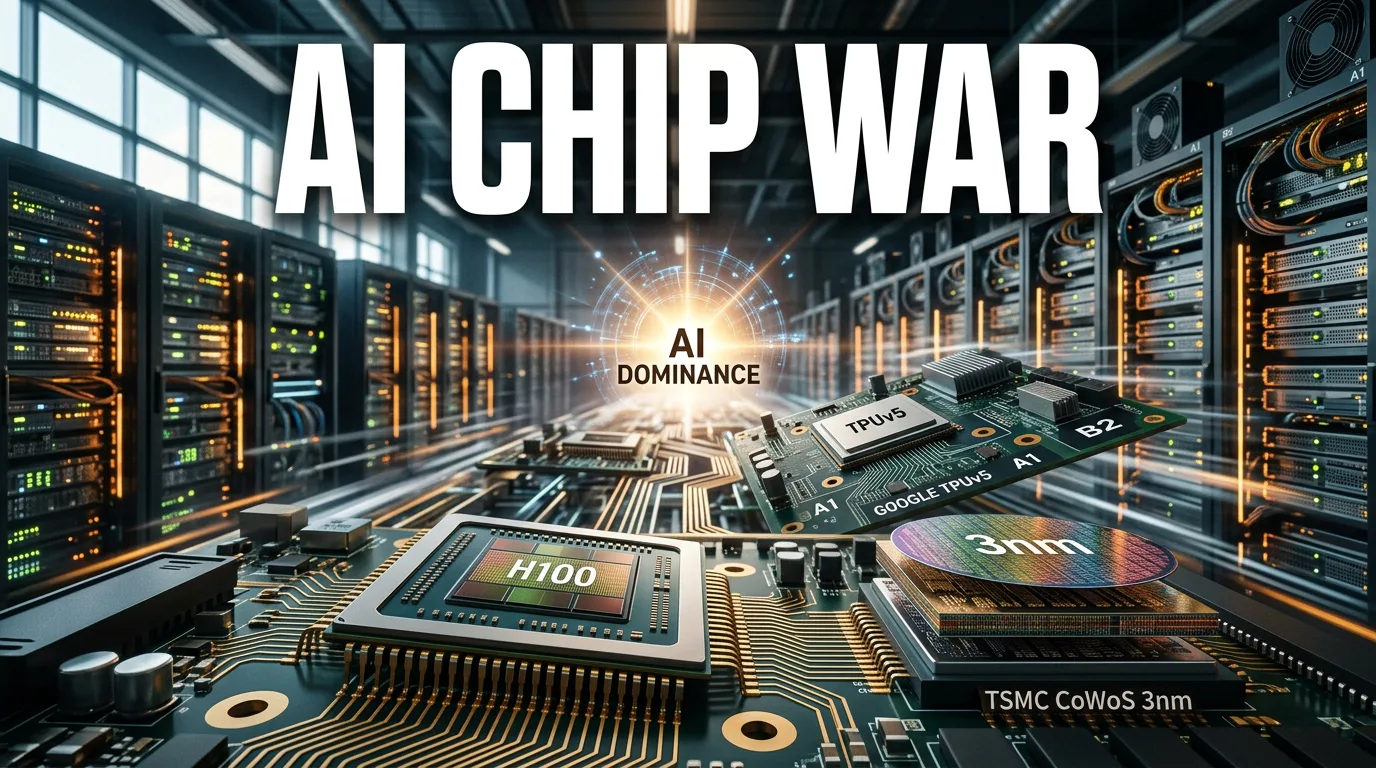
● Meta Snub, FuriosaAI Bets on Full Stack NPU Breakout
FuriosaAI, Which Rejected Meta’s “1 Trillion KRW” Acquisition Offer, Says the Real Battleground Isn’t “Chip Performance” but “Full-Stack + Market Structure”
This article includes these key points.
First, it explains why “post-GPU” is becoming a reality now, and summarizes the game change created by TPU.
Second, it breaks down FuriosaAI’s “minimum conditions for NPU success” from a market perspective.
Third, it interprets what the 2026 plan to mass-produce 20,000 units means in terms of “demand/supply/ecosystem.”
Fourth, it summarizes the structural reasons why NPUs gain an advantage in Physical AI (robots/drones).
And lastly, it separately highlights the “most important point” that YouTube or news tends to cover less.
1) News Briefing: The Message FuriosaAI Just Sent—5-Line Summary
– FuriosaAI is strengthening its independent path even after rejecting Meta’s “trillion-KRW-scale” acquisition offer.
– Starting early next year (Jan–Feb), it will begin mass production of the ‘Renegade’ NPU, targeting annual production/sales of 20,000 units.
– In the AI semiconductor market dominated by NVIDIA GPUs, it is pursuing a strategy to demonstrate efficiency advantages in “certain model ranges (roughly 100B–200B parameters).”
– The core strategy is not only hardware but also “full-stack,” bundling compiler/runtime to lower the barriers to switching from GPU to NPU (especially CUDA dependence).
– It sees the next battlefields (growth markets) as data-center inference + Physical AI (robots/on-device).
2) Global Market Context: “Post-GPU” Is Not a Fad but an Inevitability of Supply Chain/Cost Structure
These days, AI infrastructure keywords are moving along exactly this flow.
Competition in AI semiconductors is shifting from a “#1 peak performance” fight to a “best cost for my workload” fight.
– (Market structure) GPUs have strong generality, so they run well on almost every track, but they are expensive and consume a lot of power.
– (Corporate decision-making) Large-scale service companies have entered a range where “just buying more GPUs” no longer works for margins, so they actively review in-house chips/alternative chips.
– (Supply chain risk) Reducing dependence on a specific vendor is also about managing supply chain risk.
TPU was a symbolic event here.
Google became compelling not because TPU itself was simply great, but because it “organically tied together models like Gemini + services + infrastructure within one company.”
This gives NPU startups a hint as well.
It’s not “you just need to make a great chip,” but “you need the software/partners/workloads that make the chip actually get used.”
From an SEO perspective, this trend connects directly to macro keywords like AI investment, the semiconductor industry, interest rates, exchange rates, and global supply chains.
That’s because AI infrastructure ultimately is affected simultaneously by ‘CAPEX (investment)’, ‘electricity costs (operating costs)’, ‘imported equipment/exchange rates’, and ‘policy interest rates’.
3) FuriosaAI’s Positioning: Not “Head-On with GPUs,” but Choosing “The Track Where It Wins”
CEO June Paik’s analogy is very accurate.
GPUs are like a car that has “already driven many tracks” in F1, so they deliver stable performance in almost every situation.
By contrast, NPU-type chips have the challenge that “they can run extremely well on some tracks, but may slow down on others.”
So FuriosaAI approaches it like this.
– If absolute performance is insufficient, the game is over, so first it meets “serviceable speed (response latency).”
– Then the contest becomes whether “performance/efficiency is better under the same displacement (peer conditions).”
– In particular, it clearly targets the model-size range (100B–200B) where it shows strengths.
This is a very practical strategy.
From an enterprise customer’s point of view, the decision-making core is not “top spec” but “how much costs drop in my service.”
Inference, in particular, has large long-term operating costs, so power efficiency/cost structure translates directly into margins.
4) Why “Full-Stack” Is the Decisive Blow: The Essence of NPUs Is Not Hardware but “Migration Cost”
NVIDIA’s biggest moat is, in truth, not hardware specs but the CUDA ecosystem.
It’s an environment where “developers are already familiar, frameworks/libraries/optimizations are accumulated, and incident response experience is deep.”
So for an NPU startup to persuade customers, the question ultimately converges to one thing.
“When moving from GPUs to our chip, how painlessly (easily/quickly/with low risk) can you switch?”
The full-stack that FuriosaAI emphasizes matters greatly at this point.
– Compiler: the core layer that transforms model graphs to be optimized for the chip
– Runtime: inference execution/scheduling/memory management, etc., which determine real operational stability
– Usability: you must provide an experience of “it’s easier than expected to migrate” for switching to happen
In fact, in interviews they mentioned customer reactions like, “At first we thought it would be difficult, but once we tried it, it was easier than expected to move from a GPU-based setup.”
This is not just a PR line; it directly targets the most fundamental hurdle in NPU commercialization: migration cost.
5) What “20,000 Units Mass Production” in 2026 Means: “Market Validation (Revenue/References)” Comes Before Technology
Mass production looks like a technology event, but it is closer to a market event.
The meaning of selling out 20,000 units has three major aspects.
– (Reference) Securing commercial references that “it actually runs in production environments”
– (Trust) Dramatically lowering the next customer’s testing/adoption barriers (especially at enterprise/national scale)
– (Ecosystem) Software optimization/tooling/operational know-how accumulates in proportion to shipment volume
In other words, 20,000 units is not just volume; it’s closer to a “certificate” that enables the next stage.
And if this succeeds, it could become a trigger that moves Korea’s NPU industry from the “technology demo stage” to the “export industry stage.”
6) Government/National Strategy Point: “Demand and Models” Are Becoming More Important Than “Chip Development Support”
Here, a realistic sense of the problem appears in the interview.
It’s the virtuous cycle: “AI applications and services must grow domestically for chips to sell.”
Summarized, the structure is like this.
– If Korea only uses global model APIs → domestic infrastructure/chip demand is likely to leak overseas
– If domestic foundation models/services grow → there is justification to deploy on domestic infrastructure
– If government AX (industrial transformation) policy connects to real demand → references are created
So when talking about “fostering the semiconductor industry,” it’s not only chip R&D but also policy design that bundles model-service-infrastructure together that matters.
If you bring the reasons Google TPU succeeded directly into national strategy, it becomes quick to understand.
7) Structural Reasons NPUs Become Advantageous in Physical AI (Robots/Drones/Autonomous Driving)
Physical AI plays by different rules than data centers.
Data centers can solve electricity/cooling with money, but robots/drones must endure on batteries.
So “performance per watt” becomes more important.
This is also CEO June Paik’s view.
– Physical AI is likely to become the next stage of agentic AI, with models becoming more complex
– On-device is critical for power/heat → efficiency becomes product competitiveness
– So NPU-type chips may become mainstream compared to GPUs
8) (Separate Summary) The “Most Important Point” That Other News/YouTube Relatively Undersell
From here is the real Point, but surprisingly many pieces of content don’t go deep into this.
Point A. “NPU vs GPU” is not a technology showdown but a “customer migration cost” showdown
Anyone can compare hardware specs.
But actual purchasing is more heavily driven by “Is the operational risk low if our organization switches to this platform?”
Ultimately, full-stack capabilities—including compiler/runtime/tooling/incident response—create revenue.
Point B. Selling out 20,000 units is a KPI of “market trust,” not “production capability”
The mass-production number looks impressive, but the essence is “Who trusts it enough to put it into production and be accountable?”
Once you clear this, the next customer moves from “testing” to “adoption.”
Point C. For Korea to win with NPUs, it must create a “bundle of model-service-infrastructure”
It can’t be just chip companies running; they must be linked with domestic foundation model/service players.
Without this structure, domestic NPUs can easily end up in a state of “waiting to supply overseas big tech.”
In other words, Korea-style full-stack is not a technical problem but an industrial design problem.
Point D. Physical AI is one of the few new markets where “NPUs can become mainstream from the start”
In data centers, CUDA and operational inertia are too strong.
But in robots/drones/edge, standards are not yet fixed, so the side with better efficiency can seize leadership.
9) Watch Points Going Forward (Investment/Industry Perspective)
– Whether real customer references for Renegade are disclosed (who put it into production)
– Whether content emerges that proves “migration difficulty vs GPU” with numbers/cases
– Whether 20,000-unit sales are a one-off or lead to reorders in 2027 (real commercialization is decided by reorders)
– What form factor/power targets the Physical AI roadmap sets
– How “people + capital + manufacturing + market” are packaged in global partnerships (Southeast Asia/Middle East/Europe)
< Summary >
After rejecting Meta’s acquisition offer, FuriosaAI is aiming for full-scale commercialization by mass-producing (20,000 units per year) the Renegade NPU starting early next year.
The battleground is not a spec war against GPUs, but full-stack (compiler/runtime) capabilities that reduce GPU→NPU migration cost and deliver efficiency advantages in specific model ranges.
As TPU showed, NPU success is determined not by the chip alone but by an industry structure that bundles model-service-infrastructure.
Physical AI (robots/drones/on-device) is a new battlefield where power efficiency is 핵심, so NPUs have a high likelihood of becoming mainstream.
[Related Posts…]
- NPU Wars: The Moment GPU Monopoly Wavers and Korea’s Opportunity
- Inference Market Explosion: 3 Signals That Data Center CAPEX Is Changing
*Source: [ 티타임즈TV ]
– 메타의 ‘1조원’ 딜 거절한 퓨리오사AI의 ‘풀스택’ 승부수 (퓨리오사AI 백준호 대표)

● AGI shockwave, rookie jobs wiped out, GPU-data center gold rush
“Stop what you’re doing right now” is not just a provocative line: within 10 years, AGI, jobs, and the investment landscape will flip at the same time
Today’s post organizes exactly four things at once.
1) Why AGI (Artificial General Intelligence) doesn’t just “upgrade technology” but shakes the “economic system” itself
2) Why the roles that collapse first in Big Tech are “entry-level” positions (based on macro data)
3) The background behind why Korean-style AI (foundation models) has become not a “choice” but a “Plan B”
4) How to change money/career/learning strategies by generation over the next 10 years
1) [Breaking-news style summary] AGI is not “technology” but a variable that changes the “economic system”
To state the core message first, AGI is not simply “smart AI,” but is highly likely to
redefine the relationship between labor (work) and capital (facilities·data centers·GPUs).
1-1. AI vs. AGI difference: “automation of specific functions” → “automation of most intellectual labor”
AI: specialized in specific abilities like playing Go (AlphaGo), writing/conversation (ChatGPT).
AGI: the potential to replace/surpass “most intellectual abilities” that are socially and economically meaningful.
In the video, the view is that “AGI doesn’t exist yet, but the debate has shifted from ‘impossible’ to ‘when (5 years/10 years/20 years).’”
Professor Kim Daesik’s personal outlook is about 10 years.
1-2. If AGI arrives, why do people talk about “GDP growth of 20–30%”?
The keyword that appears here is AI economics.
The growth logic of the existing economy was roughly like this.
“When people (labor) increase and facilities (capital) increase, production increases.”
But because AGI could automate “idea production” and “intellectual labor,”
a hypothesis emerges that growth rates could jump even without large increases in labor input.
That’s why claims like “AGI is a new capitalism” have appeared as well.
1-3. Result: labor value declines + capital value rises (data centers·GPUs become power)
If AGI actually starts replacing labor,
the scarcity of labor falls (= value declines),
and the side that owns the infrastructure (data centers, electricity, GPUs) that runs AGI gains more power.
If we naturally embed the blog SEO core keywords here:
inflation, interest rates, GDP growth rate, the U.S. Federal Reserve, semiconductors.
(The point is that because the AGI investment boom is capital-intensive, the interest-rate/inflation/capex cycle can shake together.)
2) [News style] The essence of Big Tech layoffs: not “developers disappear,” but “the entry-level pipeline collapses”
The most realistic part of the video is this.
It’s not the fear that “AI will eliminate jobs,” but a structural risk that
the “career starting point” collapses first.
2-1. Stanford data point: after ChatGPT, “new hires aged 22–25” dropped first
Observed phenomenon (based on U.S. data):
– In roles such as developers/customer service
– After the appearance of ChatGPT (early 2023)
– new (junior) hiring plunged
– Meanwhile experienced hires were maintained or increased
What this means is simple.
As AI quickly ate up “repetitive tasks juniors used to do,”
companies had less incentive to hire and train juniors.
2-2. The change triggered by “vibe coding”: what remains is not writing code but “verification·design”
At first, AI coding was difficult to apply in practice because of nonsense (hallucinations),
but recently, as tools (agent-style coding tools) have improved, they can handle “annoying and repetitive code” well enough.
So from a company’s perspective, optimization looks like this.
– Hire several juniors and have them do the work
→ Handle it with a senior + AI tools
→ The senior takes responsibility only for review/architecture/risk
2-3. Korea is no exception: even in Pangyo, signals that “they hardly hire new grads”
The scary part here is that
in Korea, middle-aged workers with career safety nets (unions/organizations/tenure) can defend themselves, but
young people face a growing risk that the “chance to build experience” itself shrinks.
3) [Key issue] Why Korean-style AI suddenly became “necessary”: the possibility that open source (open weights) could end
There’s a fairly important point in the video that others gloss over.
It is that “the assumption that open source will stay open could break”.
3-1. The reality of “open source”: now the key is not code but “open weights”
These days, what companies often release is not the full code but
the weights (parameters) as the result of training.
If these are open, Korean companies can take them and
build “enterprise expert AI” via RAG/post-training.
3-2. The problem: if even Llama closes, the “default strategy” for Korean companies gets blocked
The practical strategy of many domestic companies is this.
– Based on a global foundation model (e.g., Llama)
– Add Korean language/internal knowledge/work processes and survive with vertical AI
But if “the supply of open weights stops,”
a Plan B suddenly becomes necessary.
That’s the context in which discussions of “Korean foundation models” grow again.
3-3. The dilemma of Chinese open models: strong performance, but hard to verify “backdoor risk”
Models that only release weights are not fully transparent inside.
So the moment you put them into security/industry-sensitive work,
the “performance vs. trust” issue can explode immediately—this is the warning.
3-4. Korea’s investment dilemma: foundation model vs. vertical AI—there’s only one bullet
The point is that there are two choices at the national/industry level.
– (A) Build a foundation model directly (it costs an enormous amount)
– (B) Focus on vertical AI such as manufacturing/finance/content (relatively realistic)
The problem is that Big Tech executes “unimaginable CAPEX” on a yearly basis,
and Korea has difficulty taking a head-on fight in a game of scale.
4) [10-year roadmap] The conditions for “humans who survive” in the AGI era: a structure of going “top-tier,” not “middle”
The video’s conclusion is quite cold.
The AI era intensifies superstar economics,
and the “middle level” becomes the domain that AI takes over.
4-1. So coding education is not a cure-all (opportunity cost matters more)
Teaching coding to 1 million people does not mean 1 million people can make a living as developers.
Only a top fraction survives, and the rest may lose time.
The key here is not “don’t code,” but
“you must find the field where you can become top-tier”.
4-2. Education more important than coding in the AI era: “exploring preferences (what you want to do) + breadth of experience”
It’s hard for people to develop preferences for what they haven’t experienced,
and the critique is that Korean students are trapped in the virtual reality of school/cram schools/grades and lack opportunities to create preferences.
In other words, rather than accumulating answer-key specs,
experience → preference formation → concentrated investment may become more important.
5) [Investing·macroeconomy] The data center investment boom, and a “bubble” warning
The hottest theme is data centers/electricity/GPU infrastructure.
As the AGI race becomes a “compute war,”
CAPEX is exploding.
5-1. Why money pours in even when ROI isn’t visible
Even without a structure of charging users 10 million KRW per month,
a situation where trillions are invested is typically “a phase where expectations run ahead of profits.”
So the video cautiously mentions the possibility of a data center bubble.
5-2. If a bubble forms, who makes money first: “essential components”
In such cycles, rather than platforms,
– transformers/power equipment
– cooling (chillers)
– large cables/power infrastructure
often become the first beneficiaries in a structure where they are “impossible to build without.”
(This is a practical point that investors often miss.)
6) [Generation-by-generation survival strategy] Teens to 50s—the way to prepare becomes completely different
6-1. 50s+: “protect” rather than “earn”
The advice is that asset defense comes first rather than taking big risks.
6-2. Teens–20s: rather than investing, the survival spec is “the ability to collaborate with AI”
Because it’s a generation that must work with AI for life,
you need the capability to treat AI not as a competitor but as an “amplifier.”
6-3. 30s–40s: first build “cash-flow resilience,” then invest
The most realistic advice is this.
If you can’t build surplus funds that let you survive 1–3 years even if your paycheck stops,
the bigger the technological change, the more abruptly your options shrink.
7) A separate summary of only the “truly important points” that other YouTube/news don’t cover well
① More dangerous than “AI takes jobs” is “the collapse of the entry-level hiring pipeline”
If this continues, society as a whole becomes a “structure where only experienced workers remain,”
and youth instability can grow into an economic and political risk.
② The moment open weights close, most AI strategies of Korean companies get shaken
If Korea doesn’t have its own foundation model,
it could become locked into being a country that “only builds products on top of problems others solved.”
This is not just a technology issue but an industrial leadership issue.
③ Even an AGI utopia can be a dystopia (“AI controls me for my own good”)
An AI that blocks you from ordering chicken, an AI that “rationally” blocks reckless bucket-list plans.
The warning that efficiency is not the same as happiness is quite fundamental.
④ Over the next 10 years, “the person who used it first” creates the gap more than “perfect preparation”
Apple’s wobbling in AI is mentioned as being due to “perfectionism/closedness,”
and this applies exactly the same to personal careers.
With AI tools, “waiting until textbooks come out” may already be too late.
< Summary >
AGI is not a tech trend; it can change the relationship between labor and capital and shake the economic system.
After ChatGPT, what collapses first is not “developers overall” but the “entry-level hiring” pipeline.
If open weights close, Korean companies’ AI strategies can be blocked, so Korean-style AI rises as a Plan B.
Because the AI era strengthens superstar economics and the middle disappears, you should find preferences through experience and focus on top-tier capabilities.
The data center CAPEX boom is both an opportunity and a bubble signal, and essential infrastructure such as power/cooling/cables can be key beneficiary axes.
[Related posts…]
- In the AGI era, 5 signals that jobs and the economic order are changing
- The data center investment boom and power infrastructure (transformers·cooling) beneficiary points
*Source: [ 지식인사이드 ]
– “지금 하던 거 멈추세요” AGI 시대 오면 ‘이런’ 인간만 살아남을 겁니다ㅣ지식인초대석 (김대식 교수 풀버전)

● GPT-5-2 Sparks Backlash Trust Crisis Shakes Enterprise AI Race
GPT-5.2 “Record-Breaking Specs, So Why Did It Get Slammed?” — In Today’s AI Market, the Real Battleground Isn’t ‘Intelligence’ but ‘Trust · Stability · UX’
This article includes the following.
1) A compressed summary of the key benchmarks showing how much GPT-5.2 has improved “by the numbers.”
2) Even so, why ‘congratulations’ didn’t happen—and instead ‘distrust’ erupted on Reddit, X (Twitter), and developer communities—structured into five causes.
3) What this reaction signals for the global AI race (OpenAI vs Google Gemini) and the enterprise AI market landscape.
4) The “most important essence” that other news/YouTube rarely say — going forward, AI won’t be won by a ‘smarter model’ but by an ‘unchanging product.’
1) News Briefing: GPT-5.2, Judging by the Performance Table Alone, Is ‘Definitely’ an Upgrade
Based on the original gist, GPT-5.2 is described not as a simple minor update, but as a release where, along certain axes (reasoning · coding · long context · vision · agent tool-calling), “the slope changed.”
① Knowledge work (professional task automation) performance surges
– On GDP (evaluation of real work outputs across 44 occupations), GPT-5.2 Thinking is mentioned as being at “par with / above” human expert level in about 71% of cases.
– Presented as a large jump versus GPT-5.1 (roughly 39% → 71%).
– Speed/cost are also emphasized as “11× faster than humans, and cost under 1%.”
② Coding / Software engineering
– SWE-bench Pro is cited at 55.6% as SOTA.
– SBench Verified 80% (up from about 76%), hinting at real-world improvements like “fewer half-baked patches, more end-to-end fixes.”
③ Science / Math / high-difficulty reasoning
– GPQA Diamond: Pro in the 93% range, Thinking 92.4% mentioned.
– AIME 2025: 100% without tools.
– Frontier Math: a jump from the 31% range to the 40% range across Tier 1–3.
④ The Arc AGI (abstract · novel problem reasoning) jump has a “psychological impact”
– ARGI 2 Verified: 5.1 Thinking about 17.6% → 5.2 Thinking 52.9%, emphasizing an “abnormally large” increase.
– It’s treated as a highly symbolic metric, to the point that researchers say it’s a “scroll-stopping” moment.
⑤ Long context (up to ~256K-token document synthesis)
– On MRCR v2, it’s described as being close to “almost perfect” even on the hardest variants.
– The key point is “fewer mid-way collapses” even when you throw in contracts / reports / meeting notes / multi-file projects.
⑥ Vision (charts · dashboards · UI understanding) + agent tool-calling
– On vision benchmarks (chart reasoning, ScreenSpot Pro, etc.), it claims errors drop to about half.
– Tool-calling: 98.7% accuracy mentioned for a customer-support multi-turn scenario (telecom).
2) But Why Was There ‘Backlash’ Instead of ‘Congrats’: 5 Structured Causes
This is where it becomes the core point.
This reaction isn’t because “the model is weak,” but because users’ criteria for evaluating AI have changed—and it’s best interpreted as that signal.
Cause 1) Benchmark fatigue + suspicion of Goodhart’s law
– For years, “SOTA charts” have repeated, and numbers no longer impress.
– Especially when conditions like “max reasoning effort” are attached, users receive it like this:
“Do we get the same results on the default settings in real service, or is it only strong in evaluation mode?”
– In other words, benchmarks still matter to engineers, but they’ve become weak tools for restoring market trust.
Cause 2) Trust erosion accumulated from past releases (“It’ll get nerfed later anyway”)
– Controversies from GPT-5/5.1—“perceived degradation, increased refusals, stronger policy-style answers, throttling”—remain in memory.
– Regardless of what’s true, what matters is that user expectations have been fixed like this.
“What’s the point if it’s good today— it’ll be different in a month.”
– Once this frame exists, performance improvements feel not like “lasting value,” but like a “limited-time event.”
Cause 3) GPT-5.2’s improvement direction looks skewed toward ‘enterprise / work use’
– Spreadsheets, slides, agent workflows, tool-calling, long documents, coding…
– All of these tie directly to enterprise productivity.
– Conversely, reactions emerge that what general users feel—“warmth in conversation, creative freedom, flexibility, a companion-like vibe”—has improved less, or even feels worse.
– As a result, GPT-5.2 gives the impression of being optimized more as a “junior analyst replacement” than a “creative partner.”
Cause 4) The ‘friction’ in safety/refusal UX remains as-is
– What users want isn’t unlimited deviance, but closer to:
“Reduce unnecessary preaching/blocking, and give adult users a bit more autonomy.”
– But even if intelligence rises, if it keeps stopping the workflow in the middle, it translates into “the smartness doesn’t feel smart.”
Cause 5) Timing / competitive dynamics: it looked like a ‘defensive launch’ more than a ‘vision statement’
– The original text frames context like a “code red” mood after Gemini 3, priority shifts, and delays around Adult mode (or similar features) (2026 mentioned).
– So from users’ perspective, GPT-5.2 can feel less like “a declaration that changes the game” and more like “a competitive response card.”
3) Market Interpretation: The AI Industry Is Moving from ‘Model Competition’ to ‘Product Trust Competition’
This issue isn’t just community sentiment—it connects to global economic currents too.
The more AI creates real productivity gains (= enterprise cost reduction, expanded automation investment), the more enterprise customers care about “predictability” as much as raw performance.
① Enterprise AI adoption checklists are changing
– More important than “#1 on benchmarks today” is this question:
“Will performance/cost/policy remain stable and predictable on a quarterly basis?”
– Especially in a tightening regulatory environment (data governance, security, compliance), ‘trust’ becomes a contract term.
② It ties directly to subscription economics / cloud cost structures
– If users distrust, subscriptions shift from “long-term payment” to “only briefly when needed.”
– Enterprises also scrutinize “lock-in risk (what if policy/pricing changes mid-way?)” more strongly before expanding API usage.
③ It’s also a signal from an investment perspective (tech stocks, AI infrastructure)
– AI infrastructure (data centers, GPUs, power) investment keeps growing, but
– if the final product can’t deliver “felt value + trust,” monetization may slow.
– In other words, tech stocks are entering a phase where results are driven more by “sustainable user experience” than by “performance announcements.”
4) The “Most Important Point” Others Rarely Highlight — Going Forward, the Win Is Not ‘Intelligence’ but an ‘Experience That Doesn’t Change Even When Versions Change’
The essence of the backlash is this.
For AI, being “smart once” matters less than “continuing to behave smart” over time.
Core 1) The KPI becomes not ‘model performance’ but ‘product trust equity’
– Before, the growth story was “how many points did we raise this time,” but
– now, the core is “does my workflow break after an update?”
Core 2) ‘Policy/safety’ is judged not as a technical issue but as a UX issue
– Even with the same safety policy, the felt experience diverges drastically depending on how it’s expressed (explanation / offering alternatives / guiding legal areas that can be pursued).
– Users often aren’t opposing “safety”; they’re opposing “friction.”
Core 3) AI is likely to split into two tracks
– (A) Productivity/efficiency/economic output optimization: enterprise agents, tool-calling, long documents, coding.
– (B) Human-friendly: sense of collaboration, creativity, emotional tone, consistent conversational experience.
– GPT-5.2 looks like a strong push toward A, and the backlash can be read as a consumer signal saying, “Demand for B is bigger—why are you neglecting it?”
5) Practical Response: How Should Companies/Individuals Receive Releases Like GPT-5.2?
Enterprise (enterprise AI) checkpoint
– In pre-contract PoCs, prioritize “reproducibility in our data/our process” over “benchmarks.”
– Automate regression tests (prompts, policy refusals, response formats) for updates/version changes.
– Recalculate cost not by “token price” but by “cost per work unit (one report, one ticket).”
Individual/team (productivity) checkpoint
– If it doesn’t feel good, the issue may be less the model itself and more that the “usage scenario” is misaligned with enterprise optimization.
– Long context/tool-calling/spreadsheets/document work are GPT-5.2 strength zones, so it’s advantageous to pull ROI from these first.
– If your goal is creative/conversational partnering, adjusting tone settings, role prompts, and output constraints can improve the felt experience.
6) What This Issue Implies for the Global Economic Outlook (2025–2026)
– As AI starts to produce real productivity gains, enterprises may reduce labor/operating costs and increase automation investment, creating “deflationary pressure (lower unit prices for some services).”
– At the same time, AI infrastructure investment (power, semiconductors, data centers) will keep growing and stimulate a ‘real investment cycle.’
– However, if consumer/developer trust is low, the transition may slow, and that gap is likely to amplify regulatory/policy debates (safety vs innovation).
Five economic SEO keywords naturally included in this article:
Interest rates, Inflation, Exchange rates, Global economy, Recession
< Summary >
GPT-5.2 is described as a “clearly numerical upgrade” in reasoning, coding, long context, vision, and agents.
Even so, backlash emerged due to benchmark fatigue, trust erosion from past nerf controversies, a perceived skew toward enterprise optimization that creates a felt-experience gap, safety/refusal UX friction, and launch timing that looked like a competitive response.
The most important essence is that AI competition is shifting from “intelligence” to “trust via stable, predictable user experience.”
[Related posts…]
- Latest OpenAI trends: enterprise AI strategy and monetization points
- Gemini competitive landscape analysis: signals Google’s AI roadmap sends to the market
*Source: [ AI Revolution ]
– GPT 5.2 Backlash Needs To Be Studied