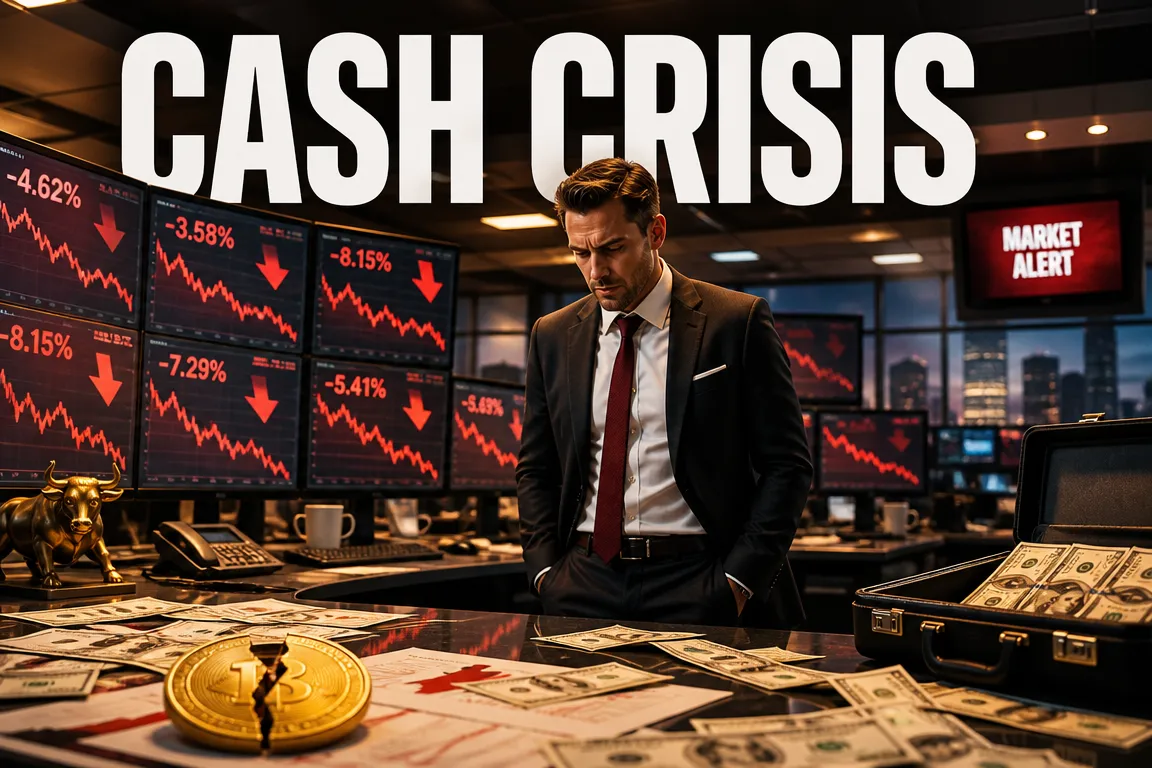
● Oracle-Broadcom Shockwave Sparks Nasdaq Rout, AI Credit Crunch Panic, 2026 Breakout Ahead
Oracle/Broadcom “Shock” Overstated? The Actual Drivers Behind the Nasdaq Selloff and the AI Battleground Through 2026
This report covers:1) Why the Oracle/Broadcom headlines were not, by themselves, a “crash signal,” and what the market actually repriced
2) Why the Nasdaq weakened while the Dow and cyclical stocks were comparatively resilient (the core of sector rotation)
3) How year-end positioning and triple witching mechanically amplify volatility
4) Why “AI is over” narratives are likely overstated: implications of U.S. Department of Defense and U.S. Navy operational deployment
5) Why 2026 could mark a structural shift from “concentrated winners” to broader AI diffusion across sectors
1) Weekly market summary: Apparent “Nasdaq plunge” versus a shift in market leadership
[News brief]
- Late in the week, Oracle (ORCL) and Broadcom (AVGO) headlines acted as catalysts for selling pressure concentrated in technology and semiconductors.
- In parallel, the Dow (cyclicals, value, industrials, financials) remained comparatively firm.
- The price action was more consistent with rotation from technology into cyclical/consumer/industrial exposure than with a broad market breakdown.
Core interpretation
- After outsized gains in AI and semiconductors (excess-return segments), year-end portfolio rebalancing tends to accelerate.
- Unless expectations for U.S. rate cuts are fully repriced out, the more likely scenario is leadership change and consolidation, not systemic deterioration.
2) Oracle’s decline: not “company failure,” but pricing of customer (OpenAI) risk
[Oracle: key issues]1) Deterioration in cash flow alongside incremental debt-funded investment
2) Concerns about data center completion timing (delay speculation)
3) A central question: payment reliability and contract durability of a major customer (OpenAI)
Oracle’s positioning
- Near-term investment is framed as necessary to secure AI-era positioning.
- CAPEX is presented as demand-led and order-backed.
- Management emphasized that demand is not limited to a single customer.
Why the market reaction was outsized
- AI infrastructure expectations are elevated; valuation sensitivity to monetization timing is high.
- Oracle’s profile is exposed to the typical asymmetry: costs are visible immediately, while payback is back-loaded—a setup that tends to attract pressure during year-end volatility.
Investor monitoring points
- The primary swing factor was not Oracle’s headline results, but counterparty/payment risk and contract persistence tied to large AI customers.
- The selloff appeared Oracle-driven, but the underlying risk being repriced was AI ecosystem monetization and cash-flow uncertainty, concentrated around OpenAI-linked exposure.
3) Broadcom: “strong results, down stock” as valuation and year-end positioning
[Broadcom situation]
- Results were solid; a modest shift in tone around next-year margin and guidance uncertainty provided a selling rationale.
- Given substantial year-to-date gains, the move aligns with profit-taking and multiple compression more than fundamental impairment.
Core interpretation
- In late-cycle momentum segments, a common pattern is inability to advance on good news, particularly near year-end.
- The move is more consistent with technical and flow-driven adjustment than with a structural demand break.
4) Four practical drivers behind the Nasdaq drawdown (reframed)
1) Rotation: concentrated tech leadership into cyclical sectors (consumer, industrials, financials)
- A pause in technology can coincide with support from previously under-owned sectors.
2) Year-end flows: incentive to lock in gains
- Taxes, performance reporting, and rebalancing can distort trading behavior.
3) Derivatives: triple witching ahead of expiration
- With thinner liquidity, small negative catalysts can be mechanically amplified by hedging and position unwinds.
4) “OpenAI-linked basket” drawdown
- Oracle, ARM, SoftBank, and select AI infrastructure/power-adjacent themes can trade as a correlated basket and decline together under risk-off repricing.
5) Under-discussed point: the adjustment reflected repricing of AI “credit,” not AI earnings
Working thesis
-
AI remains a growth theme; however, into year-end the market tends to emphasize payment capacity, cash-flow visibility, and contract durability over narrative momentum.
-
AI infrastructure is CAPEX-intensive with delayed payback.
-
In this regime, markets prioritize who funds the spend and who reliably pays over model quality or product ambition.
-
The current phase is better characterized as reintroduction of a credit/risk premium into AI valuations, not a termination of the AI cycle.
6) Why AI-bubble “end” narratives appear overstated: U.S. government operational deployment
[Case 1] U.S. Department of Defense: adoption of Google Gemini for government/defense-grade use
- Expansion beyond administrative productivity into defense-relevant data processing and decision support.
- Signals a speed-focused posture in strategic competition with China.
[Case 2] U.S. Navy: Palantir-enabled productivity gains in shipbuilding
- Strategic objective: accelerate ship production throughput.
- Software and AI are positioned as levers to compress design and production cycles.
Why this matters
- AI is moving from enterprise experimentation into national capability (security, manufacturing, procurement).
- This increases structural durability of AI demand despite intermittent market drawdowns.
7) Policy stance summary: AI as a primary instrument in U.S.–China competition
- “Single-winner” framing ties AI leadership directly to geopolitical positioning.
- Criticism of fragmented state-level regulation suggests preference for speed and regulatory streamlining.
- Historical analogy to 1990s internet deregulation implies a similar policy direction for AI.
Implication: even as political focus shifts, AI is unlikely to be deprioritized; it is increasingly embedded within the policy agenda.
8) 2026 AI trend: potential shift from concentrated winners to broader diffusion
[Content/creative] Strategic significance of OpenAI–Disney collaboration
- Engagement by a leading IP holder suggests movement from strict closure toward selective openness.
- If consumer-facing deployment expands, benefits may broaden beyond mega-cap platforms into content, tools, and distribution.
[Tool ecosystem] Adobe: enabling Adobe usage via ChatGPT
- Dual-track approach: preserve professional workflows while expanding mass-market access through conversational interfaces.
- Larger top-of-funnel adoption can translate into clearer monetization pathways.
Key conclusion
- If 2025 is dominated by AI infrastructure and mega-cap leadership, 2026 may feature broader productivity-driven adoption across defense, manufacturing, content, and consumer-facing workflows, expanding the investable opportunity set.
9) Near-term (and year-end) checklist: primary volatility drivers
1) Triple witching (index futures and options expiration)
- Positioning and hedging flows can distort price action.
2) Key earnings/events
- Semiconductors: Micron and peers (memory/storage demand signals)
- Cyclicals: Nike, FedEx and peers (consumer and logistics indicators)
3) Index rebalancing
- Nasdaq-100 changes can create short-term flow impacts.
4) Japan rates
- Focus on the gap between embedded expectations and post-decision uncertainty resolution.
10) Strategy: not “all-in AI” or “exit AI,” but diversification aligned with leadership shifts
- Near term, AI/semiconductors may enter a consolidation phase.
- Cyclicals, consumer, and industrials may provide offsetting support, arguing against a broad-market breakdown narrative.
- Practical positioning emphasizes diversification and disciplined rebalancing.
Year-end news flow can overstate directional significance; the current episode appears more driven by positioning and risk repricing than by abrupt macro deterioration.
< Summary >
- The Oracle/Broadcom-driven decline appears more consistent with year-end flows, triple witching dynamics, and profit-taking than with fundamental collapse.
- The market’s primary concern was not AI infrastructure ambition, but customer payment capacity and cash-flow visibility (credit risk).
- Dow resilience alongside Nasdaq weakness is consistent with sector rotation.
- AI “bubble end” claims appear overstated; operational deployment by U.S. defense institutions supports structural demand.
- 2026 could see AI benefits broaden across sectors (defense, manufacturing, content, tools), expanding the set of potential beneficiaries.
[Related links…]
- https://NextGenInsight.net?s=Nasdaq
- https://NextGenInsight.net?s=AI
*Source: [ 소수몽키 ]
– 오라클, 브로드컴 쇼크는 과장된 공포? 나스닥 급락의 진짜 이유들
● Sky-High Won-Dollar Shock, IMF-Style Crisis Panic, 2026 Liquidity-Fueled AI Bubble Clash
Prolonged High Exchange Rates: Could a “Real” IMF-Style FX Crisis Return? 5 Essential Facts to Monitor Now + A Consolidated View on 2026 FX and AI Trends
This report covers four items:1) Why the assumption “high FX rate implies an FX crisis” is misleading
2) Fact-checking today versus the IMF era using a five-point external stability checklist
3) Underappreciated “true risk signals” that receive limited mainstream coverage
4) How 2026 shifts in FX, rates, and liquidity (USD flow) may affect AI and equity markets
1) Core Message: A high FX rate is not the “cause”; in crises, FX often spikes as an “outcome”
A high exchange rate alone should not be treated as proof of an IMF-style crisis.
An external crisis typically occurs when a country cannot service foreign-currency liabilities. The relevant assessment is therefore balance-sheet capacity and external liquidity, not the exchange rate level in isolation.
2) Briefing (Reconstructed in Investor-Report Format)
2-1. FX-market stress: why perceived risk is elevated
The KRW/USD rate has remained elevated for an extended period, increasing risk sensitivity.
The primary near-term impact is distributional: households and SMEs face higher import costs and inflation pressure, while exporters may see partial offsetting benefits. FX levels are therefore not a standalone “sovereign default alarm,” but an immediate cost and pricing shock.
2-2. Assessment of “IMF again?” (Base conclusion)
An IMF-style foreign-currency liquidity collapse is not the central scenario implied by current external indicators. A more relevant macro frame is the risk of entrenched low growth and prolonged pressure on real activity, rather than a repeat of a 1997-style rollover failure.
2-3. Five-point external stability diagnostic
(1) FX reserves: no single absolute threshold
FX reserves declined around 2022 and have shown signs of rebuilding more recently.
“Single-number” adequacy claims (e.g., a fixed BIS-style minimum) are not robust; adequacy is typically derived from formulas conditioned on country-specific factors. Cross-country comparisons that ignore structural differences are of limited analytical value.
(2) Trade balance: surplus since mid-2023
After a sustained deficit phase across 2022 to early 2023, the trade balance has shifted back to surplus. This contrasts with crisis-era patterns characterized by prolonged and cumulative external deficits. The trade balance remains a key near-term USD supply-demand indicator.
(3) Current account: surplus maintained at the broader level
The current account includes the goods balance, services balance, primary income (dividends/interest), and secondary income. Recent data indicate a continued surplus trend since May 2023, with an expansion in the surplus expected for 2025. This does not align with a narrative of a structurally impaired FX-earning capacity.
(4) Net international investment position: net creditor vs. net debtor is central
The IMF-era vulnerability reflected a net-debtor profile and external repayment constraints. The current profile has been net creditor since 1999, with external assets exceeding external liabilities. This implies greater potential balance-sheet buffering capacity under capital outflow stress.
(5) Short-term external debt share: crisis trigger is rollover failure
In 1997-type events, a high share of short-term external debt increases rollover risk and accelerates liquidity stress. The current short-term external debt share is materially lower (referenced around 28%), and the stock is characterized as manageable relative to reserves, reducing the probability of an acute FX-liquidity shock.
3) Key Points Often Missed in Broad Commentary
3-1. More important than the reserve headline figure: the structure of market confidence
Reducing risk assessment to “reserve level = safe/unsafe” is insufficient. Confidence is determined by the combined interaction of:1) Short-term refinancing pressure (short-term external debt; bank FX liquidity)
2) Sustainability of the current account (structural vs. cyclical drivers)
3) External balance-sheet position (net creditor vs. net debtor)
4) Policy credibility (intervention approach and communication)
3-2. “FX up = crisis” framing can distort investment and policy decisions
FX weakness often reflects risk aversion and repricing rather than being a direct trigger of sovereign distress. A more actionable transmission channel in a high-FX regime is:Import prices → real income → consumption → domestic demand slowdown
This is more relevant to earnings and macro conditions than default-risk narratives.
3-3. The key to USD flows is not only interest rates, but also the speed of global liquidity expansion (e.g., M2)
FX dynamics can diverge from interest-rate differentials if liquidity conditions shift. A faster pace of USD liquidity expansion could reduce FX stress over time. FX outcomes reflect the joint effect of monetary policy, fiscal stance, USD supply-demand, and risk-on/risk-off positioning.
4) 2026 Macro Reinterpretation: a larger risk may be entrenched low growth and persistent real-economy pressure
The dominant risk frame is structural low growth rather than a visible, acute external funding shock. Even if growth recovers modestly versus 2025 (e.g., high-1% range), household and SME conditions may remain tight. Acute crises are discrete; low-growth regimes erode wages, small-business cash flow, employment, and housing demand over time.
5) Implications for AI: regime shifts in liquidity may increase dispersion between fundamentals and speculation
If USD liquidity improves, risk appetite may rise, supporting allocations to AI, semiconductors, and platform growth equities. However, assets lacking revenue, earnings, and cash-flow support may remain highly volatile even in easing-rate environments. By 2026, AI pricing is likely to reflect both technology fundamentals and the macro liquidity regime.
6) Monitoring Checklist: prioritize these indicators over “IMF replay” narratives
1) Whether the current account surplus is cyclical (e.g., semiconductor cycle) or structural (services/primary income improvement)
2) Bank and financial-sector FX liquidity stress signals in short-term funding markets
3) Short-term external debt maturity concentration and rollover timing risk
4) Composition of foreign outflows (equities vs. bonds) and the scale of hedging demand
5) Direction of global liquidity indicators (e.g., M2), alongside the USD index and US policy
6) Pass-through from import prices to CPI and the resulting drag on domestic demand
< Summary >
A high exchange rate alone does not imply an IMF-style FX crisis. External crises are defined by foreign-currency debt-servicing constraints. Current conditions differ materially from the IMF era, supported by the direction of FX reserves, a trade/current-account surplus trend, a net-creditor external position, and a lower short-term external debt share. The more relevant risk is entrenched low growth and import-price-driven pressure on real incomes and domestic demand. In 2026, a shift in the US liquidity regime may affect both FX conditions and risk appetite toward AI and growth equities.
[Related Links…]
- FX Outlook: Key variables to monitor under a prolonged high-FX regime (NextGenInsight.net?s=exchange-rate)
- Stablecoin Competition: The inflection point for 2026 liquidity and USD dominance (NextGenInsight.net?s=stablecoin)
*Source: [ 경제 읽어주는 남자(김광석TV) ]
– 고환율 장기화, ‘정말’ IMF 외환위기 다시 올까? [경읽남 223화]