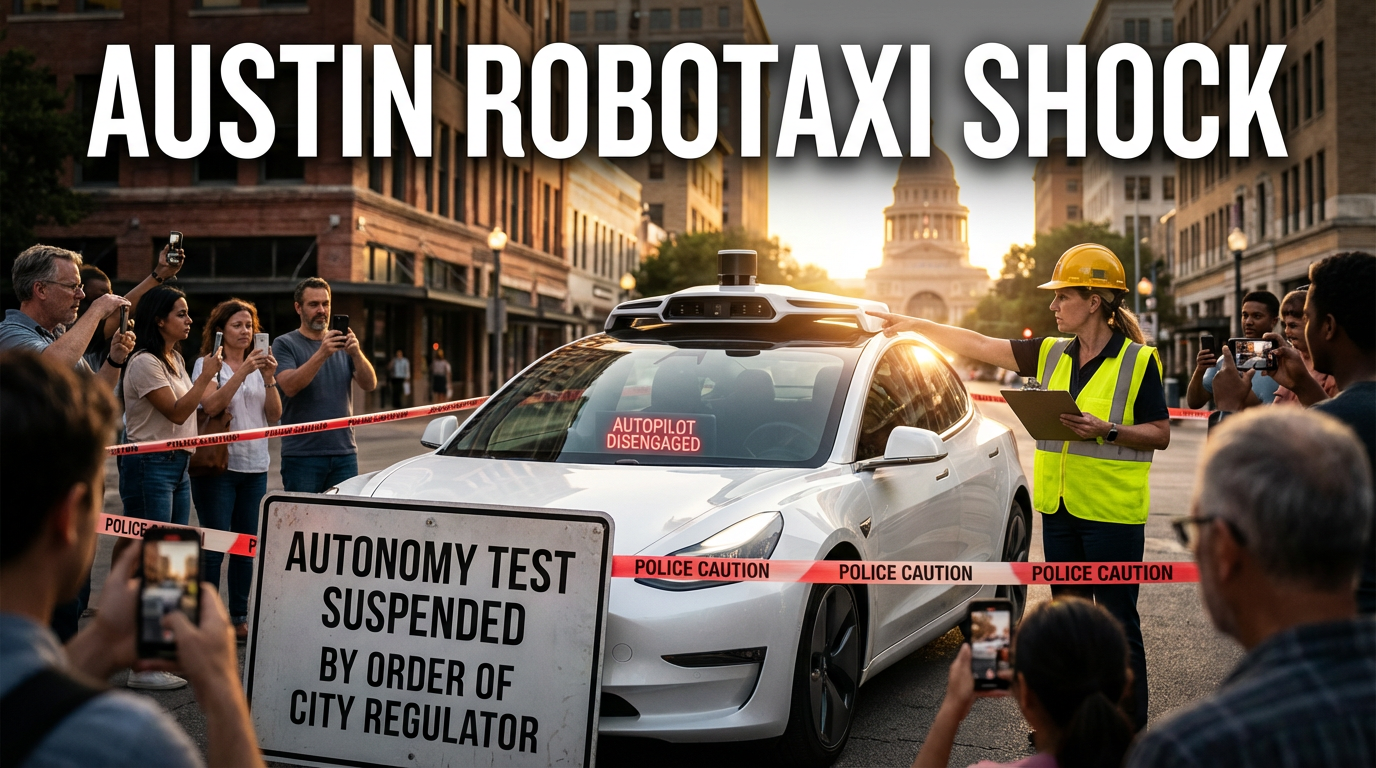
● Ghost Tesla Spurs RoboTaxi Repricing, China Backlog Shock, Cybercab Nears Street Legal, Wall Street Flips to AI
Repricing After the “Unoccupied Tesla” Sightings in Austin: What the Market Is Recalculating (Robotaxi, Cybercab, China Demand, and Shifting Wall Street Framing)
This report consolidates four developments:
1) Why the “driverless-with-no-occupant” sightings in Austin may signal a shift in the business model
2) What a reported Model 3 backlog in China extending into 2026 implies about demand quality
3) Cybercab details moving from “concept” toward a regulation-ready production configuration
4) Why Wall Street is beginning to evaluate Tesla more on AI/robotics than quarterly deliveries, and the associated risks
1) Breaking: “Unoccupied Tesla” Driving Observed on Austin Public Roads
[What occurred]
Multiple sightings were reported in Austin, Texas of a Tesla (reportedly a Model Y) operating on public roads with no one inside the vehicle. Elon Musk indicated the company is testing without an occupant, supporting that this was not merely a rumor.
[Why this is not only a technology demo but also an operating-model test]
Functional FSD performance and operating a service with no in-vehicle human are materially different. Removing the safety driver shifts the final layer of responsibility away from a person and onto a service-grade stack, including insurance, liability, regulation, remote operations, and end-to-end operating procedures.
[Facts vs. interpretation at this stage]
Fact: Footage consistent with unoccupied driving tests was captured in Austin, and Musk did not deny the activity.
Interpretation: This does not, by itself, confirm imminent fully driverless commercial deployment. Operating constraints (time, weather, geofencing), the role of teleoperation, and whether there were escort/follow vehicles have not been disclosed.
2) Core Shift: From “Selling More Cars” to “A Vehicle Network That Generates Revenue”
[Business-model shift implies valuation shift]
Legacy auto valuation is primarily driven by unit sales and margin, with quarterly deliveries acting as a key share-price catalyst. If robotaxi operations become viable, vehicles transition from one-time sale products to revenue-generating assets through utilization.
[Market focus: software revenue and network effects]
Robotaxi is structurally an AI-based mobility network, typically modeled with recurring revenue logic (subscriptions, take rates, per-ride revenue). This can pull valuation frameworks toward platform/software multiples rather than manufacturing multiples, particularly in technology-led equity regimes.
[New primary risk variable: regulatory exposure]
In uncrewed operations, a single high-profile incident can expand from a cost event into an operational shutdown, tighter regulation, or restrictions on data/operating permissions. Equity sensitivity may shift from “delivery shocks” toward “regulatory shocks.”
3) China Update: Why a Model 3 Backlog Into 2026 Should Be Read as “Demand Quality”
[Key observation]
China order pages have been cited as indicating Model 3 Long Range RWD delivery timing extending into early 2026.
[Context 1: Backlog despite intense competition]
China remains one of the most competitive EV markets, with frequent high-profile launches from domestic OEMs. A prolonged wait time in a specific trim is not fully explained by discounting or inventory dynamics and may indicate sustained product-value fit for a defined demand segment.
[Context 2: Potential pull-forward ahead of policy changes]
Expectations that EV purchase tax benefits in China may be reduced starting in 2026 could incentivize earlier ordering. Under such conditions, long wait times may reflect both supply constraints and policy-driven pull-forward demand.
[Investor checklist]
China is both a major end-market and a critical node in Tesla’s global supply chain. China demand trends therefore link to broader cost dynamics, including inputs, logistics, and parts availability.
4) Cybercab Update: From “Concept” Toward “Regulation-Passable Production Design”
[Exhibit reference: showroom display in San Jose, California]
Cybercab displays have been cited as appearing closer to production specification.
[Why details matter: regulatory and everyday-use thresholds]
Incremental changes that appear minor can be indicative of production readiness and compliance orientation, including:
- Wiper configuration adjustments
- Front-end and license-plate area detailing
- Powered strut adoption (door stability and usability)
- More practical interior materials and cushioning
- Added cupholders and cabin usability features
[Interpretation: robotaxi is a vehicle-plus-operations package]
Robotaxi viability depends not only on software performance but also durability, maintainability, passenger experience, cleaning workflows, and safety standards. As Cybercab specifications converge on production, the market’s question set can shift from “if” to “when/where/under what regulatory framework.”
5) Wall Street Reframing: Why “Quarterly Deliveries May Matter Less” Has Emerged
[Sell-side framing]
Commentary has surfaced suggesting that by 2026, quarterly deliveries may become less influential to Tesla’s share price.
[Drivers of this shift]
If Tesla is increasingly categorized as an AI/robotics company rather than a pure auto manufacturer, near-term unit volumes may be outweighed by evidence that autonomy can operate as a service. This framing aligns with the AI competitive landscape and the associated data/compute investment cycle.
[Bull-case framing: 2026 as a potential inflection window]
Some investors view 2026 as a period when autonomy and robotics could transition into more visible commercialization. In that context, Austin unoccupied-driving sightings function as on-the-ground signals rather than purely verbal guidance.
6) Under-covered but Material Points
1) The bottleneck is often operations, not only algorithms
Unoccupied driving implies an operating system: dispatch, remote assistance, exception handling, incident response, insurance workflows, and regulator engagement. The Austin activity may be best interpreted as an urban operations test.
2) Robotaxi is an attempt to decouple Tesla from auto cyclicality
Auto demand is highly sensitive to macro variables such as rates and consumer credit. A robotaxi/AI subscription model can be framed as more recurring in nature, potentially reducing cyclicality perception if execution is demonstrated.
3) In China, “which trims sell” matters more than “headline demand”
Given competitive intensity, the distribution of demand by price point, range, and drivetrain can be more decision-relevant than aggregate demand signals.
4) Key share-price drivers may rotate from deliveries to regulation and safety events
For uncrewed services, trust and permissioning are fragile. A single incident can materially alter policy stance and operational rights, with outsized equity impact.
7) Key Monitoring Items Over the Next 3–6 Months
- Whether Austin testing is constrained by geofence, time-of-day, and weather conditions
- The degree to which teleoperation is integrated into the operating model
- Whether Cybercab production details converge further toward compliance requirements (wipers, lighting, plates, door safety)
- Whether gaps widen between backlogged trims and immediately deliverable trims in China
- Whether the market increasingly applies auto vs. AI-platform valuation frameworks
< Summary >
Unoccupied Tesla driving sightings in Austin are being interpreted as a shift from technology demonstration toward robotaxi operations testing. This potentially challenges the traditional “deliveries-first” auto framing and supports a gradual migration toward AI/autonomy/robotics platform valuation logic. China Model 3 backlog signals and Cybercab production-oriented design changes provide supporting evidence of ongoing progress; however, the dominant variable remains safety and regulatory risk.
[Related links…]
- https://NextGenInsight.net?s=robotaxi
- https://NextGenInsight.net?s=autonomous-driving
*Source: [ 오늘의 테슬라 뉴스 ]
– 테슬라 무인 로보택시 첫 장면 포착, 이 순간부터 테슬라는 자동차 회사가 아니다?
● Driverless Tesla Robotaxis, Valuation Shockwave Ahead
Tesla Robotaxi With “Safety Driver Fully Removed”: The Debate Shifts From “Technical Risk” to “Economics/Valuation” (Including the Key Pitfall in NHTSA Crash Data)
This report covers five areas:
1) How “no safety driver” testing in Austin changes the business model (unit cost structure resets)
2) Why fleet growth can shift from linear to exponential (linking production to deployment)
3) How to interpret “8 Tesla cases” in NHTSA automated-driving crash statistics (the overlooked normalization trap)
4) The next institutional triggers for Tesla (revenue mix shift + EPS operating leverage)
5) Why Luminar’s bankruptcy and Ford F-150 Lightning production pauses point to the same post-subsidy market logic
1) Breaking: Indications of “No Safety Driver” Tesla Robotaxi Testing Observed in Austin
The key point is not a single anecdotal sighting but repeated observations across different vehicles, supported by identifiable details (e.g., plates).
This reduces the likelihood of a one-off demonstration and increases the probability that active operational testing has begun.
Official comments and account activity from Tesla/Elon Musk reinforced the interpretation that this is moving from planning to execution, including references to testing without a safety driver.
The primary implication is cost structure rather than technology.
With safety drivers, each incremental vehicle requires incremental hiring, training, and supervision costs.
Removing the safety driver shifts scaling constraints toward hardware availability and regulatory capacity, materially increasing operating leverage and increasing the effective share of software-driven, higher-margin economics.
2) Why Robotaxi Fleet Growth Dynamics Change: The Ceiling Becomes “Vehicles,” Not “People”
A prior example of rapid fleet expansion in the Bay Area illustrates that safety-driver staffing was a key bottleneck.
As that constraint eases, the binding limits become (i) the number of vehicles deployable into service and (ii) the pace of geographic/regulatory expansion.
Manufacturing scale is central. Reported Gigafactory Texas output on the order of 4,000–4,500+ vehicles per week implies an existing supply base capable of accelerating fleet deployment if permitted.
This is a structural advantage that is difficult for traditional OEMs to replicate quickly.
Investor-facing KPIs may shift accordingly: from quarterly EV unit sales to the number of robotaxis placed into revenue service.
This represents a cash-flow model transition, not merely an adjacent product line.
3) Data: NHTSA Automated-Driving Crash Statistics and the Correct Interpretation of “8 Tesla Cases”
The report references NHTSA incident-reporting data tied to automated-driving systems.
Comparisons often cite high counts for peers (e.g., Waymo 1,400+; Zoox 100+) versus Tesla with “8 reported cases.”
The critical caveat is that these counts are not normalized by exposure (e.g., miles driven, fleet size, operating domain).
Simple count comparisons can therefore be misleading.
However, Tesla remains notable because its user base and real-world utilization are large, yet reported cases are still low in absolute terms.
If a large-exposure system shows a large gap even without normalization, normalization could widen the inferred gap further, though the dataset alone is not sufficient to quantify that magnitude.
In addition, these reports capture crashes associated with an automated system being engaged; they do not, by themselves, allocate fault.
Accordingly, the dataset should be interpreted as an indicator of observed risk under reporting rules, not as a definitive measure of responsibility or “zero-incident” performance.
If sustained, a lower observed risk profile can translate into advantages in insurance pricing, regulatory posture, and fleet operating cost.
4) What Markets May Price Next: Revenue Mix Shift and EPS Leverage, Not “Tech Demos”
The valuation pathway is framed as: technology gap → service expansion → revenue mix transition → EPS acceleration (with time lag).
Once robotaxi operations generate material revenue, perceived cash-flow quality can change: vehicle sales are predominantly one-time, while mobility services can be recurring.
Recurring revenue combined with high gross margin potential can shift valuation frameworks toward platform/software multiples rather than manufacturing-only comparables.
Institutional commentary often highlights three core elements of autonomous advantage: data, compute, and algorithms.
A complementary lens is talent density, which is harder to quantify but can sustain long-run execution velocity and iteration advantage.
5) Industry Restructuring Signal: Luminar Bankruptcy + Ford F-150 Lightning Production Pauses = Post-Subsidy Economics
Luminar’s bankruptcy is treated as a symbolic data point: the “lidar is mandatory for autonomy” narrative weakened as the market adopted alternative approaches, undermining the company’s ability to sustain its business model.
More broadly, EV/autonomy is shifting from a capital-markets narrative to a cash-flow narrative.
Ford’s F-150 Lightning production pauses should be viewed less as a headline demand fluctuation and more as a test of whether products remain competitive on price and margins as subsidies and promotional intensity decline.
The market’s benchmark is moving from “can you build EVs” to “can you sell profitably,” implying a higher probability of continued consolidation and restructuring.
6) Three Underemphasized Takeaways
1) Markets react first to unit economics, not safety narratives
Removing the safety driver is primarily a variable-cost reduction event per vehicle.
Lower variable cost expands feasible scaling speed and improves pricing flexibility (including fare reductions to gain share).
2) The key point in NHTSA data is not “Tesla is lower,” but “the gap appears even without normalization”
If maintained, this can translate into structural cost advantages via insurance, regulatory engagement, and per-trip operating cost.
3) As subsidies fade, EV/autonomy becomes a productivity and cash-flow competition
Luminar and Ford are consistent with a capital-market regime shift where “option value” alone receives less tolerance without near-term economic proof points.
7) Near-Term Monitoring Checklist (Investor/Industry)
– Whether Austin testing expands into harder conditions (night, adverse weather, complex intersections)
– Whether fleet count accelerates on a two-week cadence (early indicator of exponential ramp)
– Whether regulator/municipal engagement becomes formalized (shift toward operational authorization frameworks)
– Whether robotaxi revenue is separately disclosed or discussed in earnings (market-recognition trigger)
– Whether service pricing actions (including fare reductions) appear alongside disinflation trends
If these signals persist, Tesla may be evaluated less as an EV manufacturer and more as an AI-enabled mobility platform, with higher volatility likely during the transition.
< Summary >
Indications of safety-driver-free robotaxi testing in Austin suggest robotaxi development is moving beyond demonstrations into a unit-economics inflection driven by cost structure.
As scaling constraints shift from labor to vehicles and regulation, fleet growth can accelerate materially.
The “8 Tesla cases” in NHTSA reporting should be interpreted through the absence of exposure normalization; the key observation is that a large apparent gap exists even before normalization, which could translate into insurance, regulatory, and operating-cost advantages if sustained.
Luminar’s bankruptcy and Ford’s EV production adjustments indicate a post-subsidy market environment increasingly focused on cash flow and productivity, with continued restructuring risk across the sector.
[Related Articles…]
- How Robotaxi Expansion Reshapes the Mobility Industry Map (Latest Overview)
- Autonomous-Driving Regulation and Commercialization: Investor Checkpoints Often Missed
*Source: [ 허니잼의 테슬라와 일론 ]
– [테슬라] 드디어 시작된 안전 드라이버 제거 로보택시! 그런데 더 충격적인 공식 사고 통계 자료가 존재! 미국 고속도로교통안전국 자율주행 사고 데이터 분석