
● Samsung Hooks Intel in Shock 8nm Foundry Coup
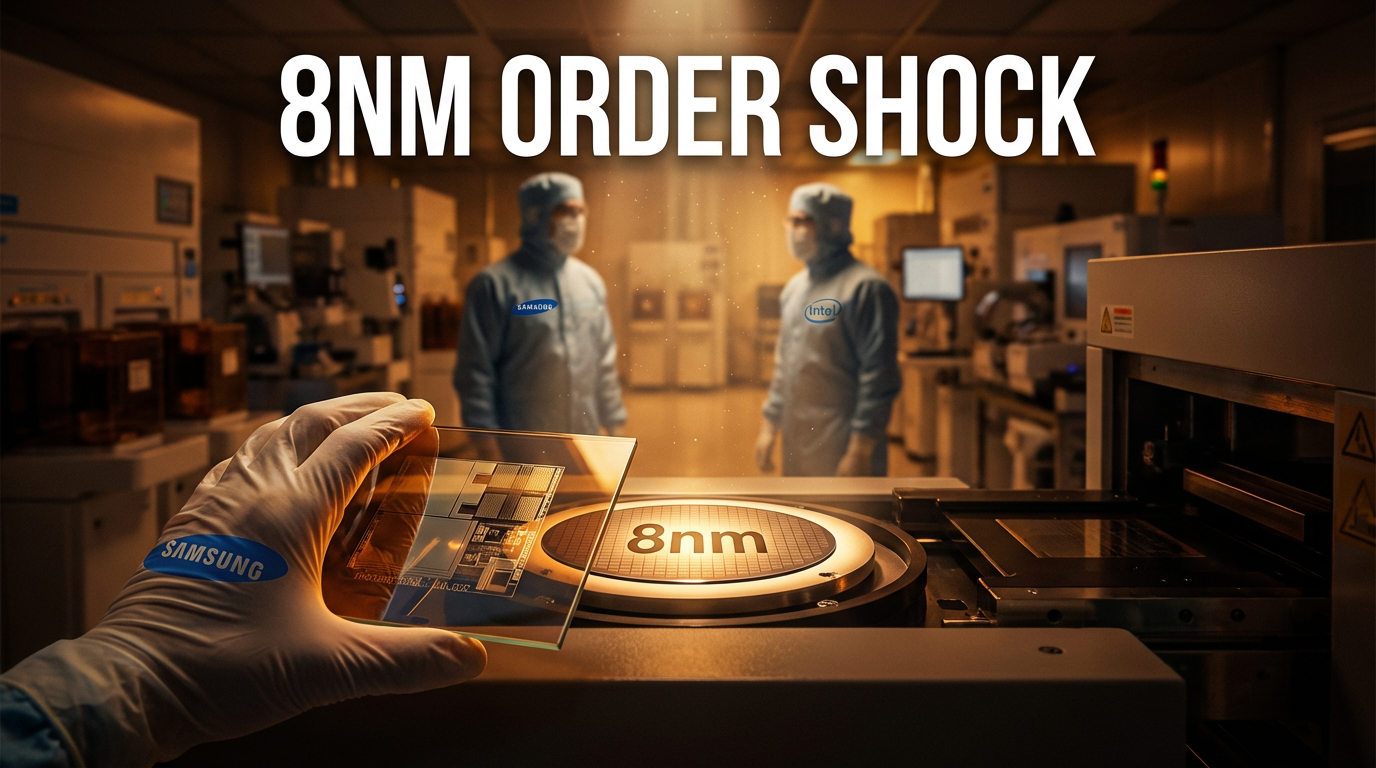
Today’s post focuses on the real meaning hidden behind the news that Samsung Electronics has attracted a giant called Intel as a client, why it is specifically the 8nm process rather than a cutting-edge one, and what trickle-down effects will occur due to this. It’s not just simple order news, but key takeaways through which you can read the future landscape of the semiconductor market, so check it out until the end.
Samsung Electronics Foundry, from NVIDIA to Intel? The Plot Twist of the 8nm Process
1. The Real Reason Intel reached out to Samsung: The ‘Cost-effectiveness’ and ‘Stability’ of 8nm
So, just looking at the news headline, it says “Samsung Electronics is making Intel chips,” but what we need to pay attention to here is exactly ‘what’ and ‘with which process’ they are making them.
The item likely to be ordered this time is Intel’s PCH (Platform Controller Hub) chip. Simply put, if the CPU is the head, the PCH acts like the arms and legs, playing a supporting role in inputting/outputting data and controlling devices.
Previously, Intel used Samsung’s 14nm process at its Austin, USA factory, but this time, they are entrusting it to Samsung again while upgrading it to 8nm.
The core point here is why 8nm, not cutting-edge ones like 3nm or 4nm.Currently, in the semiconductor foundry market, 8nm belongs to the technically mature ‘legacy’ (older generation) process. However, this is becoming Samsung’s powerful weapon.
Ultra-fine processes cost astronomical amounts, but 8nm has already finished much of its depreciation and the yield (the ratio of defect-free products) is very stable.From Intel’s perspective, since they hold a 75% market share in CPUs, they need a massive volume of PCHs. They chose Samsung Electronics as the partner who can produce this most stably and cheaply.
2. Back-to-Back Home Runs Following NVIDIA, The Rediscovery of ‘Legacy Processes’
While many people focus only on cutting-edge technologies like AI semiconductors or HBM, Samsung is quietly taking care of business.In fact, before this Intel order, they had already secured a giant called NVIDIA as an 8nm customer.
They are making the GPU going into Nintendo’s next-gen game console ‘Switch 2’ with Samsung’s 8nm, and NVIDIA has even requested additional low-end GPU volumes.What this means is that global big tech companies have acknowledged the reliability of Samsung’s 8nm process.
Youtube and other news sources worry that “Samsung can’t catch up to TSMC,” but what’s important is that they are definitely creating a cash cow in these middle-class processes that act as the backbone.This financial power must be the foundation to enable competition in 2nm and 1.4nm later.
3. [Insight] The ‘Trickle-Down Effect’ Not Mentioned in the News: Opportunities for Materials, Components, and Equipment
This is the part I want to emphasize most in this post.When Samsung Electronics’ factories run busily, the surrounding ecosystem dances along with them.
Analyzing the article contents, Samsung Electronics’ 8nm production capacity is around 30,000 to 40,000 sheets per month, and it appears the utilization rate will become full as clients increase.The change that stands out immediately due to this is the order volume for photomasks.
Photomasks are original plates used to draw semiconductor circuits. The order scale, which was at the 200 billion won level last year, is expected to surge by 50% to over 300 billion won this year.This isn’t just good for Samsung; it’s a signal that leads directly to sales growth for domestic Materials, Components, and Equipment companies.
From an investment perspective, it is the timing to not only look at Samsung Electronics’ stock price but to carefully watch the first-tier vendors supplying photomasks or related materials to Samsung.
4. This is Not a Simple Order: A ‘Stepping Stone’ Strategy to Cutting-Edge Processes
Finally, adding my perspective, this Intel order has meaning beyond just the number ‘8nm’.In the foundry business, once a transaction is opened and trust is built, the probability of being entrusted with the next generation of chips increases drastically.
What if Intel is satisfied with Samsung’s quality in 8nm this time?When Intel orders high-performance chips or next-generation AI-related chipsets to external foundries later, the possibility of reviewing Samsung’s 3nm or 2nm processes opens up.
In other words, while immediate sales are important, this deal can be interpreted as a very positive signal in the long term in that it has solidly rebuilt the network with global big tech companies.
< Summary >
- Key Takeaway News: Samsung Electronics Foundry is on the verge of winning an order for Intel’s next-generation PCH chip (8nm process) following NVIDIA, with mass production scheduled for next year.
- Strategic Meaning: Although not a cutting-edge process, it has secured a definite cash cow and restored trust with big tech companies through the 8nm process where ‘cost-effectiveness’ and ‘stability’ are verified.
- Hidden Point: With the rise in utilization of Samsung’s 8nm line, photomask orders are surging to the 300 billion won range, and a large trickle-down effect is expected for domestic Materials, Components, and Equipment companies.
- Outlook: This order will serve as an important ‘bridgehead’ for Samsung Electronics to win additional orders for cutting-edge micro-process volumes from large clients like Intel and NVIDIA in the future.
[Related Posts…]
- The Secret of Samsung Electronics Foundry’s 8nm Process
- The Semiconductor Order War and Intel’s Choice
*Source: https://www.hankyung.com/article/2025121674081