● SpaceX IPO Sparks Orbital AI Arms Race, Defense Cash Floods Space Stocks
Potential “Core Theme” in U.S. Equities Into 1H 2026: Space, AI Infrastructure, and Defense Budgets Converge (SpaceX IPO + Orbital Data Centers + NDAA)
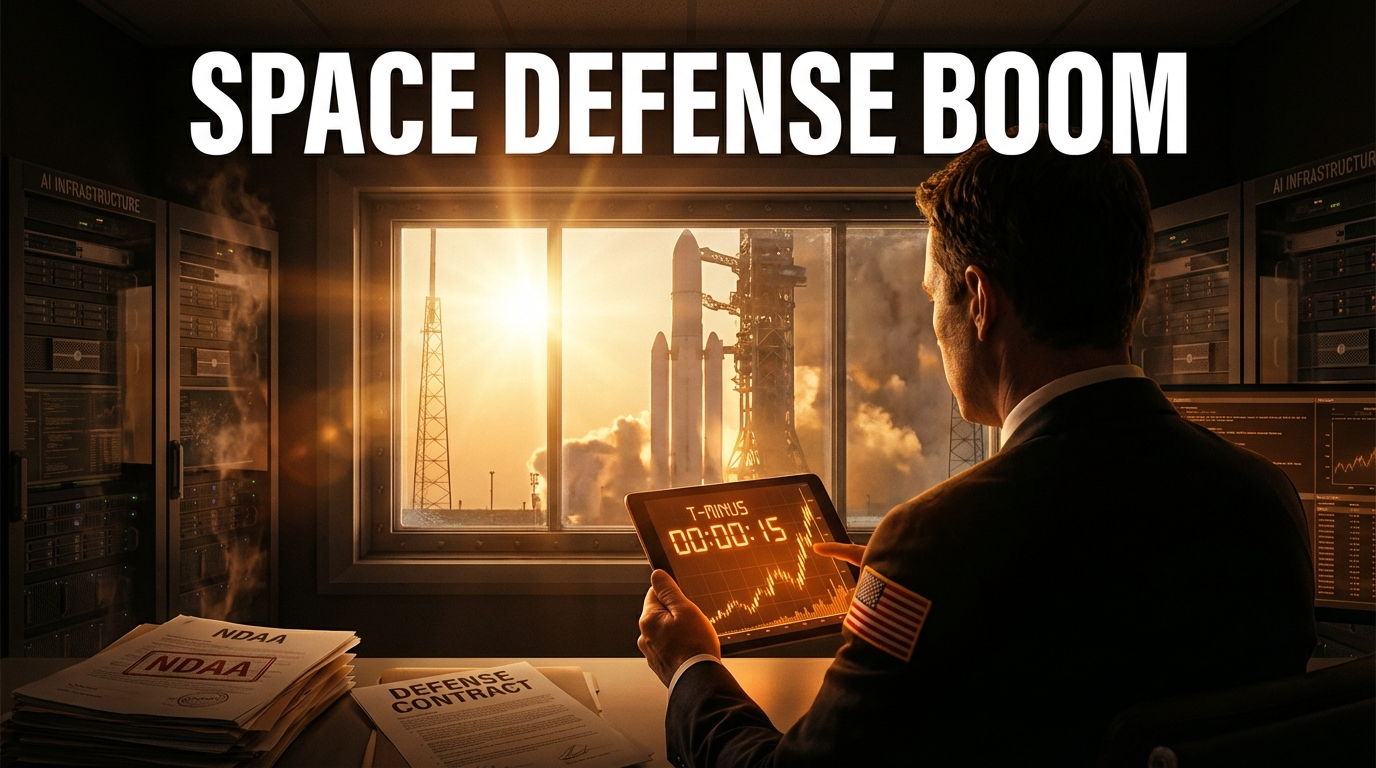
This note consolidates the most likely high-capital-flow axis into 1H 2026: (i) a potential SpaceX IPO, (ii) the emerging “orbital data center” investment narrative tied to AI infrastructure constraints, and (iii) the elevation of space to a top-tier national security priority under the U.S. NDAA.
1) Headline: In 2026, Space Transitions From a Theme Trade to a Budget- and Infrastructure-Driven Sector
Key conclusion
Space-related equities appear to be shifting from expectation-driven price action toward a structure supported by both government demand (defense budgets) and private-sector demand (AI infrastructure capex).
Why this combination matters
- A SpaceX IPO could act as a valuation and sentiment catalyst across the space supply chain.
- Physical constraints in terrestrial data centers (power, cooling, land, permitting) strengthen the investment case for alternative architectures, including orbital compute concepts.
- The NDAA increasingly frames space capabilities as critical security infrastructure, supporting sustained procurement visibility.
If these drivers persist, the market may increasingly evaluate space exposure as an intersection of AI infrastructure build-out and defense procurement, rather than a standalone thematic trade.
2) SpaceX IPO (Potentially June–July 2026): The Funding Rationale Matters More Than the Listing Event
Key point
Management has indicated a potential listing window around summer 2026, while maintaining flexibility on timing.
Why pursue an IPO
With Starlink positioned as a meaningful cash-flow engine, an IPO would more plausibly reflect accelerated capital formation for scale, rather than a balance-sheet necessity.
Strategic “convergence”
A vertically integrated ecosystem linking AI (xAI), robotics (Tesla), and space/network infrastructure (SpaceX) implies higher consolidated capex needs and tighter control of compute, data, and connectivity. Public capital markets can materially expand the capex runway and compress execution timelines.
Market implications
Even incremental IPO signaling can transmit to comparables across launch, satellite communications, and defense-space infrastructure via multiple expansion and narrative rotation.
3) Orbital Data Center Narrative: Terrestrial Data Center Constraints Are Driving the Discussion
Structural bottlenecks in terrestrial data centers
1) Land acquisition constraints
2) Power availability as the dominant bottleneck
3) Rising cooling cost and design complexity
4) Increasing regulatory friction (power pricing, environmental constraints, local opposition)
5) Political and permitting variability across jurisdictions
These constraints function as structural “speed limits” on AI infrastructure deployment, where time-to-capacity is increasingly decisive.
Why orbital compute is being discussed
Commonly cited advantages include near-continuous solar availability, reduced weather exposure, and potential cooling and regulatory benefits. The principal signal is not near-term feasibility, but that major technology decision-makers are moving from conceptual discussion toward roadmap-level references.
Direction of travel: on-orbit analytics
If AI compute is deployed closer to orbital sensors, a larger share of preprocessing can occur in space, with only prioritized outputs downlinked. This could improve latency, bandwidth efficiency, and responsiveness for specific workloads.
Parallel positioning
Similar commentary has emerged from multiple industry leaders, including indications of dedicated teams exploring low-earth-orbit data center concepts.
4) “Anti-SpaceX” Competitive Configuration: Space Infrastructure as an AI Strategic Battleground
Reported interest by AI leaders in acquiring launch capabilities, combined with potential alignment among competing ecosystems, highlights a key risk/reward dynamic: once space infrastructure is treated as part of AI supply-chain control, capex intensity and competitive urgency can increase materially.
5) The Most Important Policy Signal: The NDAA Elevates Space to a Top-Tier National Security Priority
Why the NDAA matters for markets
The NDAA is a primary mechanism shaping U.S. defense spending priorities and procurement pathways. Year-end releases are closely monitored as signals for the following year’s program funding and contract flow.
Core takeaway
Even if overall defense topline growth is constrained, space-related programs are increasingly prioritized.
Security logic increasingly embedded in budgeting
1) Missile threats require earlier detection
2) Dense LEO constellations enhance detection coverage
3) Intercept capabilities (including advanced missile defense and directed-energy concepts) require modernization
4) Sustained competition with China and Russia frames space as a strategic domain
This framing supports the transition of space from “scientific ambition” to “security infrastructure,” which can strengthen durability of demand independent of consumer sentiment cycles.
6) Sector Map: Public-Market Exposures by Category
A. Launch (rockets): direct beneficiary of higher launch cadence
- SpaceX (industry leader)
- Rocket Lab (often positioned as a leading public-market launch operator)
B. LEO satellite communications (Starlink-type competition)
- SpaceX (Starlink)
- AST SpaceMobile
C. Space sensing, surveillance, and radar (missile early warning)
- Raytheon
- Northrop Grumman
- L3Harris (LHX)
D. Intercept and missile defense (missiles / lasers)
- Lockheed Martin (interceptor programs)
- Raytheon (including directed-energy initiatives)
E. Drones (domestic supply chain emphasis)
- U.S.-based drone suppliers referenced as high-volatility exposure
F. Defense AI / software (accelerating decision cycles and operations)
- Palantir (analytics, operations, procurement workflows)
- Google (AI capability and defense application pathways)
This segment links directly to AI competition via decision advantage, production speed, and data superiority rather than platform manufacturing alone.
G. Naval build-out (shipbuilding / submarines)
- Huntington Ingalls Industries (HII)
- General Dynamics (select naval programs)
H. ETF implementation (broad exposure)
- ARKX (space/defense/drone mix)
- ITA (defense-focused)
7) Monitoring Framework: Where Capital May Concentrate Into 2026
1) IPO timeline clarity and relative valuation sensitivity
As IPO timing becomes more explicit, peer multiples may re-rate with elevated event-driven volatility.
2) Terrestrial data center constraints as a narrative accelerator
Incremental headlines on power, permitting, and cooling constraints can strengthen the “orbital infrastructure” optionality narrative.
3) Geopolitics and budget defensiveness
Prolonged geopolitical tension can support defense allocations; prioritization of space within defense can further reinforce baseline demand.
4) Rate/liquidity regime interaction
Pre-profit, high-duration space names tend to be more rate-sensitive. Large primes with multi-year backlogs typically exhibit stronger cash-flow visibility and relative defensiveness. Differentiation is essential for volatility management.
Macro variables that can influence sustainability include U.S. rates, inflation, dollar strength, global supply chains, and recession risk.
8) Key Points Often Underweighted in Mainstream Coverage
1) The SpaceX IPO is better framed as an AI infrastructure funding catalyst than a space-theme event
If Starlink cash flow is durable, the IPO motivation is more consistent with accelerating scale and time-to-capacity than with near-term profitability optics.
2) Orbital data centers are being discussed primarily because terrestrial constraints are binding
The narrative is less about technological optimism and more about terrestrial limits creating investable optionality.
3) The NDAA’s framing can reinforce a valuation floor by anchoring demand to procurement
Pure sentiment-driven themes can fade quickly; budget-backed procurement can preserve narratives through longer execution cycles.
4) 2026 exposure may broaden beyond launch into sensing, intercept, and defense software
Funding pathways may span the full chain from detection to decisioning and response, not solely launch vehicles.
< Summary >
Space-related equities into 2026 are increasingly tied to a combined framework of (i) potential SpaceX IPO-driven capital formation, (ii) terrestrial AI data center bottlenecks supporting orbital infrastructure optionality, and (iii) NDAA-led prioritization of space as core security infrastructure. Key variables include the pace of orbital compute narrative adoption, the translation of policy priorities into contracted procurement, and the breadth of beneficiaries across sensing, intercept, and defense AI/software.
[Related Articles…]
- https://NextGenInsight.net?s=SpaceX
- https://NextGenInsight.net?s=NDAA
*Source: [ 소수몽키 ]
– 2026년 미 증시 주인공은 정해졌다? 역대급 돈이 몰려갈 이곳● Korean Won Cracks, Dollars Drain, No FDI Engine
The Core Reasons the KRW/USD Exchange Rate Cannot Sustain Support: Persistent Dollar Outflows and No Domestic Engine to Push the Level Down
This report focuses on three points:
1) Why the current exchange-rate move is not short-term “volatility” but a “level shift” (a higher baseline).
2) Why combined overseas investment flows (corporates, national pension, and households) can exert pressure larger than FX reserves.
3) Why the solution is not “blocking dollar outflows,” but “building a dollar inflow engine via FDI,” and an implementable FDI blueprint for Korea.
1) News Briefing: Current KRW weakness reflects a rising baseline, not a one-off spike
Key assessment: Unlike 1997 or 2008, where shocks triggered short-term volatility followed by normalization, the post-2022 period reflects accumulated structural factors over nearly four years, lifting the exchange-rate level (baseline) upward.
Why a level shift matters:
- Volatility can be smoothed via stabilization operations.
- A level shift reflects a change in expectations toward the currency and is difficult to reverse without a coherent policy package.
2) Structural Driver (1): Overseas-investment concentration (corporates, pension funds, households) = a structural pattern of sustained dollar outflows
Recurring conclusion: Overseas investment is necessary, but the scale and speed over the past 4–5 years have been excessive.
Point 1: Corporate outbound direct investment (ODI) pressures the exchange rate through flow dynamics
- When firms transfer dollars abroad for investment, it does not immediately translate into domestic GDP.
- Value added generated offshore is not directly reflected in domestic GDP; returns to Korea are mainly partial cash flows such as dividends and interest, typically with time lags.
Point 2: Psychological impact of “more dollars tied up abroad than the level of FX reserves”
- The key is not a debate over exact figures, but the market perception that a persistent outflow structure exists, which can weaken currency expectations.
- FX reserves are approximately USD 430 billion.
Point 3: Additional pressure from the “forced” nature of the U.S.-focused investment cycle
- U.S. reshoring policies and allied-nation investment incentives (tax benefits, subsidies, tariff pressure) can create an environment where firms perceive non-investment as costly.
- This supports structurally elevated demand for dollars for overseas investment.
3) Structural Driver (2): Money-supply management gaps and a shifting floor for KRW weakness
Thesis: Since 2022, the U.S. tightened and actively managed money supply, while Korea tightened less (or maintained expansionary dynamics), with cumulative effects contributing to exchange-rate instability.
Primary analytical frame:
- Money-supply growth should be evaluated against inflation + real growth (nominal growth capacity), not via simple cross-country comparisons.
Implication:
- If real growth is 1–2% and inflation is 2%, money-supply growth around 3–4% can be broadly consistent with fundamentals.
- If money supply expands faster than real-economy capacity, currency depreciation pressure increases, and excess liquidity may raise asset-market distortion and bubble risk.
Broader risk:
- A widening gap between money supply and real activity can weaken the KRW and simultaneously distort prices in real estate and equities.
4) Separate trigger: Negotiation and political events can shift expectations and reprice the level
Conclusion: Against a structurally weakened backdrop, events such as U.S.–Korea tariff negotiations can act as triggers, producing sharp moves over 2–3 months.
Exchange rates move on expectations before data:
- If market participants internalize a higher future exchange-rate level, corporate, institutional, and household behavior can reinforce dollar hoarding and demand.
- Stabilization operations alone are insufficient; measurable policy outcomes capable of lowering the level are required.
5) Policy direction: Build an FDI-driven dollar inflow engine rather than blaming outflows
Core pivot: If outbound investment (including U.S.-bound capex) is structurally embedded, the policy objective should shift from “do not send dollars out” to designing durable dollar inflows via FDI (foreign direct investment).
Why FDI matters:
- Portfolio flows are rate- and risk-sensitive and can reverse quickly.
- FDI typically arrives with plants, infrastructure, R&D, and employment, and tends to be sticky, providing structural downside stabilization for the exchange rate.
Relevant macro keywords:
- KRW/USD exchange rate, monetary policy, FX reserves, U.S. interest rates, foreign direct investment (FDI)
6) Under-discussed issue: FDI organizations do not treat the exchange-rate level as a core KPI
A key operational weakness is the limited linkage between FDI execution on the ground and accountability for exchange-rate stabilization outcomes.
Why this is material:
- Current FX dynamics are not solvable with “export strength” alone; they require capital-account strategy, particularly direct-investment planning by strategic sector.
- If investment-promotion entities do not operate under KPIs connected to the exchange-rate level and FDI inflow execution, policies fragment and markets infer a lack of effective response.
7) FDI inflow strategy: Attract dollars by positioning Korea as a differentiated testbed
Strategic hints: GPU, HBM, physical AI, and robotics/autonomous-driving testbeds should be packaged into an integrated FDI offering.
Concrete design options:
1) AI infrastructure FDI
- Build packages that lead global big tech and semiconductor firms to establish AI data centers, AI fabless R&D, and AI service hubs in Korea.
- Priority levers: permitting speed, power-price stability, and predictable network/security rules, rather than one-off subsidies.
2) Manufacturing + robotics (physical AI) demonstration zones
- Autonomous driving, logistics robots, and smart-factory equipment depend on real-world validation.
- Create demonstration packages covering testing standards, insurance, and liability boundaries (accidents and safety) in manufacturing corridors to provide clear reasons for FDI entry.
3) Supply-chain (friend-shoring) FDI
- Firms seek politically lower-risk production bases amid U.S.–China tensions.
- Positioning Korea requires one-stop systems that include tariff/origin compliance and customs facilitation as part of the investor proposition.
8) Policy priority: Without domestic investment recovery, both FX stabilization and growth remain constrained
Repeated conclusion: Corporate domestic investment is required to restore a cycle of employment, income, domestic demand, growth, and capital inflows, which in turn supports a lower exchange-rate level.
Practical constraints:
- Drivers of offshore relocation include taxes, regulation, labor relations, costs, and market access.
- Policy should raise expected returns on domestic investment before appealing to patriotism or moral suasion.
9) Monitoring checklist: Five signals markets will track
The following moving together would indicate potential for a lower baseline:
1) Money-supply growth converging toward nominal growth capacity (growth + inflation)
2) Slowing growth in corporate overseas investment, or a recovery in domestic capex
3) FDI confirmed in executed figures, not only announcements
4) Reduced capital-outflow pressure even after a U.S. rate peak
5) Government shifting from viewing FX as “sentiment” to managing it through “industry and investment-promotion KPIs”
< Summary >
- Current KRW weakness reflects a multi-year structural level shift since 2022, not a short-lived shock.
- Concentrated overseas investment by corporates, pension funds, and households has created persistent dollar outflow dynamics, while money-supply expansion relative to real-economy capacity has increased depreciation pressure.
- The priority is to build a durable FDI inflow engine to structurally stabilize the exchange rate on the downside.
- Korea-specific FDI packages should focus on AI infrastructure, HBM, and physical-AI testbeds to improve execution and attractiveness.
[Related Articles…]
- Exchange-rate level shift and its implications for the Korean economy (https://NextGenInsight.net?s=exchange%20rate)
- Practical framework for Korea’s FDI inflow strategy (https://NextGenInsight.net?s=FDI)
*Source: [ 경제 읽어주는 남자(김광석TV) ]
– 한국 환율이 버티지 못하는 이유, 통화량이 만든 원화 약세 달러는 나가는데 대책은 없다. | 심층토론 – 김대호, 노영우 2편
● Tesla Hits 500, RoboTaxi Hype Fuels 1000 Target, Valuation Bubble Risks Loom
Tesla Nears $500; Core Thesis Behind “$1,000 Fair Value” (Robotaxi, Optimus, and the Key Valuation Drivers)
This note covers:
1) Why Tesla rose “alone” (reframed through market/rates/sentiment)
2) The conditions under which a “$300B revenue by 2030” scenario holds, and common numerical pitfalls
3) The real battleground in the Robotaxi vs. LiDAR debate
4) Why “possible” (from $500 to $1,000) differs from an “attractive entry” (risk-price framing)
5) Structural risks in Tesla’s core auto business that matter for valuation but are often under-discussed
1) Market recap: why Tesla rose while equities were volatile
[Observed]
Over the past month, Tesla rebounded approximately +22%, with pre-market levels around $493–$494, intensifying expectations of a $500 test.
[Interpretation: macro]
In this phase, equities with re-accelerating narratives can move faster than companies with near-term earnings visibility.
When recession concerns persist and the policy-rate path becomes less certain, markets periodically assign higher premia to perceived long-duration “future winners” versus firms monetizing primarily in the present.
[Interpretation: sentiment]
Tesla screens as a narrative- and event-driven equity rather than a traditional “value” purchase, with valuation shaped heavily by expectations around catalysts (Robotaxi/Optimus/FSD progress).
As a result, standard “earnings-to-multiple” logic typical for the S&P 500 or Nasdaq often explains Tesla less well in momentum-driven periods.
2) Post-$500 fork: profit-taking vs. a new leg higher
[Two near-term scenarios]
① A $500 print triggers profit-taking and a short-term pullback
② Consolidation above $500 leads to a “new level test” and continuation of the uptrend
[Key point]
Short-term direction is particularly difficult to forecast for Tesla.
The stock’s primary driver is not “confirmed results,” but shifting probabilities around Robotaxi/Optimus/FSD, where incremental headlines can reprice the multiple.
3) Core thesis: valuation framework behind “$1,000 by 2030 is possible”
[Current valuation context]
At roughly ~300x P/E, the stock appears expensive; however, the thesis argues the forward P/E could compress to ~155x within two years if earnings scale.
The claim is that while valuation is high, rapid earnings growth could reduce the multiple burden.
[2030 revenue scenario (high level)]
A framework combining auto (core) + Robotaxi + Optimus reaches approximately $300B in revenue (~$420B equivalent in KRW terms stated in the original), by 2030.
[Robotaxi revenue assumptions]
Production targets reference ~2 million units annually, with staged ramp-up assumptions.
Using ~50,000 miles per vehicle per year, 2030 Robotaxi revenue is estimated at approximately $54B.
[Optimus revenue assumptions]
Assumes a selling price up to ~$30,000, with conservative 2030 production/market share inputs (20% share assumption), yielding approximately $24B in revenue.
Also assumes competitive pressure from lower-cost Chinese robotics could cap global share.
[Margin and multiple logic]
With a 30% operating margin assumption, operating profit expands materially; relative to today’s market cap, the argument implies a ~18x multiple on 2030 earnings power.
Apple is used as a reference point (operating margin ~33% with a premium multiple), supporting the view that if Tesla approaches a similar profitability/quality profile, a ~2x equity upside (to ~$1,000) is conceivable.
4) Critical checkpoints: conditions matter more than the arithmetic
The valuation scenario is meaningful as a “possibility set,” but it requires several conditions to hold for investment relevance.
Condition A: core auto growth deceleration must stabilize
If unit demand continues to weaken across Europe/China/US, markets typically apply more conservative discounts to adjacent optionality.
Until new businesses generate durable cash flow, the core business must provide financial support.
Condition B: Robotaxi must prove scalable, monetizable service revenue
The inflection is from “likely to work” to “profitable under real constraints,” incorporating regulation, insurance, accident rates, and operating costs.
Condition C: Optimus requires a viable cost, supply chain, and lifecycle monetization model
Hardware volume alone may not deliver target margins without maintenance, upgrades, and recurring software-like monetization.
Key question: whether repeatable recurring revenue attaches to deployments.
Condition D: rates/liquidity must support premium multiples
Tesla is a multiple-sensitive equity.
If rate expectations reprice higher, the market’s acceptable P/E can compress even if operating results are unchanged.
5) Technology competition: “camera vision” vs. “LiDAR multi-sensor”
[Current structure]
Many competitors use multi-sensor stacks combining LiDAR + cameras + radar.
Tesla maintains a camera-based vision approach.
[Illustrative market event]
Discussion of Luminar’s restructuring risk increased scrutiny of LiDAR-based approaches on cost and efficiency grounds.
[Decisive factor in one sentence]
If Tesla demonstrates near-Level-4 reliability and a cost advantage using vision-only, it can pressure competitors structurally on unit economics and share capture; if LiDAR proves necessary or LiDAR costs collapse, Tesla’s differentiation weakens and competition becomes more protracted.
6) Under-discussed but material: new-model and replacement-demand constraints can reset the valuation floor
The most practical risk highlighted is structural pressure in the core auto business.
Issue 1: a weak refresh cycle may reduce replacement demand
Mainstream auto markets rely on facelifts and full redesigns to stimulate upgrade cycles.
Tesla’s product experience may reduce urgency to replace, extending replacement intervals.
Issue 2: thinner aftermarket/parts economics can reduce recurring revenue
Higher durability improves customer satisfaction but can reduce service/parts-driven repeat revenue for the manufacturer.
Over time, this can make the core auto profit model less resilient.
Issue 3: China EV pricing and lineup competition
Rapid lineup expansion and aggressive pricing by Chinese OEMs can pressure Tesla’s core growth rate.
In that case, markets tend to apply a higher discount rate to longer-dated optionality such as Robotaxi and Optimus.
7) Investment decision framework (translated into a risk-price lens)
The primary question is not whether the company is strong, but whether price compensates for risk.
Even if a $500-to-$1,000 outcome proves correct, a ~2x return over five years may or may not match an investor’s volatility tolerance.
Practical checklist
1) How much future upside is already priced in (valuation)
2) When the optionality (Robotaxi/Optimus) converts into cash flow
3) Whether the core auto business can bridge the transition
4) Whether rates/USD/liquidity conditions can sustain a premium multiple
These must align for “$1,000” to be an outcome rather than a target.
In multiple-sensitive phases, macro variables such as inflation, FX, global recession risk, asset allocation shifts, and US Treasury yields can amplify Tesla’s volatility.
8) Additional key point: the valuation debate hinges on “auto OEM vs. OS/service platform”
Tesla’s valuation regime depends on whether markets ultimately price it as an automotive manufacturer or as an operating-system/service platform for mobility.
If Robotaxi/FSD achieves operational scale, Tesla could be valued less on vehicle sales and more on platform-like economics, potentially reframing what appears expensive at $500.
If Robotaxi timelines slip, the market may revert to an auto-centric framework, emphasizing weaker refresh dynamics and intensifying competition, compressing the multiple.
For Tesla, proof points (safety, regulation, service expansion, monetization) can matter more than quarterly earnings prints.
< Summary >
Tesla’s move toward $500 reflects a renewed premium on long-duration narratives such as Robotaxi and Optimus.
A $300B 2030 revenue framework can make $1,000 arithmetically plausible, but requires simultaneous alignment across core auto stability, regulatory/technical execution, competitive dynamics, and rate/liquidity conditions.
The primary swing factor is whether vision-only can deliver cost-advantaged, near-Level-4 service reliability and whether Tesla earns an OS/service-platform multiple rather than an auto-OEM multiple.
[Related links…]
*Source: [ Jun’s economy lab ]
– 테슬라 500달러 갔다, 적정주가 1000달러인 이유