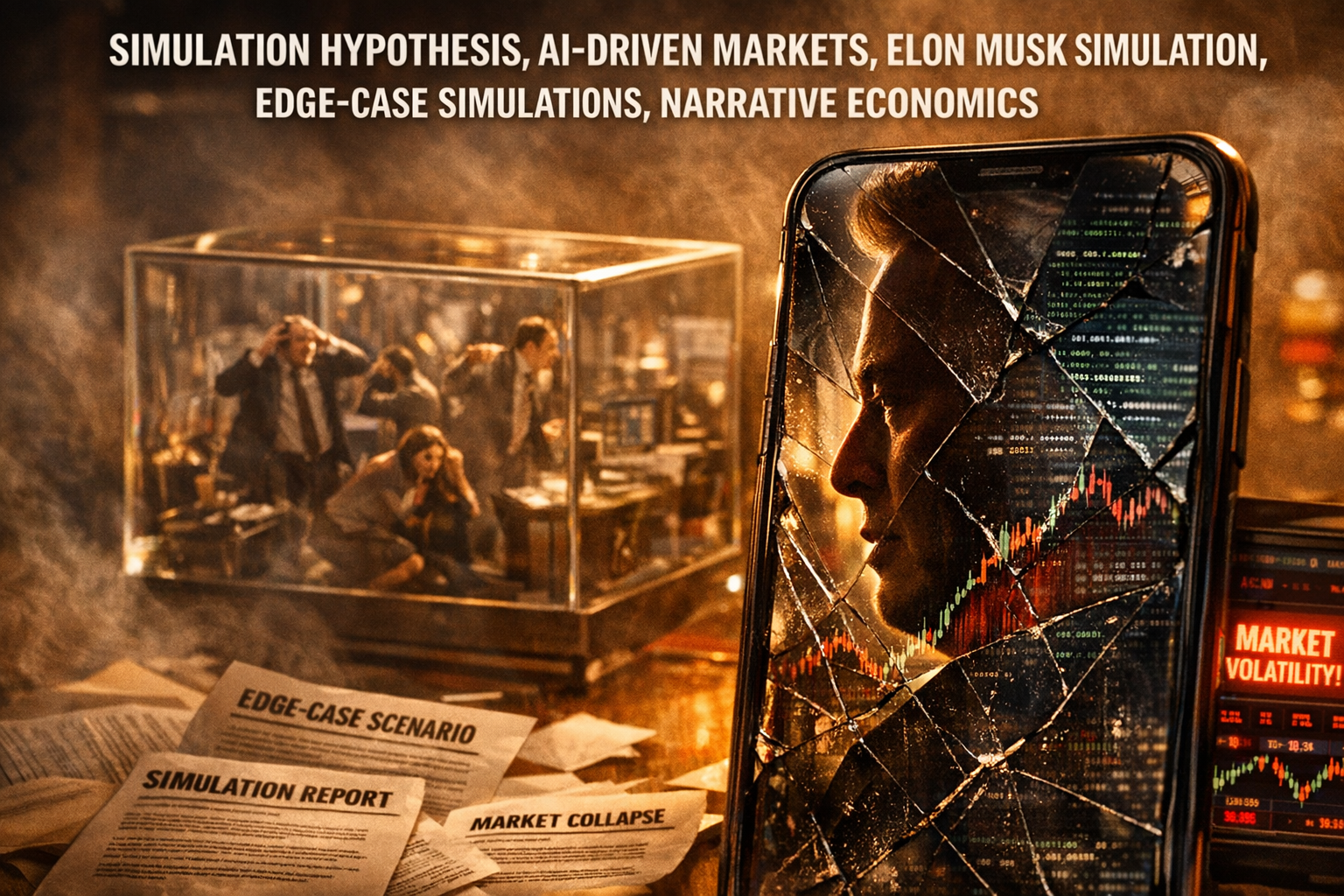
● Simulation Panic AI Frenzy Market Whiplash
Why the “Simulation” Hypothesis Feels More Relevant Today: Reframing Musk’s Remarks Through AI, Markets, and Social Platforms
This report:
- Structures Elon Musk’s claim that simulation is a probability assessment, not a proof claim.
- Links the argument to gaming, AI, and autonomous-driving simulation, and to current industrial investment cycles.
- Extracts under-discussed implications for decision-making, risk management, and operating principles.
1) Key Issue (News-Style Summary): The simulation hypothesis as a technology-driven probability problem
Musk’s position is not “prove we are in a simulation,” but “the probability has increased to a non-trivial level” given the pace of technological progress.
2) Musk Logic #1: Rapid advances in games reduce the boundary between physical and virtual
The observation is that the industry moved from early arcade graphics to near-photorealistic, large-scale shared worlds within decades. If this trajectory continues, the emergence of virtual environments indistinguishable from physical reality becomes increasingly plausible.
A critical extension is the role of AI:
- If non-player entities evolve from scripted behaviors to autonomous, learning agents, it becomes harder for participants to detect they are in a simulated environment.
- Recent generative AI systems already perform conversational and reasoning-like tasks at scale, reinforcing the directional alignment between the hypothesis and real-world AI competition.
This also contextualizes the surge in investment in:
- AI semiconductors
- Data-center power and grid capacity
- Cloud and compute infrastructure
These are enabling inputs for building high-fidelity simulated environments, not merely cyclical IT spending.
3) Musk Logic #2: “Only interesting simulations persist” (selection-pressure framing)
Musk’s operational analogy: in engineering simulation, routine cases are deprioritized because they add limited incremental value, while edge cases receive disproportionate attention.
Examples consistent with this logic:
- Rocket simulation: discard uneventful baseline runs, retain high-information failure modes.
- Autonomous driving: prioritize rare scenarios (adverse weather, complex road geometry, near-collision events) over repetitive normal driving.
Applied to the hypothesis, a cost-benefit operator would preserve high-information, high-variance scenarios, increasing the likelihood that an observed “world” appears event-dense.
Market relevance:
- Risk assets increasingly reprice around discrete macro catalysts (e.g., rate expectations) and concentrated technology inflection points.
- Pricing dynamics can reflect asymmetric sensitivity to “edge-case” events.
4) Interpreting “outside the simulation may be less interesting”
This statement can be read as an operational claim: if an observer/operator exists, there is limited incentive to allocate resources to low-information states. The system would tend to concentrate observable states with higher perceived value.
This mirrors current media and platform dynamics:
- Algorithms optimize for engagement, amplifying high-arousal content over routine information.
- The perceived “reality” experienced by users can become a compressed distribution of exceptional events.
Macro linkage:
- During periods of inflation and cost-of-living stress, audiences exhibit higher responsiveness to emotionally charged narratives, reinforcing feedback loops that can influence policy, consumption, and market positioning.
5) Why Musk introduces ethics (Spinoza): system stability rather than religion
The relevant claim is functional: durable systems require enforceable norms, which can be grounded in rational coordination rather than religious command.
The practical implication in AI-era contexts:
- As AI outputs appear increasingly human-like, organizations face recurring questions about acceptable treatment, disclosure, and manipulation.
- When incentives reward short-term rule-breaking, long-term costs rise via regulation, litigation, and reputational loss.
- These costs can translate into higher risk premia and valuation constraints.
6) Connection to Baudrillard (simulacra): representations can drive outcomes more than originals
In modern information environments, images and narratives can substitute for underlying reality in shaping behavior.
Observable manifestations:
- Filtered self-representation becomes a reference standard.
- AI-generated media can shift sentiment before verification occurs.
- If content is believed and propagated at scale, it can influence real-world demand, policy pressure, and corporate behavior.
Capital-markets relevance:
- Equity valuation can move on narrative momentum ahead of fundamentals.
- Replication via short-form video, memes, and algorithmic distribution increases the speed at which perception influences price.
7) Physics constraint (speed-of-light limit) as an efficiency analogy
The discussion raises a question: could universal constraints resemble computational limits? The point is not a claim that “the universe is a game,” but that optimized systems often show similar design patterns.
Game-engine analogy:
- Distant objects rendered at lower fidelity; detail increases with proximity (level-of-detail allocation).
AI-industry analogy:
- Modern models do not compute maximally across all tokens and contexts; they concentrate compute on salient segments.
- Efficiency optimization increasingly determines cost curves, performance, and competitive positioning.
8) Under-covered core points (reframed for 2025 operating reality)
8-1) The hypothesis is less about ontology than about a decision-making framework
The key is not belief, but adopting the prior that observed reality may be filtered, optimized, and selectively amplified.
Investment implication:
- In high-information environments, narrative diffusion can lead price action before factual confirmation.
- Risk management improves when monitoring what spreads and changes behavior, in addition to what is true.
Relevant macro variables include recession risk, asset allocation shifts, and FX volatility, which tend to spike at the intersection of fundamentals and expectations.
8-2) “Only the interesting remains” aligns with algorithmic economics
Even without any simulation operator, platform algorithms replicate the selection mechanism:
- High-engagement emotions (anger, fear, hope) receive distribution priority.
- Distribution affects consumption, voting behavior, and investment flows.
- Volatility can be structurally reinforced by engagement optimization.
This effect may intensify as AI automates content production at scale.
8-3) “Order is required even in virtuality” as a template for AI regulation and corporate strategy
System integrity is a cost function: as rules weaken, maintenance costs rise.
Corporate implication:
- Sustainable competitiveness may converge on a bundle of capability + trust + compliance.
- In safety-critical domains (e.g., autonomous driving), policy and regulatory risk directly influences valuation and capital access.
9) Practical operating posture (application)
1) Prioritize whether information changes behavior and incentives, not only whether it is authentic.
2) Counter engagement bias by maintaining low-arousal verification: data, logs, documentation, and reproducible checks.
3) Treat trust and rule adherence as long-duration assets for both individuals and firms.
< Summary >
- The simulation hypothesis functions as a probability assessment anchored in technological acceleration.
- Advances in gaming, AI, and simulation reduce the perceived boundary between physical and virtual environments.
- The “interesting-only” selection logic maps to platform algorithms and to market sensitivity to edge events.
- Representations and narratives can move economic outcomes ahead of underlying facts.
- The actionable value lies in updating decision frameworks around information dynamics, governance, and trust.
[Related Articles…]
*Source: [ 오늘의 테슬라 뉴스 ]
– 우리는 가상현실에 정말 살고 있을까? 일론 머스크가 말한 시뮬레이션 가설과 삶의 태도는 ?
● Delaware Court Saves Tesla, Musk Pay Survives, EPS Shock Averted
Delaware Supreme Court Ruling on Tesla’s Musk Compensation Plan: Why It Averted a Potential “EPS -2.57 Shock” — 5 Key Points for Shareholders
This report focuses not on whether “Musk won or lost,” but on:
1) The accounting mechanism behind a scenario in which Tesla’s quarterly EPS could have been reduced by as much as -2.57
2) How Delaware corporate-governance risk could affect broader U.S. capital markets going forward
3) Why a “shareholder re-vote” is not a universal legal cure (limits of ratification as viewed by courts)
4) Why attorney fees can still be recognized as a “shareholder benefit,” and what that implies
5) The ruling’s indirect leverage on Tesla’s autonomy in executing its autonomy/AI strategy
1) News Summary: Delaware Supreme Court Shifts Direction, Finding Full Rescission Excessive
Key conclusion
The Delaware Supreme Court rejected the Court of Chancery’s full-rescission approach and indicated that rescinding the 2018 Elon Musk performance-based compensation package in its entirety was not an appropriate remedy.
Not an unconditional endorsement of Tesla
The court acknowledged certain procedural deficiencies (e.g., independence and disclosure issues). However, it concluded that complete rescission was not a fair outcome.
2) Five Core Issues (Reframed for Investors)
(1) Did Musk exercise control?
The court recognized that the process did not reflect a fully independent framework, but did not view that as sufficient to justify blanket rescission.
(2) Was the compensation package fair?
The 2018 plan was structured as “zero payout if targets are not met.” It required multiple performance hurdles (equity appreciation and operating milestones), complicating a simplistic interpretation based solely on headline magnitude.
(3) Is rescission an appropriate remedy?
This was central. The court emphasized restoration principles and implied that undoing the arrangement would not reasonably align with the value creation over the intervening period.
(4) Is the 2024 shareholder re-vote (ratification) dispositive?
The court indicated that a re-vote does not automatically eliminate legal risk, citing limitations related to governance design, informational asymmetry, and the quality of the approval process.
(5) Attorney fees
Estimated fees were reduced from approximately $345 million to approximately $54.5 million. The court still recognized that the litigation conferred a cognizable shareholder benefit even if the monetary recovery was limited.
3) Primary Market Sensitivity: How “EPS -2.57” Became a Plausible Outcome
This is primarily an accounting and reporting issue for investors.
If rescission had been upheld
A canceled 2018 option-based structure could have required a new equity award (e.g., RSUs or similar) to replace incentives.
Why stock-based compensation (SBC) could have surged
- 2018 grant-date measured cost: approximately $3 billion
- If reissued at higher equity values: potentially approximately $12 billion
- Implied incremental expense: approximately $9 billion
Why the EPS -2.57 figure is mechanically feasible
Assuming diluted shares of approximately 3.5 billion:
- $9 billion / 3.5 billion ≈ $2.57 per share
If recognized in a single quarter, headline EPS could be reduced by approximately -2.57 due to accounting treatment.
Investor implication
While sophisticated investors adjust for earnings quality, market pricing often reacts to headline EPS. The ruling materially reduced the probability of an avoidable accounting-driven earnings shock and related volatility.
4) Why the Direct Impact on Musk May Be Limited While the Shareholder Impact Is Larger
From Musk’s perspective
Following shareholder actions addressing the compensation framework, the ruling was not necessarily the primary determinant of whether compensation could ultimately be realized.
From shareholders’ perspective
The principal risk was the accounting magnitude and timing of SBC expense, the resulting EPS distortion, and market noise driven by headline reporting.
In practical terms, the issue was less about whether compensation existed and more about how the compensation would be structured and recognized in reported financials.
5) Delaware Risk: Corporate Governance as a Broader U.S. Market Variable
This matter extends beyond a single issuer.
Erosion of Delaware as the default incorporation choice
If governance litigation and remedies introduce prolonged uncertainty and material financial-reporting consequences, incentives may rise for redomiciling to other jurisdictions.
Signals for investors to monitor
Potential increases in: charter amendments, changes in state of incorporation, strengthened board independence, and compensation committee redesign. These may indicate broader institutional adaptation rather than an isolated event.
6) AI Context: Why the Ruling Provides Indirect Strategic Leverage in the Autonomy Era
Although framed as compensation litigation, the economic effect relates to management focus and capital-market communication costs.
Tesla’s next phase involves sustained AI-related spending (FSD, robotaxi development, training infrastructure, and data-driven scaling). These initiatives require consistent investor communication regarding investment cadence and payback pathways.
A large accounting-driven EPS disruption would likely dominate headlines and dilute strategic messaging. The ruling reduced the probability of such noise during a period where narrative control and execution focus are operationally valuable.
7) Most Material Takeaways
Key takeaway 1: The core issue is accounting recognition timing, not sentiment toward Musk
The primary downside risk was an SBC expense spike and earnings distortion rather than abstract perceptions of fairness.
Key takeaway 2: A shareholder re-vote is not a complete legal shield
By explicitly limiting the effect of ratification, the court increased the incentive for firms to strengthen process design (independence and disclosure) in future governance actions.
Key takeaway 3: Delaware-related governance risk can be priced as a risk premium
If jurisdictional litigation risk increases, valuation frameworks may incorporate a higher risk premium, influencing equity valuation and capital-raising costs.
8) Macro Keywords to Track as a Practical Checklist
Although issuer-specific in appearance, market sensitivity to headline EPS tends to rise when these variables are unstable:
Interest rates, inflation, recession risk, global supply chains, equity-market volatility
< Summary >
The Delaware Supreme Court acknowledged procedural deficiencies in the 2018 Musk compensation process but determined that full rescission was not an appropriate remedy.
Had rescission been maintained, a replacement equity award could have increased SBC expense materially, creating a scenario where quarterly EPS could be reduced by as much as -2.57 on an accounting basis; the ruling reduced the likelihood of that outcome and related market noise.
The court also clarified that shareholder re-votes are not universally dispositive, and Delaware governance risk may influence future redomiciling decisions and governance strengthening across U.S. corporates.
Overall, the ruling reduces the probability of accounting-driven earnings disruption during a period when Tesla’s autonomy/AI execution requires sustained investment and disciplined capital-market communication.
[Related Articles…]
Tesla in one view: stock performance, earnings, and autonomy highlights — https://NextGenInsight.net?s=Tesla
Autonomy trend updates: robotaxi and the AI competitive landscape — https://NextGenInsight.net?s=autonomous%20driving
*Source: [ 허니잼의 테슬라와 일론 ]
– [테슬라] 델라웨어 일론 머스크 보상안 복원! 이번 대법원판결은 여러분이 상상하시는 것 이상의 중요도가 있습니다. EPS $2.57이 날릴 뻔!
● Retail Giants Rush K-Beauty Shelves, Explosive Demand Surge
The Real Reason U.S. Retail Giants Are Asking for More Shelf Space for K-Beauty: Sephora, Ulta, Target, Walmart, Their Metrics, the Numbers, and the Next Winners?
This report covers:1) Why K-beauty is a structural shift reshaping U.S. retail rather than a short-lived trend
2) How Sephora, Ulta, Target, Walmart, and Costco operationalize K-beauty within their business models
3) What reported growth (Ulta Q1 K-beauty +38%) and market expectations (U.S. sales projected to exceed $2.0B) imply as investment signals
4) The most important driver: the core KPI U.S. retailers optimize for when expanding K-beauty
1) News Briefing: Current Cash Flow Dynamics of K-Beauty in the U.S.
Key headline
Major U.S. retailers are upgrading K-beauty to a strategic category and expanding in-store shelf allocation aggressively.
Why now (trigger)
Short-form platforms (TikTok, Instagram) have accelerated a purchase funnel in which ingredient narratives, reviews, and before/after content convert directly into demand. Adoption is expanding beyond skincare into scalp care, color cosmetics, and at-home beauty devices.
Market figures (as cited)
- CNBC expectation: U.S. sales of Korean cosmetics may exceed $2.0 billion this year.
- Commentary implies ~40% YoY growth.
Economic/investment relevance
This signals verified category demand large enough to drive retailer space reallocation. In an inflation-sensitive environment, retailers prioritize categories with faster conversion and clearer value perception.
2) Retailer Strategies: Monetization Models for K-Beauty
2-1. Sephora: Buying Dwell Time via a K-Beauty-Led Experiential Store Model
Strategy keywords
Pop-ups → dedicated wall sets → experience booths/photo zones → curated checkout flows designed around K-beauty.
Why it matters
Sephora monetizes store experience and repeat visitation. K-beauty’s differentiated ingredients, textures, and routines are well-suited to discovery-led retail formats.
Watch points
Rising likelihood of exclusive distribution agreements to secure category gatekeeping. This indicates a shift from standard stocking to channel control over brand growth pathways.
2-2. Ulta Beauty: Formalizing a Growth Engine Through “K-Beauty World”
Strategy keywords
Dedicated in-store “K-Beauty World” sections. Curated multi-brand assortments positioned as a discrete category.
Reported figures
Ulta reported +38% YoY growth in Korean beauty sales in Q1, citing partnerships as a key contributor to growth.
Link to market expectations
K-beauty contribution can support sentiment around category momentum, while broader drivers (rates, consumer demand, competitive intensity) remain material.
2-3. Target: Integrating K-Beauty into Routine Basket Economics
Strategy keywords
Expansion of K-beauty sections across approximately 1,970 stores, including shelf reallocation away from incumbent U.S./European brands.
Why it matters
K-beauty is moving from destination purchase behavior to routine shopping trips, indicating broader category normalization in mass retail.
2-4. Walmart and Costco: Maximizing Turns via Hero SKUs (e.g., Masks)
Strategy keywords
Front-of-store visibility for high-velocity hero items aligned with bulk/value shopping missions.
Core implication
Success in these channels requires repeatability, low complaint rates, and stable supply. Placement functions as an operational validation of logistics, quality assurance, and claims handling, not merely viral demand.
3) Product Competitiveness Drivers in the U.S. (Reframed)
1) Granular segmentation (micro-need targeting)
Expansion from skincare into scalp care, color, and devices through problem-solution positioning.
2) Development speed (trend-response cycle time)
Rapid iteration from social demand signals to product, packaging, and line extensions, reducing inventory risk for retailers.
3) Price-to-performance (value + ingredient credibility)
Accessible pricing with measurable perceived efficacy; ingredient and texture narratives function as conversion content. Value propositions tend to be more resilient under consumer pressure.
4) Key Point: The KPI Retailers Optimize for When Expanding K-Beauty
4-1. Primary KPI extends beyond sales to store operating metrics
K-beauty can increase dwell time → engagement/try-on → attachment rate (basket size). This explains experiential buildouts and themed category zones.
4-2. K-beauty is a high-leverage customer acquisition lever
U.S. retail competition increases the marginal value of products that bring new shoppers into physical stores. K-beauty is positioned to attract Gen Z and Millennials and stimulate cross-category purchasing.
4-3. Competitive advantage shifts from brand to supply chain, data, and bargaining power
Retailer interest in exclusivity reflects an attempt to capture upside from category growth. As exports scale, complexity increases across compliance labeling, lead times, customs, and channel standards. Operational durability becomes a key differentiator.
5) Investment/Outlook Checklist: What to Monitor in 2025
1) Frequency of K-beauty references in retailer earnings
Repeated designation as a growth driver indicates internal prioritization.
2) Whether expansion is temporary (pop-up) or permanent (always-on set)
Pop-ups validate demand; permanent sets indicate long-horizon category strategy.
3) Durability of pricing and promotion economics
U.S. promotion intensity can compress margins; weaker unit economics can limit category longevity for some brands.
4) Macro variables: rates, inflation, discretionary capacity
In tighter conditions, value-driven categories can gain share, but broad demand deceleration remains a risk factor.
5) Competitive dynamic: Sephora vs. Ulta for K-beauty control
Increased competition can improve brand leverage, while also increasing retailer demands for exclusivity, funding, and commercial terms.
6) Link to AI Trends: The Next Catalyst May Be Retail AI
1) AI merchandising based on short-form data
Retailers can translate social signal velocity into SKU assortment and purchase orders. Fast product cycles align with this system.
2) Personalization (retail apps + POS data)
Problem-solution categories (e.g., sensitivity, barrier support, acne, firmness) benefit disproportionately from improved recommendation accuracy.
3) Generative AI for review summarization and assisted selling
High-review SKUs can suffer decision friction; summarization improves conversion and can provide data justification for expanded shelf space.
< Summary >
In the U.S., K-beauty is transitioning from social-driven popularity to a strategic retail category supported by shelf reallocation. Sephora emphasizes experiential KPIs (dwell and conversion), Ulta formalizes category momentum via “K-Beauty World” and reported Q1 growth of +38%, Target integrates K-beauty into mass retail missions at scale, and Walmart/Costco expand through high-turn hero SKUs. The primary driver is not awareness but measurable improvements in customer acquisition, dwell time, and basket attachment. Future differentiation is likely to depend on supply chain execution, data utilization, and channel bargaining power.
[Related…]
- https://NextGenInsight.net?s=K-beauty
- https://NextGenInsight.net?s=retail
*Source: [ Maeil Business Newspaper ]
– [어바웃 뉴욕] “매대 늘려라” 美 대형 유통사들의 K-코스매틱 모셔가기 | 길금희 특파원