● Jobs Mirage, Won Shock, Chip Crack, Nike Surge
U.S. labor data appear resilient on the surface, semiconductor supply chains show internal fractures, and FX is caught between government signals and smart money… Key takeaways only
U.S. initial jobless claims came in below expectations, supporting a “labor market is holding up” narrative; however, rising continuing claims revealed weaker underlying dynamics.
USD/KRW fell sharply into the 1,440s on strong government signaling plus tax incentives, while reports that physical USD cash “sold out” in Seoul’s affluent districts added a notable sentiment layer.
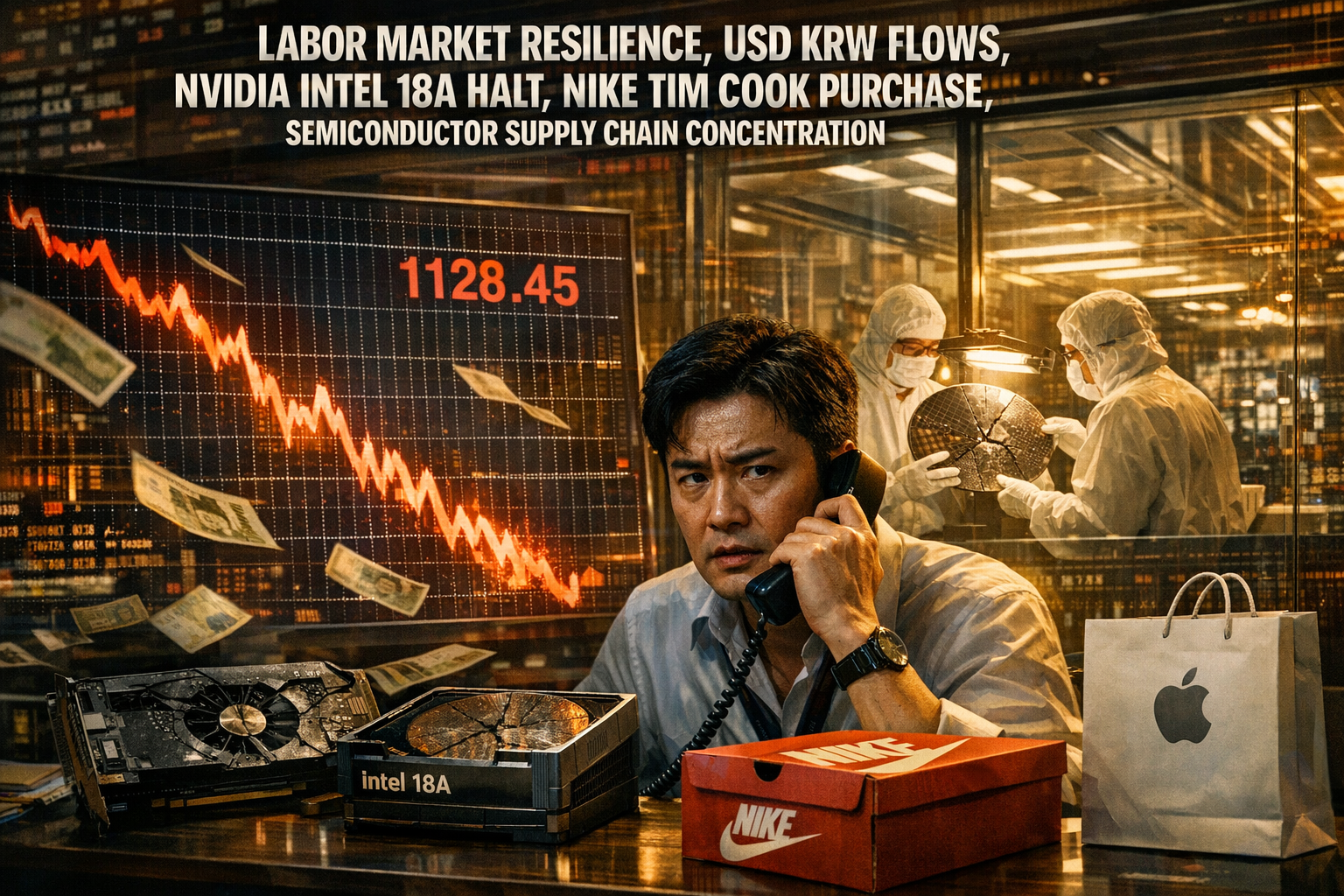
Separately, Nvidia reportedly halted testing of Intel’s 18A process, challenging the “U.S. semiconductor self-sufficiency” narrative, and Tim Cook’s personal purchase of Nike shares was interpreted by some as a potential consumer-sector re-rating signal.
This note summarizes: (1) the real message in the labor data, (2) the structure behind the USD/KRW decline, (3) implications of the Nvidia–Intel development for the semiconductor value chain, and (4) what Tim Cook’s Nike purchase may indicate.
1) U.S. equities: one-line recap (12/24, early close)
The Nasdaq opened slightly weaker and remained directionless with elevated intraday volatility, while the Dow held up relatively better.
Dispersion across mega-cap tech remained high; semiconductor headlines (Intel) and consumer headlines (Nike) dominated.
2) [U.S. Labor] Why “initial jobless claims below estimates” is not unambiguously positive
2-1. Key figures
Initial jobless claims: 214k, below consensus.
This is often interpreted as “limited layoffs → resilient labor market.”
2-2. The core issue: continuing claims increased
Continuing claims rose, indicating longer durations of unemployment and increased difficulty in re-employment.
Working summary of current labor dynamics:
- Fewer layoffs (lower initial claims).
- Weaker hiring / slower re-employment (higher continuing claims).
This combination can be an early pattern consistent with deteriorating labor-market quality during a slowdown.
If inflation remains sticky while labor conditions soften unevenly, the Fed’s policy path becomes less clear, raising market volatility.
2-3. What markets should monitor (checklist)
If firms avoid layoffs but also limit hiring for an extended period:
- Wage growth may moderate (potentially easing inflation pressure), but
- Consumption may weaken (growth headwind), and
- S&P 500 earnings expectations may face downward pressure.
As the market debate evolves toward whether gains remain concentrated in AI or broaden into consumer/healthcare/staples, labor data may act as a key directional input.
3) [FX] USD/KRW sharp drop into the 1,440s: not just “verbal intervention,” but a shift in flows
3-1. Message intensity increased
The signal came via a joint statement from operational-level officials (Ministry of Economy and Finance + Bank of Korea international line), emphasizing that “excessive KRW weakness is undesirable.”
Markets typically read this as a higher probability of follow-through actions.
3-2. The more consequential element: incentives aimed at redirecting USD flows
The move was not limited to attempting to cap the FX “price”; it also introduced measures intended to alter USD supply/demand dynamics.
Frequently cited directions included:
- Tax incentives if overseas equity investors repatriate capital (e.g., reduced capital-gains tax burden)
- Reduced tax burden for corporates repatriating dividends from overseas subsidiaries (encouraging USD inflows)
- Expanded deductions for FX-hedging products to disperse USD demand
These function as short-term, policy-driven flow catalysts capable of moving USD/KRW.
3-3. Why “physical USD cash sold out” surfaced simultaneously
A move from the 1,480s to the 1,440s can be viewed by some high-net-worth buyers as a “discount,” encouraging USD accumulation.
Banks attributed it to branch-level cash inventory limits, but markets often treat such reports as a sentiment indicator—potentially suggesting that some investors view the decline as temporary.
3-4. FX watchpoints (investor lens)
For the decline to persist, markets will likely require evidence of durable USD supply channels, not only messaging.
Key is whether tax incentives translate into measurable USD selling and whether flows rotate back into domestic risk assets.
A renewed global downturn narrative could reassert USD strength, limiting policymakers’ ability to anchor USD/KRW in one direction.
Investors should track the dollar index alongside domestic USD flow conditions rather than relying on headline FX moves.
4) [Semiconductors] Nvidia halts Intel 18A testing: credibility risk outweighs pure technology considerations
4-1. What happened
Reports indicated Nvidia halted testing of Intel’s next-generation foundry process, 18A, triggering a sharp decline in Intel shares.
No definitive reason was disclosed; market interpretations typically focus on:
- Yield/performance/manufacturing reliability not meeting Nvidia’s thresholds, and/or
- Schedule/roadmap delivery risk.
4-2. Why the spillover matters: pressure on the “U.S. foundry independence” narrative
Intel is a flagship name in the policy-backed effort to rebuild domestic foundry capability and must secure top-tier customers to sustain capex.
Failure to capture an Nvidia-caliber reference is often read not merely as a lost engagement but as evidence that structural dependence on TSMC may persist longer than expected.
Investor-level implications:
- AI chip manufacturing may remain increasingly concentrated around TSMC in the near term.
- Policy support alone may be insufficient to establish customer trust in Intel Foundry.
This can influence valuations across the broader semiconductor complex (foundry, equipment, and backend).
5) [Consumer] Tim Cook’s personal Nike purchase: potential signaling effect
5-1. Key point: personal purchase, not an Apple transaction
Tim Cook’s reported personal purchase of Nike shares supported a strong rebound in Nike’s stock.
Symbolically, markets may read this as meaningful because:
- He has long served on Nike’s board (perceived informational proximity).
- A personal purchase can be interpreted as confidence that valuation is near a trough.
5-2. Why Nike struggled over the past five years (key factors)
- Excess inventories → heavier discounting → margin pressure
- Rising competition from newer running brands (e.g., Hoka, On Running) → weaker brand momentum
- Mixed consumer response during positioning/marketing transitions
5-3. Investor checklist
To distinguish an event-driven bounce from a structural turnaround, monitor:
- Sustainability of inventory normalization
- Gross-margin recovery confirmed over 2–3 consecutive quarters
- Evidence of renewed premium brand pricing power
6) [Under-discussed] Five key points
1) More concerning than lower initial claims is rising continuing claims.
This signals re-employment friction that can lead to consumption deceleration.
2) The USD/KRW move reflected not only messaging but also policy actions aimed at flows.
Tax and incentive measures can affect actual USD circulation, not just sentiment.
3) “Physical USD cash sold out” may be anecdotal, but markets treat it as a smart-money sentiment gauge.
It can indicate a cohort viewing policy-driven dips as buying opportunities.
4) The Nvidia–Intel development is not a single-name headline; it suggests potential further entrenchment of AI manufacturing concentration.
This is a supply-chain control question, not merely a short-term theme.
5) The Cook purchase is not only a Nike-specific story; it may revive discussion of consumer-sector re-rating into 2026.
It may also inform where capital rotates as AI concentration persists and growth moderates.
< Summary >
Initial U.S. jobless claims declined, but rising continuing claims supported a “low layoffs, harder re-employment” slowdown signal.
USD/KRW fell into the 1,440s on strong government signaling and tax incentives, while reports of scarce physical USD cash suggested some investors may view the decline as temporary.
Nvidia’s reported halt of Intel 18A testing challenged the U.S. foundry self-sufficiency narrative and reinforced near-term AI production concentration around TSMC.
Tim Cook’s personal Nike purchase was interpreted as an event with potential implications for consumer-sector sentiment, contingent on inventory and margin normalization.
[Related links…]
Three items individuals should monitor after the USD/KRW drop
Revisiting global semiconductor supply-chain restructuring after the Nvidia headline
*Source: [ Maeil Business Newspaper ]
– 신규 실업수당 청구 건수, 예상치 하회ㅣ인텔, 엔비디아 테스트 중단에 4% 급락ㅣ팀쿡 개인투자로 나이키 상승ㅣ홍키자의 매일뉴욕