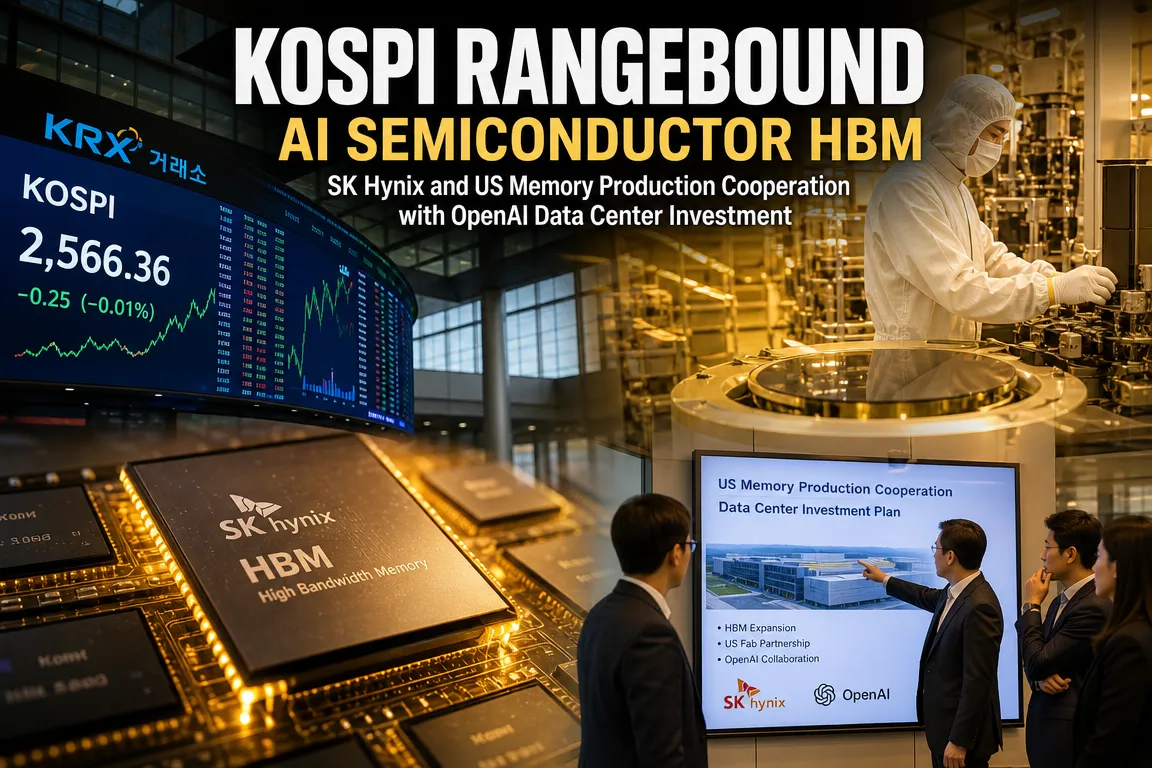
● Liquidity Flood, AI Frenzy, Economy Cracks
The Real Economy Is Weak, Yet Equities Hit Record Highs: The Structural Mechanics of the 4th Liquidity Rally (Key Checkpoints Through 2026)
This report covers three items.
1) A structural explanation of why equities rise despite weak growth, framed as the 1st–4th liquidity rallies
2) The mechanism by which AI lifts not only advanced technology but also power, energy, and legacy industries
3) The primary market triggers for 2025–2026 (risks beyond interest rates, plus the core dynamics of tariffs and rare earths)
1) Core headline
Global asset markets continue to set new highs despite soft real-economy conditions.
This is less a “disconnected bubble” than a structural rally driven by AI investment translating into earnings alongside liquidity expansion and currency value dilution.
2) News-style brief: three engines behind the current market
2-1. Engine A: The “4th liquidity rally” (peak liquidity conditions)
The key point: this is the fourth liquidity phase, and aggregate liquidity is perceived as the highest on record.
Sequence
– 1st: 1990s to early low-rate era, establishing the foundation for asset-price appreciation
– 2nd: Post-2008 global financial crisis, QE-driven asset inflation
– 3rd: Pandemic-era fiscal and monetary expansion driving broad asset rallies
– 4th: Rate-cut expectations + accumulated liquidity + policy pressure toward easing → “record-scale” liquidity conditions
Core logic
When real activity weakens, governments and central banks tend to lean toward accommodation, and asset markets typically reprice before the real economy.
This supports the “Bad is Good” dynamic observed in risk assets.
Key variables
Inflation, policy rates, USD FX, asset markets, recession risk
2-2. Engine B: AI investment at historic scale (concurrent rallies in high-tech and legacy sectors)
AI is not solely a GPU story; it pulls through power, data centers, materials, equipment, and logistics.
Why this drives an “everything rally”
– Prior bull markets often rotated narrowly (tech-only or industrials-only)
– Current cycle: AI deployment requires power, infrastructure, and supply chains → simultaneous uplift across new and old economy segments
Investor checkpoints
When “AI growth” appears abstract, it can resemble speculation; however, it increasingly manifests in measurable data such as power demand, semiconductor supply tightness, and data-center capex.
2-3. Engine C: The semiconductor supercycle has become harder to time (cycle endpoint less visible)
Historically, cycle peaks are driven by large capacity expansions; in the current cycle, expansion is progressing more slowly than expected.
Drivers of delayed capacity growth
– US reshoring and localization constraints
– Extended timelines across siting, power, permitting, and supply-chain coordination
Implication of “focus on earnings, not price”
The key is not whether prices have risen, but whether pricing strength translates into operating-profit expansion.
3) 2025–2026: two risks to monitor
3-1. System risk: non-bank credit (“shadow banking”) may break under a renewed tightening impulse
This is framed as a structural vulnerability.
– Greater liquidity increases the probability of excess lending
– Risk may build outside regulated banks (private credit and other non-bank channels)
– If rates rise again, latent credit stress can surface abruptly
Market turning points may be less about the first hike and more about
a tightening phase intersecting with accumulated credit deterioration that triggers an event.
3-2. Behavioral risk: FOMO can create the highest-cost losses
Common late-cycle pattern:
– Perceived underperformance pressure
– Momentum-driven chasing
– Volatility shock leading to forced de-risking
Execution guidance
Avoid attempting to time short-term pullbacks; in an uptrend, emphasize staged entry and position sizing discipline.
4) Tariffs and US–China deal dynamics: tariffs as an instrument, not an end goal
The central framing: tariffs function as leverage rather than the final objective.
US objectives
– Maintain competitive advantage versus China
– Support domestic manufacturing and manage political constraints
China’s leverage: rare earths (including refining)
Constraints on rare-earth refining can disrupt automotive and electronics production, transmitting immediate pressure into the US economy.
Implication
While escalation risk exists, political, inflation, and supply-chain constraints increase the probability that an agreement or de-escalation signal eventually re-supports risk assets.
5) AI into 2025–2026: track the sequence of shifting supply bottlenecks
A practical framework: scarcity migrates across the stack.
Observed/expected bottleneck sequence
– Phase 1: GPU shortages
– Phase 2: HBM shortages
– Phase 3: Power, transformers, and grid constraints
– Phase 4: As inference scales, renewed bottlenecks in servers, storage, and networking
Investment implication
Beyond mature leaders, identifying the next bottleneck can surface incremental opportunities.
6) Three opportunity areas highlighted
6-1. AI value chain (including semiconductors)
Prioritize verification that earnings are tracking investment narratives.
6-2. Quantum + drug discovery / compute expansion
Quantum computing can accelerate compute-intensive workloads, including AI-enabled drug discovery. A closely linked theme is quantum security / cybersecurity.
6-3. Energy (nuclear, LNG, solar plus storage, and grid investment)
Data centers are uptime-critical infrastructure. Intermittent generation alone is insufficient; reliable baseload and grid reinforcement must scale in parallel.
7) Underemphasized but critical takeaway
The primary issue is not whether rates are cut, but that
AI-driven bottlenecks migrate across industries, pulling legacy sectors into a concurrent rally.
Rather than limiting the thesis to mega-cap technology, the actionable sequence is:
– GPU → HBM → power → grid/transformers → (again) servers/storage
Risk assessment should focus less on generic “bubble” language and more on:
credit stress in non-bank lending that may emerge during a rate reversal.
This risk is less visible in standard indicators and may cause larger repricing when it surfaces.
< Summary >
The current record-high rally reflects a 4th liquidity phase combining AI-driven earnings and accumulated liquidity, rather than broad-based real-economy strength.
AI extends beyond GPUs, creating bottlenecks that lift power, infrastructure, and legacy industries, supporting an “everything rally.”
The semiconductor cycle endpoint is more closely tied to large-scale capacity expansion than to equity performance alone.
Key 2025–2026 risks include shadow-credit deterioration and late-cycle FOMO-driven positioning, potentially more destabilizing than rate moves.
Opportunity areas include the AI value chain, quantum (including quantum security), and energy/grid infrastructure.
[Related articles…]
- The stablecoin race: why the monetary order and payment infrastructure may shift by 2026
- Semiconductor supercycle 2.0: identifying the next bottleneck after HBM
*Source: [ 경제 읽어주는 남자(김광석TV) ]
– [모아보기] 실물경제는 무너졌는데 주식은 신고가 돈이 휴지가 되는 시대, 4차 유동성 랠리의 구조적 해석 | 이선엽 대표, 김기훈 대표
● US Pressures Taiwan,Unity or Collapse,TSMC Shock Hands Samsung a Power Grab
The Strategic Rationale Behind US Calls for “Taiwan Unity,” and How Rising TSMC Risk Creates a Semiconductor Leadership Window for Samsung
This report covers:1) Why the US demands “unity” from Taiwan (arms sales vs. underlying strategy)
2) Why Taiwan’s domestic sentiment is tilting toward “compromise with China” (dual political and economic pressure)
3) How global supply chains reconfigure as TSMC risk rises (the next phase after reshoring/friend-shoring)
4) Where Samsung Electronics can capture decisive opportunities (customers, process, packaging, geopolitics)
5) Critical points often underreported (limited US options, weakening Taiwanese leverage, customer Plan B execution)
1) [Headline] Why the US Calls for “Taiwan Unity”: Security Messaging, Supply-Chain and Defense-Industry Execution
The public framing emphasizes democracy and security. Operationally, the message reflects US concern that any instability in Taiwan would disrupt the semiconductor supply chain.
Two drivers dominate:
-
Defense-industry incentives (weapons procurement)
-
Strategic control and resilience of global supply chains (especially leading-edge semiconductors)
-
Defense angle
Larger Taiwanese defense budgets and accelerated procurement directly benefit US defense contractors. “Red line” messaging functions both as domestic cohesion signaling and as pressure to speed procurement. -
Supply-chain angle
For the US, TSMC is both a strategic and economic asset. Any production shock would transmit to AI infrastructure, servers, smartphones, and autos, with inflationary and growth implications.
Summary: The primary US objective is not escalation; it is preventing disruption—whether from conflict, blockade, or political instability—that could materially impair TSMC output and, by extension, US economic and technological competitiveness.
2) [Local Dynamics] Why Taiwan’s Domestic Opinion Is Shifting Toward “Autonomy-Level Compromise”
A growing parliamentary and public view is that outright conflict is not viable. This is driven by cost-benefit assessment rather than ideology.
-
Economic costs
Trade, investment, tourism, and corporate supply chains are increasingly sensitive to political risk. Rising geopolitical risk increases capital outflow pressure, FX volatility, and delays in corporate capex. -
Security costs
Expanded conscription, reserves, and spending on air defense, drones, and missiles increases fiscal burden and reinforces the perception of “funding arms purchases.” -
Political constraints
“Independence” is symbolically powerful but reduces strategic options once perceived red lines are crossed. A “minimum autonomy + de-escalation” posture emerges as a pragmatic alternative.
As this trend strengthens, markets tend to price uncertainty faster than they reward negotiating leverage, accelerating corporate contingency planning.
3) [US Core Dilemma] The Meaning of “Strong Rhetoric, Limited Additional Levers”
The characterization that the US has already applied near-maximum pressure implies constraints on incremental policy tools.
-
Additional sanctions
Further measures against China are possible, but they can generate domestic US backlash through higher prices, supply-chain stress, and corporate earnings pressure. US political and macro conditions cap sanction intensity. -
Military intervention
Escalation risk is structurally high, incentivizing forceful rhetoric paired with calibrated actions. -
Primary objective: buying time
The practical goal is extending the timeline until US domestic capacity—leading-edge manufacturing, advanced packaging, and upstream materials/equipment—reaches greater self-sufficiency.
This dynamic can influence rates, inflation, and FX volatility, reinforcing the pace of global supply-chain reconfiguration, with semiconductors at the center.
4) [TSMC Risk = Samsung Opportunity] Four Specific Opportunity Vectors
Rising TSMC risk changes customer decision frameworks, beyond a simple competitor setback.
-
(1) Customer “Plan B” becomes permanent
Historically, customers could concentrate on the single best node by yield/performance. Now, geopolitical diversification is a board-level KPI, expanding addressable space for Samsung Foundry. -
(2) Competition shifts from node-only to “system combinations”
Customers increasingly evaluate integrated stacks: advanced packaging (chiplets/2.5D/3D), HBM, and design ecosystem. Samsung can differentiate through memory (HBM) + foundry integration. -
(3) US industrial policy reduces single-firm dependence
Even while attracting TSMC, the US seeks to lower structural dependency. Samsung can position “US-based production + diversification” as a strategic alternative. -
(4) Reallocation of pricing power
Geopolitical premiums encourage longer-term contracting. Firms with diversified manufacturing footprints gain negotiating leverage; risk management becomes a competitive attribute alongside technology.
Summary: The opportunity is structural: procurement criteria shift from “technology only” to “technology + security + supply-chain resilience.”
5) [Market Checklist] Underappreciated Monitoring Points
-
Checkpoint 1: Taiwan’s political direction is driven by cost minimization
Public sentiment shifts influence corporate behavior, which then reshapes supply chains. -
Checkpoint 2: The US priority is managing semiconductor shock risk
Military and diplomatic messaging is also a tool to manage macro spillovers (inflation, growth, financial conditions). -
Checkpoint 3: The core risk is erosion of TSMC’s trust premium
Once customers operationalize Plan B, switching back can be costly and slow. -
Checkpoint 4: Samsung’s near-term opportunity may be faster in packaging + HBM + foundry bundling than in pure node parity
In AI, performance and cost increasingly depend on system-level integration rather than a single chip.
6) [Key Point] The US “Defends” Taiwan in Part Because Strategic Alternatives Are Constrained
The dominant narrative often frames US behavior as either “defense commitment” or “arms sales.” In practice, both are factors, but the binding constraint is limited feasible options.
The US does not have a constant, unconditional ability or willingness to guarantee Taiwan’s security, yet it also cannot easily absorb the semiconductor shock of losing Taiwan’s manufacturing capacity. The resulting approach is:
- Strong rhetoric: emphasizing red lines, unity, and democratic values to sustain deterrence
- Supply-chain execution: diversifying production, tightening allied supply-chain coordination, and strengthening controls over critical equipment/materials
For investors, focusing only on the binary question of conflict timing risks missing the ongoing shift already underway: manufacturing diversification, longer-term contracts, and packaging-led competition.
7) Forward Scenarios: Three Paths and Likely Market Responses
-
Scenario A: Persistent low-intensity tension + accelerated diversification
The highest-probability baseline. Semiconductors shift from “single-region concentration” to “multi-line sourcing,” supporting sustained capex over time. -
Scenario B: Political de-escalation attempt (autonomy-level arrangement) + short-term stabilization
Markets may react positively near term, but corporates often maintain Plan B execution once initiated; easing tension does not necessarily imply supply-chain reversion. -
Scenario C: Sudden incident or blockade risk spike
Risk assets would likely reprice lower amid logistics and component shortages, with renewed inflation risk and potential disruption to central bank rate paths.
< Summary >
US calls for “Taiwan unity” are framed as security imperatives, but materially reflect an effort to contain semiconductor supply-chain shock risk alongside defense-industry incentives.
Taiwan’s domestic debate increasingly reflects a war-avoidance cost calculus, strengthening uncertainty and accelerating corporate Plan B adoption.
As TSMC risk rises, customers incorporate geopolitical diversification into procurement, creating structural openings for Samsung through HBM, packaging, and foundry integration.
A central implication is that US policy posture is shaped less by abundant options than by constrained alternatives: strong rhetoric paired with supply-chain reconfiguration.
[Related Articles…]
- Semiconductor supply-chain restructuring and survival strategies for Korean corporates: https://NextGenInsight.net?s=semiconductors
- How TSMC risk reshapes the global foundry landscape: https://NextGenInsight.net?s=TSMC
*Source: [ 달란트투자 ]
– 미국마저 수습 나섰다. 아수라장 된 대만 현지 상황 | 김정호 교수 4부
● AI Smashes Ivy League Hiring Monopoly, Big Tech Goes Skill First
The Real Reason AI Is Undermining Academic Pedigree: Big Tech Hiring Experiments and Korea’s 10-Year Survival Roadmap
This report addresses:
- How far US Big Tech has progressed in weakening degree-based hiring, including the “College is broken” narrative.
- Why AI disrupted white-collar and professional work first, and why academic pedigree (as a labor-market signal) is a subsequent target.
- How Korea’s productivity, employment, and wage structures may distort if the transition is not managed.
- Immediate shifts required across universities, employers, and individuals, organized as “Directing–Asking–Verifying.”
- Key implications typically omitted in mainstream coverage.
1) Headline: “In the AI era, academic pedigree is not a license”
As AI adoption expands, hiring criteria are shifting from formal credentials to demonstrable capability. US Big Tech increasingly discounts degrees as a signaling mechanism, replacing them with AI-enabled assessment, portfolios, and work simulations. This is a structural change affecting labor-market matching and human-capital investment decisions.
2) Market signal: White-collar disruption preceded manual labor
Generative AI has automated white-collar workflows (documentation, analysis, reporting, code generation, contract drafting) faster than many physical tasks. Licensed professions (law, accounting) retain regulatory protection, but a growing share of tasks is being decomposed into AI-assisted components.
Key point: academic pedigree historically functioned as a signal rather than a license; AI is becoming a scalable measurement instrument that can substitute for that signal.
This shift affects labor cost structures, the pace of productivity gains, and wage dispersion. The implications extend beyond education into macroeconomic reallocation of human-capital investment.
3) US-led erosion of degree signals: observable hiring experiments
The material claim is that hiring-system redesign is already underway, not merely rhetorical. The experiments modify the pipeline through dedicated tracks and alternative credentialing.
3-1) Palantir: “College is broken” and a fellowship excluding current college students
Palantir promotes a merit-based fellowship in which individuals currently enrolled in college are ineligible to apply. The design separates degree and non-degree talent pools and creates a competitive channel for high performers outside traditional pathways.
3-2) Google: Apprenticeships expanding non-traditional routes
Google operates structured apprenticeship lanes to recruit talent beyond conventional elite pipelines. This is an institutionalized alternative funnel rather than a generic “degree not required” policy.
3-3) IBM: “New Collar” and skill-first design
IBM has advanced a skill-first model, enabling non-degree candidates to enter career tracks. The operational implication is the migration of evaluation, promotion, and job design from credential-based to performance/competency-based systems.
3-4) Amazon: emphasis on GED as an innovation-through-diversity argument
The cited logic is that overreliance on elite-degree homogeneity can reduce innovation; broader educational backgrounds can improve creativity and execution. This is positioned as an organizational performance strategy rather than purely a social objective.
3-5) Microsoft: recognition of self-taught and bootcamp talent
Microsoft has moved to treat bootcamp and self-directed pathways as formal recruiting routes, reducing the “paper ceiling” that restricts candidates without degrees.
4) Economic framework: AI weakens three core functions of higher education
The thesis is that AI pressures three value drivers simultaneously:
1) Human-capital accumulation (skills and knowledge)When content becomes cheaply accessible via AI, the marginal return on a four-year investment may decline for many curricula.
2) Signaling and filteringSelective institutions historically conveyed ability and conscientiousness. AI-based assessment (problem-solving tests, portfolio analysis, work simulations) can substitute for credential signals at scale.
3) NetworkingAs firms increase data-driven performance evaluation and reduce informal politics, the leverage of school-based networks may weaken at the margin.
This aligns with signaling theory (e.g., Spence): if AI improves selection precision, degrees as screening devices face structural devaluation.
5) Korea-specific risk: high dependence on a weakening filter
Korea’s labor market relies heavily on university admission as the primary screening step, while graduation often adds limited incremental filtering. Despite this, hiring remains credential-dependent.
In many large firms, including technology-oriented enterprises, management practices can resemble traditional conglomerate structures, favoring qualitative impressions and informal networks over standardized capability measurement. This reduces the effectiveness of identifying problem-solving talent required in AI-intensive environments.
A credential-and-licensing bias can also divert resources toward exam preparation rather than entrepreneurship, product development, and technical innovation, with potential drag on long-term productivity growth.
6) Ten-year roadmap: from “Do” to “Direct”
The proposed AI literacy framework comprises three applied capabilities:
6-1) Directing: from executing tasks to orchestrating AI
Competitive advantage shifts toward specifying objectives, constraints, and evaluation criteria to reliably produce usable outputs. Corporate reskilling is likely to concentrate on this layer.
6-2) Asking: question quality becomes performance quality
Value concentrates in problem framing: decomposing ambiguity, forming hypotheses, and navigating exploration. Project-based competence becomes more predictive than test-based proficiency.
6-3) Verifying: critical validation of AI outputs
AI can generate plausible but incorrect outputs. Verification, auditability, and risk checks become core differentiators, especially in regulated and quality-sensitive industries (finance, legal, healthcare, manufacturing).
7) Under-discussed implications
1) Not collapse, but repricing of pedigree premiums
Elite degrees may retain value, but the wage premium attributable to credential signaling may compress as substitutes (portfolios, simulations, algorithmic assessments) gain pricing power.
2) AI hiring is not inherently “fair”; it is a shift in measurement power
As pedigree matters less, the decisive variable becomes which assessments are used and who controls the rubrics, datasets, and thresholds.
3) A weaker paper ceiling increases labor-market volatility
Reduced credential insulation intensifies performance competition, increases mobility, and can make compensation negotiation more market-driven and less stable.
4) University survival requires “verified experience production,” not content delivery
Instruction is commoditized; differentiated value shifts to scarce experiences: team projects, industry collaboration, productization, internships, and applied problem solving.
5) Winners accumulate evidence, not credentials
Resumes trend toward proof: artifacts built, measurable outcomes, and portfolio depth. Git repositories, shipped products, and quantified impact become the new signaling layer.
8) Immediate individual actions (practical)
1) Redesign career documents from resume-centric to evidence-centric (projects, outcomes, portfolios).
2) Operationalize AI usage to raise personal productivity (workflow automation, drafting, analysis, coding assistance, research).
3) Prepare for work-sample and simulation-based selection (case exercises, take-home tasks, coding tests, role simulations).
4) Build at least one domain where validation is defensible (data, finance, security, quality, compliance).
5) Reprice skills regularly using compensation benchmarks, job-description analysis, and demand signals.
Higher income volatility increases the importance of cash-flow control, diversified investment exposure, and risk management to protect real purchasing power in inflationary conditions.
< Summary >
- AI has decomposed and automated white-collar and professional tasks, then began substituting for academic pedigree as a labor-market signal.
- Palantir, Google, IBM, Amazon, and Microsoft are piloting dedicated non-traditional hiring tracks to reduce the paper ceiling.
- The three core university functions (human capital, signaling, networking) face concurrent pressure; Korea’s credential dependence increases exposure to misalignment.
- The practical roadmap centers on “Directing–Asking–Verifying,” with careers increasingly priced on evidence (outcomes and portfolios) rather than degrees.
[Related Links…]
https://NextGenInsight.net?s=AI
https://NextGenInsight.net?s=inflation
*Source: [ jisik-hanbang ]
– AI시대 학벌 파괴, 서울대의 몰락? (박종훈의 지식한방)