● HBM-Bottleneck Power-Shift Silver-Shock Sector-Rotation
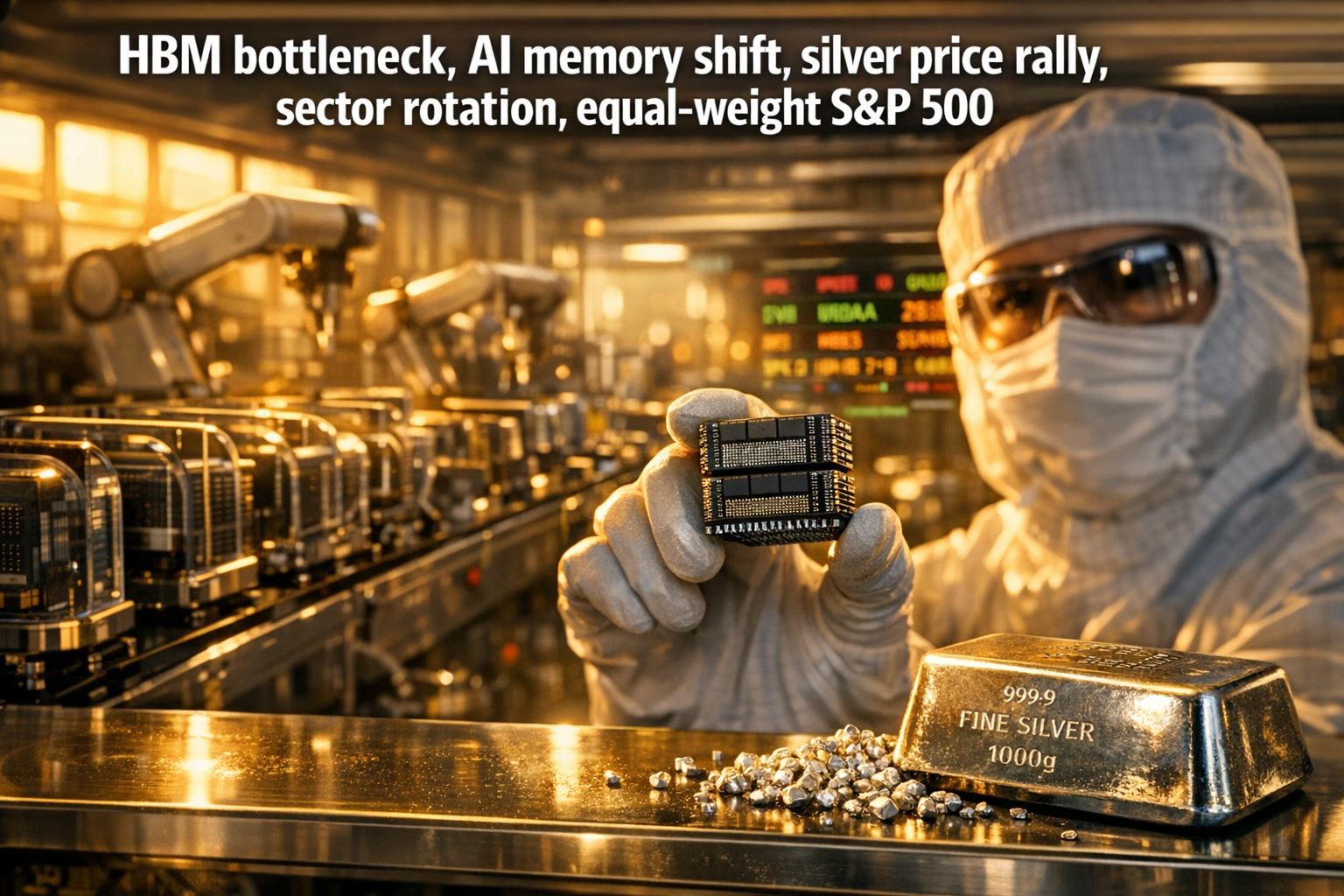
This report consolidates the underlying rationale behind Elon Musk’s comment that “silver has risen too much,” the shift in AI bottlenecks toward memory (HBM), and the potential direction of Q4 sector rotation.
This report covers:
1) Evidence that the key bottleneck of the AI rally is shifting from GPUs to memory (HBM)
2) Why SK hynix can raise prices by 50% to Big Tech and still secure acceptance
3) Why surges in silver, gold, and platinum reflect the intersection of inflation, supply constraints, and the energy transition rather than a simple “commodities theme”
4) Signals from the equal-weight S&P 500: increasing probability of a “post–mega-cap” market phase
5) The critical framing often omitted: in the AI era, the effective currency is not only dollars, but “power + memory + metals”
1) Market briefing: why markets look “confused yet resilient”
AI remains the central driver of risk assets. Nvidia appears to be extending its dominance through large-scale deals and ecosystem control, while capital is also rotating into precious metals such as gold, silver, and platinum.
Key point: the “AI growth rally” and the “real-asset rally” are not competing narratives. They can be viewed as parallel outcomes of the same forces: supply constraints and elevated inflation expectations.
2) AI semiconductor “power shift”: the bottleneck is moving from GPUs to HBM
A core message is that the competitive focus is shifting from compute to memory, transferring pricing leverage toward suppliers.
2-1) SK hynix narrative (condensed)
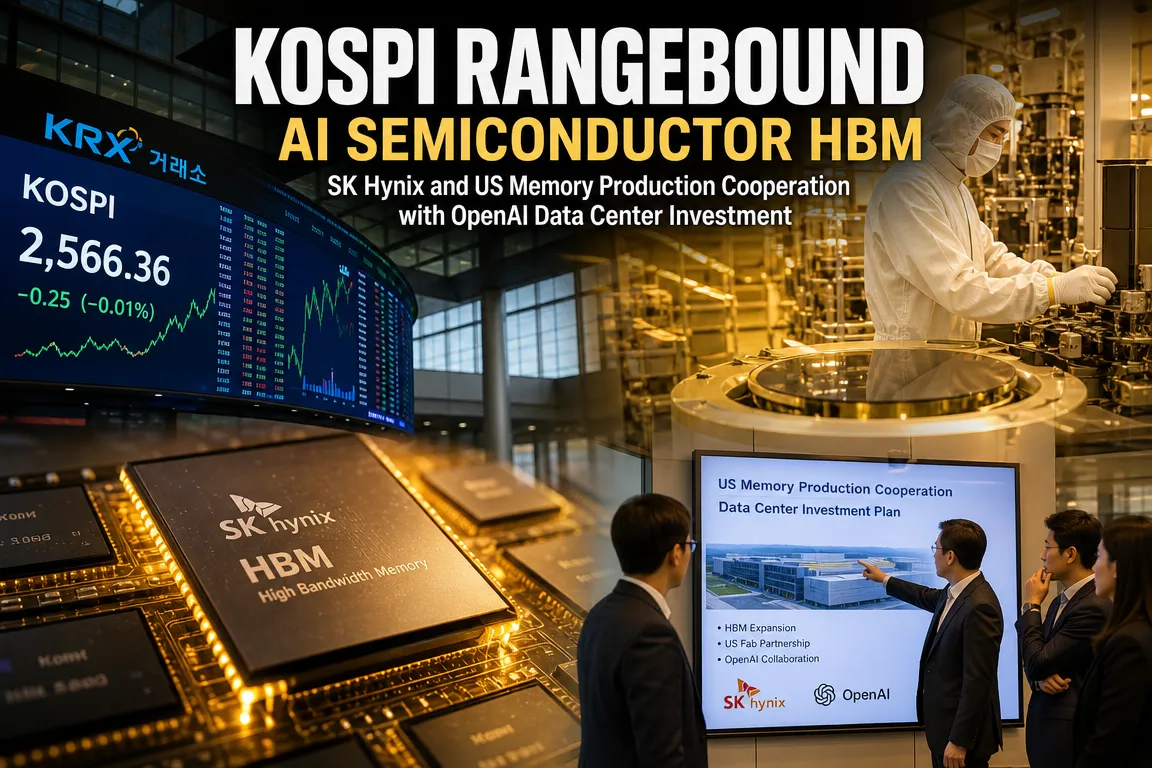
- HBM market share referenced at approximately 62%
- Capacity reportedly effectively sold out through 2026
- HBM4 pricing reportedly increased by ~50%, with indications that Nvidia accepted the increase
2-2) Why Big Tech procurement is effectively “on-site”
Hyperscalers (e.g., Google, Meta, Microsoft) are described as keeping procurement teams close to operations to secure supply. HBM is increasingly viewed as a non-substitutable input for AI scaling.
AI data centers require more than GPUs; they depend on memory bandwidth, power efficiency, and supply reliability.
2-3) Why this challenges a 20-year assumption
For two decades, the implicit premise was that memory supply is ample and prices structurally decline over time, forming a foundation for the cloud industry.
Current conditions imply the opposite: constrained supply and a supplier structure capable of raising prices even against the largest buyers.
2-4) Investment implications: “AI = GPU” is an incomplete frame
A narrow “buy the HBM leader” conclusion misses the broader shift: the AI value chain is widening across compute, memory, power, cooling, and materials.
As exposure concentrates in a few mega-caps, portfolio risk can rise, particularly as supply chains become concentrated by geography and by firm, increasing price volatility and reinforcing inflation sensitivity.
3) Context for Musk’s “silver is too high” comment: cost pressure in EVs and the energy transition
The point is practical: silver is a required industrial input, and rapid price increases translate into manufacturing cost pressure.
3-1) Why higher silver prices matter for manufacturers like Tesla
Silver functions primarily as an industrial material, used in electrical and electronic components, contacts, and multiple production processes. Energy-transition investment (grid upgrades, charging infrastructure) can structurally increase demand.
Transmission mechanism: higher silver prices can raise input costs, compress margins, and force either price pass-through or demand softening.
3-2) Why silver, gold, and platinum are moving together
Beyond traditional macro explanations (USD weakness, lower real yields, inflation hedging), current dynamics can reflect the combination of:
- Supply constraints (mining, refining, environmental constraints, geopolitics)
- Industrial demand tied to electrification and increased electronics content
Interest rates and inflation remain key variables, with markets positioning around central bank paths and inflation persistence.
4) Peter Schiff’s thesis (condensed): silver to $100, gold to $5,000–$6,000, and miners as the “high beta” exposure
The argument is structured as follows:
- A technical breakout suggests silver’s uptrend may still be early-stage
- Silver at $100 by 2026 is presented as plausible
- Gold at $5,000, and potentially $6,000, is presented as achievable under certain conditions
- Conclusion: gold and silver mining equities are positioned to benefit
4-1) Miners: operating leverage to metal prices
If gold trades at $4,300 with all-in costs around $1,500 (illustrative), margin expansion can exceed the underlying commodity’s price move. As a result, miners can outperform in upcycles but exhibit higher volatility than spot exposure.
4-2) Additive sensitivity via M&A
If large miners increase acquisitions of smaller producers, smaller-cap miners may receive additional upside from takeout premia, reflecting not only commodity beta but also industry consolidation dynamics.
5) Q4 sector rotation signal: what the equal-weight S&P 500 implies
Commentary referenced indicates broadening participation beyond a small set of mega-caps. Small caps have reached new highs amid expectations of easier financial conditions and increased leverage. The equal-weight S&P 500 is cited as evidence of this shift.
5-1) Why the rotation may not be complete
The ratio of equal-weight to cap-weight S&P 500 performance over the past year is described as historically depressed (lower deciles). This suggests that, despite some rotation, market performance may still be excessively concentrated, leaving room for further diversification across sectors and market caps.
5-2) Practical interpretation
The signal is not necessarily “sell Big Tech,” but rather “Big Tech-only positioning increases risk.” A more balanced allocation across equal-weight exposure, small caps, value, materials, and industrials may be more consistent with a market transitioning away from narrow leadership—particularly under mixed recession vs soft-landing scenarios.
6) The key framing often overlooked
6-1) In the AI era, the effective currency is “power, memory, and metals,” not only dollars
AI data centers are constrained by physical capacity, not just capital: power infrastructure, cooling, transformers and transmission, and critical components such as HBM.
Physical bottlenecks translate into supply constraints and pricing power. This framework also explains why AI strength and precious-metals strength can co-occur as outcomes of shared drivers: bottlenecks and inflation expectations.
6-2) HBM scarcity is a macro-relevant supply-chain risk premium
Concentration of supply in specific countries and firms tends to embed a risk premium into prices. While this can benefit supplier equities, it can also feed back into broader inflation pressures, creating divergence between equity performance and real-economy cost dynamics.
6-3) Precious metals: not only “fear,” but manufacturing cost
Gold is typically framed as a safe haven, but silver’s heavier industrial usage makes it a direct cost input. Musk’s comment is relevant because it highlights precious-metal rallies as a potential inflation channel affecting manufacturing margins.
7) Forward watchlist
1) HBM supply agreements, capacity expansion pace, and ASP trajectory
2) Speed at which hyperscaler capex translates into realized revenue across the AI stack
3) Rate path (central bank policy) and risk of inflation re-acceleration
4) Composition of precious-metals strength: industrial demand vs investment demand
5) Relative strength of equal-weight indices: whether rotation is episodic or structural
Tracking these items may reduce sensitivity to short-term headlines.
- The AI rally’s bottleneck appears to be shifting from GPUs toward HBM memory, with pricing power increasingly accruing to suppliers.
- Musk’s concern over rising silver prices underscores that precious-metal strength can transmit into manufacturing costs and inflation-sensitive margins.
- Schiff argues for silver at $100 and gold at $5,000–$6,000 and highlights miners and potential M&A as leveraged beneficiaries.
- Strength in the equal-weight S&P 500 suggests broader sector participation and rising concentration risk in mega-cap-only exposure.
- A unifying framework is that supply constraints in power, memory, and metals can simultaneously drive AI-linked assets and real assets.
[Related Links…]
- HBM supply bottlenecks and the reshaping of semiconductors: the memory cycle’s influence on AI
https://NextGenInsight.net?s=HBM - The economics of surging silver prices: inflation hedge vs early-stage industrial cost shock
https://NextGenInsight.net?s=%EC%9D%80%EA%B0%92
*Source: [ Maeil Business Newspaper ]
– [홍장원의 불앤베어] 일론 머스크 “은 값이 너무 올라 걱정된다”