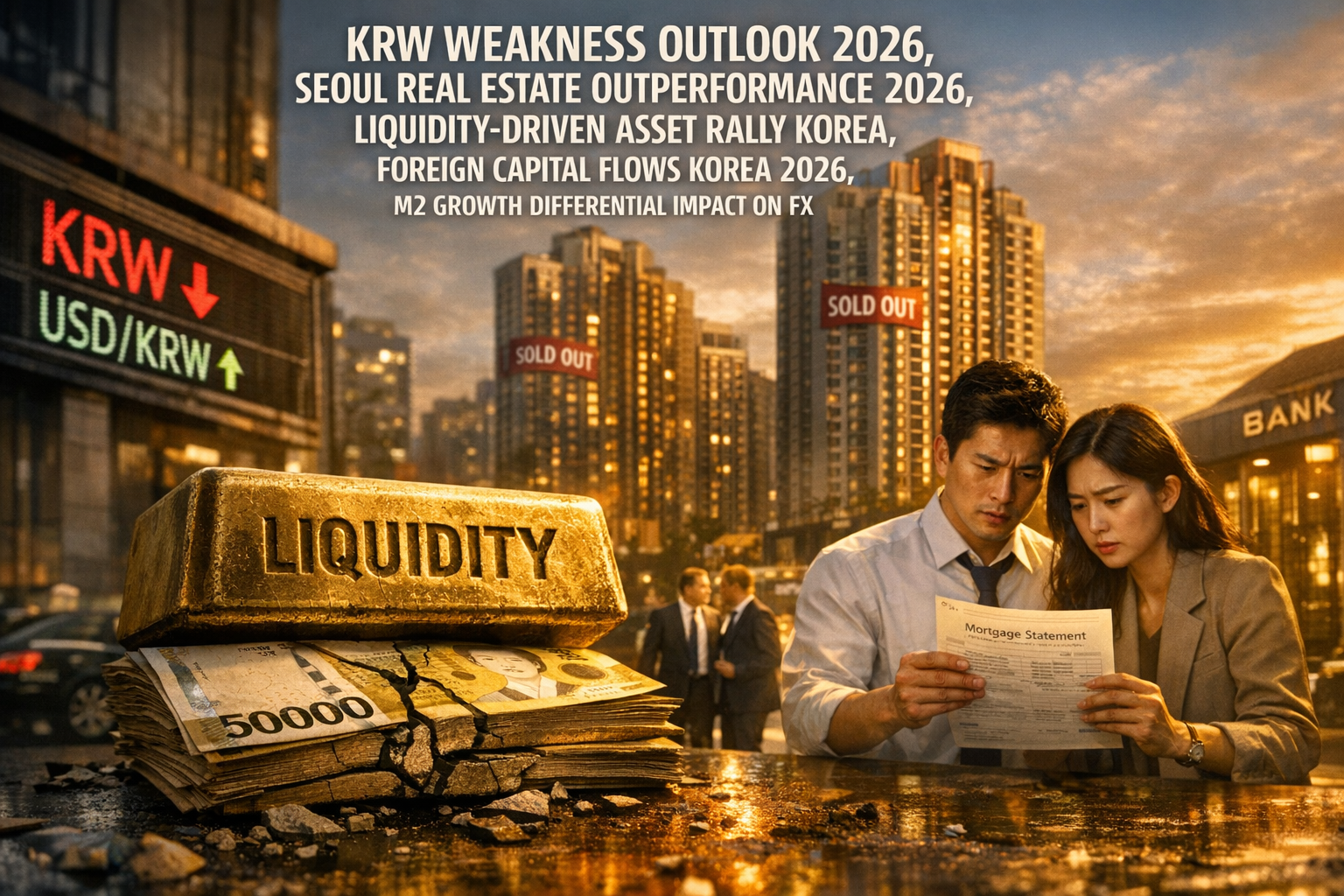
● Liquidity Surge Triggers Home Price Spike and Won Crash, US Capital Stampede Looms 2026
Persistently Expanding Liquidity Makes It Difficult to Contain Both “Housing Prices Up + FX Rate Up”
Why Capital Concentrates in the U.S., and What May Prove More Volatile in 2026
Today’s core points:
- Why the 2025 “prolonged high FX rate” is better framed as “KRW weakness,” not “USD strength”
- How faster M2 growth can push both the FX rate and real estate prices
- Why capital flows increasingly favor the U.S. (aligned incentives across corporates, households, and the national pension)
- How a pivot (rate-cut cycle) can drive an asset-market rally
- Why the Seoul vs. non-Seoul real estate divergence is becoming structural
- A separate summary of policy levers that are practically controllable, often under-discussed in mainstream media
1) News Briefing: 2025 Saw “Housing Prices Up + FX Rate Up” Simultaneously
One-line summary
Liquidity expansion tends to lift asset prices; when KRW valuation weakens concurrently, the FX rate can rise as a second, reinforcing pressure.
Key context
A defining feature of 2025 is that both housing prices and the FX rate increased. The interpretation is that this was not coincidental; both were influenced by shared drivers such as liquidity, money supply, and policy expectations.
Key tags
Korean economic outlook, inflation, policy rate, FX outlook, real estate market, liquidity.
2) Prolonged High FX Rate: Why the “KRW Weakness” Frame Matters More Than “USD Strength”
Summary
- Historical crisis-type FX moves: sharp spike (peak) → rapid normalization
- Recent pattern: elevated levels persisting for longer durations
- Implication: not only broad USD strength; KRW underperformance is a material contributor
Why the frame matters
Attributing the move solely to “strong USD” limits actionable responses. A “KRW weakness” frame highlights domestic levers (policy stance, liquidity management, expectation management) that can influence outcomes.
3) Core Issue: M2 Growth Momentum Can Drive the FX Rate
Logic emphasized
- If Korea’s M2 growth rate exceeds the U.S. M2 growth rate,
- KRW purchasing power can erode faster on a relative basis,
- and the FX rate can adjust accordingly.
Key point: relative pace, not absolute level
FX is fundamentally a relative-pricing mechanism. The relevant question is whether domestic money supply expands faster than peer economies, particularly the U.S.
Policy sensitivity
If money supply growth materially outpaces fundamentals (growth/inflation), markets may price in higher debasement risk, increasing FX pressure.
4) Why Capital Concentrates in the U.S.: Combined “High-FX Expectations + Return Expectations”
Checklist
- Corporates: Even when earning USD from exports, expectations of further FX upside reduce incentives to convert USD proceeds into KRW quickly.
- Households: Expected U.S. asset returns plus potential FX gains can structurally increase overseas allocation.
- Institutions (e.g., national pension): Long-horizon diversification policies that raise foreign allocation can reinforce persistent outbound flows.
Key implication
These flows are largely rational responses to incentives; moral suasion is unlikely to reverse them. Reversal typically requires policy and communication that credibly reshapes market expectations.
5) The Pivot Regime: Why Rate Cuts Often Support Asset Prices
Mechanism
- Slowing growth increases the probability of policy easing (rate cuts, fiscal support).
- Easing increases liquidity and can restore risk appetite.
- As a result, equities and real estate may re-rate ahead of the real economy.
Main Street vs. Wall Street
Asset prices can rise without a strong improvement in real-economy conditions, primarily due to changes in liquidity conditions and discount rates.
6) Real Estate Asymmetry: Why Seoul Outperforms While Non-Seoul Regions Remain Fragile
Conclusion
- Liquidity affects the broad market,
- but geographic concentration of demand (population flows, job clustering, education, infrastructure)
- can translate into “Seoul-led appreciation” rather than uniform gains.
Why this matters more in 2026
If a rate-cut environment persists, liquidity impact may intensify, while capital allocation becomes more selective. Divergence may therefore become more entrenched via capital concentration.
7) Everything Rally & Debasement: Asset Appreciation Can Reflect Currency Value Dilution
Debasement frameworkWhen money supply expands while the supply of scarce prime assets (e.g., Seoul core housing, high-quality financial assets) is relatively fixed, clearing prices rise because more nominal currency units compete for limited assets.
Risk signal
An asset rally may reflect currency-value dynamics rather than broad-based prosperity. When wage growth lags asset inflation, wealth and affordability gaps tend to widen.
8) “Low Growth Entrenchment” Increases Structural Pressure Toward Policy Easing
Summary
- Global growth expectations skew toward lower growth rather than high growth.
- Korea may remain below or near a low potential growth rate (approximately ~2%).
- Real-economy conditions can remain constrained, while easing bias strengthens.
Core conclusion
Weaker real activity increases incentives for easing; liquidity becomes easier to expand; managing both FX stability and asset-price inflation becomes more difficult.
9) Under-Discussed Points: Practical Drivers and Controllable Policy Levers
-
1) FX stability is an expectations game, not a moral campaign
Criticizing corporates/households/institutions does not change flow incentives. Durable stabilization requires credible policy that anchors expectations of KRW stability. -
2) The most controllable lever is the pace of liquidity provision
Despite many contributing factors, authorities most directly influence liquidity growth and signaling via policy and communication. -
3) “High FX → higher overseas investment → further KRW weakness” can become a feedback loop
Once markets adapt to a persistent high-FX regime, reversal typically requires higher policy costs; early intervention is more effective. -
4) Real estate is shifting from “up vs. down” to “which areas rise and which fall”
Liquidity expansion can increase selectivity, widening the gap between core Seoul areas and non-core regions. -
5) The 2026 watchpoint is less about real-economy recovery and more about the next liquidity impulse
Headline growth may improve on base effects while sentiment remains weak; FX and asset prices are likely to remain highly sensitive to liquidity momentum.
< Summary >
2025 can be characterized by simultaneous increases in housing prices and the FX rate under liquidity-driven conditions. Prolonged high FX levels are better explained by relative KRW weakness than by USD strength alone, which clarifies domestic policy levers. If Korea’s M2 growth outpaces the U.S., debasement expectations can rise and add FX pressure. Persistent allocation toward U.S. assets by corporates, households, and institutions reflects rational incentives and is unlikely to reverse without credible expectation management. In a pivot environment, asset markets can rally even if the real economy remains subdued, while real estate performance may become increasingly asymmetric with Seoul-led concentration.
[Related Articles…]
- https://NextGenInsight.net?s=FX
5 Checks Individual Investors Should Make First When FX Volatility Increases - https://NextGenInsight.net?s=RealEstate
Deepening Real Estate Asymmetry: Data Behind the Seoul vs. Non-Seoul Divide
*Source: [ 경제 읽어주는 남자(김광석TV) ]
– 돈을 계속 풀면, 집값상승과 환율상승 둘 다 못잡는다. 돈이 미국으로만 쏠리는 진짜 이유 [경읽남 225화]
● Silver Crash, Won Shock, KOSPI Surge
Silver and KRW/USD Sell-Off, While KOSPI Rises “Alone”: The Underlying Drivers
This report focuses on three points:
First, why sharp silver rallies are frequently followed by abrupt next-day declines (a “pass-the-bomb” liquidity structure).
Second, why the KRW/USD sell-off is better explained by flow-driven events rather than “free-market” price action (NPS actions, FX hedging, overseas asset sales, tax incentives).
Third, the recurring pattern in which foreign investors lift KOSPI large caps under this setup, and a practical trading framework to reduce retail drawdowns (fundamentals regime vs mania regime).
1) Daily Market Brief: “Silver Drop + KRW Strength + KOSPI Up”
1-1. Silver: What an Intraday -10% Reversal Signals
Silver surged in a short period (from the 40s to the 80s) while multiple overheating signals accumulated.
It then formed a peak near 82 and declined to the 74 area, producing an extreme one-day range.
In such conditions, a high share of leveraged participation (margin/derivatives) accelerates downside moves.
Small declines can trigger margin calls and stop-loss cascades, creating mechanically self-reinforcing selling.
1-2. KRW/USD: After “Defense Signals,” the Decisive Trigger Was a Shift in Flows
Market behavior suggested intervention-like defense around 1,480 KRW per USD, but intervention alone often has limited durability as buyers re-emerge.
The more effective driver was the introduction of tools that change actual flows:
NPS involvement, expanded FX hedging, and overseas asset sales reduced USD demand and increased USD supply, weakening momentum-based “buy because it is rising” positioning.
1-3. KOSPI: A Large-Cap, Index-Led Move Rather Than Broad Sector Rotation
Key features:
- KOSPI 200 outperformed the broader KOSPI
- Large foreign net buying was visible
- Retail flow appeared comparatively net selling
This resembled an index-driven market rather than a theme-led market.
KRW stabilization (or rapid appreciation) likely lowered the entry barrier for foreign investors.
2) Why Silver Is Volatile Now: Separate the “Bull Thesis” From the “Overheating Mechanism”
2-1. A Valid Macro Narrative Does Not Prevent Corrections
Even if drivers exist (inflation hedging, USD weakness expectations, industrial demand, risk-off sentiment), a vertical move typically requires repeated position handoffs (early buyers selling to late buyers).
2-2. When It Becomes “Pass-the-Bomb”: Practical Checkpoints
The structure is straightforward:
Stage 1 sells to Stage 2; Stage 2 sells to Stage 3; the final buyer pays the highest price.
When incremental liquidity stops, the last buyer becomes the residual risk holder.
2-3. Trading Signal: An Unexplained Large Bearish Candle Is a Flow Warning
A large bearish candle after an outsized rally is treated as a sign that flows have turned; risk is reduced accordingly.
A subsequent blow-off rally can occur, but participation is often asymmetric and outside disciplined risk rules.
3) The Core of the KRW/USD Move: Focus on Flow Mechanics, Not Policy “Intent”
3-1. Anchoring on FX Conviction Increases Risk
FX direction cannot be stated with certainty.
Scenario probabilities can be assessed, but treating direction as a belief tends to magnify losses.
3-2. Flow “Cards” Potentially Driving the Move
To lower KRW/USD, USD demand must fall and/or USD supply must rise. Noted drivers:
- NPS-related actions: hedging/asset allocation effects on positioning and sentiment
- Overseas asset sales: conversion into KRW increases USD supply
- Tax incentives for reallocating from overseas equities to domestic equities (e.g., capital-gains tax relief): encourages rebalancing
When these measures emerge concurrently, trend-following USD-long positions face higher reversal risk, and rapid de-risking can produce sharp declines.
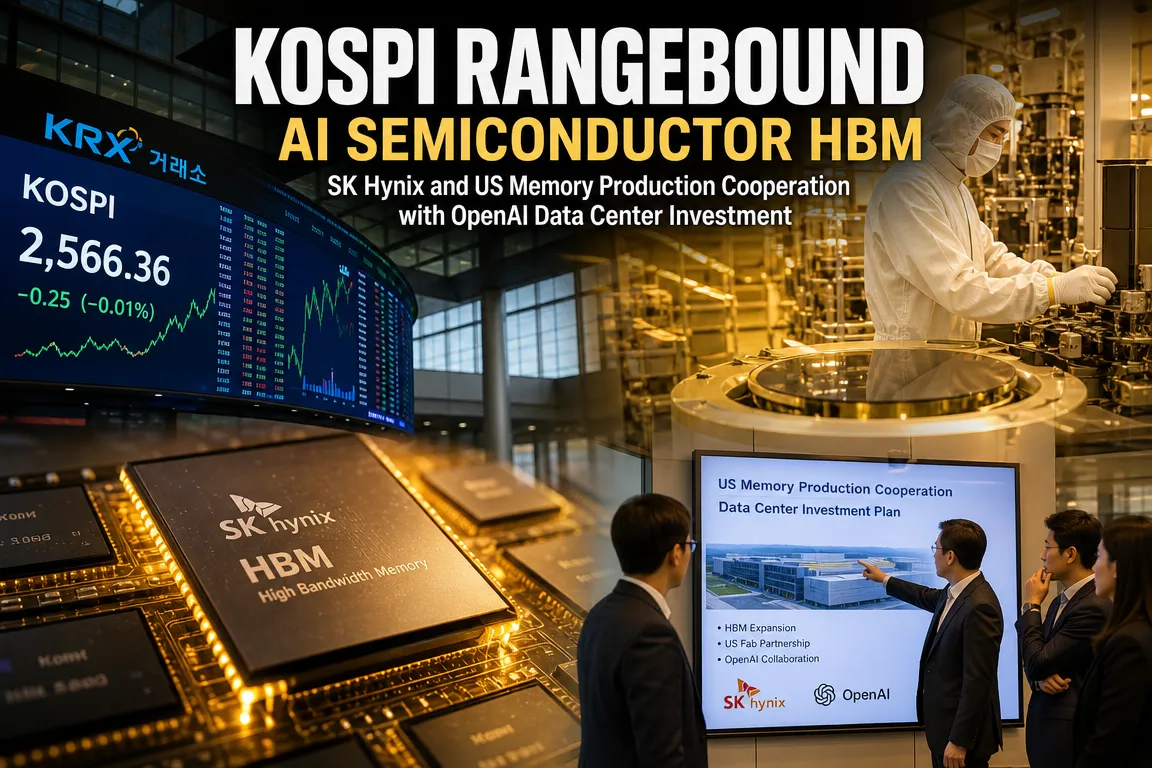
4) Why KOSPI Rose: A Setup Where “FX Stabilization + Large-Cap Index Strategy” Works for Foreign Flows
4-1. Foreign Investors Operate Primarily on Quantitative Risk/Return
Foreign flow should be assessed through hedging, futures/options positioning, cash equity net buying, and index management rather than sentiment narratives.
FX volatility can materially distort KRW equity returns for offshore investors via translation gains/losses.
KRW stabilization or appreciation improves entry conditions, and the most efficient expression is frequently large-cap (KOSPI 200) accumulation.
4-2. Conditions Under Which Korean Equities Become Relatively Attractive
If US equities (particularly pre-profit growth segments) look vulnerable while Korea benefits from policy/flow support around FX, relative allocation can shift toward Korea.
Key variables typically interact: inflation, policy rates, KRW/USD, foreign net buying, and KOSPI directionality.
5) Investment Framework: “Fundamentals Regime vs Mania Regime”
5-1. Fundamentals Regime: Define Fair Value as a Reference Line
Estimate fair value using cash-generation capacity, asset backing, and margin of safety.
Below or near this line, risk management is more controllable.
5-2. Mania Regime: Above Fair Value, Price Is Driven by Flows and Narrative
Beyond fair value, upside can become nonlinear. The dominant drivers often shift to:
- News flow (positive/negative)
- Large-holder and flow dynamics
- Retail FOMO-driven buying
In this regime, precise top-calling has low reliability.
5-3. Practical Approach in Mania: Scale-Out to Improve Outcome Distribution
Two realistic options dominate:
- discretionary timing, or
- partial profit-taking with position sizing control
As social proof and overconfidence rise (community overheating, performance boasting, elevated certainty), the probability of a mania regime increases.
6) Key Points Often Underemphasized: Structural Drivers Over Headlines
6-1. More Important Than “Intervention”: Pension Flows, Tax Policy, and Rebalancing Mechanics
Markets move on cash-flow mechanisms, not statements of intent.
When NPS actions, hedging shifts, overseas asset sales, and domestic reallocation incentives align, short-term FX direction can pivot from sentiment-driven to flow-driven, producing abrupt moves.
6-2. Interpreting KOSPI Strength as a Structural Bull Market Is Risky
Large-cap, index-led rallies can be powerful, but reversals can be equally rapid once foreign flows turn.
If the move is primarily a flow/policy probability trade rather than broad-based fundamental repricing, portfolio construction should emphasize risk controls (scaling, stop rules, position sizing) over long-horizon conviction.
6-3. Silver’s Drop as a Leverage-Market Warning Signal
Across silver, crypto, and momentum equities, rapid rallies tend to increase leverage participation.
Small declines can translate into forced selling via margin mechanics.
Such volatility can be a template for other overheated assets.
7) Practical Checklist for Retail Risk Management
- When FX turns: verify whether foreign buying is supported by both cash equities and futures
- When KOSPI rises: confirm whether the move is KOSPI 200-led (index regime) rather than sector breadth
- For silver and other high-momentum assets: monitor large bearish candles, volume spikes, and leverage overheating indicators
- For personal positioning: re-evaluate based on variable changes (policy/flows/rates), not conviction
- Strategy: accumulate/hold in fundamentals regime; reduce and manage exposure via partial sells in mania regime
< Summary >
Silver’s sell-off is consistent with a short-term overheating and leverage-driven flow breakdown.
The KRW/USD decline is more coherently explained by flow mechanisms (NPS actions, hedging, overseas asset sales, tax incentives) than by intervention narratives.
FX stabilization can improve conditions for foreign inflows; when those inflows concentrate in large caps, KOSPI 200 can pull the broader index into an index-led regime.
Separate fundamentals from mania; in mania conditions, partial profit-taking and exposure control generally improve risk-adjusted outcomes.
[Related Articles…]
- Retail survival strategies under FX volatility
- KOSPI outlook: how foreign flows shape index performance
*Source: [ Jun’s economy lab ]
– 은과 환율이 급락하고, 코스피만 오르는 이유
● Proxy War Shockwave-Defense Boom-Semiconductor Chokepoint-Energy Inflation-Full-Blown Korea Risk Premium
Thailand–Cambodia Confrontation to China, Japan, Russia, and North Korea: Signals of Shifting Global Supply Chains, Defense, and Semiconductors
This note consolidates: (i) how a Southeast Asia “proxy conflict” narrative can affect investment and trade, (ii) how operational validation of Korean defense systems can reshape export dynamics, (iii) how Japan-linked actions can disrupt China’s semiconductor stack, (iv) how Russia’s battlefield trajectory transmits into energy, logistics, and inflation, and (v) how unverified North Korea stability narratives can expand risk premia.
1) Southeast Asia Front: Thailand vs. Cambodia — Why “Weapons Systems Become Alliances”
1-1. Core Summary (Briefing)
The source assumes a structure in which Cambodia’s actions trigger conflict, Thailand benefits from operational validation of Korean-made weapons, and Cambodia relies on Chinese systems.
It further frames Cambodia as strategically constrained, backed by China, with an implied U.S.–China proxy dynamic and a higher probability of Thai advantage.
1-2. Economic and Industry Implications
First, conflict headlines are priced less by “who wins” and more by supply-chain and logistics risk.
Southeast Asia functions as a hub for manufacturing, assembly, and re-export routes. Escalation can spill beyond bilateral risk into regional investment sentiment and FDI allocation.
Second, defense procurement typically extends beyond equipment sales to training, maintenance (MRO), munitions, spare parts, and upgrades, creating long-duration contracts.
If Thai procurement shifts toward a higher share of Korean systems and performance becomes visible in high-tempo operations, Korea’s defense industry can accelerate from unit sales to “ecosystem exports.”
1-3. Investor / Operator Checklist
As escalation risk rises, markets tend to reprice commodity volatility and freight rates.
Sectors with Southeast Asia-dependent sourcing (e.g., electronic components, apparel/footwear OEM, automotive wiring harnesses) face higher schedule and continuity risk.
Conversely, defense, security, satellite/ISR, drones, and communications equipment can see accelerated demand.
2) “Cambodia Uses Chinese Systems, Thailand Uses Korean Systems” — The Underlying Meaning
2-1. Not a Simple Comparison: A Standards Competition
More material than performance comparisons is the operational standard.
Platform selection reshapes communications standards, ammunition compatibility, maintenance architecture, and training doctrine.
Defense exports therefore imply technical interoperability and durable alignment; broader adoption in Southeast Asia would represent more than a single contract loss for China.
2-2. Impact of “Operational Reference” for Korea’s Defense Industry
Korea’s recent advantages have been cost-effectiveness and delivery timelines. Once performance is validated under high-intensity use, pricing power can improve.
This can raise not only unit pricing but also expand follow-on revenue from upgrades, lifecycle support, and localized production partnerships, altering mid-to-long-term revenue quality.
3) Japan–China Frictions and Semiconductors: The Issue Is Export-Control Chains, Not Rhetoric
3-1. Structure Presented
The source describes a sequence in which a Japanese political statement triggers Chinese retaliation and raises risk of disruption to China’s semiconductor trajectory.
3-2. Key Mechanism: Supply-Chain “Switches”
China’s semiconductor vulnerability is driven less by sentiment and more by bottlenecks in equipment, materials, EDA, lithography, and metrology.
Japan retains leverage in specific critical segments. When aligned with U.S.-led export controls, constraints can produce “unbuyable” categories even with available capital.
If constraints deepen, accelerated localization efforts may increase near-term volatility in yield, quality, and supply stability, with spillovers to global IT manufacturing.
3-3. Korea: Opportunities and Risks
Opportunity: tighter constraints on China can increase relative premium for non-China supply chains (Korea/Taiwan/U.S./Japan/Europe).
Risk: substitution and localization can alter trading relationships over time as Chinese domestic alternatives scale in selected components and materials.
4) Russia’s Battlefield Trajectory: Transmission into Inflation and Rates
4-1. Primary Market Channels
Prolonged conflict can raise energy prices, freight costs, and insurance premiums, which can transmit into inflation and renew pressure for tighter monetary policy.
Europe remains highly sensitive to energy pricing; winter supply, inventory levels, and alternative sourcing can repeatedly drive volatility.
4-2. How to Interpret North Korea–Russia Narratives in Markets
Beyond the existence of cooperation, the market-relevant issue is whether regional military tension rises materially, affecting Korea-linked risk premia.
Geopolitics can alter discount rates (cost of capital) even absent direct domestic physical damage.
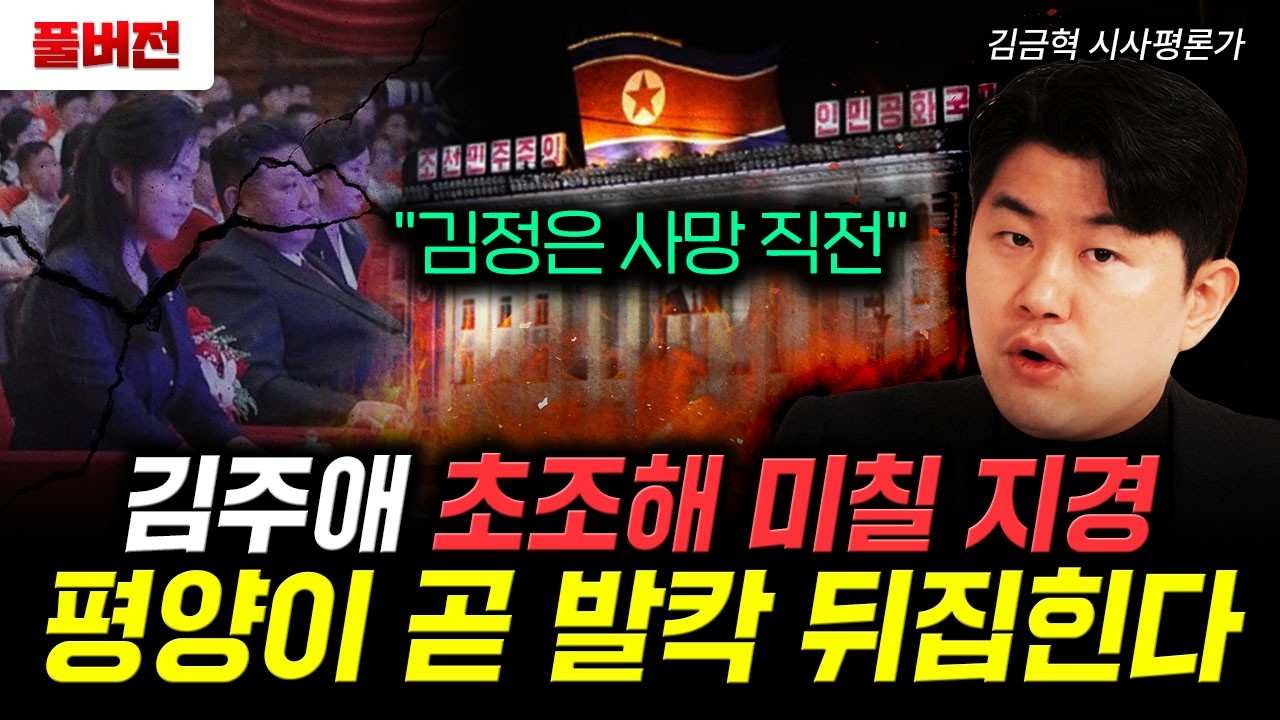
5) North Korea Internal Instability / Succession Narratives: Asymmetric Risk from Unverifiable Claims
5-1. Message Conveyed
Keywords implying covert factions, internal unrest, imminent leadership disruption, or succession anxiety are difficult to verify.
5-2. Why Markets Still React
Even without confirmation, markets price tail risk (low probability, high impact events) via insurance-like premia.
This can affect FX, foreign flows, and sector rotation (defense/shipbuilding/energy).
The key variable is not the claim’s truth value but the level of uncertainty and how it feeds into financial risk pricing.
6) Five Under-Discussed Points
6-1. “Proxy Conflict” Is an Investment Environment Story
As proxy framing strengthens, corporates slow capex and financiers demand higher risk premia.
This can reduce FDI, increase local currency volatility, raise logistics costs, and move real-economy prices.
6-2. Defense Economics: System Export > Shipment Volume
Recurring revenue is driven by training, MRO, spares, munitions, and upgrades.
Beneficiaries extend beyond prime contractors to parts suppliers, MRO providers, software, and secure communications/crypto modules.
6-3. China’s Semiconductor Stress Is Determined by Bottleneck Position
Constraints are frequently driven by access to specific choke points (equipment, materials, EDA), not only by funding or intent.
Export-control coordination and allied compliance are the binding variables.
6-4. Geopolitical Events Hit Discount Rates Before Earnings
Even if near-term earnings are unchanged, uncertainty can raise the cost of capital and compress valuations first.
This can explain price moves that appear disproportionate to the immediate news flow.
6-5. From an AI Trend Perspective, Conflict Shifts AI from Optional to Mandatory
ISR, SIGINT, counter-drone, cyber defense, and satellite analytics increasingly require AI to be cost-effective at scale.
As tensions rise, defense and security AI budgets can be less cyclical than consumer or enterprise discretionary IT.
7) AI and Industry 4.0: Technology Keywords Directly Linked to This Theme
7-1. Defense AI: Automated ISR and Data Pipelines
As sensor density increases, human analysis capacity becomes the binding constraint.
AI systems automate detection, classification, alerting, and prioritization to reduce decision latency.
7-2. Semiconductor Supply Chains: Dual Sourcing Over Full Decoupling
Rather than fully exiting a geography, firms increasingly build redundant supply paths to avoid stoppages during shocks.
This elevates Southeast Asia, India, and Mexico; Korea may gain collaboration opportunities in equipment, materials, and backend processes.
7-3. Cyber and Information Operations: Often Precede Physical Conflict
Patterns frequently show cyberattacks, disinformation, and financial infrastructure disruption before kinetic escalation.
This supports continued demand for security platforms, identity/authentication, cryptography, and OT/industrial control security.
8) One-Line Conclusion
Regardless of the accuracy of specific narratives, the market-sensitive variables are clear: supply-chain reconfiguration, commodity and freight volatility, energy-driven inflation pathways, discount-rate repricing, and structurally rising AI-enabled defense and security demand.
< Summary >
- Southeast Asia conflict framing is an economic variable that affects logistics, investment sentiment, and insurance premia.
- Korean defense performance visibility can expand from near-term exports to long-term lifecycle ecosystem revenues (MRO/spares/upgrades).
- Japan–China friction matters primarily through export-control bottlenecks; China’s constraint is purchase feasibility, not capital.
- Russia’s trajectory can pressure energy prices and inflation, influencing rate expectations.
- North Korea narratives affect markets mainly through uncertainty-driven risk premia (FX/flows/valuation).
- AI adoption in ISR/cyber/security shifts from discretionary to essential, with budgets that can be less cyclical.
[Related Links…]
- Semiconductor: https://NextGenInsight.net?s=semiconductor
- Defense: https://NextGenInsight.net?s=defense
*Source: [ 달란트투자 ]
– “김정은 사망 직전” 김주애 초조해 미칠 지경. 평양이 곧 발칵 뒤집힌다|김금혁 시사평론가 풀버전