● Wall Street Surge, AI-Fueled Rally, Rate-Cut Roulette, Volatility Cashflow Play
How to Capture the 2026 U.S. Equity Uptrend While Generating Monthly Cash Flow: Key Takeaways on Daily Fixed Covered Calls
This report includes three items:
(1) Key drivers of the 2025 U.S. equity market (rates, macro, AI) and a 2026 variable checklist
(2) Practical implementation of volatility management via a daily fixed covered call structure
(3) A dedicated section on the most critical risks and common misperceptions
1) 2025 U.S. Equity Market Review: Positive trend with elevated realized volatility
The market advanced overall, but larger swings increased implementation difficulty.
1-1. Rates: Expectations shifted to realized cuts; equities strengthened within the expected path
Rate cuts were a primary theme. Market performance was supported as policy evolved broadly in line with consensus. The key factor was the rate-cut path (pace and number of cuts), not the existence of cuts alone.
1-2. Macro: Mixed labor/consumption signals and unexpectedly stable inflation increased sensitivity
Labor and consumption indicators were intermittently weak, and unemployment data became a headwind in certain periods. Despite tariff-related concerns, inflation trends were more stable than expected, complicating macro interpretation and increasing market sensitivity to incremental news.
1-3. AI: Repeated cycles of “bubble debate” versus earnings validation supported indices
AI was the dominant theme. Markets rotated between enthusiasm and concerns over valuations, overinvestment, and capex intensity, then rebounded when earnings evidence improved. This dynamic becomes more consequential in 2026.
2) 2026 Outlook (U.S.-centric): Volatility management and “show-and-prove” fundamentals
2-1. Rates: The key variable is a potential slowdown in the easing pace
In 2026, the pace of rate cuts may drive valuation and sentiment more than directional policy intent. The policy “trajectory” may matter less than the “speed.”
2-2. Macro: Corporate earnings are the primary counterweight to stagflation concerns
If growth and inflation signals remain mixed, the Federal Reserve may face constrained policy choices. In that environment, corporate earnings become the key stabilizer. Broadening earnings improvement beyond large caps, including small and mid caps, could support downside resilience. Tariffs and geopolitics may continue to elevate upper-tail volatility.
2-3. AI: 2026 requires productivity and earnings delivery, not expectations alone
AI adoption and investment have progressed; markets will increasingly require evidence through measurable productivity gains and earnings contribution to justify valuations. If AI monetization becomes clearer, U.S. equities may sustain trend support; disappointment versus expectations could amplify volatility.
3) Covered Calls as a Volatility-Management Tool: Daily Fixed Covered Call (10% constant overwrite)
3-1. Covered call basics: Hold the underlying and sell call options to collect premium income
The strategy holds an underlying equity or index exposure while selling call options to generate option premium. It is typically more effective in range-bound or volatile markets where income can offset some fluctuations.
3-2. “Target premium” vs. “daily fixed (10%)” structure
- Target premium approach: Adjusts overwrite size to meet a target income level
- Daily fixed covered call: Keeps call selling at a fixed 10%, targeting approximately 90% underlying exposure
The daily fixed design prioritizes participation in upward trends relative to higher-overwrite structures.
3-3. Why income can be generated with only a 10% overwrite: daily option premium mechanics
The approach relies on daily-expiring options. Short-dated options can exhibit distinct premium dynamics, and the growing share of daily options reflects a shift in market microstructure that may influence premium supply/demand and realized outcomes.
4) When Covered Calls Can Help: Premiums may rise as volatility increases
4-1. Higher volatility can increase option premiums
Option prices are sensitive to volatility. Larger market swings can raise option premiums, potentially increasing monthly distributions and improving holding discipline through income.
4-2. Not a drawdown hedge: ~90% exposure participates in declines
With approximately 90% underlying exposure, the strategy generally declines in risk-off regimes. Premiums may partially cushion losses but do not provide full downside protection.
5) Product exposure determines risk profile
- U.S. Dividend Growth 100: U.S. Dividend 100 Daily Fixed Covered Call
- U.S. Technology 100 (often compared with Nasdaq): U.S. Tech 100 Daily Fixed Covered Call
- U.S. AI 15 constituents: U.S. AI Value Chain Daily Fixed Covered Call
- New (referenced): U.S. S&P 500 Daily Fixed Covered Call
Selection framework: choose the U.S. asset exposure (index, tech, AI, dividend growth) first, then apply the same overlay strategy.
6) 2026 Checklist: Conditions supportive versus adverse for this approach
6-1. Supportive conditions
- Gradual equity uptrend with frequent pullbacks (higher volatility)
- Slower easing pace, but earnings remain supportive
- AI maintains momentum via measurable earnings and productivity contribution
6-2. Adverse conditions
- Prolonged, sharp drawdowns (premium offsets are limited)
- Volatility compression (reduced premium attractiveness)
- AI capex fails to translate into earnings; valuation de-rating pressure
7) Key risks and common misperceptions
7-1. Monthly distributions are not fixed and can vary materially with volatility
Distributions typically reflect realized option premium and may fluctuate. This can be beneficial in high-volatility regimes but introduces cash-flow uncertainty for liability-matching objectives.
7-2. “90% participation” can create a defensive illusion
Covered calls are often perceived as defensive. A 10% overwrite structure preserves more upside participation, but also maintains substantial downside exposure. The strategy is better framed as income-supported volatility management rather than drawdown elimination.
7-3. The core driver is regime: rates path, AI monetization, and volatility structure
Focus on “headline yield” is insufficient. In 2026, growth signals, inflation risks, and Federal Reserve posture may drive volatility, which in turn affects option premiums, distributions, and total returns. Regime monitoring is a primary requirement.
8) Conclusion
Portfolio construction in 2026 may require maintaining exposure to U.S. equity upside while incorporating mechanisms to manage intermittent volatility. A daily fixed covered call structure is one potential tool, subject to the constraints above.
< Summary >
In 2025, U.S. equities advanced but higher volatility increased implementation difficulty; 2026 risk factors include the pace of rate cuts, ambiguous macro signals, and the requirement for AI-driven earnings validation.
Daily fixed covered calls maintain a constant 10% overwrite, targeting roughly 90% underlying participation while seeking monthly cash flow via daily option premiums.
The approach is not a drawdown hedge, and distributions are variable; regime assessment remains central to outcomes.
[Related Articles…]
- Five Common Misconceptions in Covered Call ETF Investing
- Rebalancing Strategies to Preserve Returns in Volatile Markets
*Source: [ 소수몽키 ]
– 미 증시 우상향에 올라타면서 고배당도 동시에 받는 투자법
● Reserve Crunch Triggers Deadline War, Markets Rattle
5) Macro, Supply Chain, and AI Implications: Prolonged Conflict Reprices Industrial Cycles
5-1. Global supply chains: Higher risk premia for rail, ports, and energy infrastructure
A prolonged conflict embeds a persistent risk premium in Europe’s cost structure.
Companies increase diversification of production footprints and component sourcing, accelerating supply-chain reconfiguration.
5-2. Energy prices: The primary risk is sustained volatility, not one-off spikes
Market impact increasingly reflects persistent volatility rather than discrete price shocks.
This dynamic erodes corporate margins and consumer confidence, with European manufacturing remaining structurally sensitive to energy input costs.
5-3. Inflation: Defense demand and logistics costs create downward price rigidity
Extended conflict sustains baseline demand for selected categories (ammunition, energetic materials, avionics components, industrial metals).
These categories tend to exhibit downward price rigidity, potentially prolonging inflation persistence.
5-4. Interest rates: Supply-side shocks increase policy-path uncertainty
Conflict-driven supply shocks can simultaneously pressure growth and inflation.
This mix complicates central-bank decision-making and raises uncertainty around rate trajectories, contributing to long-end yield volatility.
5-5. AI trends: Drone and electronic warfare accelerate battlefield commercialization of AI
Modern warfare increasingly depends on a loop of sensing (ISR) → decision (analytics) → strike (drones/artillery).
As AI is integrated, capabilities such as target recognition, route optimization, and jamming avoidance are likely to advance faster.
From an investment perspective, the opportunity set extends beyond large-scale models to a value-chain view spanning defense, robotics, edge AI inference, satellite/communications, and power semiconductors.
[Related Articles…]
- Key Elements of the 2026 Industrial Landscape Shaped by Global Supply-Chain Reconfiguration
- Why Asset Allocation Changes Under Higher Interest-Rate Volatility
*Source: [ 달란트투자 ]
– “언론이 이걸 숨겼다” 러우전쟁의 충격 진실. 곧 전쟁판도 발칵 뒤집힌다|진재일 교수 2부
● Trump Crypto Masterplan, Stablecoin QE, Bond Market Showdown
Key Takeaway from Trump’s “Crypto Big Picture”: More Important Than Bitcoin Price Targets (USD 180k vs USD 10k) Is the Architecture That Creates New Demand for the U.S. Dollar
This report covers:
1) Why Trump links “rate cuts” with “stablecoins,” and the policy rationale connecting them
2) Why a Bitcoin reserve (strategic asset treatment) can be bullish while also acting as a volatility-dampening mechanism
3) How stablecoins can function as “private QE” (market-driven quantitative easing)
4) Where Big Tech vs Wall Street (traditional finance) monetize, and how regulation diverges
5) Why the 2026 midterm election can become a turning point for crypto via a “politics–Treasury market–liquidity” triangle
1) News Briefing: The Market Debate Is Not Bitcoin’s Price, but an Upgrade to the Dollar System
While the discussion often opens with extreme Bitcoin targets (e.g., USD 180,000 vs USD 10,000), the core issue is how the U.S. manages roughly USD 38 trillion in debt while extending dollar primacy.
Two policy levers are emphasized:
– Rate cuts (and, if required, a more accommodative liquidity backdrop)
– Institutionalizing stablecoins (the GENIUS Act framework) + building a strategic Bitcoin reserve (the Bitcoin Act)
The design objective is to position crypto not as an alternative currency, but as a channel that expands structural demand for U.S. dollars.
2) Axis One: “Rate Cuts + (If Needed) Accommodative Policy” with the Primary Objective of Stabilizing Long-Term Yields
2-1. Why long-term Treasury yields are politically critical
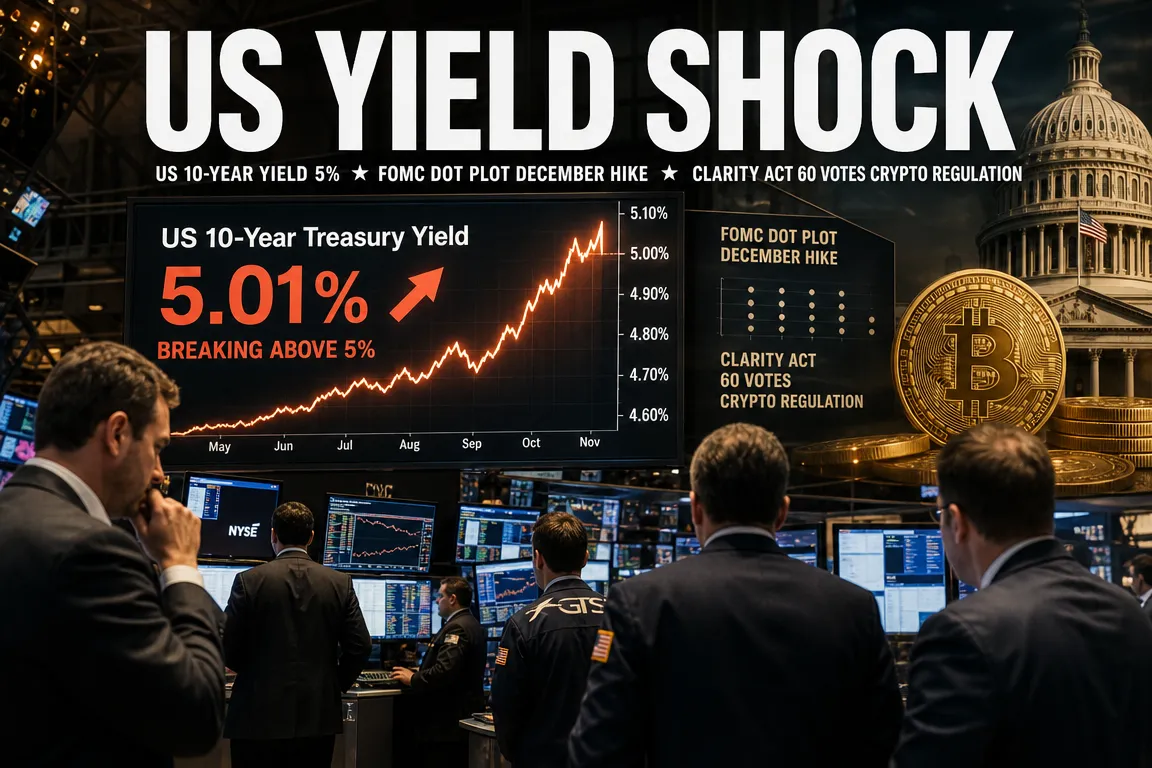
If long-term yields move into the high-4% to 5%+ range, the issue shifts from macroeconomics to political durability.
The U.S. faces structurally rising interest expense; higher rates simultaneously expand fiscal deficits and increase Treasury issuance burden.
2-2. The observed sequence: “Tariffs → inflation concern → long-end yield spike → policy delay”
Tariff escalation can initially lower yields via recession expectations, but inflation pressure can subsequently push long-term yields higher.
This dynamic forces policy calibration to bond-market reactions, implying that the Treasury market can function as a de facto constraint comparable to a second legislature.
3) Axis Two: Stablecoins as a New, Large-Scale Source of Demand for Short-Dated U.S. Treasuries
3-1. GENIUS Act implications for issuers: the key is broader eligibility, including Big Tech
For existing issuers (e.g., Tether/USDT and Circle/USDC), the “180-day” framing is best interpreted as a compliance transition window rather than delayed issuance permission.
The larger catalyst is the potential for non-financial corporates (e.g., major technology platforms) to issue stablecoins.
3-2. Big Tech’s advantage: winning share via UX, not nominal yield
Even if explicit interest is restricted, Big Tech can drive adoption through reduced payment/transfer/FX friction and faster settlement.
For example, payments could be streamlined to near-zero friction through biometric authentication and integrated wallets.
Traditional finance is more likely to compete through B2B rails, on-chain collateralization, and tokenized real-world assets (RWA).
3-3. Why Wall Street can be both supportive and resistant
As stablecoin supply grows, reserve requirements can translate into large purchases of short-term Treasuries, supporting U.S. funding needs.
However, if the broader policy objective is a softer dollar via a more accommodative environment, dollar-based financial business models may face implicit pressure. In that context, long-term yields (e.g., the 10-year) can reflect market resistance.
4) “Private QE” Framework: How Stablecoins Can Increase Effective Liquidity
Stablecoins are not base money in the traditional sense, but when a user converts USD 100 into stablecoins, on-chain circulation can create an effect similar to replicated transactional liquidity.
Even if measurement differs from standard aggregates, perceived liquidity (M2-like effects) can rise, potentially improving conditions for risk assets, including Bitcoin.
This aligns with common market linkages among liquidity, rates, and inflation expectations.
5) Strategic Bitcoin Reserve: Bullish for Demand, Potentially a Check on Extreme Boom–Bust Narratives
5-1. Supply–demand impact from sovereign accumulation
A U.S. strategic Bitcoin reserve carries high signaling value.
With supply capped at 21 million, sovereign competition for reserves can create a meaningful demand shock.
5-2. Why “institutionalization/nationalization” can reduce volatility
When Bitcoin is positioned as a purely anti-establishment asset, tail outcomes (both upside and downside) are more plausible.
As states and major institutions integrate it, Bitcoin can trend toward a more managed asset profile within a defined policy and market framework.
Implications for investors are mixed:
– Pros: greater institutional adoption, higher perceived legitimacy, structurally broader demand
– Cons: weaker “10x/100x” narratives; a shift toward slower, sustained appreciation (e.g., mid-double-digit annualized returns) becomes more plausible than extreme cycles
6) Trump vs Wall Street, and Big Tech: The Core Conflict Is Capital Flow Allocation
6-1. “De-globalization” as an internal reallocation challenge
The prior equilibrium relied on:
U.S. trade deficits ↔ China trade surpluses,
with surplus dollars recycled into U.S. financial assets (bonds/equities).
Tariffs aim to weaken that loop and rebuild domestic manufacturing capacity. This can be unfavorable to Wall Street’s global-capital intermediation model, contributing to friction between the political agenda and financial incumbents.
6-2. An alternative coalition: alignment with Big Tech
If Wall Street can resist via capital and political influence, an alternative policy coalition becomes relevant.
A plausible trade is: Big Tech support in exchange for regulatory relief, including reduced exposure to external (notably European) regulatory frameworks.
This extends beyond crypto and links to strengthening U.S. services exports, particularly digital services.
7) Political Event Watch: Why the 2026 Midterms Matter for Crypto
7-1. Midterms as the long-rate management endgame
Long-term yield stability affects housing, credit conditions, and investment sentiment, which can influence electoral outcomes.
This supports the view that the midterms can serve as a macro-policy inflection point.
7-2. Political framing of the Bitcoin Act: “defending dollar primacy”
The Bitcoin Act is positioned not merely as Bitcoin accumulation, but as an initiative to:
– complement the Treasury-backed dollar system, and
– counter strategic currency competition, including efforts to increase the global role of the Chinese yuan
These objectives provide a bipartisan national-security rationale.
8) Core Points Often Missed in Mainstream Coverage
1) Before being a Bitcoin catalyst, stablecoins can function as a demand engine for short-term Treasuries, supporting rollover capacity. The policy lens is as much Treasury-market management as it is crypto.
2) If Big Tech enters stablecoins, competition centers on eliminating payment friction (UX), shifting the battlefield from finance to platforms.
3) A strategic Bitcoin reserve can raise prices through demand, but institutionalization can also compress the boom–bust narrative and reduce the volatility premium over time.
4) Anti-globalization is framed externally but often functions internally as a reallocation of capital from Wall Street toward manufacturing and the real economy. The bond market serves as the binding constraint on policy intensity.
5) As stablecoins scale, political and user pressure may grow to broaden reserve composition beyond USD cash and Treasuries. If that occurs, tokenized RWAs and/or Bitcoin could enter reserve frameworks, reshaping market structure.
9) Conclusion: Through 2026, Monitor Three Interlocking Drivers: Macro, Regulation, and Liquidity
Crypto is likely to be driven less by single-asset narratives and more by the interaction of:
– Federal Reserve policy shifts
– U.S. Treasury supply–demand dynamics (especially short-dated rollover capacity)
– Stablecoin regulation and the pace of Big Tech entry
– Expansion of tokenization (RWA) and B2B settlement infrastructure
A key risk is a renewed inflation impulse that pushes long-term yields higher, forcing moderation in crypto-supportive policy momentum.
< Summary >
Trump’s crypto framework appears less focused on boosting Bitcoin prices and more on extending dollar primacy by using stablecoins to create incremental demand for short-term U.S. Treasuries.
Stablecoins can increase effective on-chain liquidity and operate like “private QE”; if Big Tech participates, competition becomes a platform/UX contest rather than a pure financial-rate contest.
A strategic Bitcoin reserve may be supportive via supply–demand, but deeper institutionalization could reduce volatility and shift returns toward steadier appreciation.
Into the 2026 midterms, the primary variables are long-term yield stability, regulatory architecture, and liquidity conditions.
[Related Articles…]
- Bitcoin Outlook: Key Variables Reframed Through Policy, Liquidity, and Supply–Demand
- Post-Regulation Stablecoin Landscape: Big Tech vs Traditional Finance
*Source: [ 경제한방 ]
– “18만 달러냐 1만 달러냐” 트럼프의 큰 그림은 결국 통할까 / 김창익 작가