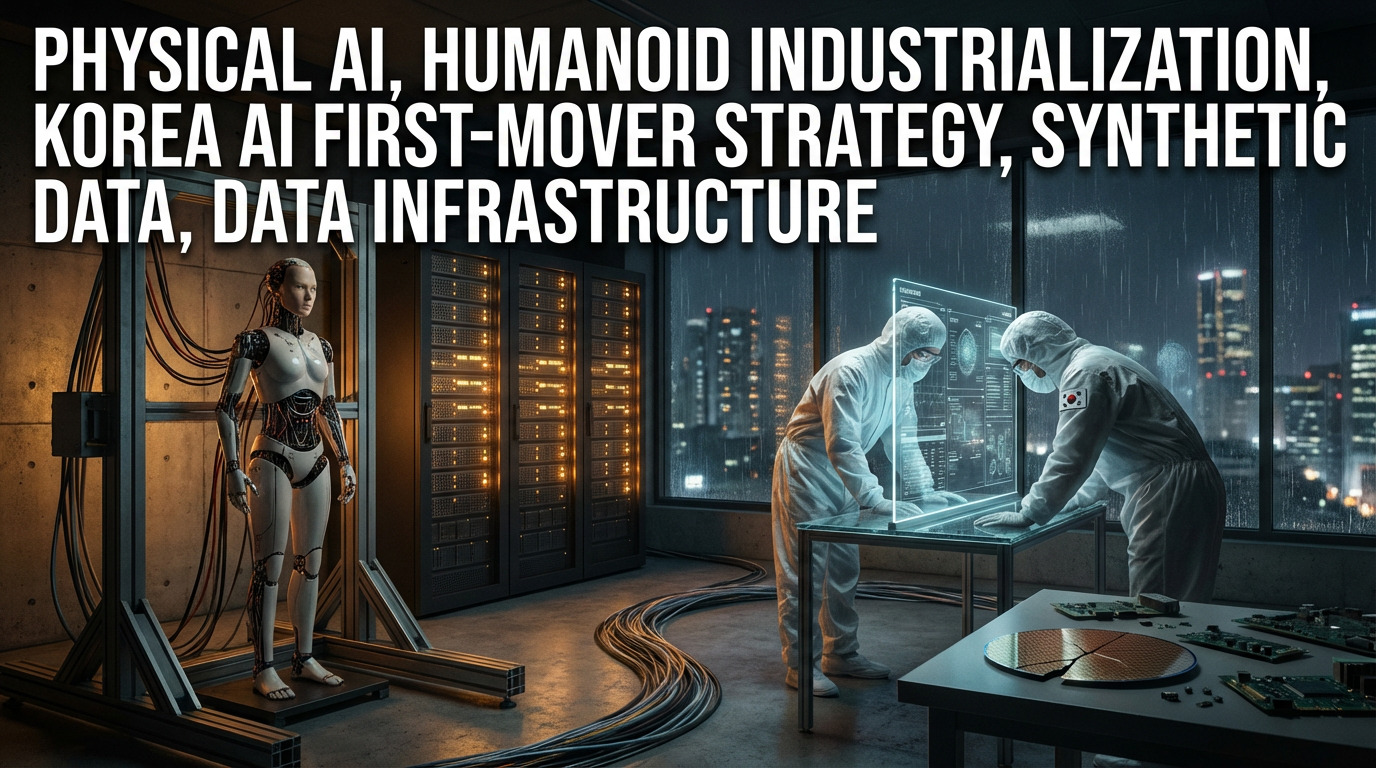
● Korea Set to Leapfrog in Physical AI, Humanoid Robot Gold Rush 2026-2030
Manufacturing Powerhouse Korea: The Real Reason for Potential Reversal in Physical AI and Humanoids
Today’s article contains three definitive elements.
1) Why Professor Byung-Tak Jang considers “LLM as a house of cards,” exploring the essence of its ‘technical limitations’
2) Why Korea is structurally advantageous in physical AI and humanoids from a manufacturing, components, and infrastructure perspective
3) The “checklist” Korea must genuinely lead from 2026 to 2030, along with core points often overlooked by news and YouTube
1) News in a Line: “2026 is the Year of Physical AI… AI Steps Outside the Screen”
The national AI strategy discussion is shifting its next keyword to ‘physical AI’.
Professor Byung-Tak Jang sees 2025 as the year when “AI agent industrialization began,” and 2026 as a turning point when “AI transitions from digital (text/image) to the real world.”
2) Why LLM is ‘Excellent but Limited’: The Issue of “Intelligence that Studied Only Letters”
The key takeaway is this.
LLM is an intelligence that has learned the world ‘only by word,’ focusing on text and image data.
Thus, no matter how many sentences with the word “microphone” are read, without actually touching, hearing, and using a microphone, there is a gap in ‘real understanding’.
This growing gap is typically manifested as ‘hallucination’.
In digital tasks, it ends as “plausible lies,” but in physical AI, it can lead to “behavioral accidents,” making the risks significantly different.
3) Why Physical AI is Called the “Ultimate AI”: The AI Application Market Changes
Until now, AI was good at tasks like document writing, summarization, and image creation, which “end within the computer.”
However, physical AI performs labor and services in the real world, like “bringing some water,” “moving boxes in a warehouse,” or “monitoring hazardous facilities.”
This implies not just a technological trend but a change in the industrial structure itself.
The market into which AI penetrates expands from the ‘software subscription market’ to ‘real industries (manufacturing, logistics, construction, caregiving).’
This flow is tied to productivity innovation and can impact long-term economic growth rates.
4) 2025 is ‘Agent’, 2026 is ‘Physical’… How Far Have Companies Come?
Professor Byung-Tak Jang’s evaluation is relatively realistic.
AI agents have “already begun” domestically as well.
However, it takes more time to spread to all tasks, and especially startups and SMEs find the building complexity significant.
5) Where Startups/SMEs Get Stuck: “Agents Are Ultimately an Infrastructure Game”
The reasons why agents are difficult in the field are summarized into three.
1) Data and work processes are not organized
2) Lack of cloud/computing resources
3) No development/operation personnel
Regarding the government’s role, Professor Jang leans towards “supporting software companies that create agents well and providing infrastructure (cloud/computing)” rather than building platforms directly.
6) Structural Reasons Why Korea is Advantageous for Humanoid Industrialization: ‘A Comprehensive Battle like the Automotive Industry’
Professor Byung-Tak Jang repeated a sentence multiple times.
“Humanoids need the simultaneous development of various component industries like the automotive industry.”
Here, Korea’s strengths are quite clearly outlined.
6-1) Density of the Hardware Value Chain
From semiconductors, batteries, sensors, motors/actuators, materials, precision machining, to production automation.
Korea already has the “manufacturing base to mass-produce robots.”
This is a competitive edge that cannot be created merely with AI models; a nation capable of controlling the entire supply chain is advantageous.
6-2) ICT Infrastructure Combined with Manufacturing Sites
Physical AI needs more than just software expertise; sensor data must come in and systems must connect on-site.
In other words, communication/edge/cloud/security must progress with ‘on-site application,’ and Korea is strong in this combination.
6-3) From “Infrastructure-Changing Robots” to “Environment-Adapting Robots”
Traditional factory automation often involved changing the factory for robots.
However, humanoids aim to work in environments created by humans like humans themselves, reducing the costs of revamping factories/warehouses.
This logic significantly accelerates industrial proliferation.
7) Core Technical Challenge: Lack of ‘World Model’ and Common Sense
One of the real challenges humanoids face is “common sense physics.”
For example, predicting that a cup might tip over if grabbed at a certain angle or spill can be challenging for AI, unlike humans who know this inherently.
Ultimately, what is needed is a ‘World Model’—an intrinsic ability to simulate how the world moves, how forces are transmitted, and what outcomes arise.
This is necessary for humanoids to move safely and naturally.
8) Why Synthetic Data Becomes Important: Physical AI Is “Hard to Gather Data For”
Unlike the domains abundant in open data like internet text/images, gathering data for physical interaction is expensive.
It takes a long time and requires repeated experiments.
Thus, Professor Jang strongly emphasizes the importance of synthetic data (simulation-based data generation).
Example: The scene of recognizing a cup is transformed with various desks/lighting/angles to massively create “plausible scenarios” for learning.
This doesn’t simply ‘increase data’,
but instead reduces on-the-ground experiment costs and speeds up learning, “advancing the timeline for industrialization.”
9) Baby Mind Perspective: It Should “Grow Over Time” Rather Than “Learn All at Once”
An intriguing point raised by Professor Byung-Tak Jang.
Current foundation models take in data all at once and appear as a ‘complete product’,
whereas humans accumulate experiences and develop over time.
The Baby Mind project models “children’s cognitive development (especially up to 18 months),”
attempting to make AI understand the world gradually through experience.
This perspective aligns well with physical AI.
Because for physical AI, ‘accumulation of experience’ directly translates to performance.
10) Hallucination Issue in Physical AI: “Behavior Safety” Requires a Separate Layer
Professor Jang also views hallucination as “imagination.”
However, when robots translate imagination into action, it can become dangerous, necessitating control/safety mechanisms.
There’s an interesting analogy.
Just like children learn the danger by touching something hot, robots need trial and error and feedback (“don’t do that”) to learn safe behavior.
Eventually, physical AI will likely evolve where ‘performance’ and ‘safety’ are learned together.
11) The Logic of Korea’s ‘Golden Time’: Why Now Might Be the Last Chance
In large models focused on language/vision, US big tech gained the upper hand based on 30-40 years of data, cloud, and platform accumulation.
This diagnosis is why Korea is considered late.
However, in physical AI, the global starting line is not yet widely separated,
and Korea possesses a manufacturing base, its “different weapon.”
The judgment is that with quick investment and ecosystem creation here, Korea can lead for the next 30 to 50 years.
12) News-Type Summary: Key Messages from This Dialogue – TOP Line
– 2025: AI agents effectively begin to penetrate corporate operations
– 2026: Physical AI emerges as a national/industrial topic, AI moves into reality
– Limitations of LLM: Text/image-centric learning → Lack of real-world understanding → Hallucination/site weaknesses
– Humanoids = Paradigm shift on par with automotive (growth accompanied by component industry)
– Korea’s Strengths: Aggregation of ICT infrastructure + semiconductor + battery + manufacturing value chain
– Synthetic data/simulations dictate the industrialization speed of physical AI
– Securing a world model (common sense physics) is the technical battleground
– Talent: Need for fusion-type talents blending software + mechanics/robotics
13) “Most Important Points” Often Overlooked in Other Videos/News (My Perspective)
13-1) Physical AI is a ‘Macroeconomy Industry’ Rather than an ‘AI Industry’
Many contents get stuck at “humanoids are cool,”
but the real core point is that once humanoids enter, AI directly connects to productivity in the service and manufacturing sectors.
This can, in the long term, affect inflation pressure (labor costs/service charges), productivity, and economic growth rates.
Eventually, physical AI is more a tool for industrial innovation than a tech trend.
13-2) The Competition Lies More in “Data Flywheel + Deployment Speed” Than in ‘Model Performance’
In physical AI, deploying gathers data,
gathered data improves performance,
improved performance enables more deployment in a flywheel structure.
Thus, starting late can rapidly widen the gap.
This is viewed as the essence of the ‘golden time’ mentioned by Professor Jang.
13-3) Korea’s True Strength Lies Not in ‘Individual Technology’ But in “National Capability to Assemble, Integrate, and Mass-Produce”
The US excels in software platforms,
China is strong in volume/speed,
but Korea’s strength may lie in its ability to integrate and mass-produce while maintaining quality.
Humanoids require not just excellence in one component but reliable integration for mass supply to dominate the market.
This has been Korea’s forte in manufacturing.
13-4) The Focus of Policies Should Be on “National-Level Testbeds” Rather than ‘One Robot’
The advice for the government not to build platforms but to support ecosystems
essentially expands to emphasize the importance of opening testbeds (logistics centers, factories, public facilities) for rapid experimentation and deployment by the private sector.
Physical AI intertwines with regulations, safety, and accountability issues, and testing environment design becomes competitiveness.
14) Checklist for Korea to Lead from 2026 to 2030 (Realistic Version)
1) Link R&D for robot/humanoid foundation models + world models with “on-site data”
2) Standardize synthetic data pipeline (simulation → learning → validation)
3) Establish a safety/control AI layer (behavior safety, work safety, accountability tracking) as an industrial standard early on
4) Develop a joint roadmap (establishing Tier structure like the automotive industry) with semiconductor, battery, sensor, and motor companies
5) Expand fusion-type talent tracks (computer engineering × mechanical × control × cognitive science) and field-oriented curricula
This flow is not a short-term theme but likely to grow into a mid-to-long-term growth story intertwined with the global supply chain.
(Interested keywords: interest rates, inflation, exchange rates, global supply chain, economic growth rate)
< Summary >
LLM, with its text/image-centered learning, has limitations in ‘understanding the field,’ whereas physical AI represents a paradigm shift of overcoming these limitations through experience-based learning.
Humanoids, much like the automotive industry, are a comprehensive venture where components, manufacturing, and ICT grow together, giving Korea a structural advantage due to the semiconductor, battery, and manufacturing value chain.
The battlegrounds are the world model (common sense physics), synthetic data pipeline, and deployment speed (data flywheel).
From 2026 to 2030, the country that leads in testbeds, safety standards, and fusion talent is likely to gain long-term dominance.
[Related Articles…]
- Three Conditions for Korea to Lead Humanoid Industrialization
- Era of Physical AI: Manufacturing Productivity Innovations and Investment Points
*Source: [ 티타임즈TV ]
– 제조강국 한국이 피지컬AI에 유리한 이유 (장병탁 서울대 컴퓨터공학과 교수)
● Korea AI Meltdown-GPU Glut Power Crunch No Killer Apps Pivot to Physical-AI Data Lock-In
“Bought a GPU but have nowhere to use it?” The real reason Korean AI will face a crisis in 2026 and the 5-year strategy to secure the future
Today’s article covers all these key aspects.
① Why has the ‘benchmarking model’ disappeared in Korea’s AI (= it’s become a test without an answer sheet)?
② Why securing a “GPU” is just the beginning, and why Korea is particularly at risk (the paradox of power, data centers, and demand)
③ When the era of search ends and the “conversation (agent)-based internet” emerges, who will profit and who will collapse?
④ The hidden industrial structure change in the assertion that ‘Apple and Meta’ among the big tech giants are at risk
⑤ A realistic winning strategy for Korea in AI: ‘Lockable data assets’ in Physical AI (robots, manufacturing data)
1) News Briefing: The Reality of Korea’s “AI Crisis”
1-1. Benchmarking Blocked: Entering an Era Without an ‘Answer’
Professor Kim Dae-shik raises a simple issue.
In the past, Korea’s industrial growth strategy was the fast follower approach, quickly absorbing things that developed countries had already tried, and it worked.
However, AI has now shifted focus to ‘application per industry (AI X)’, and areas like financial AI, educational AI, and content AI have become fields where no one knows the answer yet.
This means there are no established “successful cases we can follow”, leading to psychological panic in leadership (politics, business).
1-2. Why Being a Fast Follower Has Become Structurally More Difficult
(1) The Speed of AI is Different
A five-year gap in AI can be as wide as a fifty-year gap in manufacturing.
The tech cycle is too short for “following a bit later” to be viable.
(2) Globalization Has Ended, and “Each to Their Own” Has Begun
Catch-up was possible because of a learning environment (globalization) through international students, licenses, and market openings. Now, technology is synonymous with security and hegemony, reducing sharing.
This aligns directly with macroeconomic changes like the reorganization of global supply chains, protectionism, and technological bloc formation.
(3) The “Hungry” Long Working Hours Drive is Not Reproducible
In the past, disparities in time were bridged at the expense of individual lives, a method unsustainable both socially and economically for today’s generation.
2) Why “260,000 GPUs” is a Risk Rather than a Blessing
2-1. GPUs are Engines, but Without Car Bodies (Data Centers, Power, Services)
This is one of the sharpest points in the original text.
GPUs are like car engines, but just having many engines doesn’t make a car run.
If Korea secures a large number of GPUs but lacks data centers, power, cooling, operational staff, network, and security systems, they become “costs rather than assets.”
2-2. Power and Data Center CAPEX: The “Hidden Invoice” That’s the Real Game
Large-scale data centers inevitably consume massive amounts of power.
The original text mentions “equivalent to the power of two nuclear reactors” and lists the cost of a 1GW data center in tens of trillions.
The key is that the cost of the operational infrastructure (power, site, cooling, operations) outweighs the GPU purchase cost.
This is directly related to domestic AI industrial policy, fiscal expenditure, and energy policy, and can connect long-term with inflation pressure (power costs, construction costs).
2-3. The Greater Issue: Korea Has Weak “GPU Demand (Killer Services)”
In the US, massive services like OpenAI, Google, Meta, and Amazon are already utilizing GPUs.
Therefore, if data centers are lacking, it leads directly to “revenue loss”, thus justifying investment easily.
On the contrary, Korea has relatively fewer “services earning money using GPUs.”
Thus, ironically, Korea has entered a highly challenging game where it must build infrastructure and create demand simultaneously.
3) The End of the ‘Search Era’: The Changing Rules of Internet Business
3-1. The Significance of the Era Where Conversational AI “Starts and Pays for Apps”
The original text discusses a developer event on October 6 and presents a scenario where AI launches and pays for apps.
The critical point is that users will no longer “search for apps” but instead “pose problems verbally.”
What happens next is,
the traffic (advertisement) model based on search bars becomes unstable, transitioning to a structure where agents mediate actual purchases, reservations, and subscriptions.
3-2. The Shift of Power in Advertising/Commerce from ‘Search’ to ‘Agent’
SEO and search ads have been the core pipeline of the online economy so far.
However, if agents choose “optimal solutions” through conversation, users have fewer reasons to compare ten search results.
This change alters the competitive landscape of digital platforms and can affect the valuation of big tech companies (especially those with a significant advertising proportion) in the long term.
4) How Should We View the Claim That ‘Half of Big Tech Could Disappear’
4-1. The Essence of the Statement that Apple is at Risk: The Weakening of “Device-Centric Power”
This doesn’t mean Apple will go bankrupt tomorrow,
but that in the AI era, the core of value might shift from hardware form factors to “intelligence (models) + agent experience + ecosystem mediation rights.”
When the next interface after smartphones (glasses, voice, agents) opens, the moat of existing giants could weaken.
4-2. The Essence of the Statement that Meta is at Risk: Importance of “Product-Demand Connection” Over “Investment Scale”
The original text sees Meta making significant investments in data centers,
but lacking a strong connecting link between devices/services to recoup this in the short term.
The argument here is that ‘causing demand with products’ is more vital than merely ‘technological investment.’
4-3. NVIDIA’s Dominance Isn’t Forever: The Risk of Over-Reliance on a Single Product
With a revenue structure overly dependent on GPUs,
even the narrative of revolutionary computational efficiency (e.g., “1/100th computation possible”) can shake the market.
This is not just a company issue but indicates that the AI infrastructure industry itself can fluctuate in value based on ‘expectations (narrative).’
5) The “Truly Important Points” That Other Channels/News Don’t Talk About Much
5-1. The Answer for Korea is Not “Model Development Competition” but “Lockable Data”
Most content concludes with “Korea should also create LLMs.”
However, the original text highlights a more realistic point.
If Korea focuses on Physical AI (robots, manufacturing), it can create “data not available on the internet.”
LLMs are based on public internet data, eventually allowing others to catch up.
Yet, data from skilled workers in manufacturing sites (welding, assembly, inspection, line operation) is less digitalized and can become strategic assets owned, encrypted, and traded by a nation or companies.
5-2. Countries with “Remaining Manufacturing Industry” Could Have an Advantage in the AI Second Half
The fact that a country has a large manufacturing base has been criticized as a weakness for being slow in structural transition.
However, in the era of robotics/physical AI, it’s the opposite: a strength.
The limitation of robots being controlled only through formulas (control) leads to a shift towards learning (data).
Thus, where there are many skilled workers, the ‘ability to produce learning data’ is higher.
5-3. Korea’s Immediate Task is Not “Securing GPUs” but Building a ‘Data Production Line’
You can buy GPUs with money.
But high-quality on-site motion data + work standards + failure/exception case data do not come immediately with money.
Moreover, the retirement of skilled workers is a time-limited event.
In this perspective, the statement “the next 5 years are crucial” sounds even more daunting and realistic.
6) Practical Guide: Actions Individuals/Companies/Governments Can Take Starting This Weekend
6-1. Individuals: Start with “Vibe Coding” to Build Automation Sensibilities
As mentioned in the original text, we’re now at a stage where you can use words to build apps/tools.
The best investment individuals can make is not in “reading AI” but in “dividing and combining repetitive tasks using AI.”
Start automating frequently used report templates, data organization, email drafts, and meeting notes to rapidly get a feel for it.
6-2. Companies: Redesign the Apprentice-Type Workforce System as the ‘New=Education’ Model Shakes
If AI replaces basic tasks, companies face the issue of “who bears the cost of education.”
Thus, internal educational systems need a redesign not merely as welfare or HR but integral to productivity and the revenue model.
6-3. Government/Industry: Making Physical AI Data a National Project is Top Priority
To leverage the advantages of being a manufacturing powerhouse,
standardizing industrial motion data collection, deploying equipment (goggles/sensors), securing ownership/security, and forming data trading rules as “data infrastructure” needs national implementation.
This enables Korea to not just be an AI importing country but gain negotiation power within the AI supply chain.
It ultimately gives a ‘card’ in the technological hegemony competition.
7) Macro-Economic Perspective: The Signals This Trend Sends to Investment/Industry
This issue is not just a simple tech trend,
but touches numerous macro variables such as interest rates, inflation, global supply chain reorganization, semiconductor investment, and data center power demand.
Particularly, data center expansion connects to power/site/construction/capital procurement, significantly affecting industrial policies and capital markets (valuation, CAPEX cycles) in the mid-to-long term.
< Summary >
The reason Korea is facing a crisis in AI is that the “copying answers catch-up model” doesn’t work in the AI X era.
Securing GPUs is just the start; without data centers, power, operations, and killer services, it becomes a risk.
When search-based internet changes to conversation/agent-based, the dynamics of platform power and moneymaking methods will be restructured.
Big tech’s dominance is not everlasting; companies reliant on devices, ads, or single products may falter.
Korea’s winning strategy is not to focus on LLM itself but to quickly establish “physical AI data in manufacturing sites” as a lockable strategic asset.
[Related Articles…]
- After the GPU Investment, the Real Focus Should Be on ‘Power and Data Centers’
- Robots and Physical AI: Why Manufacturing Powerhouses Could Make a Comeback
*Source: [ 지식인사이드 ]
– “GPU 쓸 곳이 없어요.” AI 시대 한국이 ‘멘붕’에 빠진 이유ㅣ지식인초대석 EP.90 (김대식 교수)
● DeepSeek Shatters Big Tech Scaling Rule-4x Capacity for Just 7 Percent More Cost
Why DeepSeek’s mHC Shook the ‘Big Tech Scaling Formula’: Increasing Costs by Only 6-7% While Quadrupling Model Internal Capacity
Today’s article covers the following core points.
Why DeepSeek opened a new scaling axis of “widening information flow” instead of simply “making the model bigger.”
Why residual connection had become the de facto “answer” for over a decade.
Why hyper-connections seem promising but suddenly explode in large-scale training.
How mHC (Manifold-Constrained Hyper-Connections) mathematically prevents such explosions.
And how this is connected to macro trends like AI investment, global economic outlook, interest rate cuts, semiconductor supply chain, and generative AI.
1) News Briefing: DeepSeek Enhances Performance through “Wider Information Flow” Instead of “Bigger Models”
By unveiling the mHC architecture, DeepSeek has reversed one of the premises of AI scaling.
Until now, increasing layers, parameters, and data was the mainstream approach to improving performance.
However, DeepSeek has introduced an approach that involves “widening the paths (residual streams) through which information travels within the model and fixing stability with mathematical constraints.”
The core message is this:
In scenarios where inference performance is crucial, expanding the ‘working space’ internally might offer better cost efficiency than simply increasing model size.
2) Background: Why Residual Connection Became the ‘Infrastructure’ of Modern AI
Large language models become more difficult to train as layers deepen.
The farther the model is from the correct answer, the gradient should flow backward to make corrections, but as they deepen, the signals either vanish (gradient vanishing) or explode (gradient explosion).
Residual connection effectively created a “shortcut” that largely solved this problem.
It allows information to pass through layers without distortion and keeps learning signal stable.
This innovation enabled deep learning to eventually allow “stable training even with deep stacks.”
The problem is the trade-off.
While stability is gained, the communication path is effectively fixed to a ‘single stream’ which limits internal flexibility.
Initially, simply making a bigger model could solve everything, but as tasks become more complex, this single path starts to become a bottleneck.
3) Previous Attempts: Why Hyper-Connections Work Initially But Fail in Large-Scale Learning
This is what led to the idea of hyper-connections.
Instead of a single residual stream, having multiple parallel streams that mix with each other can increase internal communication volume.
Theoretically, this enlarges the internal workspace of the model, making it advantageous for multi-step reasoning and information combination.
However, the failure pattern was critical.
At first, the loss decreases well and everything seems fine, but at a certain point, the interactions among streams accumulate, amplifying the signals.
Suddenly, the gradients explode, and learning collapses “all at once.”
Why is this a big problem?
Because large-scale learning is extremely costly, and if things suddenly collapse after tens of thousands to hundreds of thousands of steps, debugging becomes practically impossible.
Therefore, hyper-connections remained as a “promising yet too risky structure” for large-scale commercial training.
4) Core Technology: How mHC (Manifold-Constrained Hyper-Connections) Allows Mixing Without Amplification
While acknowledging the ‘direction’ of hyper-connections, mHC directly addresses the cause of their failures.
The key point is placing strong constraints on the “mixing matrix” that combines the streams.
The DeepSeek method is simply this:
Information can be exchanged among multiple streams, but the total volume (size) of the signals is forced to remain constant.
Hence, information is “redistributed” but cannot be “amplified or attenuated.”
Concretely, the mixing matrix is restricted to satisfy the following conditions:
Sum of each row = 1, Sum of each column = 1.
When these conditions are maintained, it becomes difficult for the scale to suddenly spike even when layers are multiplied several times.
To implement this constraint, the Sinkhorn-Knopp algorithm is used to project the matrix into a specific geometric space (Birkhoff polytope).
The crucial aspect here is not “enduring stability through tuning”, but rather,
constraining learning into a form where structural stability is guaranteed.
5) Benchmark Performance: “Noticeable Improvement in Inference” is the Core Point
DeepSeek experimented with 3B, 9B, and 27B models and explains that mHC consistently outperformed standard hyper-connections across eight benchmarks.
The leap is particularly significant in inference tasks.
Based on the original numbers (27B model):
GSM8K (Mathematical reasoning): 46.7 → 53.8
BBH (Logical reasoning): 43.8 → 51.0
MMLU (General knowledge): 59.0 → 63.4
Such an increase is considered significant, rather than a “minor improvement,” an upswing level that becomes harder to achieve as model sizes increase.
6) Cost/Hardware: Internal Capacity Quadruples, Training Overhead is only 6-7%
Here lies the most ‘profitable’ industrial point:
Increasing streams typically leads to a surge in memory traffic and GPU demand.
In short, performance increases but it often leads to skyrocketing training costs.
DeepSeek claims to have suppressed this with engineering.
They fused computations using custom GPU kernel (tilelang) to minimize memory round-trips,
lowered VRAM usage with selective recomputation,
and reduced bottlenecks by overlapping communication and computation with dualpipe scheduling.
As a result, they claim that while “the effective internal width expanded four times,” the increase in training time was only about 6.7%, and the hardware overhead was approximately 6.27%.
This can be seen as an intelligent detour around what’s recently been a much-discussed ‘memory wall’ pressure.
7) Market/Macroeconomic Perspective: Why This Ties into the Global Economy and Semiconductor Cycle
AI had been driving a structure where the “larger model” competition overheated GPU supply and data center CAPEX.
However, mHC’s meaningful approach opens up these scenarios:
Scenario A: Higher Inference Performance with the Same GPU
In a context where GPUs are short and expensive, strategies of merely enlarging models bring huge cost burdens.
If mHC becomes widespread, there’s an option to enhance inference performance by “increasing total parameters less.”
This is directly linked to investment efficiency in data centers.
Scenario B: Rate/Liquidity Environment and AI Investment Strategy Change
If interest rate cut expectations revive in the market, growth stock/AI infrastructure investment sentiment could rise again,
yet there’s great uncertainty about “how many more GPUs need to be purchased.”
Technologies like mHC that ‘alter the axis of scaling’ can realign CAPEX direction (more chips vs more efficient training stacks).
Scenario C: Semiconductor Supply Chain and Chinese AI Strategies
The original text mentions that chip shortages have changed the approaches of Chinese labs.
mHC fits well with the trend of “when chips are scarce, circumvent through design/stack innovation.”
Ultimately, there’s a paradox where semiconductor supply chain constraints promote ‘model architecture innovation.’
8) ‘Core Points’ Other News/YouTube Often Overlook
This begins the core point that often gets missed in standard video summaries.
1) The Essence of mHC is “Change in Risk Modeling” Not a “New Layer”
In large-scale learning, the scariest aspect isn’t average performance but the “late-stage collapse probability.”
mHC holds more value in structurally blocking learning collapse in large runs, though it also enhances performance.
This is especially significant from a CFO/infrastructure team perspective.
2) The “Scaling Law” Debate May Shift from “Data/Parameters” to “Internal Bandwidth”
Until now, the scaling law was explained using parameters/data/compute,
but mHC practically opens a new axis called “model internal communication bandwidth” at reasonable costs.
If this is replicated, the industry’s experimental focus could shift once more towards architecture.
3) The Strategic Meaning of Open Release: Aiming for ‘Standards’ Not Just Models
The core idea’s open release is not merely an act of kindness but a statement saying, “We aim to preempt one axis of the next design standard.”
Once standardized, the ecosystem (framework/kernel/distributed learning tools) optimizes in that direction,
making it more expensive for latecomers to catch up.
4) “Model Deployment/Distribution” May Outrun Technical Innovation
The original text suggests that in the Western market, DeepSeek’s updates get less attention due to “distribution.”
This means even if technology is excellent, limited impact comes from weak user meeting channels (products/platform/partnerships).
It signals that in the generative AI market, the power of “model performance” and “product channel” is diverging.
9) Points to Watch Going Forward (R2, and Big Tech’s Response)
Whether DeepSeek will incorporate mHC in its next flagship (assumed to be R2 or V4) is not yet confirmed, but
based on patterns, “foundational research is published before release, then incorporated into the model.”
For big tech/open-source communities, the observation point is this:
Whether mHC is a ‘trick’ that works only in specific settings, or a stable pattern reproducible in large-scale learning.
If it can be reproduced, multiple labs might conduct an experiment rush on “constraint-based multi-streaming.”
< Summary >
DeepSeek’s mHC enhances inference performance by broadening internal information flow through multiple streams, maintaining the stability of residual connections.
It structurally prevents the problem of hyper-connections exploding in late learning phases using “mixing matrix constraints (row/column sum=1) + Sinkhorn-Knopp projection.”
Increased scores were observed in benchmarks such as GSM8K/BBH/MMLU based on 27B, and learning overhead was presented at about 6-7% compared to a quadrupling of internal capacity.
It offers a ‘more efficient scaling axis’ rather than ‘larger models,’ potentially affecting data center investments and semiconductor supply chain dynamics amidst intense GPU shortages and cost pressures.
[Related Articles…]
- Summary of Changes in AI Model Design and Market Impact from DeepSeek
- The Effect of Semiconductor Supply Chain Issues on the Generative AI Competition Landscape
*Source: [ AI Revolution ]
– DeepSeek Just CRUSHED Big Tech Again: MHC – Better Way To Do AI