● Nvidia AlphaMayo Shocks Wall Street, Tesla FSD Moat Cracks, Mercedes Road Test Countdown
CES 2026: NVIDIA’s Autonomous Driving AI Stack Announcement Rapidly Shifted Market Sentiment — Is Tesla’s FSD Moat at Risk?
This report focuses on four points:
1) Why NVIDIA’s “AlphaMayo” announcement immediately impacted Tesla’s stock
2) Whether “simulation + synthetic data” can materially erode Tesla’s real-world driving data moat
3) Why Mercedes’ public-road testing in Q1 2026 is primarily a liability and accountability contest, not a pure technology contest
4) NVIDIA’s core commercial objective and key risks (most important)
1) Key News Summary (Briefing Format)
1-1. CES 2026: NVIDIA Unveils New Autonomous Driving AI Stack “AlphaMayo”
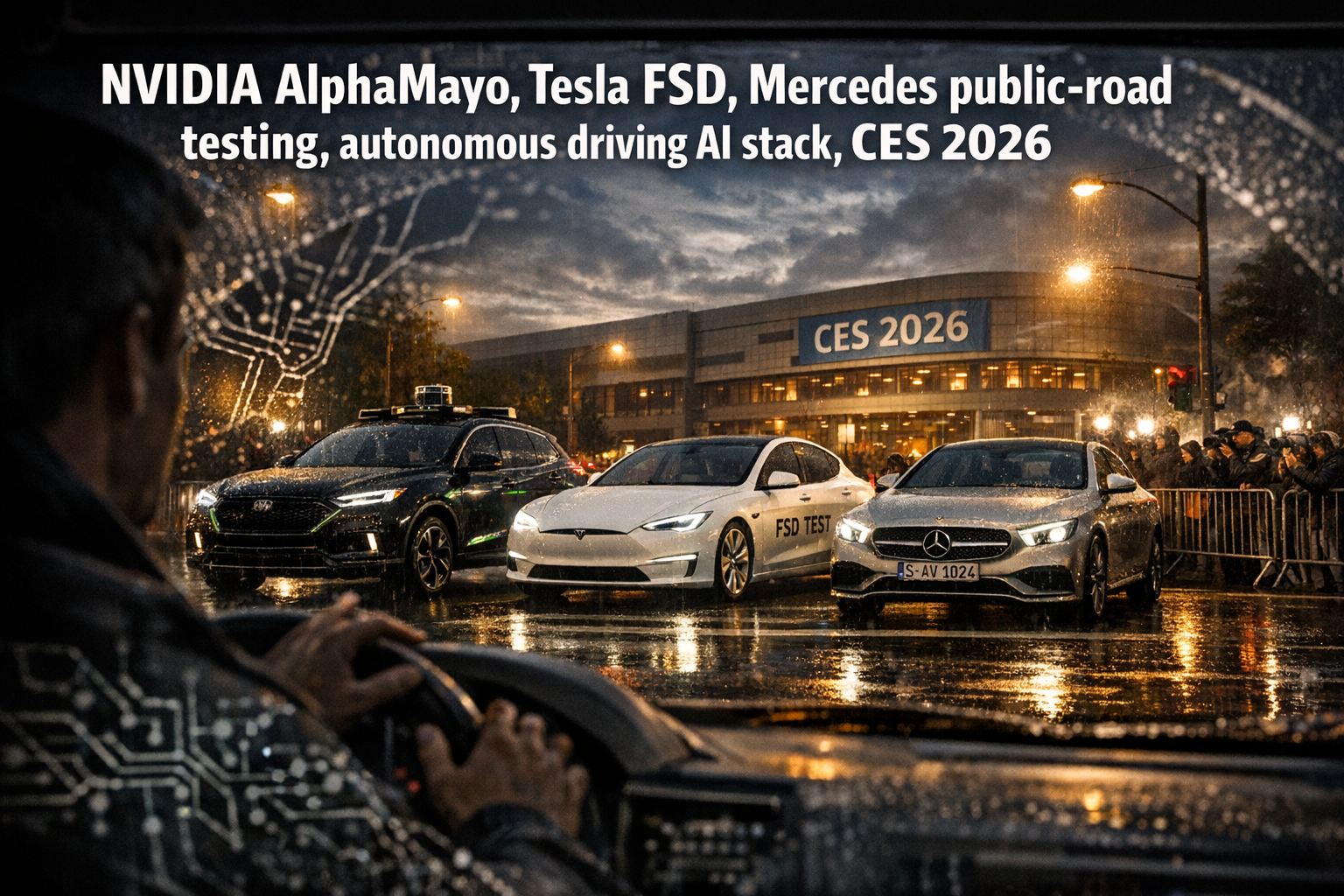
NVIDIA introduced a new autonomous driving AI stack, “AlphaMayo,” at CES 2026. The company described it as an end-to-end, reasoning-based architecture that processes inputs (camera-centric vision + radar), decision-making, and driving actions within a single model.
NVIDIA also emphasized configurable capability levels ranging from L2 to L4 based on OEM requirements.
1-2. Market Moved on “Q1 2026 Mercedes Vehicle Integration and Public-Road Testing”
Market impact increased materially after NVIDIA indicated that AlphaMayo would be integrated into Mercedes vehicles and enter public-road testing in Q1 2026.
Institutional investors reacted faster than technology communities, which is a key signal.
1-3. Immediate Wall Street Reframing: “Tesla’s Advantage May Not Be Exclusive”
A narrative gained traction that multiple manufacturers could reach robotaxi-scale autonomy on a similar timeline to Tesla. This accelerated concerns that Tesla’s FSD moat could be replicable, pressuring valuation through reduced perceived exclusivity.
2) Architecture Comparison: NVIDIA vs. Tesla — Both “End-to-End,” Different Starting Points
2-1. Similarity: One Model Links Perception to Action
Both approaches emphasize end-to-end driving, where camera-based perception interprets the scene and connects directly to driving actions.
2-2. Key Difference: Training Data Origin
NVIDIA centers development on simulation environments and synthetic data. The approach aims to generate large-scale scenario coverage in virtual worlds, including rare and hazardous situations, to accelerate iteration.
Tesla centers development on real-world failure and intervention data collected on public roads. The system is trained on cases where the vehicle struggles, requires driver intervention, or exhibits ambiguity close to safety-critical outcomes.
2-3. Why Markets Reacted: Potential Compression of Time and Cost Advantages
Tesla has positioned its large-scale real-world driving dataset (often cited in billions of miles, supported by a large vehicle fleet) as a core moat.
NVIDIA’s assertion implies real-world data may not be strictly necessary at scale if simulation and synthetic data can deliver comparable performance. Investors can interpret this as potential narrowing of Tesla’s lead, which directly affects growth expectations and valuation frameworks.
3) Why Q1 2026 Mercedes Public-Road Testing Matters: Liability Structure Over Technical Claims
3-1. NVIDIA Provides the Stack; OEMs Carry Primary Public-Road Risk
NVIDIA provides the model, simulation tooling, and platform. However, the operating entity on public roads is the OEM, which typically faces primary legal and reputational exposure in the event of an incident.
3-2. Explainability and Reproducibility Become OEM-Level Risk
In real incidents, regulators, insurers, and courts tend to focus on basic questions:
- Why did the vehicle not avoid the hazard?
- Why did it enter at that speed?
- Under what conditions did sensor fusion fail?
The competitive determinant becomes whether the OEM can provide auditable explanations, reproduce the failure, and close the improvement loop at product-grade standards.
3-3. Implication: Autonomous Driving May Be Redefined as a “Responsibility System”
Current debate appears focused on simulation versus real-world data. A single high-profile public-road issue can shift the central question to accountability: who can credibly take responsibility. At that point, commercialization readiness and regulatory response capability become primary differentiators.
4) Why NVIDIA Is Expanding Into Tesla-Adjacent Territory: The Next Growth Equation for an AI Infrastructure Vendor
4-1. Core Model: Selling Critical Infrastructure
NVIDIA’s historical strength has been supplying AI infrastructure (compute and software platforms). Sustained growth requires expanding the number of participants investing at scale.
4-2. Strategic Constraint: Tesla Dominance Can Reduce Ecosystem Participation
If autonomy is perceived as “Tesla-only,” legacy OEMs may defer investment. Fewer large-scale programs reduce platform adoption and can weaken long-run demand expansion for automotive AI compute and software ecosystems.
4-3. Primary Message: “You Can Still Participate”
AlphaMayo functions as a signal to traditional OEMs that entry is still viable. If successful, NVIDIA increases the probability of long-term platform lock-in across the automotive industry. The competitive set extends beyond autonomy performance into AI semiconductor supply-chain positioning and platform control.
5) Tesla Risk Assessment: Investor Checklist (Including Macro Considerations)
5-1. Tesla’s Defense: The Long Tail After “99%” Is the Real Battle
A key thesis associated with Tesla is that autonomy progresses quickly to high baseline performance, but the final reliability increments toward near-perfect safety are disproportionately difficult. The gap between plausible demo performance and road-validated, liability-bearing product performance is material.
5-2. Q1 2026 as a Validation Stage, Not a Definitive Tesla Negative
If Mercedes public-road testing proceeds smoothly, Tesla’s perceived exclusivity premium may compress. If issues emerge (incidents, regulatory pushback, liability disputes), the value of real-world data-centric iteration may be re-rated.
5-3. Macro Variables: AI Investment Cycle and Rates/Liquidity
This development intersects with the broader AI capex cycle. US rate expectations can drive growth-multiple volatility; higher long-end yields can pressure duration-sensitive equities. If automotive AI compute demand accelerates, benefits may extend across the semiconductor value chain, subject to supply constraints.
6) Under-Discussed Points (Highest Priority)
6-1. The Differentiator Is Not Peak Performance, but Risk Transfer Structure
The central issue is how liability is allocated when incidents occur. Platform vendors typically seek to minimize direct responsibility exposure, while OEMs absorb operational risk. Competitive dynamics therefore include contract structure, indemnification, insurance alignment, and regulatory accountability.
6-2. Synthetic Data Is Powerful, but Reality-Equivalent Simulation Remains Unlikely
Improved simulators increase development speed, but real-world edge cases often occur outside modeled distributions. For Tesla’s moat to be fully eroded, simulation would need to substitute for public-road learning rather than merely augment it. Absent that, synthetic data functions as an accelerator, not a replacement.
6-3. Q1 2026 Could Redefine “Autonomy” Itself
If testing succeeds, autonomy may move toward platform standardization. If it fails, autonomy may be redefined primarily as an operational responsibility system. This framing can alter TAM assumptions for adjacent sectors such as robotics, logistics automation, and smart-city infrastructure.
7) Forward Watchlist (Practical Roadmap)
1) Safety incidents and regulatory commentary during Mercedes public-road testing in Q1 2026
2) Whether OEMs adopt AlphaMayo as an optional module or as the core driving stack
3) Post-incident data/log disclosure standards and liability allocation (insurance/legal)
4) Tesla FSD commercialization scope expansion (regions, feature coverage, disengagement metrics)
5) Automotive AI semiconductor supply bottlenecks (manufacturing, packaging, power)
< Summary >
NVIDIA introduced the end-to-end, reasoning-based autonomous driving stack “AlphaMayo” at CES 2026 and indicated Mercedes public-road testing in Q1 2026, which materially influenced market sentiment.
The central concern is whether simulation and synthetic data can neutralize Tesla’s real-world driving data moat.
However, the primary competitive axis may shift from specification-driven performance to accountability: liability allocation, explainability, and regulatory readiness as a product-grade responsibility system.
Q1 2026 test outcomes may influence whether autonomy trends toward platform standardization or toward a responsibility-centered operating model.
[Related Articles…]
-
NVIDIA AI Semiconductors: The Key Variable Shaping 2026 Results
https://NextGenInsight.net?s=NVIDIA -
Tesla FSD and Robotics: The Next Cycle After Autonomy
https://NextGenInsight.net?s=Tesla
*Source: [ 오늘의 테슬라 뉴스 ]
– 충격! 엔비디아 발표 하나로 분위기가 달라졌다, 테슬라는 괜��을까?
● Nvidia Shockwave, AI Inference Boom Ignites Storage Surge, Trump Impeachment Risk Spikes Volatility
Has the Era of Nvidia Driving the Entire Market Ended? January’s True Leaders May Be Elsewhere (Storage, Autonomous Driving, and Trump-Driven Political Risk)
Three points explain the current market structure.
First, remarks from Jensen Huang are increasingly moving not Nvidia itself, but adjacent ecosystem stocks.
Second, as AI shifts from training to inference, storage becomes strategically critical alongside memory, for structural reasons.
Third, after Trump explicitly linked midterm losses to impeachment, political events have become a persistent driver of U.S. equity volatility.
1) One-line market summary (news brief)
U.S. major indices were broadly higher.
Semiconductors were generally constructive, excluding AMD.
Large-cap tech (including Nvidia and Apple) was relatively muted, while AI infrastructure adjacencies (storage, components, supply chain) showed larger price swings.
2) Key point: Jensen Huang’s influence is shifting from “Nvidia’s stock” to the broader AI ecosystem
Historically, the sequence was Huang commentary → Nvidia stock → Nasdaq/megacaps (top-down).
More recently, Nvidia has been comparatively stable, while smaller and mid-cap infrastructure names react more sharply when Nvidia’s roadmap implies new demand pockets.
This matters for positioning.
As the AI cycle matures, capital allocation tends to broaden from a single GPU leader to power, cooling, networking, storage, security, and data pipelines.
As AI transitions from a product cycle to an industrial buildout, leadership typically widens and opportunities diversify across the stack.
3) January’s leading theme: why storage becomes a primary beneficiary in the “AI inference” phase
3-1. Core message: storage as a newly monetizable market
As AI moves from training to inference, data is not merely accumulated; it is continuously generated and must be stored, retrieved, and iterated with low latency and high throughput.
In this context, storage functions less like passive capacity and more like an active high-speed logistics layer.
3-2. Why DRAM cannot replace storage at scale
DRAM is fast but cost-prohibitive at inference-scale capacity requirements, and supply constraints limit practicality.
The market narrative is shifting from a binary “DRAM vs. HDD/SSD” framework toward intermediate tiers that can bridge performance and cost.
3-3. Price action signal: broad re-rating across the storage value chain
The narrative was reflected in sharp moves across storage-related equities.
Synchronized strength in names such as SanDisk, Western Digital, and Seagate indicates that Huang’s commentary served as a sector-wide re-rating catalyst.
The key question is not whether Nvidia directly captures the revenue, but which components and layers see structurally higher demand under Nvidia-driven architectural change.
This is central to AI infrastructure investment theses.
4) The counter-move: why data-center cooling names weakened
Commentary around next-generation platforms (including Rubin) emphasized efficiency, which the market interpreted as potential reductions in thermal load per unit and, therefore, cooling demand.
This translated into immediate pressure on cooling and HVAC-linked equities.
However, near-term moves may reflect oversimplification.
Data-center cooling demand depends not only on per-chip heat but also on rack density, power density, and the pace of new capacity buildouts.
Even with improved efficiency, aggregate heat and power can rise if deployments scale.
5) Context for Tesla weakness: Nvidia’s “open-source autonomous driving model” signal
If Nvidia accelerates an open-source inference model for autonomous driving, OEMs and suppliers with weaker internal software stacks could narrow capability gaps more quickly.
The market concern is less about an immediate collapse in Tesla’s technology and more about whether control of standards and ecosystem leadership shifts from a single player to a platform model.
Such regime shifts can increase valuation sensitivity in growth equities.
6) Breadth signal: rotation from megacap concentration to sector dispersion
Institutional commentary implies that an AI-led rally is broadening beyond a small set of dominant names into energy, utilities, real estate, and materials.
Broader participation typically supports longer-duration rallies relative to narrow leadership.
In such environments, stock-specific alpha can become more attainable.
A potential volatility increase in February (consistent with a constructive pullback) remains a risk, as dispersion and repositioning often create interim drawdowns.
7) Market implications of Trump’s remarks: “midterms = impeachment risk” becomes a persistent variable
By explicitly linking midterm outcomes to impeachment risk, Trump elevated political outcomes into a direct proxy for policy continuity and regime stability.
This increases the incentive for more aggressive policy actions aimed at supporting growth and risk assets.
The market pathway may be as follows.
Higher importance of midterm victory → stronger incentive for stimulus and market support → near-term risk appetite may improve.
Conversely, larger political event risk raises uncertainty around regulation, tariffs, fiscal policy, and potential pressure on the Federal Reserve, embedding higher volatility as a baseline condition.
Accordingly, U.S. equities should be assessed through both earnings and macro/policy variables, including rates, inflation, recession risk, and USD strength, which are increasingly co-priced.
8) Under-discussed points (reframed)
8-1. The focus should be on “new cost lines” created by Nvidia’s roadmap
Rather than tracking Nvidia’s daily move, investors should monitor how each roadmap iteration redefines mandatory spend categories in AI data centers.
Storage is an initial example; networking fabric, data pipelines, security/compliance, and power optimization may be re-priced similarly.
8-2. The inference phase increases “data movement cost,” not only GPU demand
Training is episodic, while inference scales with always-on services.
Bottlenecks increasingly shift toward storage, retrieval, and transport cost and latency, in addition to compute.
Potential beneficiaries may include firms that reduce AI operating expense (OPEX) rather than those that only improve peak model performance.
8-3. Cooling equity weakness reflects repricing of “technology path uncertainty,” not necessarily demand destruction
New chip cycles often trigger first-order assumptions that legacy infrastructure is obsolete.
In practice, data-center capex is phased and many expansions are pre-committed.
Cooling and power exposures may be driven more by modality (air vs. liquid vs. immersion) and margin structure than by the existence of long-term demand.
9) Checklist: indicators to monitor
AI inference traffic growth (cloud operator commentary).
Storage pricing dynamics and high-speed interconnect demand.
Semiconductor cycle, including memory, and inventory conditions.
Federal Reserve stance and rate path (especially the long end).
Policy uncertainty premium tied to political event risk and midterm dynamics.
< Summary >
The impact of Jensen Huang’s commentary is shifting from Nvidia’s stock to broader AI ecosystem adjacencies.
As AI transitions from training to inference, a high-performance storage market is emerging and related equities have re-rated.
Efficiency expectations around next-generation platforms pressured cooling-linked names, but long-term demand erosion is not established.
Nvidia’s open-source autonomous driving model increased questions around platform control and competitive dynamics for Tesla.
Market leadership is broadening from megacap concentration to sector dispersion, while February volatility risk remains elevated.
Trump’s “midterms = impeachment” framing implies stronger policy-drive incentives and embeds political volatility as a structural factor.
[Related Links…]
- Why AI infrastructure may become the primary leadership theme after Nvidia
- How storage becomes a monetizable sector in the AI inference era
*Source: [ Maeil Business Newspaper ]
– [홍장원의 불앤베어] 트럼프 “중간선거지면 나는 탄핵될 것.” 엔비디아 대신 주목해야 하는 1월의 주도주