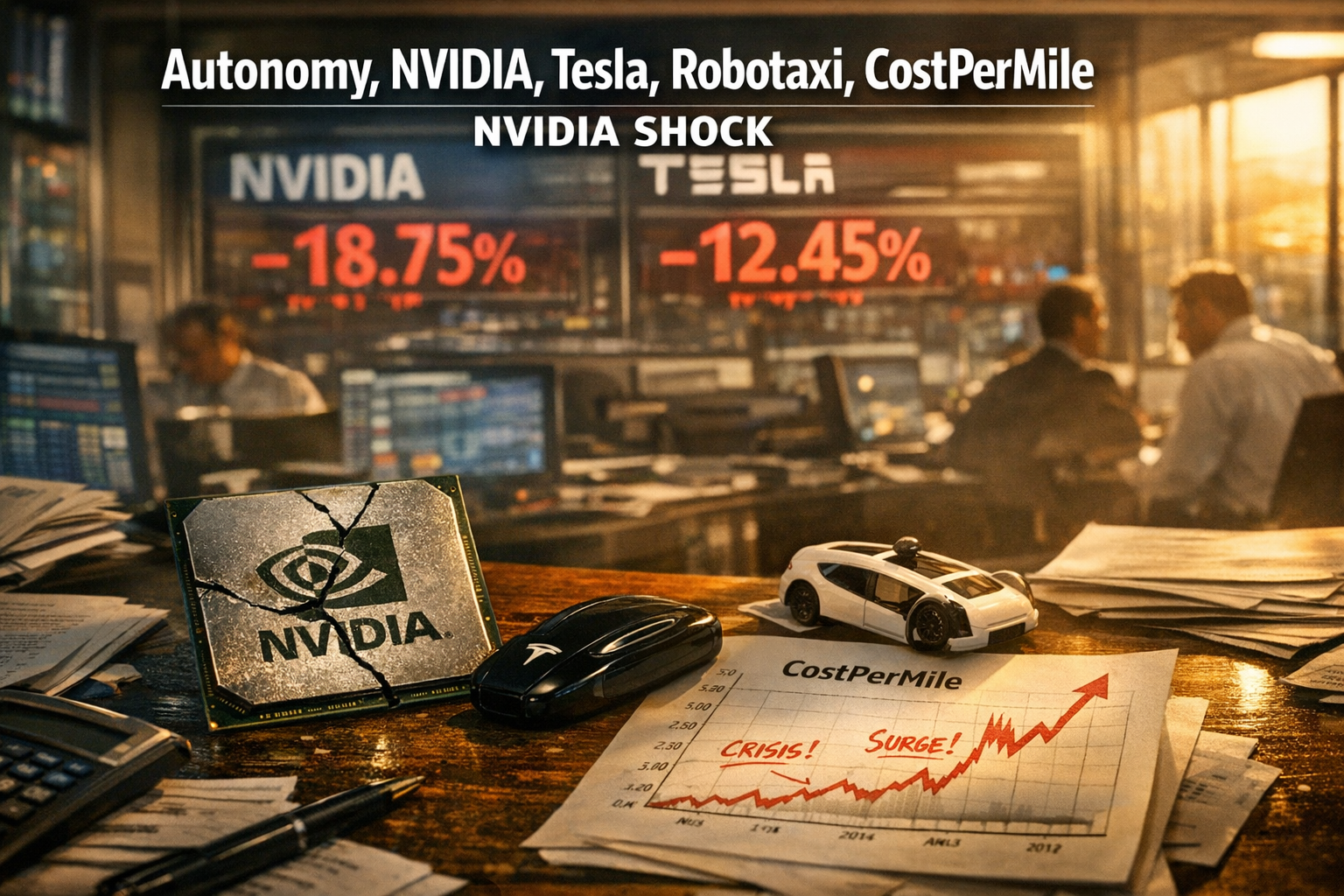
● Nvidia Autonomy Bombshell, Tesla Wobbles, Reality-Proof Cost War
Following NVIDIA’s “Autonomy Alpha” Reveal, the Underlying Reason Tesla Weakened: The Contest Is Not “Data,” but “Real-World Validation” and “Cost per Mile”
This report focuses on four core points.
1) Why NVIDIA’s autonomous-driving demo (Alpha series) moved markets, and the mechanics of “demo illusion.”
2) Why Tesla FSD’s primary moat is not “data volume,” but a system validated through real-world operation and continuous verification.
3) Why autonomous driving ultimately converges from a technology race into a “cost-per-mile (unit economics)” competition.
4) A less-discussed angle: NVIDIA may be positioned less as a direct competitor to Tesla and more as a supplier aiming to make all OEMs its customers.
1) Market-style recap: The surface rationale behind “NVIDIA demo drives Tesla weakness”
Key headline
After NVIDIA released an urban autonomous-driving demo, concerns spread that Tesla’s FSD advantage could be eroding, increasing near-term uncertainty.
Impression created by the demo
The footage emphasized scenarios that appear credible to non-experts—jaywalking pedestrians, waiting for right turns, and responses to dense urban variability—presented as stable handling.
Why Musk’s response amplified attention
Musk indicated NVIDIA was not keeping him up at night, but the market interpreted this both as confidence and as implicit acknowledgement of relevance, contributing to short-term volatility.
2) Issue 1: A practical answer to “Is Tesla’s autonomous-driving data advantage becoming irrelevant?”
Stated question
“NVIDIA likely lacks Tesla-scale real-world driving data; why does the demo look this capable?”
Two separations required
First, “a demo works” and “a deployable service generates profit” are distinct.
Second, the value of data is driven less by volume than by an iterative real-world validation loop.
Why autonomous driving fails on the long tail
Average driving performance can improve quickly to the 90–99% range.
The remaining 1% is the core challenge: rare, high-impact events such as fallen trees after an earthquake, sudden lane loss due to construction, unpredictable pedestrian behavior, and wildlife crossings.
An individual driver may never encounter these scenarios, but at fleet scale they occur daily somewhere. Long-tail exposure makes “real-world fidelity” decisive.
3) Issue 2: The core question behind “Can synthetic data (simulation) solve the long tail?”
Market interpretation of Jensen Huang’s message
The claim implied that simulation/synthetic data can compensate for limited real-world data.
Structural limitation
Fully solving the long tail with synthetic data would require near-complete replication of physical laws and combinatorial real-world variability in digital environments, approaching the complexity of building a high-fidelity “second Earth.”
Why this remains unresolved
Tesla presented similarly compelling demos in 2019–2021, yet the transition from demo-quality performance to safety at or above human levels has taken substantial time.
At scale, deployment-driven iteration and regression testing represent the primary cost and barrier, not the initial demonstration.
4) A recurring market error: “AI makes everything work” (lesson from Apple Titan)
Reference case
Apple’s autonomous-driving “Titan” program ran for roughly 2014–2024 and was ultimately discontinued, despite strong expectations that Apple would deliver a differentiated outcome.
Implication
AI capabilities have advanced rapidly, but the gap between laboratory feasibility and field validation is large.
Autonomous driving is tightly coupled with safety, liability, insurance, and regulation; unvalidated systems are structurally discounted by markets. From this perspective, continuous real-world validation remains Tesla’s most defensible advantage.
5) Where the competitive landscape ultimately settles: The decisive metric is “cost per mile”
Key point
Beyond “it works/it does not work,” the central question becomes:
“What is the total cost to operate one mile?”
This includes inference compute (chips), sensors, software licensing, energy, maintenance, operational labor, and insurance/accident costs.
Why Tesla is structurally advantaged on cost
Tesla has pursued long-term vertical integration and optimization across its chip stack and software, targeting lower unit costs.
Many legacy OEMs adopting NVIDIA solutions may face a buy-and-license structure for both inference hardware and software, increasing the risk of “autonomy that functions but fails economically” in robotaxi-like deployments.
The competition therefore shifts from demonstration to economies of scale, supply chain control, and a resilient cost structure under inflationary conditions.
6) Reframing via macro and AI trends: NVIDIA’s likely role is “standard supplier,” not direct operator
Higher-order interpretation
NVIDIA may be less focused on defeating Tesla as a robotaxi operator and more focused on selling end-to-end platforms—chips, software, and development tooling—to OEMs that lack an internal solution.
In this framing, “entry into autonomy” is an extension of NVIDIA’s AI infrastructure monetization into automotive.
Under such a scenario, Tesla may experience intermittent headline-driven pressure, while the broader industry shifts toward an NVIDIA-centered autonomy supply chain. The pace of this shift is likely influenced by capex cycles, regulatory frameworks, insurance/liability regimes, and data governance more than by demo-level performance.
7) Key points often omitted in mainstream coverage
1) Demo footage reflects selected pass cases, not validated performance
Autonomy failure modes are low-probability but high-severity; average-case driving can appear strong. Evaluation hinges on cumulative miles, crash rates, intervention/disengagement rates, and auditable regression testing.
2) Synthetic data is an amplifier, not a full substitute
Its highest value is accelerating reproduction and amplification of issues discovered in the real world. Claims that synthetic data alone can “finish” the long tail are likely overstated without a real-world validation loop.
3) The winner is not the company with working autonomy, but the company that profits from autonomy
Market evaluation is expected to migrate from demos toward cost per mile, insurance/liability structure, and operational efficiency.
4) NVIDIA’s primary target may be the broader OEM base, not Tesla
If so, near-term NVIDIA headlines may appear negative for Tesla, while longer-term outcomes could clarify a cost gap between a vertically integrated, low-cost model (Tesla) and a purchased-stack model (other OEMs).
< Summary >
NVIDIA’s autonomy demo increased market concern that Tesla’s advantage could be narrowing, pressuring sentiment.
However, the core challenge in autonomy is the long tail, and synthetic data alone is unlikely to fully resolve it.
Competitive outcomes are likely to be determined by real-world validation and cost per mile; Tesla may retain structural advantages through vertical integration and cost control.
NVIDIA may be positioned less as a direct competitor and more as a standard supplier converting OEMs into platform customers.
[Related Articles…]
- https://NextGenInsight.net?s=autonomous%20driving Autonomous driving market restructuring: identifying the likely winners
- https://NextGenInsight.net?s=NVIDIA NVIDIA’s AI infrastructure economy: the next cycle’s key driver
*Source: [ 허니잼의 테슬라와 일론 ]
– [테슬라] 엔비디아의 자율주행 시장 진입! 테슬라에게 미치는 영향은? 현실 세계 AI에서 가장 중요한 것은 ‘이것’입니다!
● Venezuela Crackdown, China Targeted, Taiwan Strait Flashpoint
Venezuela Is the “Pretext”; the Primary Target Is China: A Single Escalation Path Linking the Taiwan Strait, Energy, and Maritime Logistics
This report consolidates four points:1) Why the United States is amplifying the “Venezuela case” (beyond oil, narcotics, and crypto narratives).2) How this pressure exploits China’s vulnerabilities in Belt and Road lending, heavy crude energy security, and maritime logistics (bunker fuel).3) Why “status quo” dynamics in the Taiwan Strait represent a direct shock channel to global supply chains and the Korean economy.4) The most decision-relevant points that are often underemphasized in mainstream coverage.
1) News Briefing: “The Strike Is on Venezuela; the Impact Is on China”
Key point (one line)
U.S. pressure on Venezuela is publicly framed around narcotics/illicit finance/regime issues, but functionally resembles a warning action intended to constrain China’s expansion in energy, logistics, and diplomacy.
Indicator 1: Escalatory messaging through official channels
Use of unusually direct language via official White House communications suggests signaling priority over diplomatic restraint, consistent with broader U.S.–China strategic competition rather than a single-country dispute.
Indicator 2: Post-APEC perception that China did not materially concede
When summit optics do not produce visible Chinese retrenchment, the United States may increase pressure via alternative theaters. The Western Hemisphere is a logical pressure point; Venezuela is a salient node.
Indicator 3: “Oil, narcotics, crypto” as triggers rather than core drivers
Fentanyl-related framing can be linked to China, and illicit finance/crypto narratives provide political and legal justification. However, crude type and downstream utility suggest the issue extends beyond generic “oil” politics.
2) Why Venezuela Hits China at a High-Leverage Point
2-1. Energy (heavy crude) structure: “China is more exposed than the United States”
Decision-relevant point
Venezuelan exports skew toward heavy crude, with material linkage to marine fuel economics (bunker fuel).
Implication
- The United States has substantial light crude supply flexibility (including shale).
- China’s maritime trade scale structurally increases sensitivity to heavy crude and bunker fuel supply/price dynamics.
- Disruption in Venezuelan supply chains can raise China’s costs across procurement, pricing, and freight.
Macro transmission
Higher oil-market uncertainty can re-accelerate inflation. The United States faces heightened sensitivity to inflation management, while China is exposed through manufacturing input costs and logistics expenses.
2-2. Belt and Road lending exposure: “Loan-for-resources repayment becomes a target”
China’s mechanism
China has provided large-scale lending to Venezuela with repayment structured via physical commodities (notably oil).
U.S. strategic view
Destabilizing Venezuela can impair China’s resource security and repayment channels while reducing China’s influence in the Western Hemisphere.
2-3. Western Hemisphere strategy (revived Monroe Doctrine logic): “The external actor is China”
Core shift
The strategic logic is less about European influence and more about limiting Chinese presence in the Western Hemisphere.
Market relevance
Escalation can expand beyond diplomacy into supply chains, commodities, shipping, and financial sanctions, increasing cross-asset volatility.
3) Taiwan Strait: Why U.S. Security Hearings Concentrate on Taiwan
3-1. Taiwan as the key lever in maritime containment
Taiwan functions as a critical geographic chokepoint and leverage point for constraining China’s maritime access, increasing U.S. commitment to deterrence.
3-2. Trade flows: Disruption risk implies a global supply chain shock
Referenced scale
Annual transit through the Taiwan Strait is cited at roughly 1.3 million vessels; potential impact on global cargo flows is described in the 30–50% range depending on definitions.
Why this is acute for Korea
Korea’s export dependence and reliance on imported intermediate goods and energy create direct exposure via freight rates, insurance premia, delivery reliability, and inventory strategy, translating into margin and export performance pressure.
3-3. The “One China” language trap: principle vs. policy
Many governments avoid language that implies legal obligation, preferring formulations akin to “acknowledge” rather than “accept.” In escalation scenarios, wording can affect sanctions justification, alliance participation logic, and international legal framing.
4) Scenario Conclusion: “Full-force unification is unlikely; prolonged status quo may be higher risk”
A full-scale forced unification is assessed as difficult due to legitimacy constraints and high expected costs. However, this does not imply stability: a prolonged status quo can institutionalize elevated military tension and persistent economic costs.
For markets, low probability of total war can coexist with sustained risk premia through prolonged uncertainty.
5) Priority Points Often Underemphasized
1) The Venezuela frame is less about generic oil and more about marine fuel (bunker fuel) and the cost base of China’s export-shipping system. Shipping capability is a core element of China’s competitiveness; fuel, insurance, and route risk translate into national-level cost pressure.
2) Western Hemisphere pressure is increasingly executed through sanctions, finance, and currency/settlement mechanisms rather than primarily through military action. The first rupture may occur in payment rails, asset freezes, or commodity settlement terms.
3) The Taiwan Strait is not only a semiconductor issue; it is a repricing channel for global logistics via insurance premia, freight rates, and inventory costs that directly enter corporate P&Ls.
4) “Status quo” is not synonymous with peace; it is a cumulative-cost regime. Supply-chain diversification expenses, defense spending, and energy procurement premia can compound over time.
6) Forward Watchlist: Global Economy and AI Trends (Investment/Strategy Lens)
Global economy
- Higher oil volatility can re-ignite inflation pressure and complicate the interest-rate path.
- Rising energy and shipping costs in China can affect export pricing and margins, with spillovers to global trade dynamics.
Supply chains
- Taiwan Strait risk increases the realized cost of reshoring/friend-shoring.
- Freight rates, insurance costs, and port/route risk may become more explicitly priced into corporate valuations.
AI trends
- Elevated geopolitical risk supports two demand vectors:
1) Logistics, demand forecasting, and inventory optimization AI to reduce uncertainty costs.
2) Defense, security, and intelligence-analysis AI across surveillance, reconnaissance, and cyber domains. - Supply chain volatility can accelerate B2B AI adoption in agent-based operational automation (procurement, price negotiation, and routing).
< Summary >
U.S. pressure on Venezuela, while justified through oil/narcotics/crypto narratives, also functions as a Western Hemisphere warning action that can simultaneously strain China’s Belt and Road repayment channels (loan-for-resources), energy security tied to heavy crude, and maritime logistics costs linked to bunker fuel.
In the Taiwan Strait, prolonged status quo dynamics appear more plausible than immediate large-scale conflict, but this regime can sustain higher supply-chain costs (freight, insurance, inventory) and contribute to persistent inflation sensitivity.
[Related]
- https://NextGenInsight.net?s=Taiwan
- https://NextGenInsight.net?s=Inflation
*Source: [ 경제 읽어주는 남자(김광석TV) ]
– 베네수엘라는 명분일 뿐, 중국을 향한 경고 사격이다. 베네수엘라·중국·대만의 연결 고리 | 경읽남과 토론합시다 | 전가림 2편● Dollar Doom, Bankless Liquidity Surge, XRP plus Gold
Dollar Weakness, Liquidity Expansion, and the Erosion of Banks’ Intermediation Role: Reframing “XRP + ‘This Asset’” as a Macro-Economic Scenario
This report consolidates: ① The practical meaning behind claims that “the dollar becomes worthless” (not the collapse of dollar hegemony, but changes in payment and deposit architecture), ② Why “payments that bypass banks” can expand effective liquidity (reallocation of latent liquidity), ③ Key diligence items when evaluating XRP by function rather than price, ④ A market-structure method to narrow “the asset to buy alongside XRP” to two candidates, and ⑤ Under-discussed core risks (regulation, custody, and the on-chain transparency paradox).
1) Executive Summary of the Core Statements (News Format)
① “It is already quietly deployed” → Payment infrastructure is shifting incrementally
This is most plausibly interpreted as a gradual shift from bank-centered rails to blockchain/token-based rails for transfers, clearing, and settlement. Institutional adoption often precedes retail awareness due to cost reduction, faster settlement, and 24/7 operability.
② “The dollar will soon be worthless” → Not a collapse in value, but weakening exclusivity in global settlement
The more precise interpretation is not an immediate loss of confidence in the dollar, but a gradual decline in structures where the dollar must be used as an intermediary. This implies partial de-dollarization of payment and settlement pathways and a move toward multipolar rails. Such a shift can affect FX volatility, global liquidity conditions, and monetary-policy transmission.
③ “Move cash here” → The role of “cash (bank deposits)” may fragment
The central point is not that deposits lose all relevance, but that their functions (payments, transfers, yield, capital preservation) may be split across multiple instruments. Deposits remain necessary, but may be insufficient as a single solution across all functions.
④ “Because it bypasses banks, the U.S. cannot track it” → Surveillance shifts away from traditional intermediaries
Traditional finance concentrates data and control points in intermediaries such as banks, card networks, and payment processors. Blockchain-based transfers reduce some intermediaries and reallocate control points to exchanges, custodians, bridges, and compliance layers. “Impossible to track” is overstated; the practical reality is a trade-off between on-chain traceability and reduced visibility via mixers, privacy tools, or offshore venues.
⑤ “Banks weaken → liquidity increases” → Less friction and higher velocity can raise effective liquidity
Bank-based credit intermediation is constrained by regulation, risk controls, and limited operating windows. Faster rails and automation of collateral and settlement can increase turnover of the same capital, raising perceived liquidity. This can support risk-asset pricing while also amplifying downside volatility during liquidity reversals.
2) In “Buy XRP and ‘This’ with 100 million,” what is the most likely “This”?
Because the source does not specify a definitive answer, the most plausible candidates are narrowed using the stated macro context (dollar weakness, bank bypass, payment infrastructure, liquidity expansion).
Candidate A) Gold and real assets (commodities/energy) — the conventional hedge aligned with dollar-weakness narratives
Historically, dollar-weakness or confidence-risk narratives most frequently map to gold and other real-asset hedges. Gold tends to regain prominence when inflation risks re-emerge or geopolitical risk rises. A portfolio rationale can be framed as functional diversification: XRP as a settlement/liquidity rail and gold as a store-of-value hedge.
Candidate B) Bitcoin (BTC) — the primary “bank-bypassing value transfer” narrative
Bitcoin is the most established proxy for narratives involving weaker dollar dominance and disintermediated value transfer and storage. XRP is typically framed as a payment/settlement rail, while BTC is often positioned as “digital gold,” implying different use cases. Accordingly, an “XRP + BTC” pairing is commonly presented as “payment rail + store of value.”
Conclusion: Within the stated context, “This” is most plausibly gold (real-asset hedge) or Bitcoin (disintermediated store of value)
Both link directly to dollar-weakness narratives and to reduced reliance on bank intermediation. Investment decisions should be based on whether the functional thesis is supported by measurable adoption indicators.
3) XRP as Infrastructure: Six Due Diligence Items (Function Over Price)
1) Regulatory risk: viability as a “payment token” versus classification as a financial security/investment product
XRP has historically been highly sensitive to regulatory developments. The key question is whether regulatory uncertainty declines as payment and remittance use cases expand across jurisdictions.
2) Adoption reality: transactional usage growth versus headline partnerships
Partnership announcements are less informative than observable migration of payment and settlement flows onto the network. Sustained usage metrics are more likely to support valuation than narrative.
3) Fees, speed, and operational resilience: durable structural advantage versus incumbents (e.g., SWIFT and correspondent banking)
Technical advantages can compress over time as competitors replicate features. The question is whether cost, speed, and settlement-risk advantages remain defensible.
4) Liquidity quality: exchange liquidity versus institutional settlement liquidity
Retail-facing order-book liquidity differs from institutional capacity for large settlements. Institutional participation can reduce volatility, while regulatory shocks can trigger rapid institutional withdrawal and higher volatility.
5) Custody and security: replacing banks increases the importance of asset safeguarding
Reduced reliance on banks implies greater responsibility for key management and custody controls by individuals and corporates. Custody infrastructure growth is typically accompanied by heightened operational and cyber risk.
6) Macro sensitivity: historical response to rates, liquidity conditions, and the dollar index
Crypto assets generally behave as risk assets and remain sensitive to interest rates and global liquidity. Policy stance, recession risk, and renewed inflation pressures materially affect performance regimes.
4) Conditions Required for “Hold Regardless of a Crash” (Practical Constraints)
Condition 1) Risk capacity and cash-flow resilience are required
Withstanding drawdowns is primarily a balance-sheet constraint, not a psychological one. Excessive position sizing increases forced selling risk at adverse points in the cycle.
Condition 2) Survival risks must be controlled: regulatory blocks, exchange failures, and custody incidents
Beyond price volatility, key threats include loss of access (halts), delistings, custody failures, and jurisdictional restrictions. “Bank bypass” convenience can coincide with weaker protective frameworks.
Condition 3) Diversification must be defined beyond crypto-only allocations
Crypto-only diversification often remains exposed to the same liquidity regime. Real assets (e.g., gold), cash-like instruments, and currency/geographic diversification are typically required to improve robustness.
5) Under-Covered Critical Issues (Concise)
Key Point 1) “Untrackable by the U.S.” can be a regulatory escalation signal
Policy responses tend to intensify when financial flows become less observable. As disintermediated payments grow, regulation is more likely to become more granular rather than weaker. Markets may increasingly price a premium for regulatory-compatible design and compliant distribution channels (custody, identity, auditability).
Key Point 2) Banks may not disappear; their functions may unbundle
Banking decomposes into deposits, lending, payments, custody, identity, and risk management. Partial migration of any subset to fintech or blockchain can be perceived as “bank weakening,” but the more likely outcome is functional redistribution across platforms, big tech, custodians, and networks.
Key Point 3) Liquidity expansion is both opportunity and bubble fuel
Higher liquidity can support asset prices, but rate increases or recession shocks can trigger rapid liquidity withdrawal and volatility spikes. Crypto theses should be evaluated alongside monetary-policy regimes.
Key Point 4) Long-run winners are more likely “standardized rails” than specific token brands
Payment-infrastructure outcomes tend to converge on standards that can integrate regulation, institutional processes, accounting treatment, and custody. Investors should track signals of standardization: institutional adoption, regulatory clarity, and integration into settlement infrastructure.
6) Portfolio Framing for Weak Market Conditions (Analytical Framework)
Group A: Defense (survival) — resilience through rate and recession regimes
Core elements include cash-like instruments (short-duration, money-market characteristics), limited gold exposure as a hedge, and avoidance of excessive leverage. Currency diversification can be relevant given FX volatility.
Group B: Infrastructure (structural change) — exposure to payment/settlement rails
Assets positioned as payment rails, including XRP, fit this category. Outcomes depend on regulation, counterparties, and measurable usage; a checklist-driven approach is required.
Group C: Growth (optionality) — higher beta to liquidity upswings
Large-cap crypto assets such as Bitcoin may benefit from faster institutional integration, but remain sensitive to rates and liquidity. Position sizing is the primary determinant of risk-adjusted outcomes.
7) Monitoring Indicators for Follow-Up (Action Items)
① Dollar index and major currency trends
Risk-asset conditions differ materially depending on whether dollar weakness is structural or cyclical.
② Federal Reserve policy: rate path and liquidity (balance-sheet) changes
Major crypto cycles remain tightly linked to monetary-policy conditions.
③ On-chain and exchange data: distinguishing real usage from speculation
For payment-rail assets, real-usage indicators are central to thesis validation.
< Summary >
The relevant scenario is less about immediate dollar collapse and more about changes in payment and settlement infrastructure that can reduce the dollar’s intermediary dominance over time. Bank-bypassing payments can raise effective liquidity by reducing friction, while simultaneously increasing regulatory, custody, and exchange-related risks. XRP should be assessed primarily through regulatory clarity and measurable payment-rail usage rather than price narratives; the companion “asset” most consistent with the stated framework is likely either gold (real-asset hedge) or Bitcoin (disintermediated store of value). Crypto allocations should be evaluated alongside rates, inflation, FX dynamics, recession risk, and monetary policy.
[Related Articles…]
- Five checks retail investors should prioritize when FX volatility rises
- How asset markets typically respond to signals of a monetary-policy pivot
*Source: [ 달란트투자 ]
– 폭락 오든 말든 1억으로 XRP와 ‘이것’ 사라. 평생 돈 걱정 없다|홍익희 교수 4부