● K-Startups Storm CES, AI Powerhouse Shift, Deal-Driven Funding Funnel
Why the ‘K-Startup Pavilion’ at CES Eureka Park is Truly Meaningful: Covering the “Actual Application of AI” and “Investment Connection Design” Beyond Just Innovation Awards
This article focuses on three core points.
First, why Korean startups at CES Eureka Park shifted the focus from ‘quantity’ to ‘quality’.
Second, the true signal behind the achievement of top innovation awards in the AI sector in the global AI competitive landscape.
Third, how the little-discussed “change in government support design (from exhibition to contract/investment facilitation)” actually worked.
1) On-Site News Briefing: What Happened at CES Eureka Park This Year?
1-1. Korean Startups Prove Their Presence ‘Through Numbers’
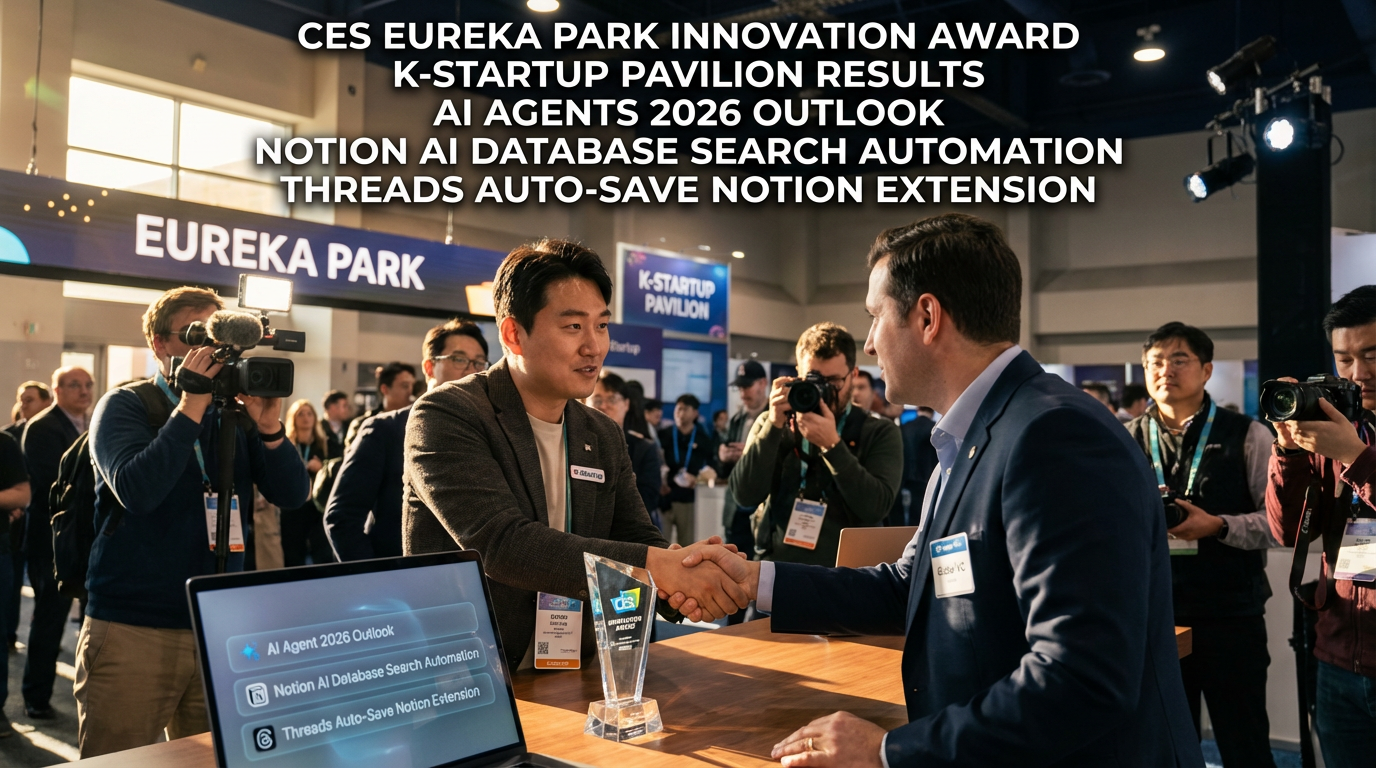
Approximately 1,100 startups participated in CES 2026 Eureka Park,
among which 411 were Korean companies, accounting for about 37%.
This indicates that Korea is not just a pillar of Eureka Park, but is virtually perceived as the “main player.”
1-2. K-Startup Pavilion: 81 Participants, 11 Innovation Awards, 3 Top Innovation Awards
The K-Startup Pavilion, led by the Korea Startup Promotion Agency, had 81 participating companies,
of which 11 received CES Innovation Awards and 3 even won Top Innovation Awards.
Specifically, the fact that “all 11 companies that received innovation awards were supported by the Ministry of SMEs and Startups policies” is a strong message.
This means that the structure connecting policy-support-performance has been validated in the field.
1-3. This Year’s Keyword: “Refinement and Practical Support” Over “Scale Expansion”
This year, the pavilion’s focus shifted from merely increasing the number of participants
to enhancing the density of support to boost corporate competitiveness.
In other words, it wasn’t about exhibition for exhibition’s sake, but about creating business models, investor relations, and networks that work in the global market.
2) Why Top Innovation Awards in AI Matter: ‘Position Change’ of Korean Startups in Global AI War
2-1. Two Out of Three Top Innovation Awards in AI
The fact that two of the three top innovation award winners are in the AI category is pivotal.
This signals that Korea is not only participating in AI but is capable of winning in global evaluation criteria (marketability/completeness/uniqueness).
2-2. A More Important Story: ‘Pivoted in 10 Months to Win’
As the original text highlights, winning an award 10 months after pivoting from IoT/mobile peripherals to AI
indicates that AI is now a “leverage for business transformation” rather than just “lab technology.”
Today’s global market emphasizes ‘execution speed’ and ‘learning curve’ over technology itself,
which significantly influences a company’s worth.
2-3. At a Macro Level: Korea’s Strategic Advantage in AI Supply Chain (Model-Data-Device-Service)
Korean startups typically excel in areas like these.
Combining devices/sensors/manufacturing foundations with AI (Edge AI, smart factory, healthcare devices, etc.).
Instead of competing head-on with “buying a lot of GPUs for model training”,
the position is more about winning with on-site data and productization speed.
This trend is quite practical in the upcoming global AI competition.
3) Support from the Korea Startup Promotion Agency: From ‘Booth Provision’ to ‘Investment/Contract Funnel’
3-1. Pre-Mentoring + Pre-Reach Out to Investors
A crucial point in this support is not the sudden on-site IR but
a structure where mentoring, pre-engagement with investors, and on-site matchmaking are done in advance.
This is the method currently preferred by global VCs and corporations.
On-site meetings should be part of an ongoing deal progression, not a standalone event.
3-2. On-Site IR Matching Program + Ongoing VC Seminars
Daily IR pitching and continual VC seminars are planned at Eureka Park.
The aim is not just “exchanging business cards” but
increasing the likelihood of follow-up meetings, due diligence, PoC, and negotiation of investment terms.
3-3. Innovation Award Support Done ‘Properly’: Webinar/1:1 Consulting/Meetings with Senior Companies
Innovation awards aren’t just granted because the product is good,
as category positioning, submission material composition, and messaging often determine outcomes.
Providing close support through expert webinars, 1:1 consulting, and matchmaking with senior firms is practical.
4) Promoting the Global Startup Ecosystem (Inbound): “Strategy to Turn Korea into a Market”
4-1. Promoting Inbound Policies Like Startup Korea Special Visa
What’s interesting about this pavilion is that it not only promotes Korean startups overseas but
also advertises “policies to bring foreign entrepreneurs to Korea.”
This signals a change in the way the domestic startup ecosystem is being nurtured in the long run.
4-2. K-Startup Grand Challenge + Global Startup Center + Settlement Support
It comprehensively introduced programs that support the settlement of foreign companies in Korea.
Ultimately, the aim is to shift Korea’s positioning from a ‘country going out for investment’ to
a ‘country where startup teams come to scale up’.
This trend will have a direct impact on the domestic innovation ecosystem and employment in the medium to long term.
5) Five Most Important Key Takeaways from This Year’s CES K-Startup Achievements (Not Widely Discussed in News)
5-1. More Significant Than “Innovation Awards” is the Proven ‘AI Transition Speed’
The AI top innovation awards are the result, but
the real essence is the process where startups quickly pivoted to AI and commercialized their offerings.
Currently, the global market continues to attract CAPEX and talent to AI despite swings in interest rates/economic cycles.
In this context, “fast product commercialization” is a weapon for maintaining valuation while attracting investment.
(This naturally connects with global economic forecasts, interest rate cuts, and investment attraction needs.)
5-2. ‘Refinement’ is Not Cost Cutting, But “Optimization for Success Rate”
Reducing the number of participating companies is a strategy, not a downsizing.
Global exhibitions like CES value “follow-up meetings/pilot/projects” conversion rate more than “exposure”.
Distributing support weakens the results.
5-3. Government Support Evolved from ‘Priming Water’ to ‘Funnel Operator’
The structure from pre-mentoring → outreach → on-site IR → networking → follow-up VC seminars
is essentially a sales funnel and a deal funnel.
The fact that this was designed by the public sector is the point.
5-4. Eureka Park is Now a “National Brand Competition Arena”
While Eureka Park gathers startups that find it challenging to set up dedicated booths like big tech
paradoxically, this makes the national competition more pronounced.
The 37% share of Korea doesn’t simply represent participation but serves as a tangible indicator of “national innovation capability.”
5-5. Promoting Inbound (Attracting Foreign Startup Teams) Changes the Korean Economy’s Structure Long Term
Policies like startup visas and the grand challenge are structural changes, not short-term news.
As foreign teams start in Korea, employ in Korea, and conduct PoC in Korea
the domestic industry’s competitiveness and productivity will increase in the long term.
This ultimately impacts macro indicators like GDP, exports, and productivity.
6) Future Watch Points: Viewing the 2026 Global Economy and AI Trends from These Perspectives
6-1. In the Period of Expectations for Interest Rate Cuts, ‘Growth Stocks/AI’ Easily Gain Premium Again
When the market starts reflecting on interest rate cuts,
companies with distant cash flows (tech/AI) often see a recovery in valuation.
During this phase, CES awards/global PoC/VC meeting outcomes serve as persuasive evidence for attracting investment.
6-2. AI is Rapidly Shifting from “Model Competition” to “Industrial Application Competition”
While mega model races favor those with massive capital,
industrial applications (manufacturing, healthcare, distribution, security, robotics) value on-site understanding and productization speed.
This is where Korean startups have an advantage.
6-3. The Next CES May See More ‘Contract/Revenue’ Disclosure Cases
Until now, focus has been on awards,
but moving forward, there will likely be more emphasis on “how much has been turned into investment/PoC/delivery.”
As the pavilion support shifts to funnel-type, it’s natural for performance indicators to follow suit.
< Summary >
Korea demonstrated its presence in CES Eureka Park with 411 participations (about 37%).
The K-Startup Pavilion not only scored ‘quantitative achievement’ but also ‘qualitative success’ with 11 innovation awards and 3 top innovation awards among 81 companies.
The fact that two of the three top innovation awards were in AI indicates Korean startups’ AI competitiveness met global standards.
This year’s core change was a shift from exhibition-focused support to an “investment/contract funnel-type support” involving pre-mentoring-investor outreach-on-site IR-networking.
Additionally, highlighting not only outbound promotions but also inbound policies like startup visas suggests a strategy to position Korea’s startup ecosystem as a ‘global hub’.
[Related Articles…]
- Post-CES Innovation Awards: 3-Step Strategy for Startups to Actually Secure Investments
- Common Traits of Teams that Achieved Results in AI Pivot in 10 Months: Productization Roadmap
*Source: [ 티타임즈TV ]
– AI 부문 최고혁신상 배출! K-스타트업 활약상 스케치
● Rate-cut-hype-ignites-risk-asset-rally
The Real Secret of People Making Money with AI: The Era of “Creating and Selling Directly” Has Arrived (Thread→Notion Automatic Save Chrome Extension + 2026 AI Agent Outlook)
Today’s article includes just four key points.
1) The core structure of a Chrome extension that automatically organizes saved Threads into a Notion database with a single “heart click”
2) Why the ‘Vibe Coding’ method, which can be created in five minutes without knowing how to code, revolutionizes productivity
3) Operating method for automating “search/summary/classification” using Notion AI for saved articles
4) How the ‘Year of the AI Agent’ in 2026 changes the revenue model and what to prepare for now
1) News Briefing: The Current Issue People Face Is Not “Saving” but “Rediscovery (Search) Impossible”
Core Point
Even if you save useful articles from Threads, you have to endure endless scrolling and loading to find them again later.
Ultimately, saved knowledge piles up but cannot be reused and fades away.
On-Site Symptoms (From User Perspective)
– As saved articles increase, search costs massively increase
– Articles mixed with images/videos/comments are harder to find
– People consume the same information again because they can’t find “that article from before”
Solution Direction
The problem disappears when the storage location is moved from the platform (Threads) to a personal knowledge database (Notion) and left as structured data.
2) One-sentence Summary of This Case: “Auto Save to Notion DB with a Heart Click” Chrome Extension
Operational Flow (Based on User Action)
1) Discover a favorite post on Threads
2) Click the heart (like)
3) The extension extracts the post information
4) Automatically creates a record in the Notion database
5) Organizes summary/URL/author/post date/save date/category
Data Being Saved (Based on Video Content)
– Title/Summary
– Original text
– URL
– Author
– Post date / Save date (recorded separately)
– Images / videos (media included)
– Comments (can save “all” including text/images/videos/links)
Point
It’s not just a “bookmark,” but it’s key that it’s turned into “data” that can be reused later.
3) How Was It Made: Using Claude Code for ‘Prompt→Code→Compress→Load into Chrome’
Production Method (Reconstructed Video Flow)
– In Claude Code (desktop), select a folder and create an extension with prompts
– Initially made based on a “save button,” but switched to using “heart (like)” as a trigger due to instability
– Compress the result folder and load it in the Chrome extension (developer mode) to use
Why the Heart Is a Good Trigger
– UI events are clear, simplifying the automation point
– User actions are intuitive, making the habit easy to establish
– “Save” and “categorization” happen simultaneously, increasing operational efficiency
Important Reality Check Here
– Claude Code may include paid-based features
– However, there was mention that similar implementations can be achieved with free tools/open source combinations, with the emphasis on “structure rather than tools”
4) What Comes After Saving Is More Important: Turning ‘My Saved DB’ into a Search Engine/Research Tool with Notion AI
Scenes Using Notion AI (Summary of the Video)
– Asking questions like “Curious about Claude Code”
– Notion AI finds related articles within the database
– It categorizes (usage method/function updates/advanced usage, etc.), summarizes, and provides links
Why This Is a Game-Changer in Productivity
– Saved articles transform from ‘memory’ to ‘knowledge assets’
– The quality of responses improves cumulatively as the personal DB grows
– Ultimately, it creates a structure where individuals have “their own internal wiki + research bot”
Meaning from an Economic/Business Perspective
This flow applies equally in companies.
If a team’s work know-how/customer response/market research is turned into a DB, and AI searches, summarizes, and suggests, it changes the cost structure.
The reason recently companies fail to see effects from adopting generative AI is often due to “database design rather than AI.”
5) Monetization Point: Not ‘Subscription’ but Making ‘My Problem-Solving App’ into a Product
Message from the Video (Reorganized)
– Now not only responsible for document work, but also for “creating and using the function you want on the spot”
– If you have development knowledge, you can publish and monetize it
– Actually, the person is proceeding with commercialization in this way
Why This Model Works
– Customers pay for “solving my workflow problem” rather than “tools”
– Even if similar services exist, it’s a product when a combination like specific platform (Threads) + specific purpose (NotionDB) + specific usage (heart trigger) changes
– Especially, automation shows immediate ROI, lowering payment barriers
The Natural Bigger Picture Here
As these micro-automation products increase, productivity at individual/team levels increases, ultimately changing labor productivity, digital transformation, and IT investment direction.
If interest rate cut expectations increase in recent macro trends (with varying speeds by country), it often leads to a cycle of increased capital flowing back to growth sectors such as AI startups/software as risk asset preference increases.
This ultimately links to market volatility.
6) 2026 Outlook: Why “The Year of the AI Agent” Is Truly Profitable
Keywords Mentioned in the Video
– 2026 is when AI agents will proliferate in earnest
– Expanded to the realm of scientists (invention/research support)
– Interoperability and synergy increase with MCP, skills, sub-agents, etc.
– It’s likely to be a year when “things that seemed impossible become possible”
Reinterpretation from a Blog Perspective (Only the Core)
The goal of agents is “not to answer” but to “complete the task (end-to-end execution).”
So, the future points of profit will shift from model performance to the following three:
1) What data can be accessed (personal/team/company DB)
2) What actions can be executed (browser/app/payment/CRM/Notion, etc.)
3) What verification loop exists (feedback/log/retry on execution results)
7) “Most Important Content” That Other YouTube or News Does Not Often Mention (Essence of This Case)
Important Point 1: The Essence of ‘Vibe Coding’ Is Not Coding but the Ability to “Redesign the Work Interface”
Everyone focuses on “made it in five minutes,” but the real core is “which buttons to remap to which actions (heart→save)” such as task design.
This sense is needed to get results no matter what AI tool you use.
Important Point 2: Saving Automation Is the Entry; Real Money Comes from ‘Search/Summary/Reuse’
Everyone saves.
But the point where teams/individuals actually make money is “speed of finding and using immediately when needed.”
In other words, DB schema (field design) and AI search experience are the centers of monetization.
Important Point 3: The Most Realistic Way to Reduce Platform Risk Is ‘Escape into Personal DB’
If platform policy/algorithm/service quality changes, your knowledge shakes with it.
By moving your assets to external platforms like Threads→Notion, you reduce long-term volatility (including platform changes).
Important Point 4: ‘Chrome Extensions’ Are a Form Factor That Can Immediately Connect to B2B
Everyone only thinks of apps or SaaS, but Chrome extensions are easy to distribute/onboard quickly at the team level.
Especially sales/marketing/research teams have a lot of browser-based work, so small automation quickly translates into performance.
8) Immediately Usable Checklist: To Create or Extend “Thread→Notion Automation”
A. Notion DB Design (Essential Fields)
– Title (automatic generation rule)
– Summary
– Original Text
– URL
– Author
– Posted Date / Saved Date
– Media (image/video link)
– Comments (whole save option + original)
– Category (automatic classification)
B. Choosing an Automation Trigger
– Capture “clear user action” as a trigger (heart in this case)
– Think of a maintainable way even if buttons/icons change (from maintenance perspective)
C. Monetization Ideas (Start Lightly)
– Sell as a template + extension program bundle
– For teams: provide shared Notion DB + permissions + standard categories
– Education/Consulting: ‘Collection-Organization-Search’ package for our organization
< Summary >
The real problem with saved Threads is “not being able to find them later.”
A Chrome extension that automatically saves posts/media/comments to a Notion DB with a heart click solves this issue by data conversion.
After saving, it transforms into a personal knowledge engine by searching, summarizing, and classifying DB with Notion AI.
In 2026, with the spread of AI agents, the value center shifts to “task execution” instead of “answering,” and such micro-automation apps become a revenue model.
[Related Articles…]
- Practical Strategies to Increase Productivity with AI Automation
- Preparation Checkpoints for Individuals and Companies in the Era of AI Agents
*Source: [ AI 겸임교수 이종범 ]
– AI로 돈 버는 사람들의 비밀: 남들은 구독하는데 나는 직접 만들어 팝니다