● Invisible AI Hijacks Daily Life, Korea Startups Spark Form Factor War
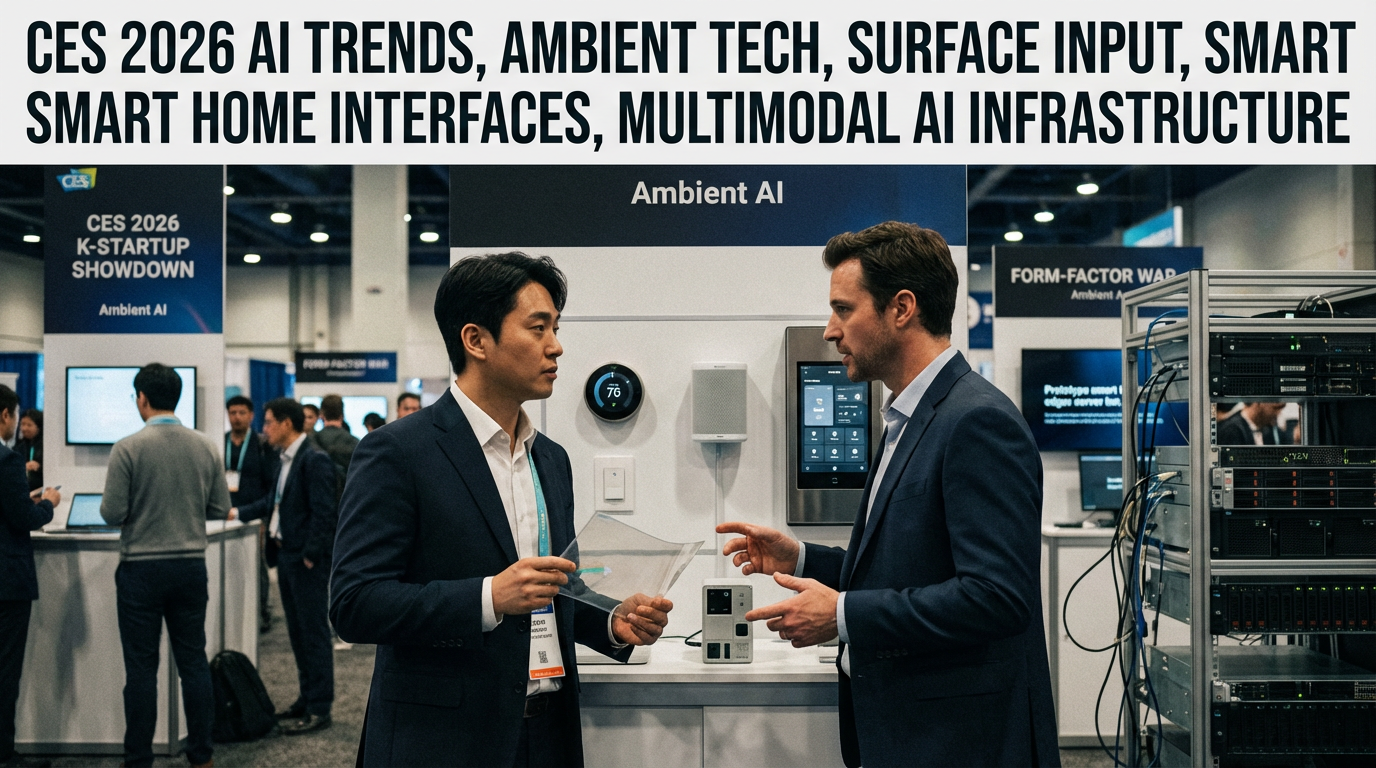
CES 2026 K-Startup Integrated Pavilion Key Takeaways: The Era of “Ambient Tech” Truly Begins
This article contains three core points.
First, why the two K-startups (City5 and Geeksloft) that won the top innovation award at CES 2026 are capturing the “next form factor.”
Second, how “input methods” are being revolutionized, such as with Commonlink, which turns a sofa, wall, or table into a touchpad with a single sensor.
Third, what other news outlets or YouTube channels often overlook—the “real important thing”—where these technologies will ultimately generate revenue and which industry structures they might disrupt.
1) CES 2026 in One Sentence: ‘Ambient Tech’ Is More Frightening than ‘Physical AI’
Everyone says AI is the star of this year’s CES.
But the real competition now is not “AI performance” but how AI infiltrates environments so users don’t even realize they are using it.
If physical AI is like a robot with a body,
ambient tech permeates into space, objects, surfaces, and habits to change the “behavior itself.”
Ultimately, ambient tech is likely to be the side that creates a larger market.
2) Signals from Awards: “Korean Startups Have Entered the Form Factor War”
The K-Startup Integrated Pavilion won 11 innovation awards and 3 top innovation awards (top 1% globally).
Interestingly, the awards were scattered across categories such as ‘wearable, audio, interfaces, robotics, air, mapping, smart home’ rather than concentrated in one area.
This indicates that Korean teams are moving toward “restructuring whole lives with AI” rather than following a “single trend.”
3) Company News Briefing (CES 2026 K-Startups 7 Companies)
3-1. City5 — ‘Screenless AI Companion’ Zone HSS1 (Top Innovation Award)
The core product is a screenless AI wearable ‘Zone HSS1’ worn around the neck.
The concept is to “connect with the world through conversation alone,” without touch.
The key point is large multimodal (voice + image/video) based interaction.
AI no longer excels by merely understanding text,
it’s evolving to comprehend the ‘context’ by taking in what people see, hear, and say as a whole.
This device approach perfectly aligns with that trend.
Its business model encompasses not only B2C but also B2B (e.g., airport AI tour guides).
From an investment perspective, “devices that change user habits” have strong lock-in effects, allowing them to capitalize significantly when the market opens.
3-2. Geeksloft — XR + Headphone Combination ‘Perisphere’ (Top Innovation Award)
Geeksloft declared its intent to create the “smart headphone” segment by combining the strengths of XR and the everyday nature of headphones.
The focus is on two main aspects.
First, a display that drops down only when needed (without fully blocking the view, offering an overlay feel).
Second, capturing the user’s viewpoint in 3D and sharing it in real-time with cameras on both sides.
One reason XR’s popularization is slow is due to the “cumbersomeness” rather than specs,
whereas headphones have been a natural object for people for 100 years.
This team’s strategy is to layer ‘visual information’ over that established habit.
On a macro level, this isn’t merely a product launch but a competition for the ‘next-generation computing interface.’
Who captures the platform after smartphones will ultimately change the flow of the global economy.
3-3. Commonlink — Turning “Every Surface into a Touchpad” with One Sensor (Innovation Award)
Instead of drilling holes into surfaces and attaching panels, Commonlink uses sensors on the ‘back’ of surfaces to turn them into input devices.
Its operation is intriguing.
It recognizes the ‘sound of friction’ to read the direction/pattern of swipes across the surface as input.
Simply put, the sensor listens “as if a person is pressing their ear to the surface.”
Why is this crucial?
Future interfaces are moving towards ‘invisible inputs’ rather than ‘visible buttons.’
There is significant expansion potential in smart homes, vehicle interiors, furniture (sofas/tables), security (safes/doors), and industrial sites.
3-4. Humanics — Robot + Fitness Equipment Combination ‘AI Workout Partner’ (Robotics Innovation Award)
The digital training machine ‘Sazim’ creates desired weight with a motor instead of changing weight plates.
The core point is its ability to precisely control in 0.1~1kg increments by detecting the user’s intent as they apply force.
It includes safety detection, rehabilitation, long-term data accumulation, and physical diagnostics.
In the long run, it’s projected to expand from gyms/B2B to hospitals/nursing homes/homes (B2C).
This is closer to “automation in healthcare based on human exercise data” rather than mere fitness.
Demand grows in rapidly aging countries, laying out a neat long-term growth story.
3-5. Phonatures — AI-managed ‘Microalgae Air Purification/Carbon Reduction’ (Smart City/Sustainability Innovation Award)
It’s a device that absorbs CO₂ and supplies oxygen based on microalgae cultivation.
The size is said to be ‘refrigerator-level’, and it can be used as a standalone air purifier or expanded modularly.
Its strength lies in contrasting usual physical/chemical carbon capture which typically “consumes a lot of space/energy and lacks consumer utility.”
This model simultaneously offers tangible benefits in everyday spaces (air purification, oxygen supply) while targeting carbon reduction.
Figures like a yearly carbon reduction of 2 tons were mentioned,
such measurable outcomes align with future ESG investments, carbon accounting, and corporate carbon reduction requirements, creating marketability.
3-6. Vacatio — ‘Conversational AI Maps’ Playlist (Place List)
Traditional map searches follow the process of “searching for a restaurant → scanning a list → selecting,” don’t they?
Placelist functions by allowing users to “express mood/situations verbally, and AI immediately limits choices to their match.”
In other words, it’s a conversational exploration in map format (a sort of ChatGPT-style UX).
Another aspect is the lodging software ‘Pinehost’ for property owners.
Capturing the supplier (SMB) sector with features like price auto-adjustments and optimization,
there’s a visible structure expanding to the consumer experience (travel exploration).
If the model runs well, a data flywheel (demand-supply-reviews-repeat visits) can easily form.
In travel, the more personalized an experience, the higher the conversion rate, giving it strong market impact.
3-7. Oddly Reality — Bringing Korean ‘Ondol’ Smart Heating to the U.S. Market
The plan is to lower installation/operation burdens of Korean ondol (underfloor heating) to fit US housing environments,
while offering energy tracking, remote control, and automatic temperature control integrated with IoT like Google Nest.
According to the prototype, a felt efficiency improvement from 10% → 30% was mentioned,
the core point is the “solutionization of underfloor heating, notoriously costly in the US.”
The truly intriguing point here is the branding strategy.
They expressed a desire to establish ‘ondol’ as a standard term in the US, not just ‘underfloor heating.’
If successful, it becomes a category naming, not merely a product, strengthening long-term positioning.
4) (Important) The “Real Core Points” Other News Often Miss
4-1. The Core of the AI Era Is Not ‘Output’ but ‘Input Revolution’
Everyone focuses on what generative AI creates (output) these days,
but what actually transforms markets is the input method.
City5 aims for “touchless voice/context input,”
Commonlink transforms “surfaces themselves into input devices,”
Geeksloft uses headphones (wearing habits) as an input hub.
Companies that capture input methods gain usage frequency and data,
making monetization through subscriptions, ads, commerce, or B2B contracts easier.
This is the next round of digital transformation.
4-2. Form Factor Succeeds Only on the ‘Habit,’ Not the ‘Technology’
The slow popularization of XR is due to “cumbersomeness” rather than specs.
That’s why Geeksloft chose headphones,
and City5 went the direction of removing screens, stating “we won’t occupy your hands.”
4-3. The Winner in Wearables Is Likely to Prevail in “B2B Fields” First
B2C involves substantial marketing costs, with burdens like returns/CS.
Thus, initially, B2B channels such as airport guides, industrial safety, fitness centers, hospitals can operate much faster.
All teams strategically set this direction concurrently.
4-4. Sustainability (Carbon) Requires ‘Consumer Tangibility’ to Be Profitable
The sharp aspect of Phonatures’ model is
carbon reduction starts not as a “noble cause” but with perceptible value as “air quality improvement/oxygen supply.”
This eases market entry for both corporate and individual buyers.
Especially in today’s high-interest environment, such ‘immediate utility’ is vital for investment decisions.
4-5. Korean Startups’ Global Strategy Has Become More Sophisticated as ‘Device→Service→Data’
In the past, hardware may have excelled, but service/platform aspects were frequently critiqued.
Yet this lineup doesn’t end with devices (wearables, sensors, machines, air devices);
many now naturally link AI operation, personalization, data accumulation, and subscription-based BM.
This builds global competitiveness in the long run.
5) Macroeconomic Perspective: Why This Trend Is Emerging Now
The global economy post-high interest rates phase is obsessed with “certain productivity.”
This means AI survives only by attaching to tasks/life, enhancing productivity, rather than serving merely as a ‘demo.’
K-Startups all target precisely this point in common.
Invisibly permeating to reduce friction (time/energy/cost),
then accumulating data and transitioning to automation.
This path survives despite fluctuations in business cycles.
All these aforementioned trends will likely dovetail with semiconductor supply chains, energy efficiency, and demand for smart home/wearables,
potentially crafting the next investment themes.
6) Checklist: Key Points to Observe in These Teams for the Next 6-12 Months
City5: Whether airport/tourism B2B contracts are actually achieved, and if multimodal usability is truly hands-free
Geeksloft: Display’s wearing fatigue/battery/weight, and how they handle regulations/privacy for the ‘recording’ feature
Commonlink: Malfunction rate (by surface/noise environment), and commercial partnerships for secure input (OTP/pattern)
Humanics: Whether they enter rehabilitation/hospital channels, and the regulation/certification of diagnostic algorithms based on long-term data
Phonatures: Maintenance costs (level of microalgae management automation), and expandability of installation sites (office/school/data center)
Vacatio: Consumer product revisit rates and lock-in of accommodation SaaS, and whether the data flywheel spins
Oddly Reality: US installation cost/certification/distribution partners and whether energy savings are quantifiable
< Summary >
The core point of CES 2026 K-Startup was not ‘AI performance’ but ‘AI inconspicuously permeating daily life through ambient tech.’
City5 and Geeksloft showcased next-generation form factors (screenless AI, smart headphones), while Commonlink demonstrated an input revolution (all surfaces = touchpad).
Humanics (robotic exercise/rehabilitation), Phonatures (microalgae carbon reduction/air purification), Vacatio (AI conversational map), and Oddly Reality (US-style Ondol IoT) clearly exhibited “AI integration into the entire daily life.”
The truly important points lead to structures involving input methods, habit-based form factors, B2B diffusion strategies, perceptible sustainability, and data-driven monetization.
[Related Articles…]
- Post-CES Innovation Award: The Battleground for Korean Startup Global Expansion Strategies
- The AI Wearable War: Who Captures the Platform After Smartphones?
*Source: [ 티타임즈TV ]
– 헤드셋, 헤드폰, 소파 표면까지 스며든 K-스타트업의 AI 기술력● Big Tech AI Swarm Crushes Startups – New Moats Are Infrastructure And AI Native Code
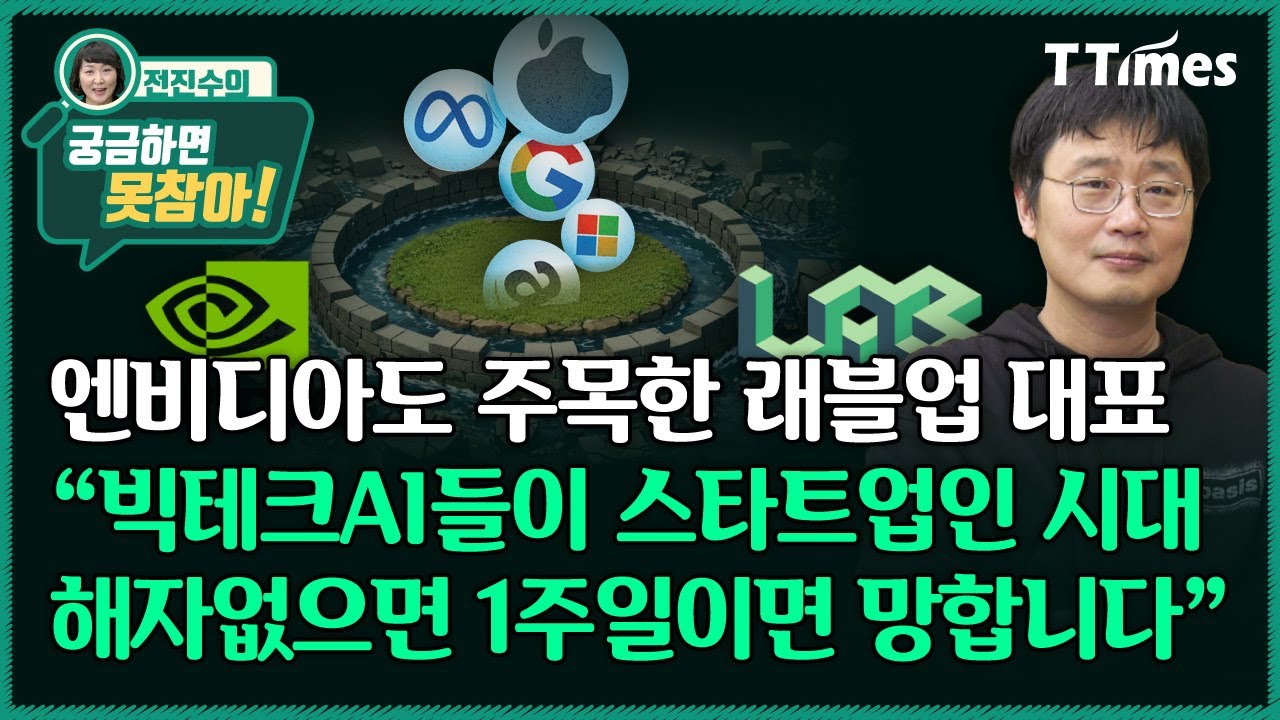
The Era of ‘100 AI Startups’ within Big Tech—Where Should Entrepreneurship Head Next? (Reinterpreting Statements by Shin Jeong-kyu of Ravelup through Economic/AI Trends)
Today’s text has been clearly structured into four points.
First, how the era of “100 AIs within big tech acting like startups” actually changes the market structure.
Second, why CEO Shin Jeong-kyu said, “If I were to start a business now, I would create a programming language” (the core point being ‘the language AI uses’).
Third, how developers/organizations can immediately implement ‘AI coding error prevention operational methods (test/review systems).’
Fourth, where AI infrastructure investment, monetization, and token economy will explode by 2026, and why multimodal is a game changer.
1) Today’s Core News: “Startups now compete with Big Tech’s ‘in-house AI teams’”
Shin Jeong-kyu’s concern is straightforward.
He states, “Creating a good service can now be copied in less than a week.” This is alarming because the competitor is no longer a “similar startup,” but “AI organizations within Big Tech running 50 to 100 experiments simultaneously.”
The implications of this structure are threefold.
First, as product launch cycles shorten, the market shifts from “planning capability” to focusing on “experimental speed.”
Second, differentiation in low-entry-barrier web/app services becomes increasingly difficult.
Third, this means that the business moat shifts from “marketing/features” to “deep technology/operations/data/deployment systems.”
2) Why Ravelup (Backend.AI) is in the Spotlight: Achieving Scale at the ‘AI Engine (Infrastructure)’ Level
Ravelup positions itself not as a notable B2C service but as the “engine” that powers AI services.
The statement is clear: “We are like an engine manufacturer for cars.”
Economically, the important point is that as the AI market grows, the “operations” will inevitably become more profitable than the “models.”
(This is linked to why AI infrastructure is repeatedly strong in the global stock market these days.)
Translating the technical points made by the CEO into market language gives this picture:
When you have 100 GPUs versus 5,000, it is the “operating system itself” that must change, not just the “product.”
You must manage even far-flung clusters (scale across).
When new GPUs (like Blackwell) emerge, real operational issues arise in terms of stability, drivers, and optimization.
Ultimately, “AI Infrastructure” is not merely hosting;
it involves resource partitioning/virtualization/overbooking of GPUs, which become the moat due to low-level optimization capabilities.
This is nearly impossible to replicate quickly.
3) The Real Meaning Behind Shin Jeong-kyu’s Statement that “If I Were to Start a Business Now, I Would Create a ‘New Programming Language’”
There is a common misunderstanding here.
When he says to create a language, it’s not just “another JS/Python.”
The paradigm shifts from a “language easy for humans to read” to a “language easy for AI to use.”
The core logic is as follows.
Current programming languages are optimized for human mental models (abstraction, OOP, etc.).
However, these are somewhat distant from how the CPU/GPU actually execute, with compilers bridging the gap.
When AI becomes a major player in coding, the need for human-friendly languages decreases.
Instead, a combination of “machine-friendly languages + translators + AI coders” closer to hardware architecture can be more productive.
Thus, as a startup item, “language” is likely not a standalone product but rather part of such a bundle.
A DSL/language optimized for AI authorship
A translation model that converts existing code to the new language
A testing infrastructure that automatically verifies performance/stability
Why is this important?
Because this arena, unlike simple apps/services, has very high “copy costs” and, once adopted, strong lock-in.
It’s one of the few directions where a real moat can be established.
4) Startup Prospects: Why “Companies Refusing Investment” Are Increasing (And Why VCs Are Anxious)
The most realistic point in the original text is this one.
The trend is growing that “startups now try to avoid investment” in Silicon Valley.
The reason this is possible is simple.
With AI, an MVP can come out in three weeks,
If it doesn’t work, they pivot immediately,
If it succeeds, revenue quickly follows, surpassing the breakeven point.
This trend sends two messages to the market.
First, the capital efficiency of startups is rapidly improving (initial fixed costs are decreased).
Second, from the VC’s perspective, there is a shift towards having to buy “teams already generating revenue” at higher valuations.
Thus, early investment logic is being shaken.
Broadly, this aligns with startup survival strategies in a high-interest environment.
Teams that quickly prove cash flow gain an advantage,
Where “good stories” matter less than “rapid experimentation and monetization.”
5) Practical Tips from a Developer’s Perspective: The Most Common Failure Patterns in AI Coding and Their Solutions
The mistake, according to the CEO, is not that “AI writes code well,”
but that it leads to the “illusion of having written it, or to misunderstanding, resulting in something nonsensical.”
Hence, the solution is closer to Test-Driven Development (TDD).
It’s about putting a “harness” on AI to prevent wandering.
Operational patterns that can be immediately applied are like this:
Instead of having AI implement features, let it write test cases/validation scenarios first.
Separate code-generating AI from PR review AI for cross-checking.
View unit tests/integration tests not as “for persuading humans” but as “AI control mechanisms.”
This goes beyond individual productivity issues
At the enterprise level, it signals a shift in development processes themselves to include “AI-responsive quality management.”
6) 2026 AI Outlook (Based on the Original Text): Core Point Lies in ‘Explosive Growth in Multimodal Tokens’
The indicators suggested by CEO Shin Jeong-kyu are intensely important from an economic viewpoint.
“The token generation rate is increasing exponentially.”
Google mentions a 100-fold increase in 14 months,
Anthropic noted a 40-fold increase.
The core point here is that it’s not text but images/videos that are at the heart of this explosion.
While text has limited tokens per entry,
An image generation requires tens of thousands of tokens per image,
Videos consume tokens continuously per second, pushing infrastructure demands to a new level.
Why does this create debates around “AI infrastructure investment” (over-investment vs. essential investment)?
Externally, it may seem like CAPEX overages;
However, from Big Tech’s viewpoint, once multimodal is unlocked, the existing infrastructure is far from enough.
And herein lies the “monetization” dilemma.
With intense competition, monetizing quickly could, paradoxically, push one behind.
This suggests that investment is unlikely to easily falter.
7) The ‘Truly Important Points’ Not Often Discussed by Other News/YouTube
This is where the core insights lie.
Moving beyond merely summarizing the original text, these are the five most underappreciated points in the market:
1) More than “AI creating products,” the bigger change is “AI changing the ‘release cycle.’”
Competitive edge comes from the ‘release speed gap,’ not function differentials.
2) The definition of a moat has changed.
It is moving from being based on UI/features to “low-level optimization + operations + distributed scaling + stability” in engineering.
This cannot be achieved by merely hiring staff; it requires cumulated time and experiential failures.
3) ‘Language (Programming Language)’ can be the hidden killer item for the next cycle.
The goal for AI languages is not human friendliness but optimization of cost/performance/error rates.
This connects to cloud expenses and ultimately links to business margins.
4) Test code is now an “AI control system” rather than a “development culture.”
As AI coding becomes common, teams without testing will find not speed but their downfall, due to frequent mishaps.
5) The explosive point in the token economy is with multimodal (images/videos), not text.
Hence, the key point to watch until 2026 is likely to shift from model performance rankings to
GPU/network/storage/scheduling/control-oriented infrastructure supply chains and cost structures (cloud costs).
< Summary >
Dozens to hundreds of AI teams within big tech now operate like startups, rapidly consuming the market.
Low-barrier services can be copied within a week, making moat-building increasingly difficult.
Examples like Ravelup show that AI Infrastructure (operations, scale, GPU optimization) arenas become strong moats.
If founding a business today, high-difficulty segments such as ‘AI-friendly programming language + translation + verification’ would be compelling.
By 2026, token generation will surge around multimodal content, suggesting infrastructure investment will remain strong.
[Related Articles…]
- Summary of AI Investment Trends and Global Market Changes
- Economic Implications of Semiconductor Supply Chains and Rising GPU Demand
*Source: [ 티타임즈TV ]
– “지금 창업한다면 새로운 프로그래밍 언어 만들 겁니다” (래블업 신정규 대표)