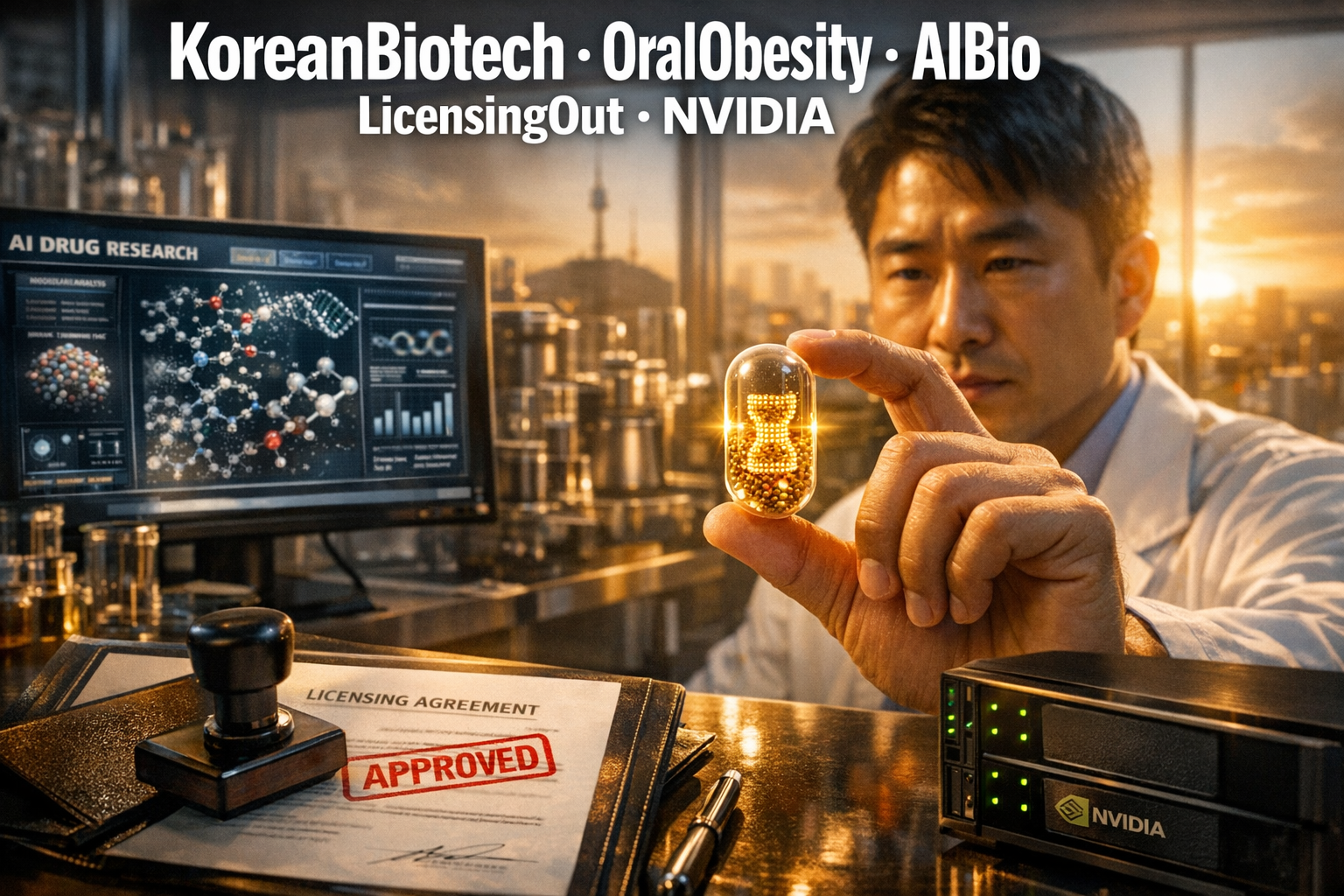
● K-Bio Boom-Real 2026 Jackpot JPMorgan Oral Obesity AI Deals Policy Surge
Not the Same as Before: Why a “Real Opportunity” Has Emerged for K-Bio in 2026 (JPM, Oral Obesity, AI Bio, Policy, Deals)
This report consolidates five items:1) Why Korean biotech has recently risen (three defining characteristics)
2) How to structure a 2026 biotech strategy using “ETF + single names + momentum”
3) The largest 1H event: what changed for Korean biotech at the JPMorgan Healthcare Conference
4) How Korean names gain exposure to oral obesity therapeutics (peptides vs small molecules)
5) Signals that AI bio is transitioning from “theme” to “revenue/deals”
1) News Briefing: “Why Has Korean Biotech Rallied?” Three Core Characteristics
[Characteristic 1] Newly listed companies and names with visible revenue upside led
Recent leadership has come from companies that are recently listed, aligned with global trends, and perceived to have near-term revenue visibility. The market has favored revenue probability over early-stage narratives.
[Characteristic 2] Capital concentrated in companies with credible earnings momentum
With interest rates and liquidity conditions constraining risk appetite, cash flow and operating performance have become more influential. Companies expected to deliver in earnings seasons have outperformed.
[Characteristic 3] Premium valuation for companies with licensing-out expectations or proven execution
Cases such as ABL Bio illustrate that companies with executed licensing-out deals, or high-probability assets suited to large pharma demand, receive premium pricing. The market is shifting from high-variance bets toward higher-probability outcomes.
2) Investor Preference Shift: From “Narrative-Driven” to “Data-Driven” Biotech
Past (10 years ago)
Investors frequently allocated to preclinical or very early pipelines with limited validation.
Current (2026)
Preference has shifted toward companies with:
- A demonstrated licensing-out track record or assets aligned with large pharma demand
- At least entry into clinical stages (preclinical-only risk is increasingly penalized)
- Evidence of revenue growth or narrowing losses (implying a clearer path to breakeven)
This matters because dispersion within biotech is structurally high; security selection risk has increased.
3) 2026 Biotech Strategy: Clear Role Separation Between ETFs and Single Names
Why ETFs are necessary
Biotech leadership can change materially over 5–10 years; “holding only large caps” does not consistently reduce drawdowns. Active ETFs may be structurally advantaged versus passive approaches.
Practical portfolio framework
- ETFs 40–60%: combination of domestic active ETFs and U.S. biotech ETFs
- Single names 40–50%:
- Core/validated names (licensing-out history, pipeline quality, clinical data)
- Momentum names (AI bio, RNA, ADC/XDC, policy beneficiaries, event-driven setups)
Key point: not generic diversification, but explicit role separation—ETFs capture sector beta; single names target event-driven alpha (deals, clinical milestones, policy catalysts).
4) 1H 2026 Korea Biotech Catalysts (Event Calendar)
[January] JPMorgan Healthcare Conference (JPM)
The key change is increased presence through booths and formal presentations rather than attendance alone.
Presented companies: Alteogen, DND Pharmatech, Celltrion, Samsung Biologics, Hugel
Participating/monitor list: Rznomics, Ildong Pharmaceutical, Onconic Therapeutics
[April] AACR (American Association for Cancer Research)
High-volume release of clinical and preclinical results increases volatility while accelerating validation or de-risking.
[June] BIO USA
A concentrated season for business development meetings, often associated with licensing and collaboration announcements.
[Throughout 1H] Earnings seasons + policy momentum
KOSDAQ market support measures and policy initiatives across biotech/AI can materially affect flows.
5) Oral Obesity Therapeutics: The Mechanism by Which Korean Names Gain Exposure
Global trigger
Eli Lilly’s oral obesity candidate (orforglipron) is frequently discussed in the context of potential approval within the year.
Why it matters domestically
Given the market size, capital rotation within the theme is common, extending to companies perceived to have relevant pipelines.
Competitive framing: peptides vs small molecules
- Oral peptide approaches: Novo Nordisk’s oral semaglutide provides a reference case
- Oral small-molecule approaches: Lilly’s orforglipron is referenced as a small-molecule GLP-1
Korean companies frequently cited within the theme (examples)
- DND Pharmatech (oral peptide formulation)
- Ildong Pharmaceutical (oral small-molecule approach)
- Hanmi Pharmaceutical (preclinical assets)
Investment focus is less on a single “winner” between peptide and small molecule and more on the possibility of parallel market expansion driven by adherence, manufacturing, distribution, and safety profiles.
6) 2026 AI Bio Outlook: “NVIDIA + Large Pharma” as an Industrial Anchor
NVIDIA’s third consecutive year at JPM
This signals AI’s integration as infrastructure across drug discovery, clinical development, and biomanufacturing.
Potential updates on NVIDIA–Lilly collaboration
Ongoing collaboration initiated the prior year is viewed as a potential source of updates during the current cycle.
Primary KPI for AI bio: operating leverage, not immediate profitability
Markets often re-rate AI bio when losses narrow and a path to profitability becomes visible. The shift is from thematic valuation to metrics-based validation.
AI bio names frequently monitored (examples)
- Protina: deal formation viewed as a key inflection point
- Seers Technology: revenue/earnings momentum
- Tomocube: cited as comparatively less re-rated within the theme
- Expansion into medical robotics/med-tech within the AI bio umbrella (e.g., Curexo)
Conclusion: AI bio durability increasingly requires a combination of partnerships, revenue, and measurable operating improvement.
7) Four Structural Changes Differentiating Today’s Biotech Cycle
- Higher-tier global counterparties: partnerships increasingly involve top-tier global leaders (e.g., Medtronic)
- More revenue-generating biotech companies: a broader base of companies with visible operating performance
- Licensing-out as a track-record game: prior execution commands premium valuations
- Greater influence of engineering-led talent (physics, chips, equipment, AI): AI bio is expanding into computing- and equipment-linked domains
8) Key Points Often Underemphasized
1) The market is shifting from a liquidity-driven regime to a validation-driven regime
Performance is increasingly differentiated by clinical stage, earnings, partner quality, and deal execution.
2) The primary variable is deal quality, not deal count
The identity and credibility of the counterparty and deal terms can drive markedly different sector-level impacts. During the JPM window, counterparty quality is a central signal.
3) Valuation drivers for AI bio are revenue mechanics, not model demos
AI bio must monetize through B2B structures (large pharma, research institutions, hospitals). Publications and demonstrations are insufficient without repeatable revenue models.
4) In oral obesity, formulation competition is a central investment variable
The market may support multiple modalities; adoption may be determined by adherence, manufacturing scalability, distribution logistics, and safety/tolerability.
9) Macro Linkages (Rates/Policy) and Biotech
Two principal monitoring points:
- Rate-cut expectations: a near-term hold remains possible, with potential cuts discussed later in the year
- Policy support: government-backed sectors are viewed as having relatively higher probability of translating into revenue opportunity
Biotech sensitivity increases when discount-rate relief and policy-driven capital direction align. As a result, macro variables such as rates, FX, KOSPI, NASDAQ, and semiconductors can remain intertwined with biotech flows.
< Summary >
Korean biotech is transitioning toward a validation-driven market structure, centered on new listings with revenue visibility, operating performance, and licensing-out track records. In 1H 2026, catalysts are dense—JPM (including AI bio), followed by AACR and BIO USA—while policy momentum may further influence flows. Oral obesity (peptide vs small molecule) and AI bio (revenue, narrowing losses, and deal activity) are key tracks. A role-separated portfolio approach—active ETFs for sector exposure and single names for deal/clinical/policy-driven excess return—appears structurally suited to the current regime.
[Related Links…]
- K-Bio Momentum Overview by Event: JPM, AACR, BIO USA Scheduling and Investment Focus
https://NextGenInsight.net?s=bio - AI Bio 2026: Implications of NVIDIA Participation for Drug Development Industry Structure
https://NextGenInsight.net?s=AI
*Source: [ Jun’s economy lab ]
– 그때와 다릅니다 K바이오에 큰 기회가 왔습니다(ft.강하나 대표 2부)● Big-Tech Power Panic, Gas-Turbine Nuclear Pivot, 2026-2027 Mega-Trend
Why Big Tech Is Pivoting to “Gas Turbines + Nuclear”: The 2026–2027 Megatrend Evident in Both Doosan Enerbility and LG Energy Solution
The market is currently driven by two core factors.
First, surging AI data center electricity demand is aligning nuclear (SMRs) and gas turbines (gas-fired generation) into a complementary portfolio.
Second, as the EV cycle becomes less reliable, battery earnings potential increasingly shifts from EVs to ESS (energy storage systems).
This report consolidates: (1) why a Trump-driven nuclear push extends beyond a single name, (2) the underlying reasons Big Tech is prioritizing gas turbines, (3) how to approach security selection across the Doosan value chain, (4) why the thesis remains intact despite LG Energy Solution’s KRW 13 trillion contract-related issue, and (5) key variables often underemphasized (grid constraints, gas, and CAPEX timing mismatches).
1) News Briefing: Reframing the Comments as Market Events
[Power/AI] AI CAPEX cycles are short and volatile, while nuclear projects operate on materially longer timelines.
As AI-driven data center expansion turns electricity into a binding constraint, the most actionable response is emerging as a gas turbine solution (fast deployment) paired with SMRs (long-term low-carbon baseload).
[Big Tech] Microsoft, Meta, and Google show increasing interest in gas turbines.
For data centers, certainty of supply is becoming more critical than marginal power pricing, strengthening incentives for private procurement of generation assets, fuel contracts, and long-duration power arrangements structurally similar to long-term PPAs.
[Korea] Doosan Enerbility is discussed as a candidate for KRW 8 trillion+ revenue in 2026, with re-rating potential under an “SMR + gas turbine” value-chain framework.
The relevant chain extends beyond a “nuclear theme” to include data center power shortages → incremental gas capacity → turbines, maintenance, parts, and service.
[Batteries] LG Energy Solution may see faster growth in ESS mix than in EVs, with potential for step-change expansion in ESS revenue.
When EV demand slows and pricing competition intensifies, batteries can build an alternative growth curve through ESS linked to policy support, grid investment, and data center load.
2) Macro Framework: A New Winner Structure Driven by the “AI Power Shock”
A key global variable is AI data center electricity demand.
This is not solely an IT issue; it is increasingly determinative for energy, infrastructure, and industrial earnings.
Why SMRs and gas turbines are being paired
Nuclear—particularly SMRs—offers low-carbon, stable baseload, but requires extended permitting, construction, and commissioning timelines.
Gas turbines can be deployed more rapidly and match data centers’ priority: near-term, reliable power availability.
The market is therefore positioning gas turbines for the near term and SMRs for the medium-to-long term, with parallel investment pathways.
Rate and inflation linkages
Rising power-infrastructure investment can reintroduce cost pressures (cost of capital, fuel, labor) with implications for inflation and interest-rate paths.
Monitoring the chain power CAPEX → inflation pressure → rates is increasingly important alongside AI growth indicators.
3) Doosan Enerbility: Risks of Viewing It Only as a “Nuclear Theme”
The key issue is not directional price movement, but whether Big Tech power demand expands the addressable Doosan-linked value chain.
1) SMRs: Benefit via long-cycle orders and policy support
Political catalysts can expand the project pipeline, but SMRs remain long-duration.
Focus areas are order backlog, partnerships, and supply-chain positioning rather than near-term earnings.
2) Gas turbines: Demand acceleration in the near term
Data centers typically cannot wait for power delivered on multi-year timelines.
Gas turbines re-emerge as the pragmatic near-term option, where value can accrue not only from equipment but also from MRO, parts, and long-duration service revenue as recurring cash-flow drivers.
3) Framework for “Doosan group” exposure
An approach referenced is prioritizing a Doosan preferred share as a way to maintain nuclear exposure while buffering project-level volatility through group-level assets and cash flows.
Security selection should still incorporate dividend profile, liquidity, volatility, and discount-rate sensitivity.
4) LG Energy Solution: Structural Shift Matters More Than the “KRW 13 Trillion Contract Issue”
The battery market can be summarized as follows.
EV demand can soften, but grid reliability requirements are non-discretionary.
1) Mix shift from EV to ESS
EV demand is highly sensitive to rates, subsidies, and competitive pricing pressure.
ESS demand is supported by grid stabilization needs, renewable intermittency management, and data center power-quality requirements (UPS, peak shaving).
ESS can therefore function as both a defensive earnings lever and a growth option when EV momentum slows.
2) Why ESS revenue can scale rapidly
Once adoption accelerates, ESS tends to follow a cycle of initial installs → expansions → replacements.
AI data center growth increases sensitivity to power quality and transient load stability, reinforcing ESS relevance.
3) Key diligence point: ESS profitability, not volume, is decisive
Margins depend on safety performance, BMS competitiveness, and long-term warranty terms.
Assessment should extend beyond “ESS growth” headlines to whether safety, warranty structures, and project economics are improving.
5) Underemphasized Variables with High Explanatory Power
Across nuclear, gas turbines, and ESS, outcomes are frequently determined less by technology and more by timing mismatches.
Key 1) Data center CAPEX and power-infrastructure CAPEX move at different speeds
AI infrastructure investment decisions can shift quarterly, while generation, transmission, and permitting evolve on annual timelines.
This mismatch sustains power scarcity and supports premiums for “immediate solutions” such as gas turbines and ESS.
Key 2) For nuclear, the binding constraint may be supply chain, not policy
Even with policy acceleration, bottlenecks can arise in large forgings, specialty materials, quality certification, and skilled labor.
Benefits may concentrate in firms controlling supply-chain choke points rather than broadly across “nuclear” exposure.
Key 3) Gas turbine re-rating depends on fuel and contract structure
While gas generation faces decarbonization scrutiny, near-term power availability is driving decisions.
Differentiation often arises less from the turbine itself and more from fuel procurement, long-term service agreements (LTSAs), and the maintenance ecosystem.
Key 4) ESS is not solely a battery-cell business
ESS projects require an integrated stack: cells plus PCS (power conversion), EMS (energy management), EPC/operations, and insurance/certification.
Evaluation should consider which participants can deliver near-turnkey solutions within grid and data-center projects.
6) 2026–2027 Investor Checklist (Action-Oriented)
[Doosan Enerbility / Nuclear and Gas Turbine Exposure]
– How order backlog mix shifts toward “SMR / gas turbines”
– Whether gas turbine service and maintenance revenue share increases
– Evidence of direct or indirect references with Big Tech or utilities
[LG Energy Solution / ESS Exposure]
– ESS revenue mix and pace of regional expansion (North America / Europe / Korea)
– Safety and warranty-term trends (recalls, provisions, and risk containment)
– Whether the pipeline thickens alongside grid CAPEX expansion
[Macro / Global Indicators]
– Durability of AI infrastructure investment (Big Tech earnings and CAPEX guidance)
– Inflation and rate implications of incremental power-infrastructure CAPEX
– Direction of policy catalysts (energy security, carbon regulation, subsidies)
< Summary >
Explosive AI data center power demand is making “gas turbines (near term) + SMR nuclear (medium-to-long term)” a mainstream buildout framework.
Doosan Enerbility should be assessed beyond a nuclear narrative, including gas turbines and service as an expanded power value-chain exposure.
LG Energy Solution can reshape its growth path via ESS even amid EV softness; the key variables are profitability and risk control, not shipment volume alone.
Underemphasized determinants are primarily timing and structure: CAPEX speed mismatches, supply-chain bottlenecks, and fuel/long-term contracting frameworks.
[Related Articles…]
- SMR Investment Flows and Key Checks Across the Korean Supply Chain
- Rapid ESS Market Expansion: How It Translates into Battery Company Earnings
*Source: [ 달란트투자 ]
– 빅테크 업계에 싹다 퍼졌다. 두산에너에 대한 충격 소문 | 김지훈 대표 2부
● Maduro Bust Oil Crash Inflation Squeeze Trump Midterm Plot Tesla Meta Broadcom Rocket Lab Oracle Watchlist
Maduro Arrest “Spectacle” to Curb Inflation? Trump’s Midterm Macro Blueprint + U.S. Equity Watchlist for Next Week (TSLA, META, AVGO, RKLB, ORCL, etc.)
This report consolidates three items:
1) A Trump-style inflation-management scenario: “Venezuela (Maduro) issue → oil prices decline → reduced inflation pressure.”
2) A midterm-focused macro framework combining shelter costs (a core CPI driver) and defense spending (policy-driven investment).
3) A market checklist using S&P 500 E-mini futures for trend confirmation, plus key price levels for TSLA, META, AVGO, RKLB, ASTS, MSTR, SNDK, LAC, and ORCL.
1) [Global Macro Briefing] The Logic Behind “Arresting Maduro Controls Inflation?”
1-1. Core framing: Inflation as a political constraint
The underlying argument is:
- Trump’s policy toolkit includes inflationary levers (tariffs, fiscal expansion, higher defense spending).
- As a result, the framework assumes a heightened need to pursue offsetting measures that suppress inflation.
- Inflation is treated less as a purely economic variable and more as a political approval indicator.
1-2. Venezuela variable: Oil control as a lever to push prices lower
The thesis emphasizes a scenario in which the U.S. seeks to influence Venezuelan oil output and flows:
- The intent is framed not as “conflict raises oil,” but as policy intervention aimed at lowering oil prices.
- Venezuelan crude is heavier/lower-grade and requires refining capacity, infrastructure, and operational restarts.
- If U.S. majors (e.g., Chevron, Exxon Mobil) participate, production recovery and supply expansion could increase.
- Higher supply would create downside pressure on oil prices, potentially easing inflation.
1-3. References to additional targets (Iran/Cuba/Mexico/Colombia): political signaling and volatility management
Mentions of potential “next targets,” including military options, are interpreted as:
- Not a definitive forecast of war, but an acknowledgment that geopolitical risk can raise oil/CPI volatility.
- In such regimes, the incentive to pre-emptively manage oil and CPI may strengthen.
2) [U.S. Inflation Management Levers] Oil + Shelter + “Perceived” Cost of Living
2-1. Oil price declines: the fastest CPI handle
- Energy prices transmit quickly into CPI.
- Lower oil prices reduce cost expectations across transport, logistics, and production.
- This can support market narratives around disinflation and provide policy cover for a dovish Fed stance.
2-2. Shelter disinflation: targeting the heaviest CPI component
A key focus is policy proposals such as restricting institutional home purchases:
- Shelter has a large CPI weight and persistent impact on perceived inflation.
- Containing shelter inflation can materially improve headline narratives around “inflation under control.”
- The mechanism is both economic and electoral.
2-3. Tariffs are structurally inflationary; offsetting measures become necessary
- Tariffs can raise supply-chain costs and lead to consumer price pass-through.
- The framework therefore assumes simultaneous pressure on oil and shelter to maintain net inflation neutrality.
3) [Defense and Industrial Policy] Limiting dividends/buybacks in defense: signaling enforced reinvestment
3-1. Rationale for restricting dividends and buybacks
The proposal is interpreted as:
- Constraining cash returns to shareholders and redirecting capital toward capacity expansion.
- A message that defense production capability will be managed more directly as a national priority.
3-2. Market implication: defense spending as a capacity cycle, not a one-off event
- Higher defense budgets can trigger multi-year capex and throughput expansion.
- Key variables may shift from near-term earnings toward production capacity, delivery schedules, supply chains, input costs, and labor availability.
4) [How to Read Labor Data] Why initial jobless claims may matter more than the unemployment rate
4-1. Why payroll survey prints remain contentious
- Sampling and survey-reliability debates persist.
- Markets often react inconsistently to the same type of surprise.
4-2. Advantages of initial jobless claims
- Claims require an actual application, reducing certain survey distortions.
- A meaningful acceleration could signal broader white-collar or higher-income layoffs.
4-3. Current regime interpretation
- Job growth is slowing, but claims have not spiked materially.
- Lower- and mid-income workers may substitute into gig/platform work, limiting claims pressure.
- A key risk signal would be a sustained surge in claims driven by higher-income layoffs.
5) [Market Checkpoint] Trend framework using S&P 500 E-mini futures
5-1. Index level: 6,900 as a key risk regime threshold
- Above 6,900: reduces immediate systemic risk concerns.
- Below 6,900: increases probability that drawdowns reflect broader risk-off conditions rather than idiosyncratic stock factors.
5-2. Regime characteristics: concentration and thin liquidity
- Index resilience can coexist with weak performance in many individual names.
- If the index holds, declines in fundamentally intact stocks may reflect market structure rather than company-specific deterioration.
6) [Next-Week Equity Watchlist] Price-level driven monitoring
6-1. TSLA (Tesla): failure to negate an “island” structure keeps near-term risk elevated
- Key support: ~439.
- Sentiment stabilization may require a sustained move above ~470.
6-2. AVGO (Broadcom): 330 support is the primary level
- Repeated tests can indicate basing, but also weaken support credibility.
- Near-term resistance/target: ~355–360.
- Priority: defend ~330.
6-3. RKLB (Rocket Lab): monitor flow rather than chase
- Prior accumulation zone referenced: ~50–55.
- After sharp upside moves, emphasis shifts to index trend and pullback quality rather than momentum chasing.
6-4. ASTS (AST SpaceMobile): prior highs as automatic resistance
- ~102–103 acts as structural resistance (all-time high area).
- A breakout could open ~115–120.
6-5. MSTR (Strategy): a low-signal must not be invalidated by renewed weakness
- If a bottom signal appears, follow-through is required.
- Key risk level: below ~143–140.
6-6. SNDK (SanDisk): overbought technically; theme flow can override charts
- Chart-based pullback risk is elevated.
- Preference: avoid chasing (e.g., mid-350s); consider waiting for supply zones (e.g., low-320s).
- If index trend remains constructive, upside extension toward ~400 cannot be excluded.
6-7. LAC (Lithium Americas): buy at supply zones, then confirm with volume
- Supply zone: ~4.7–4.75.
- Volume is the primary confirmation variable; without it, upside expectations weaken materially.
6-8. ORCL (Oracle): 175 is the key downside line; upside reference 210
- A sustained break below ~175 increases downside risk.
- If defended, rebound potential remains; upside reference: ~210.
6-9. META (Meta): post-death-cross, “holding” is insufficient without recovery
- If price stays below the 50-day moving average, downward drift along the moving average can persist.
- Near-term rebound reference: ~660.
- Stabilization improves if ~670 is reclaimed and held.
7) Key Takeaways Often Underemphasized
7-1. Priority may be CPI optics rather than broad real-economy relief
- Policy focus may target high-weight CPI components (oil, shelter) to stabilize the reported inflation profile.
7-2. Restricting institutional home purchases links to equity valuation support
- Lower shelter inflation can reduce inflation expectations and stabilize rate paths.
- This is generally supportive of growth-equity valuation frameworks.
7-3. Defense payout restrictions signal broader political risk to capital allocation
- A precedent in “strategic industries” could expand to other sectors.
- This introduces policy risk to dividends/buybacks as capital-allocation tools.
8) Action Checklist for This Week / Next Week
1) S&P 500 E-mini futures: use 6,900 as a risk-on/risk-off regime check.
2) Oil: focus less on headlines and more on actionable supply expansion/control measures.
3) CPI framing: shelter-related regulatory/policy headlines may trigger outsized market reactions.
4) Labor: prioritize the direction of initial jobless claims over the unemployment-rate headline.
5) Single-name monitoring: emphasize “price + volume”; for LAC-type setups, volume is a first-order signal.
< Summary >
- The macro framework treats inflation as a political constraint, emphasizing the suppression of high-weight CPI components such as oil and shelter.
- The Venezuela angle is interpreted as a potential supply-side lever to pressure oil prices through production and refining value-chain reactivation.
- Limits on institutional home buying may transmit into equity valuations via lower inflation expectations and a more stable rate path.
- Restricting defense-sector dividends/buybacks signals enforced reinvestment and increases policy risk around corporate capital allocation.
- Next-week positioning centers on the S&P 500 E-mini 6,900 threshold and key levels: TSLA (470), AVGO (330), ASTS (102–103), ORCL (175), META (670).
[Related Links…]
- U.S. inflation and rate outlook: what markets focus on after CPI (NextGenInsight.net?s=inflation)
- Tesla equity outlook: flow/technical levels that matter more than earnings (NextGenInsight.net?s=tesla)
*Source: [ 미국주식은 훌륭하다-미국주식대장 ]
– 마두로를 체포했더니 인플레가 잡힌다? 트럼프의 중간 선거 큰 그림, 다음주 준비할 종목.테슬라 메타 로켓랩 오라클 브로드컴 ASTS MSTR SNDK LAC 오라클