● Tesla Roulette CPI Shock Self-Driving Act Showdown World Cup Deadline
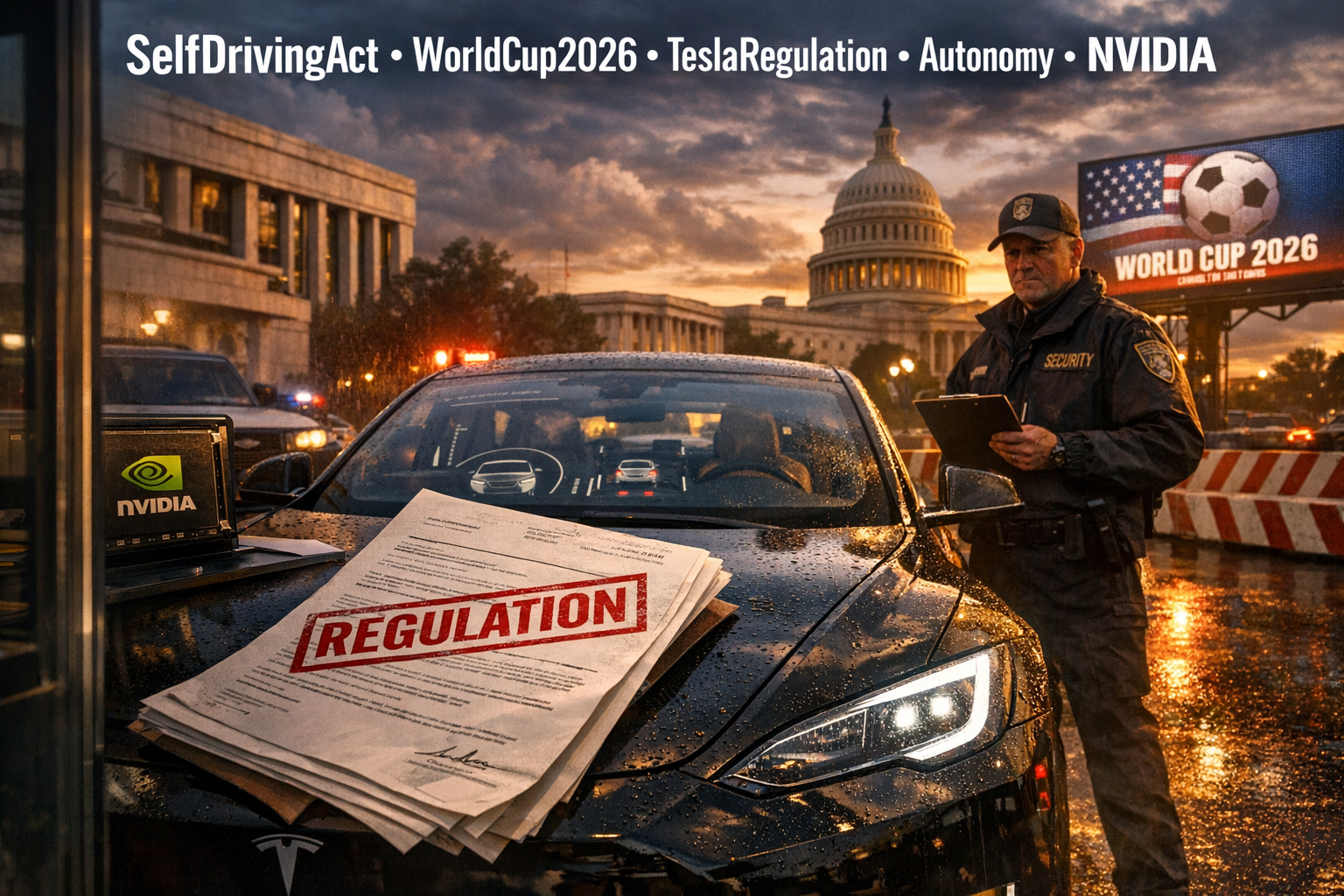
Will U.S. Autonomous-Driving Regulation for Tesla “Actually” Open Up on Jan 13, 2026? A Consolidated Brief Covering CPI, Jobs, Legislation, and the World Cup Deadline
This report consolidates four elements:1) Why the 1/13 CPI directly affects Tesla (EV demand and installment/lease rates) as a downside risk or tailwind
2) Whether the “Self-Driving Act 2026” could stall again as in 2017, and why the passage probability may differ this time
3) How the 2026 World Cup (June 2026) functions as a “physical deadline” that can accelerate legislation
4) The core competition: NVIDIA’s simulation stack vs. Tesla’s real-world driving data (10B miles)
1) Key Schedule (Starting 1/13): Macro Data and Policy Catalysts Converge
1-1. January 13 CPI: The installment-rate barometer that drives EV demand
Market expectations are approximately 2.7% YoY headline CPI (core also expected around +0.3% MoM). The market impact is less about the absolute print and more about whether rate expectations shift.
Tesla sells vehicles, and vehicle purchases are typically financed (installments/leasing). Disinflation can translate into rate-cut expectations, lowering monthly payments and supporting EV demand.
Conversely, an upside CPI surprise can lift Treasury yields (especially longer duration), pressure growth-equity multiples, and tighten financing conditions.
Accordingly, the 1/13 CPI is both a near-term volatility driver and a macro signal for consumer conditions into 1H 2026.
1-2. Thursday labor (jobless claims) + manufacturing data: A “Goldilocks” outcome is preferred
If unemployment is too low (overheating), the Fed may delay easing. If unemployment rises too quickly (recession risk), risk assets can reprice lower.
The market’s preferred scenario is a controlled slowdown. Improving manufacturing indicators (e.g., regional Fed surveys) can reinforce a “manufacturing trough” narrative, supportive for sentiment toward manufacturers including Tesla.
2) Primary Catalyst: Why the “Self-Driving Act 2026” Draft Could Define Tesla’s Next Decade
2-1. Why the 2017 AV START Act failed in the Senate: Three structural blockers
The 2017 failure is commonly attributed to:(1) Transportation unions (Teamsters): job-displacement pressure
(2) Trial-lawyer groups (AAJ): lobbying for liability structures that increase manufacturer exposure
(3) Senate procedural resistance and safety framing (notably associated with senior lawmakers): effectively preventing advancement
House passage was insufficient; Senate political incentives, liability design, and procedure jointly halted the bill.
2-2. What is different in 2026: The frame shifts from “safety” to “national competitiveness”
The framing has evolved:Past (2017): “Autonomous driving is risky; require more validation.”
Current (2026): “Should regulation constrain domestic firms while China advances?”
Regulatory enablement is increasingly treated as industrial policy and technology leadership. This connects to supply-chain strategy, advanced-industry policy, and post-election policy direction, increasing investor sensitivity.
2-3. The significance of a pro-legislation posture from Senate leadership figures
A notable signal is that lawmakers historically aligned with internal-combustion and ethanol-linked constituencies have engaged more constructively with Tesla-adjacent themes.
This suggests autonomous driving and AI may be moving from narrow industry lobbying into a category of industries the U.S. is willing to support. Passage remains contingent on bill text details (production caps, liability allocation, and exemption/approval pathways).
3) Underappreciated Driver: The June 2026 World Cup as a Regulatory Deadline
3-1. Why the World Cup can pull forward autonomous-vehicle legislation
The U.S.-Canada-Mexico World Cup is a large-scale transportation stress test.
Rideshare capacity alone may be insufficient for peak demand. Robotaxis deployed first on structured routes (airport and stadium shuttles) can serve as a high-visibility proof point.
For this to occur, a timeline is required: draft in January → passage in 1H → operational deployment by June.
3-2. Tesla’s primary benefit: Proof of scalable legality, not near-term revenue
Near-term revenue matters, but the larger impact is demonstrating a regulatory regime shift.
Once permitted, city-by-city and state-by-state expansion can accelerate, creating platform-like network effects.
4) The Core Product Question: Whether Cybercab Can Remove the Steering Wheel Depends on Legislative Detail
4-1. Current regulation produces design distortions: prototypes retain steering wheels by necessity
A Cybercab sighting with a steering wheel is not incidental.
Under current federal safety standards, vehicles without steering wheels/pedals face significant barriers to on-road authorization, and annual production limits (cited as 2,500 units) can create bottlenecks.
As a result, Tesla has incentives to accumulate data using steering-equipped configurations, while passage could materially change the product definition and vehicle design constraints.
4-2. What investors should look for in the 1/13 draft language
Broad “regulatory easing” headlines are insufficient; valuation and feasibility depend on bill specifics, particularly:(1) Certification pathway for steering/pedal-less vehicles (exemption vs standard certification)
(2) Annual production cap (magnitude and phase-in)
(3) Crash liability structure (allocation among manufacturer, operator, and software provider)
5) The Technology Competition: Tesla “10B Miles” vs NVIDIA Simulation (“AlphaMayo”)—What Matters
5-1. Tesla’s 10B-mile framing: A timeline driven by data velocity, not a completion claim
Tesla has cited cumulative FSD miles near 7.2B, with daily increases around 14M miles, implying a potential 10B-mile milestone around July 2026.
The strategic claim is that autonomy is not only algorithms but also exposure to real-world long-tail edge cases, and the rate of real-world learning becomes a competitive lever.
5-2. NVIDIA’s positioning: Enabling “you can do this too” to expand the chip ecosystem
NVIDIA’s CES autonomous-driving stack messaging is also a go-to-market strategy.
If legacy OEMs view autonomy as “Tesla-only,” they may reduce investment. NVIDIA’s thesis is that simulation and synthetic data can narrow the gap, encouraging broader platform adoption.
5-3. A key risk often underemphasized: OEMs retain end-liability and brand risk
Even with advanced simulation, public-road incidents translate into political, regulatory, and litigation risk borne primarily by the company that sells and/or operates the vehicle.
NVIDIA can supply tooling, but OEMs and fleet operators typically carry final responsibility. Market outcomes may therefore hinge less on demonstrations and more on who can implement a liability-tolerant operating model under real regulatory scrutiny.
6) Market Framing: Direction Matters Less Than Speed and Wording
Bull cases emphasize regulatory easing as a catalyst for an AI/autonomy cycle and potential target upgrades. Cautious views argue that pricing power remains constrained until bill details are confirmed.
A shared conclusion is that the market increasingly treats the direction as set, while 1/13 is positioned as a pace-setting event.
7) Key Takeaways (News-Style)
- The 1/13 CPI is the first near-term gate, moving rate sensitivity that affects Tesla demand and valuation.
- The larger 1H 2026 variable is the “Self-Driving Act 2026” draft language.
- The 2017 blockers (unions, liability risk, Senate procedure) are perceived as weaker in 2026.
- The June 2026 World Cup can function as a deadline that accelerates legislative timing.
- Certification for steering/pedal-less vehicles, production caps, and liability allocation will determine robotaxi economics.
- NVIDIA’s simulation stack supports ecosystem expansion, but accident liability remains with OEMs and operators.
The Single Most Important Line
The core issue is not whether autonomy is technically feasible, but who will be permitted to operate steering wheel-less vehicles, under what liability structure, and at scale during a high-profile event such as the World Cup.
< Summary >
The 1/13 CPI is a near-term event that moves rate expectations, influencing Tesla demand and valuation.
The larger variable is the 1/13 release of the “Self-Driving Act 2026” draft; compared with 2017, the political frame has shifted from safety-first to U.S.-China technology competitiveness.
The June 2026 World Cup may impose a deployment deadline that accelerates legislative progress, while the decisive details are certification pathways for steering/pedal-less vehicles, production caps, and accident liability allocation.
[Related Articles…]
- https://NextGenInsight.net?s=CPI
- https://NextGenInsight.net?s=Autonomous%20Driving
*Source: [ 오늘의 테슬라 뉴스 ]
– 2026년 1월 13일, 테슬라를 막아왔던 자율주행 규제의 문이 움직이나?
● Trump Blitz Iran Unrest Oil Shock Inflation Spike AI Stocks Whiplash
From Venezuela to Iran to Cuba to Greenland: Four Market Signals from “Trump’s Sprint” (Oil, Inflation, U.S. Elections, and AI Equities)
This note consolidates four items for investors.
1) How crude oil and inflation typically respond when protests in Iran evolve into regime-risk dynamics
2) The strategic intent behind a “multi-target, single-strike” approach spanning Venezuela, Iran, Cuba, and Greenland
3) The transmission channels into the U.S. macro outlook (rates, inflation) and U.S. equities (energy, defense, AI)
4) A frequently under-discussed driver: how satellite internet (e.g., Starlink) and information warfare are reshaping geopolitics
1) News Briefing: Reframed Through a Market Lens
1-1. Iran: Escalating Protests + Communications Blackouts + Signals of External Involvement
The source emphasizes that domestic unrest in Iran has expanded beyond universities into constituencies historically associated with the post-1979 order.
Surging prices and FX instability are highlighted as key catalysts, while casualty estimates vary materially across reports, indicating elevated uncertainty.
Authorities have restricted internet and communications; Starlink is referenced as a focal point for connectivity bypass.
Trump stated publicly that Iran “wants freedom” and that the U.S. is prepared to help, implying a willingness to support involvement.
The source cites foreign media suggesting military options, including against non-military facilities, are being considered.
1-2. Cuba: Pressure to Disrupt Venezuela–Cuba Oil and Security Linkages
Trump frames Cuba as receiving oil and funding from Venezuela in exchange for providing security services that support the Venezuelan regime.
The stated posture is escalating pressure to curtail those flows and push toward negotiation under time constraints.
1-3. Venezuela: “Mission Accomplished” Framing to Build a Domestic Success Narrative
The source presents the “arrest of Maduro” as a given and links it to indications of a modest post-event rebound in Trump’s approval.
For markets, the key point is less the assertion itself than the use of “achievement storytelling” as a domestic political tool.
1-4. Greenland: Bundling Resources, Shipping Lanes, and Security
Greenland is positioned as a package of energy/resources, military/security considerations, and expanded influence.
2) Strategic Objectives: Three Buckets
2-1. Domestic Politics (Elections): A “Consecutive Wins” Narrative to Stabilize Support
The source treats the broader approach as inseparable from the election cycle.
A hawkish foreign-policy posture can consolidate core supporters, and a moral framing (“rolling back authoritarian/communist/clergy-led regimes”) can reduce persuasion costs.
If oil prices stabilize, headline inflation pressure may ease, improving the political backdrop given the electoral sensitivity to inflation.
2-2. Macro Policy: Using Oil as a Political-Economic Lever
Iran is a core node of Middle East risk; even incremental escalation signals can move oil prices.
Higher oil prices can re-ignite U.S. inflation concerns and shift expectations for the policy-rate path.
This creates a transmission chain: geopolitics → energy → inflation → rates → equity and bond valuation.
Two broad strategic outcomes are implied.
(1) Positioning as a leader who “manages risk,” compressing oil prices and easing inflation
(2) Accepting a short-term shock while attributing it externally to strengthen the case for harder measures
2-3. Power and Technology: Treating Information Infrastructure as a Form of Military Capability
The Starlink reference is a central signal.
Historically, shutting down the internet degraded protest organization; satellite internet can sustain connectivity via infrastructure outside national control.
This is not merely a communications issue; it can affect regime durability.
3) Investor Lens: Market Transmission Checklist
3-1. Oil: The Primary Trigger Is Often Uncertainty Premium, Not Full-Scale War
Markets frequently price supply-disruption risk, insurance costs, freight, and risk premia ahead of kinetic escalation.
As a result, brief public statements can move futures pricing before any confirmed policy action.
3-2. Inflation: Energy Shocks Can Be More Destabilizing Than Services Inflation
Energy prices can shift inflation expectations quickly.
Firms attempt pass-through, while consumers adjust spending behavior as perceived cost of living rises.
If inflation re-accelerates, rate-cut expectations may retrench, pressuring growth-equity valuations via a higher discount rate.
3-3. U.S. Equities: The Same Headline Produces Divergent Sector Effects
– Energy: potential near-term benefit if oil-price expectations rise
– Defense: heightened geopolitical tension can support expectations for orders and budget expansion
– Big Tech/AI: rate repricing can raise volatility; however, expanded information and data conflict can also reinforce long-term demand for AI infrastructure
3-4. Crypto (Bitcoin/Ethereum): Not Fully Explained by “Risk-On”
The inclusion of crypto themes reflects an additional narrative channel: capital controls, remittances, and censorship resistance.
When communications restrictions coincide with capital constraints, crypto can be framed locally as a payments and value-transfer mechanism.
4) Key Points Often Underweighted in Mainstream Coverage
4-1. The Core Battlefield Is Connectivity, Not Conventional Firepower
Repeated internet shutdowns increase the strategic value of satellite connectivity.
Control of communications infrastructure becomes a variable in regime stability.
4-2. Messaging Often Impacts Price Before Policy
Formal policy execution requires time and coordination; markets can move immediately on framing and expectations.
Investors should monitor narrative formation, not only confirmed facts.
4-3. Oil Stability Is a Key Input to the Federal Reserve Path, Not Only CPI
Oil-price stability can support disinflation expectations, reduce rate pressure, and lower the equity discount rate.
Accordingly, this is a U.S. macro variable, not merely a regional headline.
4-4. Cuba and Venezuela Function as an Integrated “Energy + Security Services” Network
Targeting Cuba is framed as more effective than single-country pressure because it disrupts the network.
Separating oil-derived cash flow from regime security capacity can reduce regime endurance.
5) Three Practical Scenarios
5-1. (De-escalation) Hawkish Rhetoric Converges Toward Negotiation and Pressure
Oil volatility declines; inflation concerns ease.
Risk appetite can recover, supporting equities.
5-2. (Volatility) No Direct Clash, but Uncertainty Intensifies
Oil retains a risk premium; rate expectations become unstable; U.S. equity volatility increases.
This environment is operationally challenging for investors.
5-3. (Shock) Limited Military Action and Retaliation
Near-term risk includes oil spikes and broad risk-asset drawdowns.
Historically, relief rallies can follow once outcomes appear contained; risk management via stops, cash levels, and hedges becomes central.
6) Investor Monitoring Points (Operational)
1) Brent/WTI futures gap behavior (identify overreaction to headlines)
2) U.S. breakeven inflation (BEI) trend (whether expectations re-accelerate)
3) Market-implied probability of Fed rate cuts (rate-narrative shifts)
4) Relative strength in defense and energy (first-order beneficiaries)
5) Nasdaq volatility (AI/Big Tech sensitivity to rates)
6) Expansion of communications blackouts and satellite internet references (intensification of information-war conditions)
< Summary >
The pressure applied across Venezuela, Iran, Cuba, and Greenland is framed as a combined strategy linking domestic politics, oil-price management, and great-power competition.
Escalating unrest and communications restrictions in Iran underscore that satellite internet can function as a regime-stability variable.
Geopolitical risk can reprice oil, transmit into inflation and rate expectations, and amplify volatility in U.S. equities via the discount-rate channel.
[Related Articles…]
- International Oil Price Volatility: Implications for Inflation and Rates
- AI Infrastructure Investment Cycle: Potential Beneficiaries Beyond Nvidia
*Source: [ Maeil Business Newspaper ]
– [홍장원의 불앤베어] 베네수엘라 이어 이란, 쿠바 그린랜드까지…. 질주하는 트럼프의 노림수는