● Korea Sweeps CES 2026, Startup Surge, AI Sensor Boom, 4D Radar Shakeup, Health Toilet Disruption, Robot Pet Gold Rush
CES 2026 ‘Innovation Awards Showcase’: Highlighting Profitable Trends – A Comprehensive Overview from South Korea’s 206 Wins to 4D Radar, Health Toilets, AI Homes, and Senior Robot Pets
This article covers four key points. First, we categorized by product group what products received awards at the CES 2026 Innovation Awards Showcase operated by CTA, the most attended exhibition. Second, we interpreted why 206 wins out of 347 by Korean companies signal a ‘structural change in the industry’, emphasizing the importance of the fact that over 70% of the awards went to SMEs and startups rather than large corporations. Third, we tied recurring keywords from the exhibition (sensors+AI+health+robots+smart home) to market implications (interest rates, supply chains, investment). Fourth, we identified the “storytelling formula” that tends to succeed in innovation award judging, highlighting key points for our companies to prepare for in the upcoming years.
1) One-line News from CES 2026 Innovation Awards Showcase
The ‘Innovation Awards Showcase’ operated by the Consumer Technology Association (CTA) is an exhibition hall that gathers innovation award winners in one place, making it the quickest way to grasp “what’s hot” at CES.
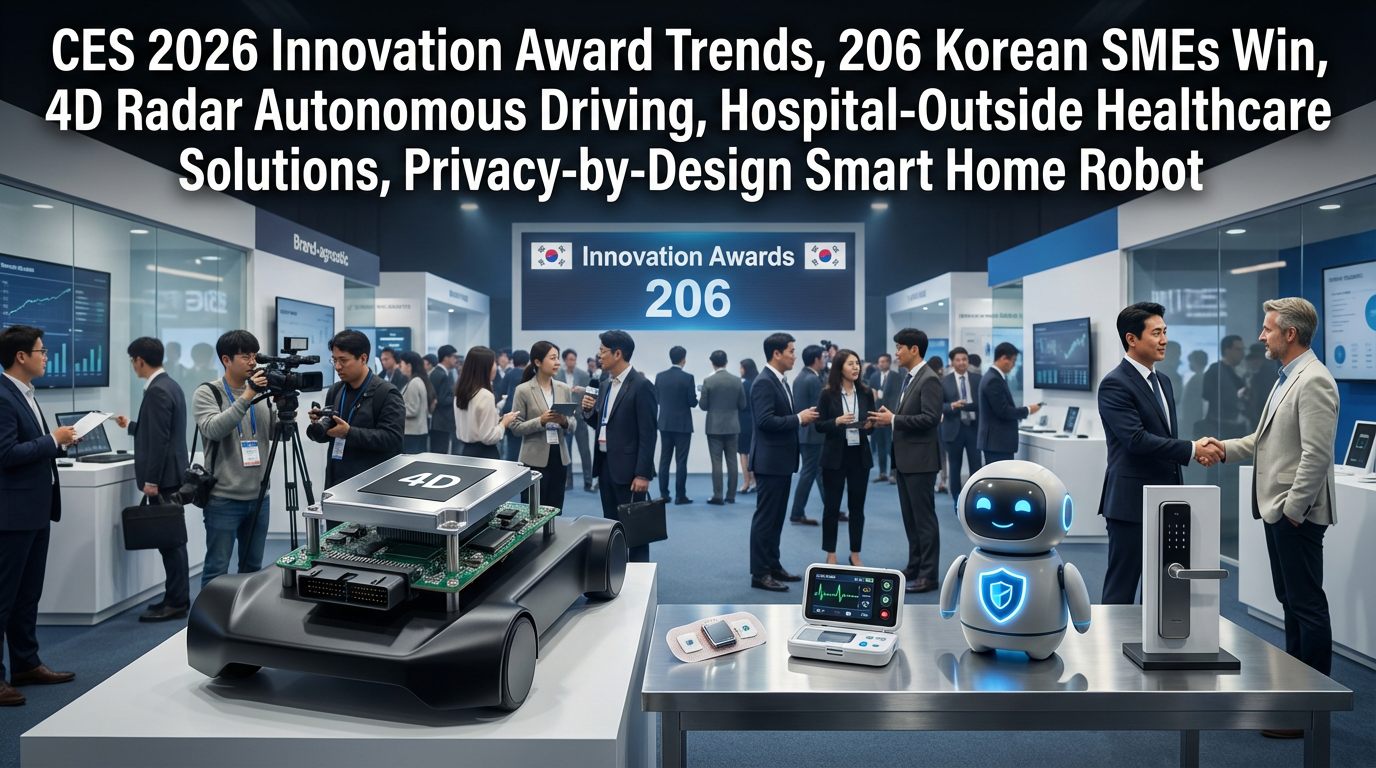
At CES 2026, Korean companies won 206 out of 347 innovation awards. Moreover, over 70% of these awards were claimed by SMEs and startups, which is not merely a point of national pride but a signal that “technology trends are shifting from standalone hardware competition by large corporations to problem-solving product-service combinations.”
2) Five ‘Core Codes’ Observed at the Exhibition (Common Denominators Across Fields)
There were five clear core codes that permeated this showcase.
1) “Solving human pain points” can secure an award even if technical difficulty is not high.
2) The structure from sensor data → AI inference → automation (or notification) has become the default.
3) Healthcare is expanding outside hospitals (bathrooms, pads, insoles, wearables, public spaces).
4) Robots are focused on reducing operational costs in areas like water management, delivery, and caregiving rather than showcasing “fancy demos.”
5) Smart home/smart city concepts are integrating cameras, radar, and satellites, with privacy design emerging as a competitive edge.
These trends connect with the macro environment (interest rate fluctuations, global supply chain, inflationary pressures) as companies prefer “solutions that start small and quickly improve operation efficiency” over “large CAPEX investments.”
3) Core Items by Product Category at the CES 2026 Innovation Awards Showcase
3-1. Mobility/Robotics: ‘Maintaining Ride Comfort in Rough Terrain’ + ‘Deployable Field Robots’
– Hyundai’s ‘flexible wheel/suspension’ concept was notable. It allows wheel structures to adapt on uneven or off-road surfaces, reducing shakes for passengers. The key point is its broad applicability from elderly/personal mobility devices to bicycles and cars.
– Exhibition of stair/off-road capable robot platforms (often used in delivery robots). The focus is not on “speed” but on reliability and maintenance costs in diverse operational environments (stairs, slopes, loads).
3-2. Autonomous Driving/Sensors: 4D Trend of ‘Radar Partially Replacing Lidar’
– Mention of a Korean company’s 4D radar technology. Autonomous driving generally combines lidar, radar, and cameras, and radar, being relatively cheaper, is continuously being pushed to take on some lidar roles.
This is important because the speed at which autonomous driving becomes mainstream is determined by the “BOM cost of vehicles” as much as the technical capabilities. Thus, technology that disrupts the sensor price structure has significant investment implications.
3-3. Environment/Smart City: Water Quality Robots + Digital Twins + Satellite-Based Agricultural Information
– Concept of robots checking, managing, and digital twinning water quality in places like Lake Seokchon. The core point is automating/recording the “operation process” rather than just “measurement.” This area is backed by municipal/public budgets, offering relatively sustainable opportunities despite economic cycles.
– Using around 200 satellites for soil/water resources/climate analysis → providing agricultural information. Though this might appear as simple data service, it gains prominence as agricultural productivity and risk management rise amidst recurring food price (inflation) issues.
3-4. Healthcare/Bio: Products Capturing Health Signals Outside Hospitals as the Mainstream
– Bathroom technologies focusing on ‘accessibility,’ including automatic door opening, flushing, and bidets. Even without cutting-edge technology, this serves as a representative case that reducing inconvenience for the disabled/elderly is recognized as innovation.
– Pads with sensors for women’s health → reporting conditions/alarms through smartphone connection. Due to the high sensitivity of data in this sector, medical device authorization and personal data processing are likely to comprise half of the product value in the future.
– Posture/exercise analysis based on insole/shoe sensors. This field might seem like a red ocean already, but it has potential for growth when linked with insurance (health incentives) or corporate welfare (B2B).
– Anomaly detection in public places without personal data (sensor method explanation lacking). The real market issue here is not “accuracy” but “Privacy by Design.” Ensuring anonymity could determine the business’s viability.
3-5. Smart Home/Devices: Expansion of ‘Voice + Context’ and ‘Camera Sensor Automation’
– Device controlled and featuring conversational interaction via voice with minimal displays (HS1 mentioned). This is evolving not into a simple voice assistant but into one that understands surrounding context to provide guidance.
– Like Nest, home automation centers on “detection sensors,” with a Korean company winning an innovation award for implementing similar functionality using cameras. While cameras offer ample information convenience, privacy issues invariably arise. Thus, future market growth is likely tied to on-device AI (local processing).
3-6. XR/Wearables: Shifting Competition Focus to Weight, Comfort, and ‘Real-World Application’
– XR/VR-based social/meeting experiences continue to emerge. – For AR glasses, instead of flashy features, the message is driven by “25g wearability.” This signals a transition from ‘demo competition’ to the stage of ‘everyday wear.’
3-7. Industry/Safety: Reducing ‘Operational Risk’ like Electric Shock Response, Minimizing Factory Downtime
– Instead of cutting off power entirely during electric shocks as done historically, new products were introduced that reduce process interruptions and ensure human safety through bypass/protective design. Although not flashy, these concepts are compelling in manufacturing since “one hour of downtime equals loss,” making clear ROI and likely translating into actual sales.
3-8. Senior/Care (including AARP): Robot Pets Taking Root as ‘Emotional + Medication Reminders’
– In the AARP (American Association of Retired Persons) space, robot pets (capable of conversations, tail wagging, and medication time alerts) are gaining popularity. The core point here is not “robots replacing people” but providing support for loneliness, medication, and routines with low entry barriers.
As hyper-aging becomes a key issue in Korea, this field is likely to grow in line with fiscal policy demands tied to pension, insurance, and caregiving workforce shortages.
4) (Important) The ‘Real Point’ Often Missed by News/YouTube: Winning Innovation Awards Relies More on ‘Narrative Design’ Than Technical Prowess
The most practical message from on-site comments was this. Rather than shouting “world’s first,” designing a narrative around what benefits (or pain reduction) it provides to people is key to winning innovation awards.
To put this more into practice, there’s a formula that works not only for CES Innovation Awards but also for global B2B sales.
– Problem Definition: Who (target) experiences what inconvenience in what situation
– Solution Approach: What actions are substituted by sensors/AI/robots/devices
– Validation Metrics: Can outcomes be expressed in quantifiable terms like time savings, cost reduction, accident decrease, health metric improvement
– Risk Management: Is there a design addressing personal information, safety, and regulatory compliance (medical/public/industrial)
Even with simple technology, if these four points are neatly addressed, the probability of being classified as “innovative” increases. The showcased products this time precisely demonstrated this trend.
5) Economic Implications of Korea’s 206 Wins, Especially with ‘70%+ SMEs and Startups’
This record goes beyond signifying “Korean technology is excellent” to suggest that the industrial structure is transitioning from hardware manufacturing to ‘problem-solving product-service’ expansion.
In a macro view, during periods of significant interest rate fluctuations, investment is more accessible for solution-type products that can rapidly generate sales compared to large-scale capital investments. As global supply chains falter, ‘operating efficiency on-site’ becomes a survival issue for companies.
Thus, the strength of Korean SMEs at the CES Innovation Awards reflects not only good ideas but also the start of producing “problem-solving packages that can be immediately launched in the market.”
< Summary >
The CES 2026 Innovation Awards Showcase was the fastest way to glimpse “products that hit the market now,” with Korea winning 206 out of 347 awards.
The key takeaways include solving human pain points, sensor→AI→automation, healthcare outside hospitals, operational cost-cutting robots, and privacy design competition.
Especially, innovation awards favor teams that quantify and narratively demonstrate “whose problems were reduced and how,” rather than focusing on technological bragging rights.
[Related Articles…]
- Key Takeaways from CES Innovation Awards for 2026 Consumer Technology Trends
- Why the Service Robot Market is Expanding, from Caregiving to Delivery and Underwater Cleaning
*Source: [ 티타임즈TV ]
– [CES2026]혁신상 수상작만 모아둔 전시관엔 어떤 제품들이 있을까