● Apple Picks Google Gemini, Meta Mega AI Power Grab, DeepSeek Sparks DDR5 Shock
DeepSeek’s Latest Paper Re-Rated the Market: Three Signals That Resemble an “Answer Key” for 1H 2026 (Apple × Google, Meta 50GW, DDR5 Shock)
This note consolidates three market-relevant developments in a news-style format:
- Why Apple selected Google Gemini rather than ChatGPT (and how this could re-accelerate smartphone replacement demand).
- Why Meta committed to a multi-decade-scale AI data center roadmap measured in tens of gigawatts (and how this may extend the infrastructure capex cycle).
- The core takeaway from DeepSeek’s latest paper: not “GPU efficiency,” but “memory expansion,” implying potentially higher pricing and supply pressure for DDR5 and CXL-linked memory.
A separate one-line conclusion that is underemphasized in mainstream coverage is provided at the end.
1) [Breaking] Apple × Google “Gemini + Cloud” Collaboration: A Material Shift If Siri Personalization Works at Scale
Key development
- Apple entered a collaboration to support next-generation Apple Foundation Models using Google’s Gemini models and cloud infrastructure.
- The objective is to strengthen Apple Intelligence features, including a more personalized Siri to be introduced this year.
Market significance
- The key signal is not that Apple is adopting AI, but that it selected Gemini as the primary partner after evaluating alternatives.
- This implies that Google is being recognized as a comparatively de-risked option on quality, operational stability, and scale.
Why Siri personalization matters for equities and the ecosystem
- If on-device AI can unify personal data domains (email, calendar, messages, photos, files) into actionable responses, the iPhone could shift from an “app container” to a “personal assistant OS.”
- This would deepen user lock-in and could pull forward device upgrade cycles if user satisfaction is meaningfully improved.
Core theme: renewed focus on on-device AI
- On-device AI previously re-rated and then weakened amid early Apple Intelligence quality concerns.
- By supplementing weaker areas (dialogue, reasoning, voice, personalization) with a leading external partner, Apple may raise the probability of improved end-user experience, which is the primary catalyst for demand acceleration.
Execution risk
- The key variable is user adoption and satisfaction, not announcements. If the personalized Siri experience is incremental rather than material, the theme could fade again.
Additional signal: Elon Musk’s reaction
- Musk’s comments framed the partnership as increased concentration of power at Google (Android plus Chrome), indicating perceived strategic risk from Google extending influence deeper into consumer devices.
2) [Breaking] Meta “Compute” Commitment: Tens of GW Over 10 Years, With a Path Toward Hundreds of GW
Key development
- Meta announced the “Meta Compute” initiative.
- The company outlined a plan to build AI data center capacity measured in tens of gigawatts over the next decade, while leaving open a longer-term expansion path toward hundreds of gigawatts.
Why the magnitude matters
- Investors already expected elevated AI capex; the messaging indicates a willingness to invest beyond prior expectations.
- Directionally, the statement implies multi-fold expansion versus current scale, with optionality for substantially larger long-term buildout.
Capex cycle implications
- This is less a near-term earnings event and more a signal that the AI infrastructure investment cycle may extend into a multi-year, potentially decade-long horizon.
- Even under macro volatility (rates, inflation, recession risk), the probability increases that data center construction remains a strategic priority rather than a discretionary spend.
Second-order effects: value chain rotation
- Capital typically migrates to the binding constraint at each phase of the AI buildout.
- Recent bottlenecks have rotated from cooling to optical interconnects; the market is increasingly focused on memory and storage constraints.
3) [Core Clarification] DeepSeek’s Latest Paper: Not “Efficiency,” but “Memory Expansion”
Common misinterpretation
- A recurring concern is that DeepSeek implies doing more with fewer GPUs, potentially compressing GPU demand. This paper is directionally different.
Central thesis
- Given severe constraints in HBM capacity and supply, the approach focuses on breaking the limitation of HBM-only configurations by:
- attaching more DDR5 (including CXL-attached memory) to expand model capacity.
Conceptual framing
- HBM functions as the high-speed working memory tier, while DDR5/CXL functions as a larger-capacity tier.
- The objective is not to place everything in the fastest tier, but to structure access such that larger working sets can be supported.
Market implication
- If memory-tiering approaches scale, AI growth may become less dependent on GPUs alone and more dependent on the full memory hierarchy.
- This can extend effective scaling by reducing the degree to which HBM supply caps model expansion.
Secondary implication: DDR5 pricing and supply pressure
- If the market adopts similar memory-expansion architectures, incremental demand for DDR5 could rise alongside already-tight HBM conditions.
- This increases the likelihood of tighter DDR5 supply dynamics and upward price pressure.
4) Reframed as a 1H 2026 Market “Answer Key”: Six Items to Monitor
1) AI traffic share shifts as an indicator of competitive rotation
- Gemini’s share gains versus an OpenAI-dominant baseline highlight that distribution, platform leverage, and cash-flow durability can be as decisive as model quality.
2) Big Tech can sustain long-duration capex without equity issuance
- Companies with large operating cash flows can fund extended investment cycles, linking AI buildout momentum to large-cap index dynamics.
3) Bottlenecks rotate: cooling → optical interconnects → memory/storage
- Capital flows toward the scarcest constraint; if memory and storage are binding, narrative and allocation can rotate accordingly.
4) On-device AI: potential inflection or renewed disappointment
- The determining factor is product experience and user feedback. If devices become meaningfully more assistant-like, upgrade demand may be pulled forward.
5) Meta’s GW framing extends the infrastructure capex horizon
- The statement implies structural demand across power, data centers, semiconductors, and memory supply chains.
6) Macro volatility may impact valuation, but AI capex remains prioritized
- Rates and inflation can drive multiples, but strategic capex is less likely to be cut sharply once committed.
5) Underemphasized but High-Impact Takeaways
1) DeepSeek’s paper supports an “AI gets larger” narrative, not an “NVIDIA is structurally threatened” narrative
- The focus is expanding memory tiers to support larger models, not reducing GPU usage as the primary objective.
2) Apple selecting Gemini indicates the competitive arena is shifting from “model performance” to “platform penetration”
- Embedding at the device layer changes traffic patterns, data flows, and user habits.
3) Meta’s GW framing reinforces power as a terminal bottleneck for AI
- GPU and HBM are necessary but incomplete; power infrastructure increasingly anchors the next phase of the cycle.
4) The 1H 2026 memory focus should be framed as “HBM + DDR5 + CXL,” not HBM alone
- The theme is becoming more granular, and single-factor positioning may miss key inflections.
5) AI investment narratives evolve; bottlenecks often matter more than identifying a single winner
- Profit pools repeatedly shift toward the most constrained layer (cooling, optics, memory, power).
< Summary >
- Apple partnered with Google Gemini to strengthen next-generation Siri and Apple Intelligence; if user experience improves materially, on-device AI and smartphone replacement demand may re-accelerate.
- Meta’s tens-of-gigawatts, 10-year compute plan increases the likelihood that the AI infrastructure capex cycle extends over a long horizon.
- DeepSeek’s latest paper emphasizes scaling via DDR5/CXL memory expansion to offset HBM constraints; this may increase the probability of tighter DDR5 supply conditions and upward price pressure.
[Related…]
-
AI infrastructure capex cycle extension: data centers, power, and semiconductors in one view
https://NextGenInsight.net?s=AI -
After HBM: DDR5/CXL? Memory bottleneck transition into 2026
https://NextGenInsight.net?s=memory
*Source: [ 내일은 투자왕 – 김단테 ]
– 딥시크가 사고쳤다? 2026년 상반기 주식시장 답안지 나왔네요.
● Physical AI Gold Rush, Memory Boom, Power Crunch
After ChatGPT Comes “Physical AI”: Five Capital Magnet Axes for 2026 (Memory, Autonomous Driving, Robotics, Power, Big Tech Winner Strategies)
This report covers:1) The practical meaning of Jensen Huang’s statement that “memory is the core of the inference era,” and why memory/storage could absorb incremental capital from early 2026.
2) The structural conditions under which a “ChatGPT moment for Physical AI” becomes plausible post-CES (commercialization inflection in autonomous driving and robotics).
3) Why autonomous driving is not ultimately a three-way contest (NVIDIA vs. Tesla vs. Google/Waymo), and where monetization concentrates by layer.
4) Why robotics hinges less on technical demos and more on the “USD 20,000 threshold,” and which operating models are structurally advantaged.
5) How AI data-center power constraints can form the next cycle after semiconductors (power, fuel cells, nuclear, power-efficiency semiconductors).
1) Market Update: Memory and Storage Lead Early-January Performance Rankings
Key trend
In the early-year rally, leadership has shifted from mega-cap platform equities to memory, storage, and semiconductor equipment segments.
Korea benefits from a memory-heavy market structure (Samsung Electronics, SK Hynix). In the U.S., memory (Micron), storage (SanDisk, Western Digital, Seagate), and equipment (ASML, Applied Materials, Lam Research) have also moved in tandem.
Why memory is re-emerging as a primary driver
As AI demand transitions from training to inference, compute performance alone becomes insufficient; throughput of data ingestion/egress becomes the binding constraint.
The center of gravity is shifting from GPU performance to memory bandwidth/capacity and storage hierarchy architecture.
2) Jensen Huang’s Message: “In the Inference Era, the Decisive Factor Is Memory, Not the Chip”
Market interpretation of the CES comment
The message signals a change in the cost structure of AI infrastructure, not a generic endorsement of memory.
Three structural shifts1) Inference unit economics increasingly depend on memory/bandwidth per token
As models scale and real-time inference rises, memory bottlenecks translate directly into higher costs.
2) Storage is entering an underpriced innovation phase
Explosive growth in training data, inference logs, simulation outputs, and robotics/vehicle sensor streams increases the value of “store → index → reuse,” expanding monetizable segments across the storage value chain.
3) Equipment acts as leverage on the memory cycle
When memory process competition and capacity expansion accelerate, tool replacement and incremental capex tend to follow, lifting equipment demand with a lag.
3) Policy: U.S. Semiconductor Reshoring Uses Intel as a Policy Instrument
What to monitor
Public visibility of meetings with Intel leadership and U.S. Commerce officials indicates intent to sustain “domestic advanced-node and supply-chain restoration” as an ongoing political agenda.
Market implications1) Intel can receive a policy-driven premium independent of near-term technology execution and earnings.
2) Expanded U.S. production implies secondary demand for equipment, materials, and power infrastructure.
3) This segment is prone to “expectation → delay → renewed expectation,” implying elevated volatility.
4) 2026 Core Theme: A Potential “ChatGPT Moment” for Physical AI
Definition
Physical AI refers to systems that interpret real-world sensor data and execute actions (autonomous driving, robotics, smart factories), rather than purely screen-based AI.
Why 2026 is positioned as an inflection point
The industry is moving from demonstrations to revenue-relevant deployment: in-vehicle adoption, factory integration, and logistics automation.
5) Autonomous Driving: NVIDIA’s “Alpha” Platform and the Significance of the Mercedes Roadmap
News summary
NVIDIA is emphasizing an autonomous platform designed to reason about scenarios and predict hazards, with a deployment narrative tied to Mercedes and a geographic rollout sequence (U.S. → Europe → Asia).
Primary investment takeaway
Competition is shifting beyond driving performance toward risk reduction and passing insurance/regulatory thresholds.
Scenario-based reasoning (e.g., predicting that a rolling ball may imply a child entering the road) indicates a transition from perception to higher layers: prediction and planning.
6) Tesla: Why Jensen Huang Characterized Tesla as “Best-in-Class”
Surface message
Tesla’s autonomous-driving capability is positioned as leading.
Underlying driver
The key differentiator is training data quality and scale. NVIDIA is strengthening synthetic data and simulation, while Tesla benefits from extensive real-world driving data accumulation. Autonomous driving exhibits strong data network effects, supporting durable advantage periods.
7) Robotics: CES Attention Centered on Deployable Factory Robotics, Not Entertainment
News summary
Boston Dynamics’ Atlas drew attention primarily for near-term industrial applicability and productivity impact.
Investment perspective
Robotics is transitioning from showcase demonstrations to cost-structure transformation in manufacturing. Factory automation can materially alter productivity by compressing human-centric cost constraints (lighting, rest, shift rotation).
8) Under-discussed Point: Robotics Is Decided by the “USD 20,000 Price Threshold,” Not by Technical Novelty
Core framing
A widely used assumption is that humanoid robots require an approximate USD 20,000 cost threshold to economically substitute for human labor. As capability becomes more commoditized, the durable winners are likely the firms that can meet cost targets at scale.
“NVIDIA tax” concept
If robotics companies rely on external chips and external cloud/runtime stacks, variable costs rise with utilization. Hardware-only sales struggle to sustain margins; the key is who controls recurring monetization.
Who is structurally advantaged
Vertical integration across chips, software, data, and manufacturing improves cost control and margin capture. Tesla is frequently cited as an example. The broader implication is that as robotics scales, integrated platform/stack operators may become structurally favored.
9) Where Monetization Accumulates in Physical AI: High-Value Layers Skew Toward Big Tech
Manufacturers (e.g., automakers) can benefit from adoption, but recurring value tends to concentrate in:1) Compute accelerators and platforms,
2) Software layers (robot foundation models and control stacks),
3) Cloud and data operations.
This supports a framework in which NVIDIA, Alphabet (DeepMind and robotics initiatives), and Tesla may capture outsized economics behind the hardware deployment cycle.
10) Alphabet Checkpoints: Quiet Re-Rating Catalysts
Why Alphabet can strengthen1) Waymo exposure to autonomous-driving monetization,
2) DeepMind-led robotics software momentum,
3) Cloud and AI infrastructure expansion,
4) Increasing visibility in generative AI distribution.
This combination blends cash generation (cloud/advertising) with next-platform optionality (robotics/autonomy), supporting improved market appraisal under favorable execution.
11) AI Data-Center Infrastructure: After Memory, Power Becomes the Binding Constraint
News summary
As AI data-center buildouts expand, constraints often surface first in power delivery, cooling, and supply chain rather than in GPUs alone. This pulls forward attention to rapid-deploy power solutions (fuel cells), power-efficiency semiconductors, and baseload capacity (including nuclear).
Investment considerations
AI infrastructure is capex-driven and therefore linked to interest rates. Large contracts and policy actions can produce high volatility. Risk control is required, particularly after short-duration price spikes.
12) 2026 Investment Framework: Combine Winner Concentration With Layered Diversification
Why dispersion rises
As autonomous driving and robotics markets open, participant count increases. More demo-stage entrants typically leads to higher washout risk during commercialization.
Implementation approach1) Core exposure to likely platform/stack winners (chips, OS/runtime, cloud),
2) Satellite exposure to cycle beneficiaries (memory, storage, equipment),
3) Power infrastructure as a recurring bottleneck theme.
This framework can remain directionally consistent even under macro shocks, assuming structurally rising AI demand, while requiring continuous monitoring of tariffs, regulation, and policy shifts.
13) Single Most Important Line
Physical AI is not primarily about impressive robots; it is a reconfiguration of the profit pool via inference, storage, power constraints, and platform monetization.
< Summary >
- As AI demand shifts from training to inference, memory and storage bottlenecks are intensifying, supporting relative strength across related equities.
- Post-CES, 2026 is positioned as a commercialization inflection for Physical AI, with autonomous driving and robotics as central themes.
- In robotics, the decisive factor is the USD 20,000 cost threshold; vertical integration and platform monetization structures may determine winners.
- AI data-center expansion elevates power/cooling/energy infrastructure as the next bottleneck theme with repeated relevance.
- A practical strategy emphasizes platform winners while diversifying across memory/equipment and power infrastructure by layer.
[Related Articles…]
- Physical AI era: key changes in the industrial landscape driven by robotics and autonomous driving (https://NextGenInsight.net?s=physical)
- Memory semiconductor cycle re-acceleration: checkpoints for beneficiaries in the AI inference era (https://NextGenInsight.net?s=memory)
*Source: [ 소수몽키 ]
– 챗GPT 가고 피지컬AI 시대 온다, 젠슨황이 찍어준 2026 주목할 분야와 주식들
● Tesla FSD Crash Shock, RoboTaxi Boom, Insurance Power Shift
Consolidated View on Tesla FSD: “Crisis or Evolution” — Hydroplaning Incident Root Cause, Implications of 19,000 km No-Intervention Driving, Cybercab Extreme Testing Rationale, and Market Reshaping from Robotaxi + Insurance
This report covers:
1) Why the recent FSD hydroplaning incident is difficult to classify as a definitive “autonomous driving failure,” and what Tesla must improve
2) The statistical and business significance of a 19,000 km (12,000 miles) no-intervention driving case
3) Why Cybercab (robotaxi) testing includes footage that appears to show the vehicle stopped or being prepared for towing (i.e., extreme-test design)
4) The linkage across robotaxi app hiring, China FSD reactivation rumors, and Tesla insurance expansion
5) Why “10B miles” functions as a threshold for regulation, insurance, and fleet operations
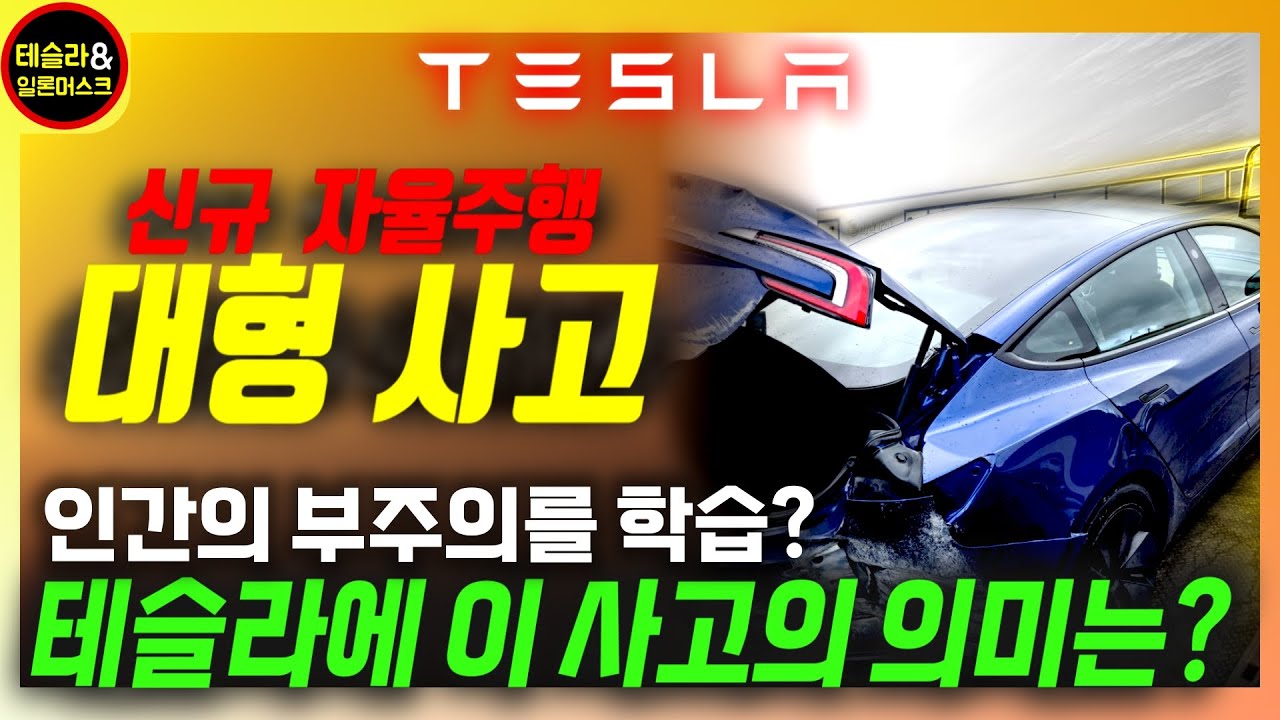
1) FSD Hydroplaning Incident: More “Physics Limit + Driving Policy” Than a Fatal System Defect
Incident summary
- A 2025 Model 3 was likely operating with the latest FSD enabled
- The system appears to have interpreted dark skid marks on the road as an obstacle and attempted an evasive steering maneuver
- On a wet surface, hydroplaning occurred, traction was lost, and vehicle stability control was compromised
- Driver intervention occurred late; the situation had entered a physics-limited regime and a collision followed
Key interpretation: closer to a behavioral policy issue than a perception failure
- Hydroplaning is predominantly governed by physical factors (speed, water depth, tire condition), not by whether the sensing stack uses cameras, radar, or lidar
- The central variable is how conservatively the system reduces speed under wet or low-traction conditions, rather than whether an obstacle was detected
Primary drivers cited for hydroplaning
1) Tire condition (pressure / tread wear)
2) Speed (wet-road conditions may require additional reduction even below posted limits)
Implications from this case
- The driver shared images suggesting adequate tread, reducing the likelihood of negligent tire maintenance as the dominant factor
- Indications that FSD maintained roughly 65 mph (100+ km/h) elevate the importance of improving conservative speed management in wet or adverse conditions
Common market misinterpretation
- Single-incident videos propagate rapidly, while large volumes of uneventful driving receive minimal coverage
- Data-driven systems frequently face a “perception vs. statistics” gap in public evaluation
2) Why the 19,000 km (12,000 miles) “No-Intervention” Case Matters
Case reference
- A lidar industry salesperson, David Mosen, reported that FSD smoothly avoided road debris
- He stated he completed 12,000 miles (~19,000 km) using FSD with no driver interventions
Why this is material
- No-intervention driving is meaningful as repeated stability over time, not as a single successful demonstration
- Robotaxi economics are determined less by isolated incident rates and more by fleet-average operating cost, claim frequency, and safety performance
Investment linkage
- Autonomous driving is positioned as a platform business rather than a single product feature
- As the platform scales, valuation sensitivity may increase to macro discount rates, while the operational trajectory may also track compute and AI investment cycles
3) Cybercab Testing: Why “Stopped / Tow-Adjacent” Footage Can Be Part of the Test Design
Observed signals
- Cybercab sightings appear to be increasing across multiple states
- A sighting near Buffalo, New York suggests winter-environment validation
- Scenes showing the vehicle stopped or appearing to be staged for towing drew attention
Interpretation
- The more relevant frame is boundary testing to capture failure-mode data rather than concealment of issues
- Tesla’s development approach often emphasizes collecting real-world edge-case data to accelerate iteration
Why robotaxi testing is inherently more extreme
- Robotaxi is an operating-hours revenue model, not a one-time vehicle sale
- The business requires robustness across long-tail conditions: durability, safety, sensor contamination, adverse weather, and rare events that dominate operational risk and downtime
4) Robotaxi App Development and Hiring: Transition from Core Tech to UX and Operations Readiness
Key developments
- Tesla is accelerating hiring for a dedicated robotaxi mobile app and related engineering roles
- Management messaging emphasizes experience quality beyond baseline functionality
Implications
- Commercial readiness requires more than driving capability
- The operating stack must include dispatch, pricing, claims handling, incident response, cleaning, remote support, and customer service workflows
- App-focused hiring is consistent with a move toward a launch-oriented service checklist
5) China Variable: Rumors of FSD Reactivation Starting on the 20th
What is circulating
- Unverified social posts claim FSD purchasing/subscription in China may resume from the 20th
How to treat it
- Without official confirmation, it should be classified as rumor
- China is structurally driven by the interaction of regulation, data governance, mapping, and operations; any credible signal can have outsized impact
Broader implications
- If access expands, software and subscription revenue exposure may increase
- Subscription-like cash flows can be valued differently depending on inflation and FX regimes
6) Insurance as the Strategic Lever: Why “Autonomy + Insurance” Can Reprice the Market
Current status
- Tesla Insurance continues expanding by state, with uneven pace due to differing regulatory processes
- Wider deployment of unsupervised robotaxi and unsupervised FSD would structurally increase the addressable insurance opportunity
Why the pairing is strategically powerful
- Tesla controls vehicle hardware, driving data, and risk measurement in a unified stack
- The firm can price risk based on empirical differences between human-driven and FSD-driven exposure
- A plausible direction is incorporating “FSD usage share” into premium calculation
Mechanism of market restructuring
- Higher autonomy safety performance reduces loss cost and can reduce premiums
- Lower premiums reduce robotaxi unit economics (cost per mile / cost per trip)
- Improved unit economics can accelerate adoption, creating a reinforcement loop
- This extends Tesla’s competitive scope into mobility finance and risk pricing, not only automotive manufacturing
7) The Meaning of “10 Billion Miles”: A Regulatory, Statistical, and Operational Threshold
Milestones referenced
- 2016: 220 million cumulative Autopilot miles cited
- 2024: 1 billion cumulative FSD miles cited
- Management has stated 10 billion miles is approaching
- The total cited stands at 7.2 billion miles, with 10 billion potentially within months
Why mileage scale matters
- Autonomous driving must be validated via statistics such as crash rate, intervention rate, and claim rate
- Regulators, insurers, and public acceptance respond to large-sample evidence rather than demos
- At sufficient scale, arguments that safety exceeds human baselines gain credibility due to tighter confidence intervals
How to view schedule delays
- Delays are a negative operational signal in the short term
- If unsupervised autonomy becomes viable at scale, multi-month slippage may be less material than the pace of learning and edge-case resolution
- Competitive assessment should emphasize the speed of exception-handling improvements rather than announcement dates alone
8) Headline-Style Summary
- The FSD hydroplaning incident appears driven by a physics-limited scenario and high-speed behavior policy; conservative adverse-weather speed logic is a clear improvement target
- A 19,000 km no-intervention case underscores that single viral incidents are insufficient to judge system performance
- Cybercab winter testing sightings suggest boundary-condition validation; “stopped” scenes may reflect extreme-test execution rather than simple failure
- Robotaxi app development and hiring indicate progression from driving capability to service operations readiness
- China FSD resumption remains unconfirmed; if substantiated, software subscription leverage could increase materially
- Insurance expansion continues; combined with unsupervised autonomy, risk-based pricing could pressure incumbent insurers and improve robotaxi economics
- Approaching 10B cumulative miles functions as a statistical and regulatory threshold for trust, insurability, and scalable fleet operations
9) Most Material Points Often Missed in Coverage
1) The incident is less about “did not see an obstacle” and more about wet-surface speed conservatism and behavior policy.
- A sensor modality debate (camera vs. lidar) is not the core determinant in hydroplaning-limited regimes
2) Robotaxi competitiveness depends on total cost structure, including insurance, claims, and operations automation, not only driving performance.
- Insurance is a strategic lever to reduce robotaxi cost per mile, not merely an ancillary business
3) “10B miles” is not marketing; it is statistical ammunition for regulatory and insurance acceptance.
- At scale, the debate shifts from feasibility to cost-effective, safer-than-human fleet operation
4) Cybercab test footage showing stoppage can be a constructive signal.
- Organizations that systematically surface and measure failure boundaries often improve commercialization velocity
Summary
The recent FSD hydroplaning incident is more consistent with the need to strengthen conservative adverse-condition speed policy than with a general repudiation of autonomy. In parallel, accumulating no-intervention driving examples shift evaluation from anecdote to statistics and operational feasibility. Cybercab appears to be in an extreme-testing phase including winter conditions, while robotaxi app hiring indicates progress toward service launch readiness. Tesla Insurance becomes strategically important when paired with unsupervised autonomy, potentially lowering robotaxi unit costs through data-driven risk pricing. Approaching 10B cumulative miles is a meaningful statistical threshold for regulatory, insurance, and public trust needed for scaled deployment.
Related Articles
- NextGenInsight.net?s=Tesla — Comprehensive overview of Tesla robotaxi and autonomous driving competitive landscape
- NextGenInsight.net?s=Robotaxi — How insurance and data reshape mobility business models in the robotaxi era
*Source: [ 허니잼의 테슬라와 일론 ]
– [테슬라] 위기의 자율주행? 신규 사고 vs 19,000km 무개입 주행, 데이터가 말하는 실체는?