● Semiconductor Legend Buyback Shock, 2026 AI Hype Crash, Davos Market Bombshell
From a Semiconductor “Legend’s” Questionable Buying to a 2026 “AI Trough of Disillusionment” Scenario, and the Davos Forum’s Clues for Global Equities This Year—Three Critical Market Puzzles, Consolidated
This note covers:
1) Why a semiconductor industry “legend’s” share purchases may not be a simple positive signal (including a verification checklist)
2) If a “2026 AI trough of disillusionment” materializes, which industries/companies are positioned to endure (winner criteria summarized)
3) Recurring signals the Davos Forum has historically conveyed to markets, and a key point investors may overlook this year
A final section consolidates the most decision-relevant takeaways.
1) News Briefing: A Semiconductor Legend’s “Questionable Buying”—A Positive Signal?
1-1. Why “Legend Buying” Can Move Markets
Semiconductors are cyclical.
Market participants who identify cycle troughs and peaks tend to capture disproportionate returns.
Accordingly, purchases by a highly informed, industry-insider figure can quickly generate expectations of a cycle bottom.
1-2. Why It Is Considered “Questionable” (Positive and Negative/Neutral Scenarios)
Treating such buying as unconditionally bullish can be risky.
The key is not the purchase itself, but the rationale, timing, and execution method.
Positive scenario
Purchases may reflect a proactive position near a confirmed industry trough.
If AI server/accelerator demand remains resilient, spillover demand may support memory, HBM, advanced packaging, and semiconductor equipment.
Negative (or neutral) scenario
1) The purchase may be symbolic or aimed at stabilizing sentiment, including for liquidity considerations
2) It may be linked to internal company issues (litigation, governance, funding, or a specific corporate event)
3) The market may be mid-rebound rather than near a true bottom
1-3. Actionable Verification Checklist (Core Items)
Assess the following five factors jointly:
- Buyer identity: individual vs. entity/foundation/special-purpose vehicle
- Execution: open-market purchase vs. block trade or pre-arranged transaction
- Entry level: magnitude of drawdown from peak (including valuation)
- Concurrent signals: peer executive buying, share buybacks/cancellations, guidance revisions
- Earnings trigger: evidence of structural improvement beginning next quarter (quantitative, not narrative)
The primary focus should be convergence across multiple signals, not a single prominent buyer.
2) News Briefing: “A 2026 AI Trough of Disillusionment?”—Key Claims
2-1. Definition (Practical Interpretation)
AI currently includes elements of overheating.
Expectations that “adding AI” supports equity valuations may outpace operational results, while practitioners increasingly emphasize insufficient ROI.
This gap can catalyze a trough-of-disillusionment phase.
2-2. Why 2026 Is Cited (Market Mechanism)
If AI infrastructure investment (data centers, GPUs/accelerators, networking, power) accelerates through 2024–2025, CFO scrutiny typically rises around 2026:
“How much revenue and profit has this generated?”
If credible answers are lacking, valuation compression may occur first, followed by budget reductions, and then broader pressure across the AI value chain.
2-3. A Trough Does Not Imply the End of AI (Winner Criteria)
Resilient segments are comparatively identifiable:
- Cost-reduction AI: solutions that measurably reduce labor or operating expenses
- Revenue-generation AI: models that translate directly into monetization (e.g., advertising, recommendations, pricing optimization)
- Regulation/security/IP compliance: areas where non-adoption increases enterprise risk
- Infrastructure efficiency: power, cooling, and inference optimization that lowers compute cost
- Data advantage: proprietary data and workflow control
If 2026 volatility emerges, the first contraction is more likely to be the “AI expectation premium” rather than underlying demand for AI itself.
2-4. Key Cross-Asset Linkages (System-Level View)
AI should be assessed alongside macro variables.
For example:
Delayed rate cuts can pressure growth equity premia first.
Renewed inflation can raise data-center power and build-out costs.
Escalating US–China tensions can drive further supply-chain reconfiguration and duplicated CAPEX, increasing overall system cost.
3) News Briefing: The Davos Forum as a Market Signal—Does It Still Matter?
3-1. Davos (WEF) Signals “Agendas,” Not Point Forecasts
The Davos Forum is better understood as an agenda-setting venue indicating where capital allocation and policy may concentrate over the next 12–24 months, rather than a forum for predicting index levels.
3-2. Recurring Patterns (Investor Lens)
- Policy/regulation: increasing weight of AI regulation, data governance, and cybersecurity “rules”
- Supply chains: higher geopolitical risk tends to increase the premium on secure supply chains
- Energy/power: in an AI-driven economy, power availability becomes a core competitiveness factor
- Capital flows: elevated uncertainty favors cash-flow durability and quality equities
3-3. A Practical View on “Whether Davos Is Right”
When Davos “appears correct,” it is often because governments and large corporations act in the same direction, making the agenda self-reinforcing in real economic outcomes.
The key diligence question is:
“Will this agenda translate into actual budgets (CAPEX/OPEX) and enforceable laws/regulation?”
4) Key Points Commonly Underemphasized in Mainstream Coverage
4-1. “Legend Buying” May Be a Catalyst That Coordinates Positioning, Not a Signal
Markets react to who bought; markets ultimately validate whether earnings follow.
The core test is whether, after the purchase, industry guidance, orders, pricing (ASP), and inventories inflect in the same direction.
4-2. Any 2026 AI Disillusionment Is More Likely to Start with Cost/ROI Pressure than Demand Collapse
A frequently missed point is that AI adoption may slow not due to irrelevance, but due to higher-than-expected costs.
Accordingly, likely winners are those that deliver:
lower inference cost, higher power efficiency, and operational optimization.
4-3. Davos Provides Clues About Bottlenecks, Not Just Themes
In an AI-driven cycle, bottlenecks extend beyond GPUs to real-world infrastructure constraints:
power generation, transformers, transmission, cooling, networking, and data governance.
Market leadership can rotate in line with the sequence in which these bottlenecks are resolved.
5) Investor Framework (Implementation-Oriented)
5-1. Validate Semiconductors via Cycle Data, Not Personalities
Confirm inflections in inventory indicators, pricing trends, CAPEX guidance, and order lead times.
5-2. AI Outcomes Will Be Determined by Accounting (ROI), Not Technology Narratives
During 2025–2026, dispersion may widen between enterprises that move from PoC to company-wide deployment and those that stall at PoC.
5-3. Integrate Macro Through a Five-Variable Set
If rate-cut expectations weaken, growth equities typically reprice first.
Persistent inflation increases power and build-out cost burdens.
Rising US–China tensions increase supply-chain costs.
A shift in the USD trend can destabilize emerging-market flows.
Ultimately, only companies with resilient earnings profiles tend to sustain valuations.
Because these variables are interdependent, single-factor positioning increases timing risk.
< Summary >
A semiconductor “legend’s” buying should be treated as a hypothesis and verified through cycle data.
A 2026 AI trough of disillusionment is more likely to originate in cost/ROI constraints than in an outright demand collapse.
The Davos Forum’s most actionable signals relate to bottlenecks—power, supply chains, and regulation—and whether agendas convert into budgets and policy implementation.
[Related]
- Semiconductor Cycle: Is This a Bottom Signal?
- After AI Overheating: A Survival Strategy Based on Enterprise ROI
*Source: [ 소수몽키 ]
– 반도체 전설의 수상한 매수, 긍정 신호일까 / 26년 AI 환멸의 골짜기 온다? 충격 보고서 / 증시 족집게 다보스 포럼, 올해도 맞을까
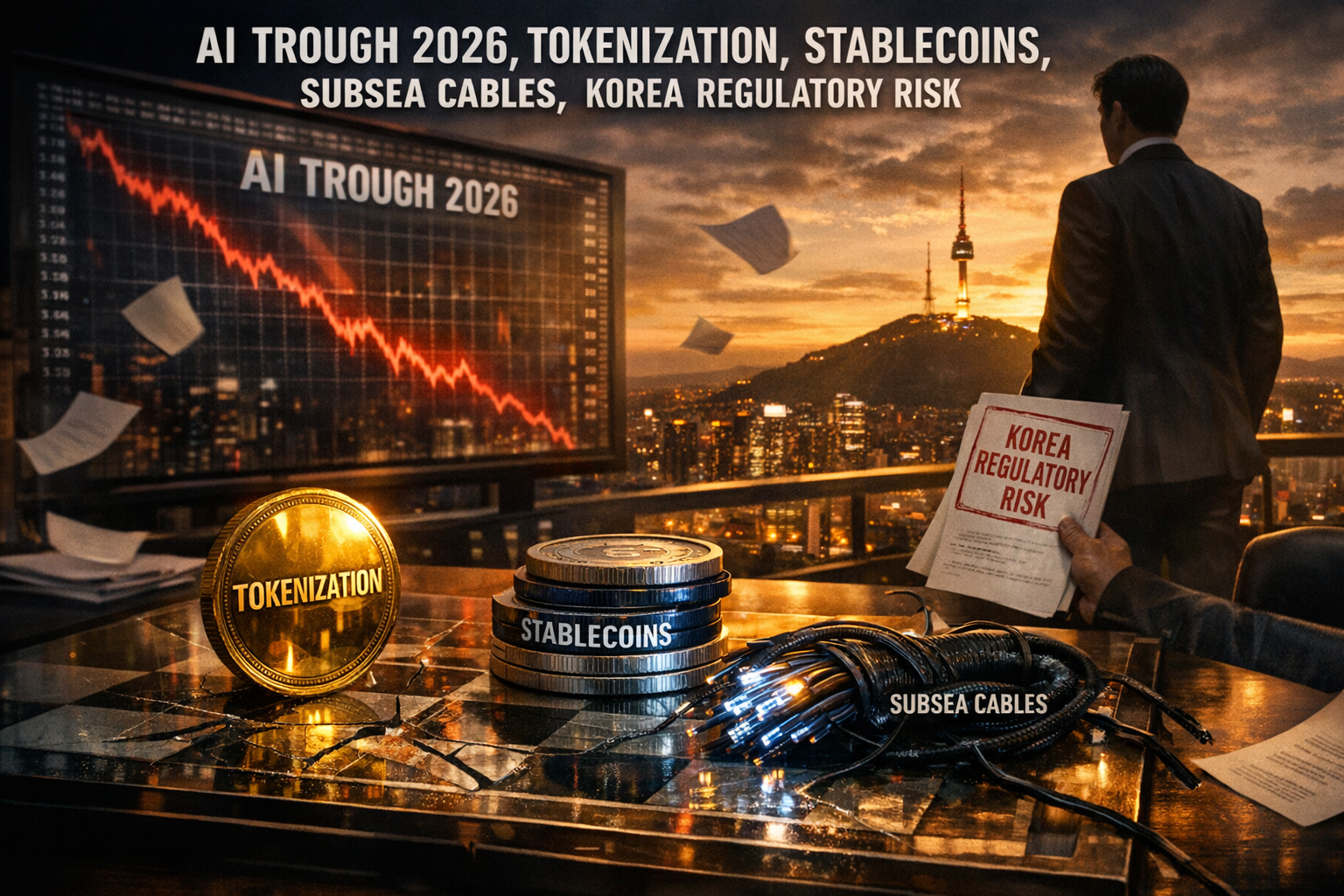
● Tokenization Boom, Dollar Stablecoin Powerplay, Korea Left Behind
Crypto in 2026: Institutions, Not Prices, Will Reshape the Market — Tokenization, Stablecoins, Dollar Hegemony, and Korea’s “School-Zone” Regulatory Risk
This report covers four points:1) Why 2026 is not “the end of crypto,” but the first year of a structurally different market.
2) How tokenization can reconfigure real-asset markets (real estate, equities, infrastructure) through direct access, asset-level issuance, fractionalization, and continuous liquidity.
3) Why stablecoins may function less as “innovation” and more as a geopolitical instrument reinforcing U.S. dollar dominance.
4) Why the U.S. is moving at high speed while Korea remains constrained by regulatory conservatism, and how the gap may translate into costs for Korea’s asset markets.
1) Key Briefing: 2026 as the First Year the “Tokenization Triangle” Becomes Institutionalized
The central thesis is that crypto is not primarily a “token price” story, but a financial infrastructure redesign.
2026 is positioned as the timing when this redesign accelerates under U.S.-led institutional frameworks.
Scale effects emerge when market adoption, technology, and institutions align (“tokenization triangle”).
If institutionalization proceeds, liquidity flows may extend beyond crypto markets into equities, fixed income, real estate, and infrastructure via tokenized rails.
2) Four Structural Changes Enabled by Tokenization: Direct, Individual, Fractional, Continuous Liquidity
Tokenization is framed as a preview of the future configuration of finance, summarized in four mechanisms.
2-1) Directization: Bypassing Large Intermediaries
Post-2008 sentiment has emphasized perceived misaligned incentives in large financial intermediaries.
Token-based structures can connect suppliers and investors more directly, typically via platforms, reducing intermediation layers and reallocating costs.
2-2) Individualization: Investing in Assets/Projects Rather Than Entire Corporations
Equity markets generally require investing at the corporate level, even when funding needs are project-specific.
Tokenization can enable financing at the asset/project level, with cash-flow distribution linked to that specific unit (e.g., a defined production line or facility expansion).
At scale, this may compete with and/or integrate into traditional project finance structures.
2-3) Fractionation: Lowering Entry Barriers for High-Value Assets
Fractionalization can structurally reduce purchase and allocation constraints by splitting ownership and/or cash-flow rights.
In real estate, this could broaden participation and alter the distribution of economic interests across regions, potentially changing the political economy of asset-price dynamics.
2-4) Constant Liquidity: Shifting From Maturity-Based Liquidity to Continuous Trading
Traditional assets embed waiting periods (maturity, lockups, exit timelines).
Tokenization targets near-continuous price discovery and trading access, increasing both market depth potential and volatility risk.
This reinforces the need for regulatory, accounting, tax, and investor-protection frameworks for scalable adoption.
3) Why the U.S. Is Advancing Institutionalization: Integration Into Core Financial Infrastructure
The key distinction is not “more regulation,” but integration into mainstream financial infrastructure.
The U.S. is characterized as moving toward rule-making that standardizes market participation and embeds token rails into capital markets.
This is materially connected to rates, FX, and the dollar-centered payments network, implying tokenization is increasingly a macro-linked infrastructure contest rather than an industry niche.
4) Stablecoins: A Dollar-Dominance Instrument More Than a Consumer Innovation
The report frames stablecoins as reinforcing dollar hegemony and payments influence.
4-1) Legislation as a Reordering Mechanism for Incumbent Issuers
A cited “18-month grace period” is interpreted as targeting large incumbent issuers, with pressure to restructure reserves toward more conservative U.S.-centric assets (notably U.S. Treasuries).
This links stablecoin growth to incremental demand for U.S. government debt.
4-2) Limited Issuer Margin Potential Under Tight Governance
Well-regulated stablecoins may constrain issuer profitability; aggressive margin extraction increases reserve and solvency scrutiny.
The investable focus may shift from issuers to distribution and control points: wallets, merchant acceptance, settlement, compliance (AML/KYC), and on/off-ramps.
4-3) Cross-Border Payments Likely to Consolidate Around the Dollar
Given entrenched dollar usage in trade, commodities, and supply chains, USD stablecoins are positioned as the dominant cross-border unit.
Local-currency stablecoins may be relevant for domestic pilots and regulatory capability-building, but are less likely to set the global standard.
4-4) Deposit Disintermediation Risk
As referenced by IMF analysis, increased stablecoin adoption may accelerate shifts from local-currency deposits into dollar-denominated value storage, particularly in emerging markets.
Because bank lending capacity relies on deposits, deposit outflows can transmit shocks into the real economy.
5) Korea’s Core Risk: Institutional Gaps Create Costs
The primary concern is not strict regulation per se, but delayed or incomplete institutionalization.
If tokenization and platform development are constrained domestically, activity may migrate to offshore platforms.
This extends beyond Koreans purchasing foreign equities: it implies the possibility that trading and financing tied to Korean equities and Korean real estate could increasingly occur on non-domestic platforms.
The consequence is loss of capital-market control points and potential downward pressure on long-run growth.
6) 2026 Macro Linkage: Tariff Conflict → FX Conflict → Stablecoin/Payments Conflict
Sequence framework:1) 2025: Tariff conflict increases investment and supply-chain reconfiguration pressure.
2) Late 2025 to early 2026: FX conflict intensifies via rates and monetary-policy constraints.
3) 2026: Stablecoin conflict escalates as payments infrastructure is re-anchored to the dollar.
Stablecoins are presented as potentially embedded in policy packages (e.g., payments adoption linked to trade concessions), implying quasi-state strategic use.
7) Five Under-Discussed Investment-Relevant Points
7-1) The Bottleneck Is Tax, Accounting, and Legal Rights Definition — Not Throughput
If token issuance proceeds are classified as taxable income rather than debt or equity financing, the model becomes non-viable.
The binding constraints are tax classification, accounting treatment, and formal definitions of ownership vs. cash-flow rights.
7-2) “Stablecoin Equity” May Be Riskier Than Expected
As regulation increases, issuer margins may compress.
Value capture may accrue to payment rails and network control points: wallets, settlement, merchant networks, compliance infrastructure, and on/off-ramps.
7-3) Korea’s Opportunity Is Financial Market Leadership, Not Monetary Sovereignty
Dollar dominance is unlikely to be displaced.
However, Korea may capture parts of regional financial-hub value chains if regulatory design is timely and execution-capable, leveraging high digital adoption and large technology platforms.
7-4) Deposit Outflows Could Emerge Quietly in Korea
If USD stablecoins materially improve usability for wage payments and remittances (including in manufacturing regions with rising foreign-worker demand), adoption could expand ahead of formal response.
Delayed recognition can lead to abrupt, heavy-handed regulation, increasing the probability of suppressing innovation while addressing stability concerns.
7-5) 2026 Winners May Be Those Positioned for Institutional Change, Not Token Selection
Tokenization is characterized as a restructuring of ownership, collateralization, liquidity, and settlement.
Implications extend to corporate financing strategy, household portfolio access, and national competition for financial infrastructure control.
8) Korea: Action Checklist
8-1) Legal Framework: Define the Legal Nature of Tokens
Binary “security vs. non-security” classification is insufficient.
Core rights require definition: ownership, cash-flow rights, collateral rights, and liquidation rights.
8-2) Tax/Accounting: Prevent Misclassification of Financing Proceeds
Clear standards are required to distinguish equity financing, debt, and prepayments; ambiguity suppresses issuance and adoption.
8-3) Industry: Build Competitive Payment Infrastructure (Wallets/Settlement/Merchants)
Local-currency stablecoins can serve as domestic innovation pilots and regulatory skill-building.
Strategy should also target participation in the USD-stablecoin era via settlement, compliance, and merchant distribution capabilities.
8-4) Investors: Shift From “Tokens” to “Infrastructure and Regulatory Beneficiaries”
Focus shifts from price selection to identifying assets likely to gain liquidity premia through tokenization.
Asset allocation should integrate FX, rates, and global liquidity dynamics rather than isolating crypto as a standalone segment.
< Summary >2026 is framed less as a crypto price cycle and more as the first year U.S.-led institutionalization completes the market-technology-institution “tokenization triangle.”
Tokenization can reshape financing and trading structures across equities, real estate, and infrastructure via direct access, asset-level issuance, fractionalization, and continuous liquidity.
Stablecoins may operate primarily as a dollar-dominance and payments-infrastructure tool, with potential spillovers such as bank deposit disintermediation.
Korea’s constraint is not technology but institutional readiness (tax, accounting, and legal rights definition); delays may shift Korean asset trading to offshore platforms.
Priority actions include defining token legal character, standardizing tax/accounting treatment, strengthening payment infrastructure competitiveness, and repositioning investor focus toward regulatory and infrastructure beneficiaries.
[Related…]
- Stablecoin conflict scenarios reshaping payments infrastructure: https://NextGenInsight.net?s=stablecoin
- Structural impact of tokenization on real estate and equity markets: https://NextGenInsight.net?s=tokenization
*Source: [ 경제 읽어주는 남자(김광석TV) ]
– 2026년, 크립토 판에 거대한게 온다. 크립토 패권을 둘러싼 제도 전쟁의 실체… 한국은 준비됐지만 시작도 못 했다.. | 경읽남과 토론합시다 | 오태민 교수 4편
● Greenland Power Grab, Arctic Route, Cable Spy Net, Tariff Shock
Greenland Issue: The Core Strategic Stakes Extend Beyond Minerals — Arctic Shipping Lanes, Subsea Cables, and Energy in One Framework
This report covers:1) Why Trump frames Greenland primarily as a national security issue (a broader strategic rationale than minerals).2) How the deployment posture of eight European countries and retaliatory tariff dynamics can transmit into global supply chains and inflation.3) Why the Arctic route is not only a logistics shortcut, but also a lever for data sovereignty (subsea cables) and military surveillance.4) Why, in the AI era, “rare earths + copper + uranium” increasingly function as national security assets.5) The under-discussed view of “subsea cables as an underwater sensor network,” plus an investor-oriented risk checklist.
1) News Briefing: “Annex Greenland” Messaging → European Deployment Signaling → Trump’s Tariff Leverage
- [Situation] The U.S. (Trump) escalates messaging that Greenland is an asset the U.S. “must have,” emphasizing security imperatives. Europe moves toward coordinated posture-building to defend Denmark’s sovereignty claims over Greenland (autonomous territory).
- [European response] Eight European countries signal heightened pressure via potential Greenland-related deployments: Denmark, Norway, Sweden, France, Germany, the United Kingdom, the Netherlands, Finland.
- [U.S. response] Trump references tariffs against these eight countries (signaling a move from 10% to 25%), reframing the dispute as: non-cooperation on security issues triggers economic penalties.
2) Where Tariffs Create the Most Economic Damage: Mutual Supply-Chain Exposure
Tariffs are structurally bilateral in impact, with transmission into U.S. import costs and inflation risk.
- Major European exports to the U.S.: pharmaceuticals; refining/chemicals; automobiles; gas turbines; automation/semiconductor equipment; ships.
- U.S. spillovers: higher import unit costs (inflation pressure); bottlenecks in critical intermediate inputs (margin compression).
- European spillovers: reduced U.S.-linked revenue in export-dependent industries; higher fiscal and political risk under weaker growth.
Key point: this is not a conventional trade dispute; it binds trade tools to security alignment, shifting negotiation from rules-based trade to alliance redefinition. Market sensitivity typically rises via supply-chain uncertainty and volatility.
3) Why Europe Has Limited Room to De-escalate: Territory, Credibility, and Precedent
Europe faces a credibility problem if it retreats under tariff pressure, as it could institutionalize a precedent of repeated concession under economic coercion.
- Territorial dimension: the symbolic cost of allowing a major power to reshape European sovereign claims.
- Alliance credibility: concern that “Europe follows U.S. demands” becomes entrenched within NATO dynamics.
- Long-duration risk: prolonged U.S.-Europe friction increases complexity across energy, exports, and finance.
4) Why Trump Prioritizes “U.S. Security” Messaging Over “Minerals”
Trump emphasizes Greenland as a defensive asset rather than a commodities play, due to stronger political and negotiating leverage.
- Security rationale: proximity to U.S. strategic approaches; relevance to homeland defense.
- Negotiation pressure: framing opposition as obstruction of U.S. security interests.
- Potential NATO stress: widening internal alliance friction could weaken European coordination.
This shifts the market lens from tariff headlines to geopolitics as an economic variable, increasing sensitivity to diplomatic and military catalysts alongside rates and earnings.
5) Why Russia Over-invests in the Arctic: Second-Strike Capability
Russia’s Arctic posture is closely linked to second-strike deterrence.
- Northern Fleet concentration: nuclear submarines, air assets, ground forces, coast guard, and surface combatants.
- Geographic advantage: shorter attack vectors toward Europe and the U.S.
- U.S. interpretation: Greenland as a forward node for detection and interception in homeland defense architecture.
6) The Arctic Route: A Combined Contest Over Trade, Data, and Military Advantage
Ice melt expands navigability, altering both shipping economics and strategic geography.
- Europe → Russian coastline → Shanghai (Arctic route): time compression versus Suez (37 days → 22 days). Fewer sailing days affect fuel, insurance, and vessel utilization.
- New York → Shanghai: time/distance reduction versus Panama (43 days → 32 days).
- Strategic chokepoints: Greenland, Iceland, and Norway gain relevance.
A critical implication: as the Arctic route becomes viable, communications infrastructure (subsea cables) tends to follow shipping and strategic corridors.
7) Under-covered Core Issue: Subsea Cables Are Not Only Communications — They Can Function as Underwater Surveillance
Most intercontinental data traffic moves via subsea cables (95%). Shorter routes can reduce build costs. The strategic issue is dual-use capability.
- Subsea cable + sensors: integrated sensing/acoustic monitoring can enable detection of underwater activity (submarines, fleets).
- Meaning of Arctic subsea cables: cable corridors along the Arctic route could generate informational advantage on underwater movements.
- China-related exposure: broad involvement of Huawei Marine in subsea projects sustains recurring debate over communications infrastructure as a strategic asset.
Implication: interpreting Greenland purely through “rare earths” is incomplete; the combined package is Arctic shipping lanes + subsea cables + surveillance/defense architecture. Escalation can migrate from trade conflict to data-sovereignty competition, with potential spillovers into FX and inflation via risk premia and supply-chain repricing.
8) Resources: The AI Build-out Shifts “Resources = Economics” Toward “Resources = Security”
As AI and power infrastructure scale, securing supply increasingly matters as much as price.
- Rare earths: motors, defense, and electronics; persistent political risk due to concentrated supply dependence.
- Copper and silver: directly tied to data centers, grids, and electrified defense systems.
- Uranium: strategic value rises with nuclear power re-acceleration.
An additional factor is the potential oil and gas resource base around Greenland. The strategic framing is less about short-term price relief and more about long-cycle energy positioning, consistent with a heavier policy tilt toward gas and nuclear alongside renewables.
9) Forward Scenarios: Near-term Shock vs Long-term Reordering (Investor Checklist)
-
Scenario A: Rapid coercive settlement attempt
Trump intensifies tariffs/diplomatic pressure to deliver a near-term “win.”
→ Higher short-term volatility; relative resilience may emerge in defense, energy, and infrastructure. -
Scenario B: Prolonged European resistance
Expanded tariffs and retaliation extend negotiations.
→ Slower supply-chain reconfiguration; reduced earnings visibility. -
Scenario C: Expanded Russian/Chinese influence via alliance fragmentation
Greater NATO stress and European division increase Arctic leverage for Russia and China.
→ More explicit competition over Arctic shipping lanes and subsea cable corridors.
Key investor monitoring points:
- Whether trade pressure transmits into inflation: tariffs → import costs → consumer prices can affect central bank reaction functions.
- Whether security regulation tightens around subsea cables/data infrastructure: exclusion of specific firms/countries can reshape market structure.
- Speed of energy-mix adjustment: sustained gas/nuclear share expansion can lengthen the capex cycle for resources and equipment.
10) Single Highest-Impact Takeaway
Greenland functions less as a “minerals island” and more as a forward strategic platform that links Arctic shipping lanes, subsea cables (data sovereignty), and underwater surveillance/missile defense. This raises the probability of joint shocks across geopolitical risk, supply chains, FX, and inflation over a multi-year horizon.
< Summary >
The Greenland issue extends beyond rare earths into a combined security-economic package: Arctic route logistics leverage, subsea cable (data and underwater surveillance) competition, and U.S. homeland defense framing. Europe faces high costs in conceding due to sovereignty and precedent. U.S. tariff leverage ties trade to security alignment. The resulting risk set can simultaneously pressure global supply chains, FX, inflation, and geopolitical risk premia.
[Related Articles…]
- https://NextGenInsight.net?s=Arctic
- https://NextGenInsight.net?s=subsea-cable
*Source: [ Jun’s economy lab ]
– 그린란드를 반드시 가져가려는 트럼프의 숨겨진 이유(ft.해저케이블)