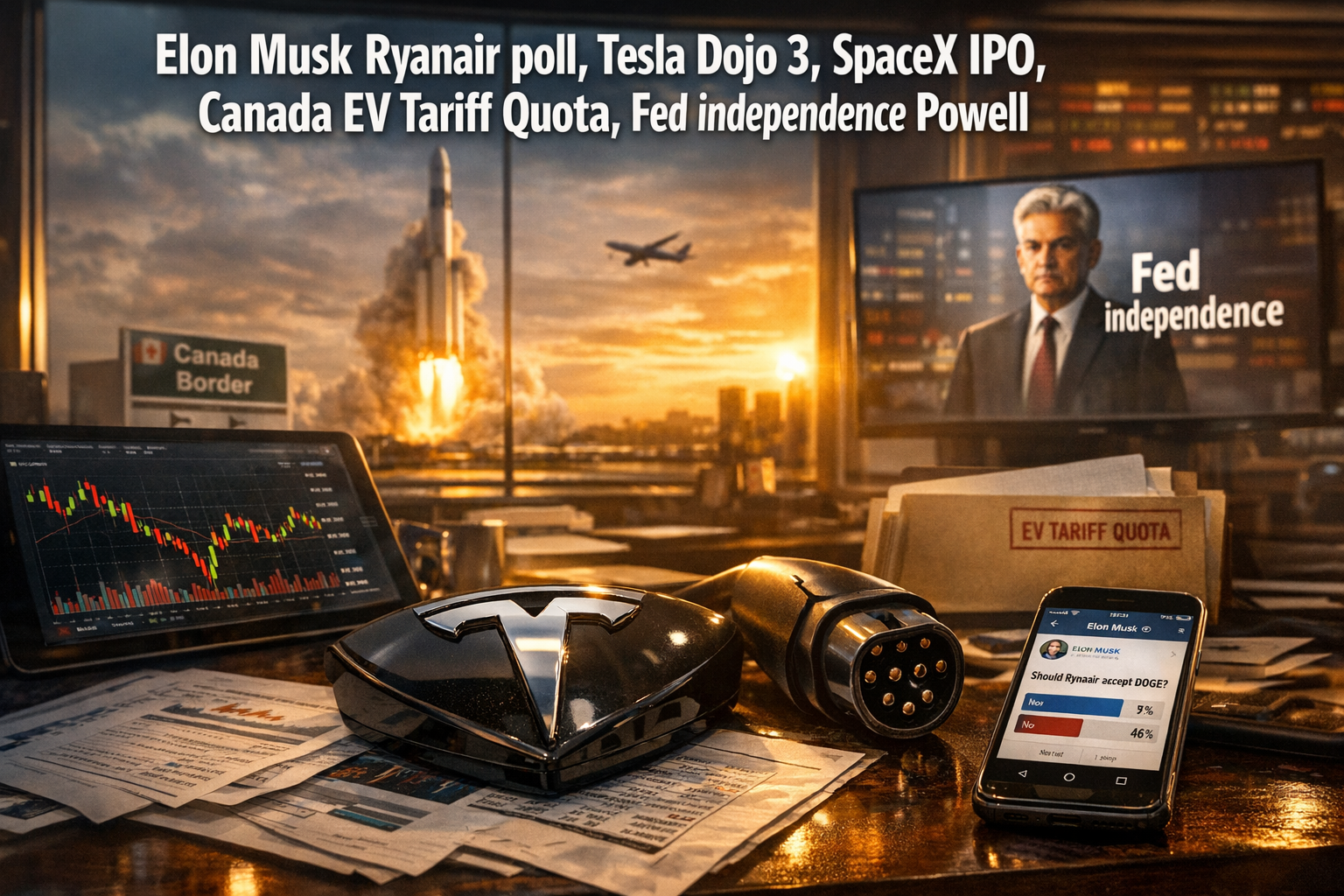
● Musk-Ryanair Buyout Poll-Tesla Stock Shock-Dojo 3 Reboot-SpaceX IPO Buzz
Elon Musk’s “Ryanair Acquisition” Poll: Why It Matters Beyond a Joke (Tesla Equity Risk, SpaceX IPO Optionality, and Dojo 3)
This report consolidates three investor-relevant issues:1) Why Musk’s Ryanair acquisition poll can be material for Tesla shareholders (including the Twitter precedent).2) Why Canada’s potential easing of tariffs on China-made EVs could be comparatively favorable to Tesla (quota mechanics, supply chain readiness, first-mover execution).3) Why Tesla is reviving Dojo (Dojo 3) and what it implies for AI compute economics and competitive positioning versus Nvidia.
1) [Key Update] Musk’s “Should I acquire Ryanair?” poll: Why Tesla shareholders monitor it
1-1. Event summary
Musk posted a poll on X asking whether he should acquire Ryanair. While framed as humor, investors recall the prior sequence in which informal posts and polls preceded the Twitter acquisition.
1-2. Source of conflict: Starlink inflight connectivity dispute
The catalyst was Ryanair CEO Michael O’Leary’s public skepticism regarding Starlink onboard aircraft, citing:
- Antenna installation may increase aerodynamic drag.
- Fuel cost could rise by approximately 2%.
- Ryanair’s short-haul customer mix may not justify the service.
Musk countered that:
- Current aviation Starlink antennas are low-profile and streamlined.
- Fuel-efficiency impact is below 0.3%, not 2%.
The dispute escalated from a technical disagreement into an adversarial exchange, followed by the acquisition poll.
1-3. Core consideration: Feasible acquisition scale
Ryanair’s market capitalization was cited at approximately $25–30 billion. Relative to the $44 billion Twitter transaction, the lower headline scale increases the perceived plausibility of a transaction.
1-4. Transmission mechanism to Tesla equity (investor perspective)
Primary risk is financing structure rather than airline fundamentals.
(Scenario A) Tesla share sales to fund a deal → near-term volatilityAs seen during the Twitter acquisition, equity sales by Musk could pressure Tesla’s stock independent of operating fundamentals, increasing perceived key-person and governance risk.
(Scenario B) SpaceX/Starlink funding (IPO or alternative financing) → reduced direct pressure on TeslaIf financing is sourced via SpaceX/Starlink value realization rather than Tesla share sales, direct selling pressure on Tesla could be mitigated. This framing contributes to renewed discussion of SpaceX IPO optionality.
2) [Macro/Policy] Why Canada’s “China-made EV tariff easing” could be favorable to Tesla
2-1. Policy structure: “100% tariff → 6.1%, with an annual quota”
Canada previously applied punitive tariffs (100%) on China-made EVs. The referenced framework involves lowering the tariff to 6.1% while imposing an annual volume cap of approximately 499,000 vehicles.
2-2. Why Tesla could benefit despite apparent advantages for China-based OEMs
The key variable is allocation and execution under a quota regime, not headline tariff relief.
Tesla advantages under this framework
- Prior operational readiness to export from the Shanghai facility to Canada.
- Flexibility to shift supply between Berlin and Shanghai depending on tariff and logistics conditions.
- Existing Canadian sales and service footprint supports faster volume deployment in a quota-limited environment.
In contrast, competitors such as BYD and NIO may face longer lead times due to incomplete local distribution, logistics, and service infrastructure.
2-3. Investor takeaway: Distribution and supply chain readiness can dominate tariff headlines
When policy barriers are partially lifted, near-term winners are often those with immediate operational capacity (certification, logistics, retail/service coverage), not necessarily the lowest-cost producer.
3) [AI/Compute] Why Tesla is reviving Dojo: Dojo 3, AI5/AI6, and AI hardware control
3-1. Update: Dojo 3 work restarted
After signaling potential de-emphasis of Dojo in favor of tighter integration with in-vehicle compute platforms (AI5/AI6), Musk stated that Dojo 3 development is being resumed.
3-2. Strategic rationale: Controlling AI training cost and throughput
The objective extends beyond “GPU cost” considerations. Competitive advantage increasingly depends on:
- Model capability
- Data scale
- Training infrastructure (chips and clusters)
For FSD and humanoid robotics programs, training requirements scale materially. GPU availability and compute cost can become binding constraints. Dojo 3 is positioned as an effort to internalize and control compute economics and iteration speed. Execution risk remains: success could lower unit training cost and improve development cadence; failure could increase capital intensity without commensurate returns.
3-3. Implication of “new chips every nine months”
A stated cadence of releasing new silicon every nine months implies an aggressive R&D cycle. If sustained, it supports an interpretation of Tesla as an integrated AI hardware-and-software operator, with potential to challenge Nvidia-centric infrastructure dependence in specific workloads.
4) [Scenario Framework] Two business rationales for interest in an airline asset
4-1. Expanding X’s payments and commerce ecosystem
Air travel is high-ticket and rich in ancillary fees. Airline integration could enable X to capture booking, ticketing, baggage, seat selection, and add-on payments, supporting a transaction-fee model consistent with a super-app strategy.
4-2. Optionality around aviation electrification as a testbed
Near-term aviation electrification is more plausible in short-haul use cases. Ryanair’s short-haul exposure could provide a large-scale operating environment for experimentation and commercialization pathways related to electrified aviation and battery applications.
5) Key points for investors
1) The central issue is not the airline itself but whether deal financing could reintroduce Tesla equity selling risk and governance overhang.
2) Canada’s tariff easing is best analyzed as a quota allocation and execution problem; incumbents with ready supply chains and established distribution can capture early share.
3) Dojo 3 is primarily a compute economics and iteration-speed strategy. It can support valuation re-rating if it lowers training cost and accelerates development; it can also increase valuation discount if capital intensity rises without measurable productivity gains.
Musk’s Ryanair acquisition poll should be treated as a monitoring item for potential financing-related Tesla equity volatility, given prior precedent. Canada’s potential tariff reduction coupled with quotas may favor firms with immediate supply and distribution readiness, where Tesla has structural advantages. Tesla’s Dojo 3 restart signals an effort to internalize AI training infrastructure to control cost and development velocity, potentially reducing dependency on Nvidia-led compute supply for targeted workloads.
[Related Links…]
- Tesla equity volatility and key-person risk checkpoints: https://NextGenInsight.net?s=tesla
- How Starlink is reshaping aviation and connectivity markets: https://NextGenInsight.net?s=starlink
*Source: [ 오늘의 테슬라 뉴스 ]
– “일론 머스크, 항공사 인수? ‘라이언에어 인수’ 투표의 충격적 진실! 주가, 이번엔 괜찮을까?”
● KOSPI Undervalued Surge – FX Pivot, MSCI Shock, Profit Boom
The KOSPI Is “Still Cheap”: A Structured Case (FX, MSCI, Earnings Momentum, and a U.S. Range-Bound Market)
This report covers:1) Why Korean equities have recently outperformed U.S. equities (including historical parallels)
2) The core triggers behind a KOSPI 5,000–6,000 scenario (FX, MSCI, valuation)
3) Why leveraged inverse and inverse products are structurally disadvantageous (product mechanics + behavioral factors)
4) Key 2026 market risks (U.S. employment, JPY signals, policy variables) and an investor checklist
5) Why AI-driven leadership may rotate from U.S. mega-cap tech to Korean manufacturing/export sectors
1) Headline: “The U.S. Is Flat While the KOSPI Rises” Is Unusual but Not New
The key framework is that relative valuation (cheap vs. expensive) can redirect global capital flows rather than represent an anomaly.
1-1. Historical periods when the U.S. paused and Korea strengthened
(1) Post-2000 dot-com bust
- While the Nasdaq declined by roughly 80% from its peak (~5,100),
- The KOSPI recorded a +36% gain in 2001.
- Interpretation: markets with larger bubbles reprice first; relatively cheaper markets can outperform.
(2) Why the dynamic extended into 2007
- Global capital rotated toward growth regions (e.g., BRICS; manufacturing cycle following China’s WTO entry).
- Korea benefited from a shipbuilding and broader manufacturing upcycle, extending the rally.
2) Rationale for “KOSPI Is Still Cheap”: Valuation + Earnings Momentum + Institutional Re-rating
2-1. Valuation: PER ~10x vs. S&P 500 ~22x
- S&P 500: PER referenced at ~22x
- Korea: PER referenced at ~10x
Conclusion: on headline multiples, Korea is not easily characterized as being in a valuation bubble.
2-2. Earnings momentum: Re-rating plus upward revisions
- The central claim is a structural re-rating (a reduction in the “Korea discount”) alongside improving earnings expectations.
- Earnings trajectory referenced:
- 2025 operating profit: ~KRW 280–290 trillion
- 2026 operating profit: ~KRW 400 trillion, with discussions extending to ~KRW 430–470 trillion
- With market cap referenced at ~KRW 4,000 trillion, the implied PER remains near ~10x under the stated assumptions.
2-3. Institutional reforms: governance and market “advanced status” as re-rating catalysts
- Governance and legal reforms (including commercial law amendments) are framed as potential drivers of a higher valuation premium.
- Lower discount rates (via rate-cut expectations) are positioned as supportive for equities.
- FX stability and potential MSCI-related developments are cited as mechanisms to reduce perceived risk premia for foreign investors, supporting re-rating narratives.
3) KOSPI 5,000–6,000 Scenario: Primary Triggers Are FX + MSCI + USD Weakness
3-1. FX: unwinding KRW undervaluation can change index-level outcomes
- The thesis emphasizes that an excessively weak KRW may normalize.
- If USD strength fades (with a lower DXY), capital may rotate toward emerging markets and manufacturing exporters.
- KRW appreciation (lower USD/KRW) can add potential FX gains for foreign investors, reinforcing equity inflows.
3-2. MSCI: the mechanism is flows timing, not the headline decision
- The argument stresses a lag: if inclusion is decided in one year, material inflows may occur from the following year.
- Passive (index-tracking) and certain active flows often concentrate around implementation and rebalancing windows.
3-3. Logic behind references to 6,000 by 2027
- Combined conditions—KRW appreciation, MSCI-related flows, and earnings expansion—could accelerate performance.
- The 2027 6,000 level is presented as plausible under a multi-catalyst alignment rather than a base case.
4) Why Leveraged Inverse/Inverse Products Are Discouraged: Structural, Not Probabilistic
(1) Asymmetric risk profile (short exposure)
- Long equities have a maximum loss of -100%.
- Short/inverse exposures can have theoretically unlimited losses.
(2) Path dependency: value erosion in range-bound, volatile markets
- Markets often decline through oscillations rather than a straight line.
- Daily reset and compounding effects can degrade returns for leveraged and inverse products in sideways/high-volatility regimes.
(3) Behavioral risks
- The perceived reward of being contrarian can impair discipline and risk management.
5) 2026 Framed Through an 1980s Analogy: Transition from “King Dollar” to USD Weakness
5-1. Rationale for the 1980s framework
- The post-2022 aggressive tightening cycle is compared to early-1980s inflation-fighting policy, where market drawdowns were tolerated to restore price stability.
5-2. Post-1985 shift: when USD weakened, Japan/Korea outperformed
- Strong USD conditions tend to pressure emerging markets and manufacturing exporters.
- A USD downtrend historically coincided with improved relative performance for manufacturing-competitive economies, including Korea.
6) Why U.S. Equities May Be Range-Bound: AI Capex Costs and Elevated Expectations
6-1. Source of U.S. strength: multi-year AI infrastructure investment
- Post-ChatGPT urgency has supported elevated capex.
- GPU-centered infrastructure spending concentrated benefits in a small set of suppliers.
6-2. Why momentum may fade: extended streak risk and margin sensitivity
- After multiple years of double-digit gains, additional consecutive double-digit performance is described as statistically less likely.
- Market sensitivity increases if leading AI beneficiaries show margin compression.
6-3. Implications of sustained USD weakness
- U.S. equities are USD-denominated; USD weakness can reduce returns for non-USD investors via FX translation.
- This can create incentives to reduce USD asset exposure, supporting relative demand for KRW assets.
- A potential U.S. market range of approximately +10% to -10% is referenced.
7) 2026 Risk Checklist: Focus on U.S. Employment and JPY
7-1. Primary risk: rising U.S. unemployment (white-collar recession)
- Labor market deterioration is framed as a key risk factor.
- Unemployment rising toward ~4.7–4.8% is cited as a potential threshold where recession pricing may intensify.
- AI-driven productivity and automation are noted as potential pressure points on white-collar employment.
7-2. When “bad news is good news” breaks
- In stress regimes, rate cuts may be interpreted as confirmation of severe weakness rather than relief.
- Historical examples are used to illustrate that aggressive cuts can coincide with negative equity reactions.
7-3. Early warning indicator: sharp JPY appreciation
- JPY strength is treated as a risk-off signal in certain regimes.
- Technical breakouts are referenced as triggers for switching to a more defensive posture.
8) Consolidated Key Takeaway: Korea’s Upside Case Relies on a Multi-Engine Setup
(1) FX is not only an earnings variable; it is a foreign-flow condition
- KRW appreciation can reduce perceived entry barriers for foreign investors and introduce an additional FX-return component.
(2) MSCI is primarily about implementation mechanics and passive-flow behavior
- The critical factor is how and when index-linked capital reallocates, often after market repricing.
(3) AI is a macro variable affecting employment, policy, and FX
- AI diffusion can pressure U.S. labor markets, influence policy responses, and alter USD direction.
- These linkages can support relative attractiveness for manufacturing/export-oriented markets under certain conditions.
9) Practical Dashboard: Six Indicators to Monitor in 2026
1) USD/KRW trend (confirmation of sustained KRW appreciation)
2) U.S. Dollar Index (DXY) direction (persistence of USD weakness)
3) MSCI process milestones (decision timing and rebalancing windows)
4) Korea earnings consensus revision rate (durability of earnings momentum)
5) U.S. unemployment approaching ~4.7% (potential regime shift)
6) Rapid JPY appreciation (early risk-off signal)
< Summary >
- Korea’s relative strength is framed as a repeatable pattern driven by relative valuation and capital rotation.
- The “still cheap” case is anchored in valuation gaps, improving earnings expectations, and reform-driven re-rating potential.
- The primary triggers for a 5,000–6,000 scenario are KRW appreciation, MSCI-related flows, and USD weakness.
- Leveraged inverse/inverse products are structurally disadvantaged, particularly in volatile range-bound markets.
- Key 2026 risks center on U.S. labor deterioration and risk-off signals such as sharp JPY strength.
- AI is positioned as a driver not only of equity leadership but also of employment, policy, and FX dynamics that may affect Korea’s relative appeal.
[Related Articles…]
- https://NextGenInsight.net?s=FX
- https://NextGenInsight.net?s=MSCI
*Source: [ Jun’s economy lab ]
– 코스피 아직도 쌉니다 올해 더 오르는 이유(ft. 박세익 대표 1부)
● Powell Fights Back, Fed Independence at Risk, Next Chair Wildcard
Why Markets Are More Tense as Powell “Confronts Head-On”: “The Real Risk Is the Next Fed Chair” (Warning from Claudia Sahm, Creator of the Sahm Rule)
This report focuses on three points.
First, why Powell abruptly shifted from restraint to a public rebuttal.
Second, Claudia Sahm’s core message: Powell may hold the line, but the next Chair may not, creating structural risk.
Third, the emerging successor field (Waller, Rick Rieder, etc.) and what markets are beginning to price in: the potential erosion of the Fed-independence premium.
1) Key News Briefing: “Powell Will Not Step Back”
Following growing investigative pressure related to the Federal Reserve building renovation, Chair Jerome Powell released a roughly two-minute explanatory video over the weekend, signaling a shift toward direct engagement.
Powell had previously avoided responding to political attacks, making this change more consequential for markets.
The message went beyond a factual clarification and elevated the question of whether rate decisions can remain grounded in economic conditions rather than political pressure.
This frames the issue as institutional independence rather than personal defense.
2) Powell to Attend the “Cook Governor” Court Proceeding: A Stronger Signal
A further symbolic development is Powell’s plan to attend the Supreme Court oral arguments (21st local time) related to the attempted removal of Governor Lisa Cook.
Powell had previously limited comments on the matter; attending a venue where his presence is not required indicates a deliberate signal.
The implied warning is that political attempts to remove Fed officials cross a critical threshold.
For markets, the central issue is whether confidence in monetary-policy credibility and consistency could weaken.
3) Claudia Sahm’s Assessment: Powell Endures via Personal Capacity
Claudia Sahm (former Fed economist; known for the Sahm Rule) argues that Powell’s resistance is supported less by institutional safeguards and more by Powell’s personal network and financial capacity.
3-1) Powell as a Rare Figure with Bipartisan Credibility
Powell’s background includes Republican affiliation, Treasury experience under the George W. Bush administration, appointment as a Fed Governor during the Obama era, selection as Chair by Trump (2018), and reappointment under Biden.
Sahm’s view is that this combination creates bipartisan trust that is difficult to replicate, helping explain rapid supportive statements from some Republican figures.
3-2) Practical Consideration: Capacity to Sustain Legal Conflict
Sahm cites estimates of Powell’s net worth at approximately $20 million to $55 million.
This implies an ability to fund prolonged legal defense if pressure escalates.
The policy concern is that personal resilience may become a de facto barrier protecting monetary policy from political-legal interference.
4) The Primary Concern: “The Post-Powell Chair Could Be More Vulnerable”
Sahm’s conclusion is that the next Fed Chair is less likely to have comparable bipartisan standing and financial capacity.
If political actors strongly demand rate cuts, the Fed could face intensified dual-track pressure.
4-1) Scenario A: Politically Driven Rate Cuts -> Erosion of Fed Independence
Markets may interpret such an outcome as increased executive influence over the Fed.
If confidence in price-stability commitment weakens, long-term inflation expectations could rise, potentially pushing long-term yields higher even amid policy-rate cuts.
4-2) Scenario B: The Fed Resists -> Repeated Attempts to Replace the Chair
If the Fed does not deliver cuts, political actors may pursue leadership change under various pretexts.
If repeated, independence risk becomes persistent, increasing the risk premium embedded in the policy path and in asset pricing.
5) Sahm’s Proposed Institutional Backstops: “The Supreme Court and the Senate Must Constrain It”
Sahm highlights two institutional mechanisms.
First, the Supreme Court should avoid rulings that would make removal of Fed officials (Chair/Governors) easier.
Second, the Senate should scrutinize and potentially block nominees perceived as excessively aligned with the President, including through confirmation denial.
The underlying point is that monetary-policy governance directly affects household economic outcomes, linking to inflation dynamics, the policy-rate path, and spillovers to Treasury yields and the U.S. dollar.
6) Successor Landscape: Why Rick Rieder Has Recently Emerged
The source references prediction-market dynamics (e.g., Polymarket) showing changes in implied odds among leading candidates.
BlackRock CIO Rick Rieder reportedly moved from outside the top tier to near the top three.
6-1) Why Markets Prioritize “Confirmability”
Rieder’s mention is tied to perceived ease of clearing Senate confirmation.
This suggests markets are shifting from focusing on “who will cut rates” to “who can secure legitimacy and execute policy under institutional constraints.”
6-2) Implications of Mentions of Waller and Hassett: Political Distance Over Policy Lean
Christopher Waller remains positioned as a leading contender, while Kevin Hassett’s prospects are described as weaker following remarks urging him to remain in the White House.
The key market variable is increasingly the nominee’s distance from political leadership, rather than a simple hawk/dove classification.
7) Investor Framework: Transmission Channels to Market Pricing
7-1) Fed Independence as an Embedded, Often Unpriced Premium
A longstanding support for U.S. assets has been policy credibility.
If Fed independence is questioned, investors may demand higher risk premia across dollar assets, including Treasuries.
This can influence long-term yields, the dollar index, and global capital flows.
7-2) Why a Re-acceleration in Inflation Would Be More Disruptive
If markets suspect a premature pivot driven by political pressure, inflation expectations may fail to stabilize.
This raises the risk of a stop-start policy cycle in which larger tightening is required later, increasing volatility in rates and risk assets.
7-3) Direct Sensitivity for AI and Mega-Cap Technology: Stability of the Discount Rate
Many AI and large-cap technology firms have cash flows weighted toward longer horizons and are therefore highly sensitive to discount-rate assumptions.
While near-term rate-cut expectations can appear supportive, a loss of policy credibility that lifts long-term yields can destabilize valuations.
8) Key Point Often Underemphasized
The core issue is not a personal conflict; it is the risk that Fed independence is increasingly maintained by individual capacity rather than durable rules.
The market’s primary concern is not a single rate decision, but the prospect that independence disputes recur at every meeting under the next Chair.
If entrenched, each FOMC decision becomes a political-risk event alongside economic data.
Because U.S. policy rates and Treasury yields anchor global asset allocation, higher uncertainty can transmit to emerging-market FX and cross-border flow volatility.
9) Conclusion (Key Investor Keywords)
Potential leadership change at the Fed is not merely a personnel story; it can affect the expected path of U.S. policy rates, risks of renewed inflation pressure, U.S. Treasury yield volatility, dollar scenarios, and recession probability reassessment.
< Summary >
Powell has shifted to direct public engagement amid investigative and political pressure, and is elevating Fed independence as a central issue, including through visible attention to the Cook-related Supreme Court matter.
Claudia Sahm warns that Powell’s bipartisan credibility and financial capacity may not be replicable, making the post-Powell period potentially more exposed to political interference.
If political actors force cuts, independence risks rise; if the Fed resists, repeated efforts to replace leadership could become a recurring feature, raising risk premia in markets.
Rick Rieder’s rise in the perceived candidate set reflects a market focus on confirmability and political distance, not only policy stance.
[Related Articles…]
- Why Markets React First When Fed Independence Weakens
- Mechanisms That Can Produce Rate-Cut Expectations and Rising Long-Term Yields Simultaneously
*Source: [ Maeil Business Newspaper ]
– [홍장원의 불앤베어] ‘삼의법칙’ 창시자 “파월 다음 의장이 진짜 걱정된다”