● Tesla FSD slashes insurance premiums 50 percent, autonomy turns into cashflow
Tesla Says “Insurance Premiums Halved” If FSD Is Enabled… The Structure Where Autonomous Driving Becomes ‘Cash Flow’ Rather Than an ‘Option’ Has Opened
In today’s piece, I will summarize these three things at once.
1) Why the AI insurer Lemonade went for the bold move of announcing a “50% discount on insurance premiums” for Tesla FSD.
2) Why this is a signal that can overturn the pricing power structure of the auto insurance market, not just simple marketing.
3) How linking xAI’s 1GW training cluster and the AI5 (2nm) roadmap shows the ways “physical AI (AI that moves the real world)” will reorganize the economy.
1) Today’s headline: The meaning of the declaration “If you turn on FSD, we will halve your insurance premium”
core point summary
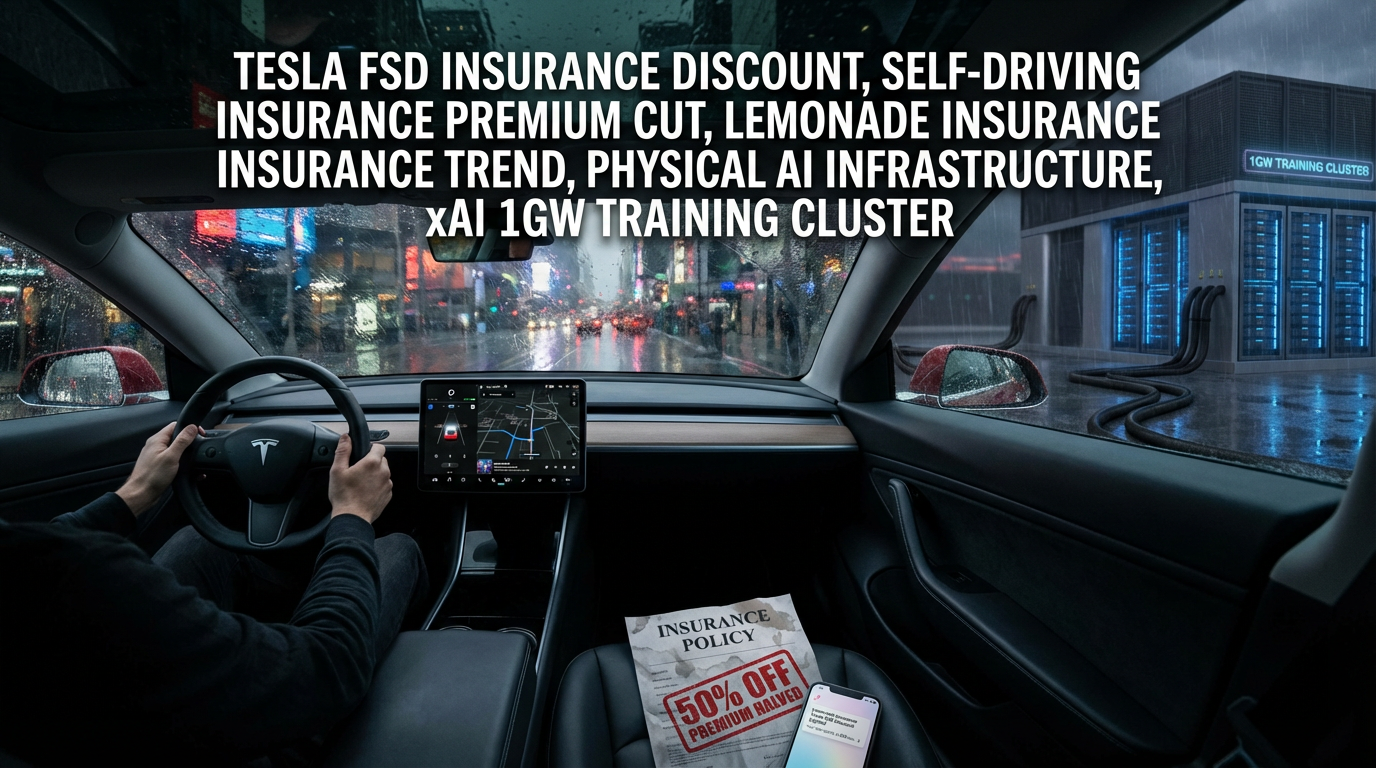
The core point is that the American AI insurer Lemonade has hinted/announced a “50% discount on auto insurance when using Tesla FSD.”
If this logic is true, for some drivers there emerges a range where the FSD monthly subscription fee (about $99) is smaller than the insurance discount amount.
In other words, the structure becomes not “you use autonomous driving because it’s convenient” but “you use autonomous driving because it saves you money.”
Why this is shocking to the market
Insurance is an industry that prices “safety,” and those prices are governed by statistics.
An insurer cutting premiums in half means either a judgment that “risk is that much lower” or at least confidence that “it’s a profitable structure to win competition.”
In capitalism, prices rarely lie.
2) The essence of insurance: an industry that tied people to prices using “a century of statistics”
The economic moat of traditional insurers was data
Insurance ultimately comes down to predicting accident rates, so it has computed “who is more likely to cause accidents” using large-scale aggregated data.
Example: charging young men more and 50-year-old women less, that kind of thing.
Why Buffett likes insurance
As mentioned in the original text, one of the core cash generators supporting the Berkshire Hathaway empire is insurance (notably GEICO).
If done properly, insurance is a business with very strong cash flow and strong economies of scale.
3) The point where Tesla shakes insurance: “past statistics” versus “real-time behavioral data”
Traditional insurance = using past data to predict the future
Tesla-style insurance/risk assessment = observed in real time from the vehicle
Tesla collects very granular data from vehicle sensors and driving systems about driver behavior and driving environments.
It accumulates “causal data for accident probability” in real time: braking habits, steering inputs, movements of surrounding objects, responses to hazardous situations, and so on.
The reason this is frightening is simple.
Once premiums are determined by individual behavior instead of group averages, the pricing models of traditional insurers collapse.
4) The moment it becomes “a loss not to use FSD”: the subscription model replacing insurance
What changes economically
In cases where insurance premiums are around $200 per month, a 50% discount represents a $100 monthly saving.
There will be people for whom the FSD subscription fee (around $99 per month) is about the same or even smaller than the discount they receive.
What this implies
Part of auto insurance premiums moves from “insurer revenue” to “Tesla software subscription revenue.”
In the long run this shrinks the pie for traditional insurers and shifts the economic value toward software-based safety systems.
This is not merely good news for Tesla; it should be seen as a signal that the value chain of insurance and financial services in the U.S. is being reorganized.
5) The regulatory variable: state-by-state insurance and autonomous driving regulation is a bigger enemy than “technology”
This is the realistic part among the original points.
The United States has different insurance regulations and product approval processes by state, and there are states where Tesla insurance cannot enter.
So if a firm like Lemonade creates a workaround by offering discounts tied to Tesla FSD usage, the spread could accelerate.
In summary,
with technology at a certain level, regulatory risk is likely to determine the speed of business expansion.
In this segment the market can react to regulatory issues as sensitively as to interest rate movements.
6) The bigger picture: what xAI’s 1GW training cluster and Tesla’s AI chip roadmap imply
(1) xAI’s “1GW-class” training cluster signals a change in the scale of the “AI production factory”
1GW is comparable to the power consumption of a city.
Infrastructure at this scale means “AI has become an infrastructure industry,” and it drives investments in data center power, cooling, land, and grid upgrades.
In other words, AI impacts not only the tech sector but also inflation and CAPEX cycles for infrastructure.
(2) Edge vehicle chips like AI5 (2nm) reduce the cost of “AI that operates in the real world”
Autonomous driving cannot rely solely on the cloud.
Vehicles must make immediate decisions.
As edge chip performance and power efficiency improve, both “autonomous driving safety” and “the capacity to offer insurance discounts” increase.
(3) Result: the way physical AI makes money changes
Now AI will generate revenue not only through ads and subscriptions,
but by directly reducing “real-world costs” such as insurance premiums (risk pricing), accident costs, logistics costs, and maintenance expenses.
If more models like this emerge, the macro effect is expected productivity improvement (positive for long-term growth), while in the short term there could be a boom in investment for power, semiconductors, and data centers, triggering strong sector rotation in the stock market.
7) News-style summary: one line takeaways for this issue today
[Insurance] An AI insurer hinted at a 50% discount for Tesla FSD users → change in safety pricing.
[Business model] There emerges a range where insurance savings offset FSD subscription fees → reframing autonomous driving from a cost to a saving.
[Industry structure] Moving from group-statistics-based insurance to individual behavior-based insurance → weakening the economic moat of traditional insurers.
[Regulation] Spread speed will be determined by state-level rules → partner insurers can provide workarounds where Tesla insurance cannot operate.
[AI infrastructure] xAI 1GW cluster and vehicle AI chip roadmap → lowering training and deployment costs for physical AI → simultaneously improving safety and price competitiveness.
8) The “really important points” that many YouTube videos and news outlets miss
Point A: The “insurance discount” is effectively a new form of subsidy (incentive)
It is not a government subsidy but a private insurance discount that pushes autonomous driving adoption.
If this spreads, consumers will enable autonomous driving not because the feature is superior but because they do not want to lose out economically.
The technology adoption curve could accelerate significantly.
Point B: When insurers lower prices, the social burden of accident costs is redistributed
Autonomous driving users naturally pay less while manual drivers pay more.
As a result, “manual driving” becomes treated more like a luxury, further increasing the share of autonomous driving on the road and creating a feedback loop that reduces accident rates.
Point C: The competitor to insurance companies becomes “software subscriptions,” not just other insurers
If premiums fall, the total revenue of the insurance industry shrinks.
Where that reduced money flows is the key question, and it is likely to move to autonomous driving software and vehicle data platforms.
This should be seen as a structural shift of value from traditional finance to AI, semiconductors, and platforms.
< Summary >
Lemonade’s suggestion of “a 50% discount on insurance premiums when using Tesla FSD” is a signal that autonomous driving safety is beginning to be reflected in insurance pricing.
For some, the FSD subscription fee (about $99 per month) will be outweighed by the insurance discount, creating a situation where “using autonomous driving leaves you better off financially.”
This accelerates the shift from group-statistics-based insurance to individual behavior-based insurance, weakening the traditional insurer’s moat.
Meanwhile, xAI’s 1GW training cluster and the vehicle AI chip roadmap accelerate the spread of physical AI, with potential to reorganize insurance, transportation, and infrastructure industries.
[Related posts…]
- The Impact of Tesla Autonomous Driving (FSD) on Insurance and Mobility Markets
- When Premiums Change, the Market Changes: The Price-Setting Structure in the AI Insurance Era
*Source: [ 월텍남 – 월스트리트 테크남 ]
– 폭주하는 테슬라, 이제 자율주행하면 오히려 돈을 받는다고?! / 보험회사의 충격적인 발표 ㅎㄷㄷ