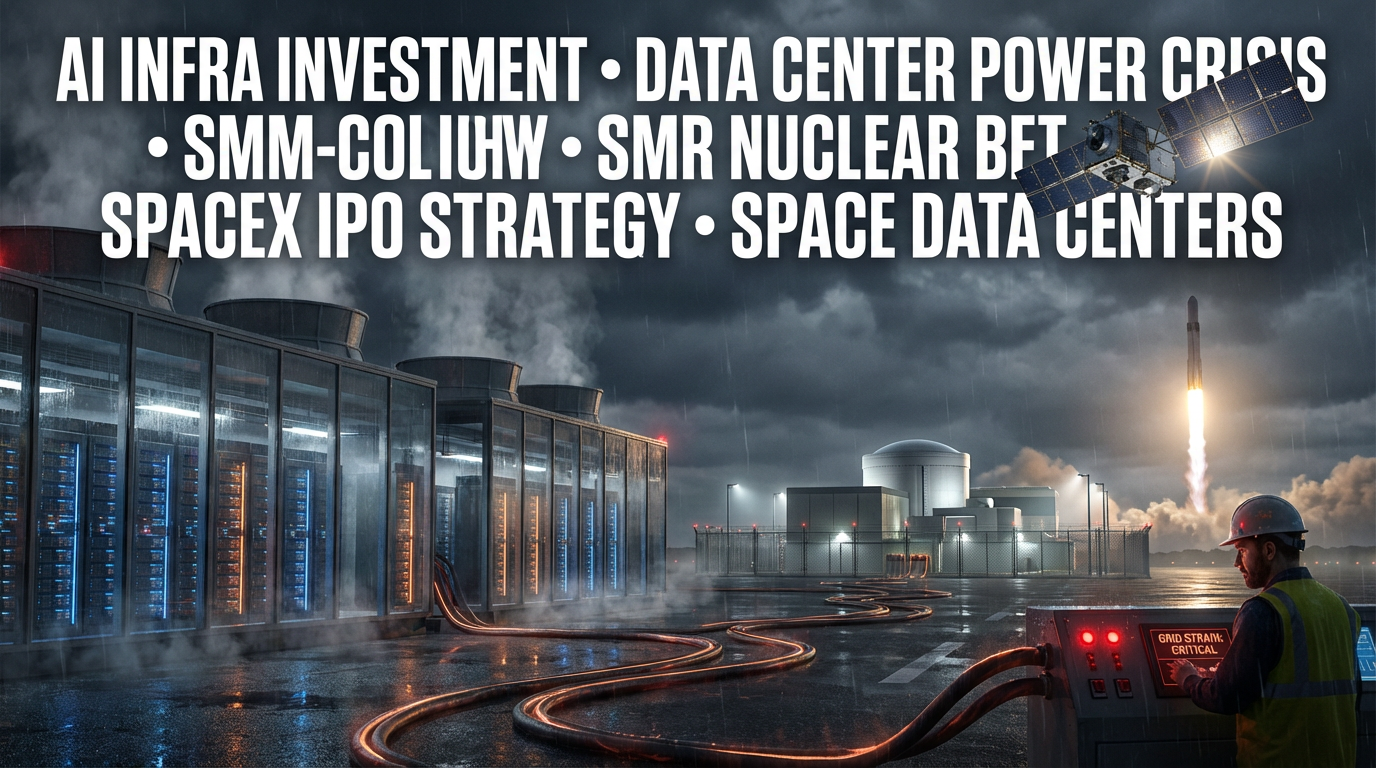
● SpaceX IPO Shockwave, AI Power Crunch Sparks Nuclear Rush and Space Data Center Race
Talk of the SpaceX IPO, the real core point is not ‘going public’ but ‘power supremacy’: Why the AI war is spreading to electricity, nuclear power, and space
This article will summarize exactly four things at once.
① Why “There is plenty of AI but no electricity” changes the global economic trend for 2026–2030.
② The real reason Big Tech is obsessed with nuclear power (especially SMR) and the next money channel for AI infrastructure investment.
③ How a SpaceX IPO links to ‘space data centers/space solar’ as a way to bypass ground power bottlenecks.
④ A conclusion that many news outlets miss: going forward, energy, power grids, cooling, and launch vehicles will decide AI outcomes more than model competition.
1) [Breaking format] A sentence Musk threw at Davos: “The fundamental limit of AI deployment is power”
core point message: “By the end of this year we will be able to build more AI than the available power can support.”
The gist is simple.
AI models keep being created, but there is not enough electricity (power) to run them, so “actual service/inference/training” is blocked.
This means that data center power shortages have become an economic issue, not just a technical one.
Why this matters from an economic perspective
As AI grows, power demand spikes, and if power grid expansion and generation capacity are slow, bottlenecks appear.
When bottlenecks occur, what drives investment and policy is not AI revenue but power, transmission and distribution, cooling, land, and regulation.
Ultimately, the next cycle’s leadership will shift from “model performance” to “ability to secure power.”
2) [News summary] Why Big Tech is moving toward nuclear power: “If you bought a supercar you need to buy the gas station”
The original analogy (supercar vs gas station) is extremely accurate.
AI doesn’t just require high-performance GPUs/accelerators; it also needs steady 24/7 power to become a business.
Recent developments (summarized like a news article)
– Big Tech is increasing touchpoints with nuclear power companies and the SMR ecosystem.
– Rather than just long-term data center power purchase agreements (PPAs), they are considering equity and investment in the power production value chain itself.
– The reason is simple: power price, reliability, and predictability determine AI profitability.
Key keyword here
Nuclear power is not just a green/carbon-neutral slogan; it is a war to secure the AI era’s baseload power.
In particular, SMR (small modular reactors) are repeatedly mentioned because of expectations that they can be deployed faster than large reactors.
On a macro level this links to inflation/interest rates
Power infrastructure expansion is CAPEX-intensive, so over the medium term it stimulates demand for raw materials, equipment, and construction.
In short, AI is a digital industry but acts as a catalyst to revive the real investment cycle.
3) [core point development] Why Sam Altman and Musk look to “space”: a design to bypass ground power limits
On the ground, power grid expansion is slow and there are many variables like regulation, local opposition, transmission lines, land, and cooling water.
So one step further yields this thought experiment.
“What if we take power/computation directly from the place with the most sunlight (space)?”
Assumptions that make this logic plausible
– Reusable rockets reduce launch costs.
– Satellite and orbital infrastructure are entering commercial stages.
– AI computation depends on ‘power + cooling + network’, and on Earth the most expensive items are power and cooling.
4) [Case] The meaning of the experiment “They ran Nvidia chips in space to run AI”
As mentioned in the original text, the event of putting GPUs (Nvidia family) on a satellite and running AI models in orbit is highly symbolic.
Here’s why it matters.
Meaning 1: ‘Space data centers’ become a roadmap rather than a joke
Ground data centers face bottlenecks for power intake, cooling, and permits, while space offers an alternative way to solve those bottlenecks.
Meaning 2: The AI battlefield expands from ‘chips’ to ‘systems (power + cooling + transport)’
No matter how good GPUs are, if you cannot handle the power and heat, you cannot extract performance.
So going forward, the likelihood increases that “who has better infrastructure” will matter more than “who has the better model.”
5) Three reasons to put up space data centers (tidying the original logic)
① Solar efficiency (availability/time/conditions) becomes overwhelmingly better
On the ground there are night/clouds/seasons/latitude effects, but orbital conditions are different.
This can be interpreted as reducing the “variability of power production.”
② Reworking the cooling cost structure
Cooling is a real money-eater for ground data centers.
Space is different, and the core point is that “how to dump heat” can be approached with a completely different design than on Earth.
③ Bypassing ground power grid bottlenecks (transmission, permitting, local opposition)
On the ground, building a power plant is not the end; you also need the transmission and distribution network.
Those systems are slow, which often prevents data centers from being built.
6) SpaceX IPO’s ‘real purpose’ scenario: capital raising for space data centers and energy infrastructure
The original text mentions “SpaceX raising more than $30 billion through an IPO,” but the point is not the amount itself but the destination of the capital.
Possible big picture (reinterpreted)
– Phase 1: Expand ground solar, batteries, power grids, and data centers as much as possible
– Phase 2: Attach stable power for AI uptime via nuclear/SMR
– Phase 3: If still insufficient, explore space (orbit) infrastructure to break the ceiling on ‘power + computation’
In other words, the IPO could be seen not merely as “a space transport company’s listing” but as project financing to expand AI infrastructure into space.
7) (A point many miss) The economic structural change implied by “energy is the limit of intelligence”
From here on it gets truly important, and general news/YouTube often overlook this.
Point A: AI is becoming an ‘energy-intensive industry,’ not just a software industry
Going forward, AI will be a battle over cost per kWh and utilization, not just cloud fees or subscription prices.
That means AI’s cost structure will become as sensitive to energy prices as semiconductors are.
Point B: National competitiveness will be determined more by “power, transmission, nuclear, land, and water” than by “models”
Countries with slow power permitting and weak transmission networks will be disadvantaged in attracting AI data centers.
Thus AI dominance won’t be decided only by the number of engineers but by state capacity, including infrastructure, bureaucracy, and regulation.
Point C: Space data centers may face finance, insurance, and regulation bottlenecks before technical ones
Even if the technology works, asset insurance, liability for accidents, orbital debris (congested orbits) regulation, and spectrum/communications rules could be the bigger hurdles.
This is a core risk that receives less coverage in the news.
8) Translating Musk’s “universal high-income (UHI) era” into economics
The original nuance is that this will upend human-labor-based economies.
Economically translated, it looks like this.
① Labor (wages) → capital (robots/AI) substitution accelerates
If humanoid robots and physical AI are commercialized, certain industries will face labor supply shocks.
② Distribution issues grow larger
Even if productivity rises, income will not automatically distribute evenly.
So UBI/UHI is not just about technological optimism but about tax policy, social contracts, and political agreement.
③ A tug-of-war between ‘interest rates’ and ‘productivity’ begins
If AI raises productivity, there could be deflationary pressure, but at the same time large CAPEX for power and infrastructure could create inflationary pressure.
These two forces colliding could make macro interpretation much more difficult in coming years.
9) Watchlist going forward (checklist)
Power: Data center power contract (PPA) prices, pace of regional transmission expansion.
Nuclear/SMR: Whether permitting times shorten, fuel supply chains, changes in safety regulation.
Semiconductors: Whether competition shifts from GPU supply to “performance per watt (Perf/W).”
Space: Trends in launch costs, orbital regulation, latency/bandwidth issues for satellite data centers.
Policy: National AI data center attraction policies (tax incentives vs shifting grid burden to hosts).
10) The “most important points” that other YouTube/news rarely cover
1) The winner in AI will likely be determined not by “who has the better model” but by who owns/controls power, transmission, and cooling.
2) Big Tech’s move into nuclear is less about ESG marketing and more about vertical integration to stabilize AI cost structures.
3) Space data centers are more likely to be bottlenecked by finance (insurance/liability), regulation (orbit/communications), and operations (impossibility of physical maintenance) than by technology.
4) The “SpaceX IPO” should be seen not as an investment event but as a capital-raising event that could reallocate energy-computing supremacy long-term.
5) On a macro scale, AI may re-stimulate global supply chains and real CAPEX, re-highlighting manufacturing and infrastructure cycles in economic fluctuations.
< Summary >
The real bottleneck to AI proliferation is power, and data center power shortages are becoming a global economic issue.
Big Tech is expanding the value chain to include nuclear/SMR to secure stable power and accelerate AI infrastructure investment.
The SpaceX IPO is not merely a listing event; it could lead to projects like space solar and space data centers that bypass terrestrial bottlenecks.
Going forward, AI competition is more likely to be decided by control of power, transmission, cooling, and launch vehicles than by model performance.
Related articles…
- Summary of nuclear investment trends and the AI data center power war
- A map of supply chain beneficiaries created by data center power shortages
*Source: [ 월텍남 – 월스트리트 테크남 ]
– 스페이스 X상장.. 사실 목적은 따로 있다?