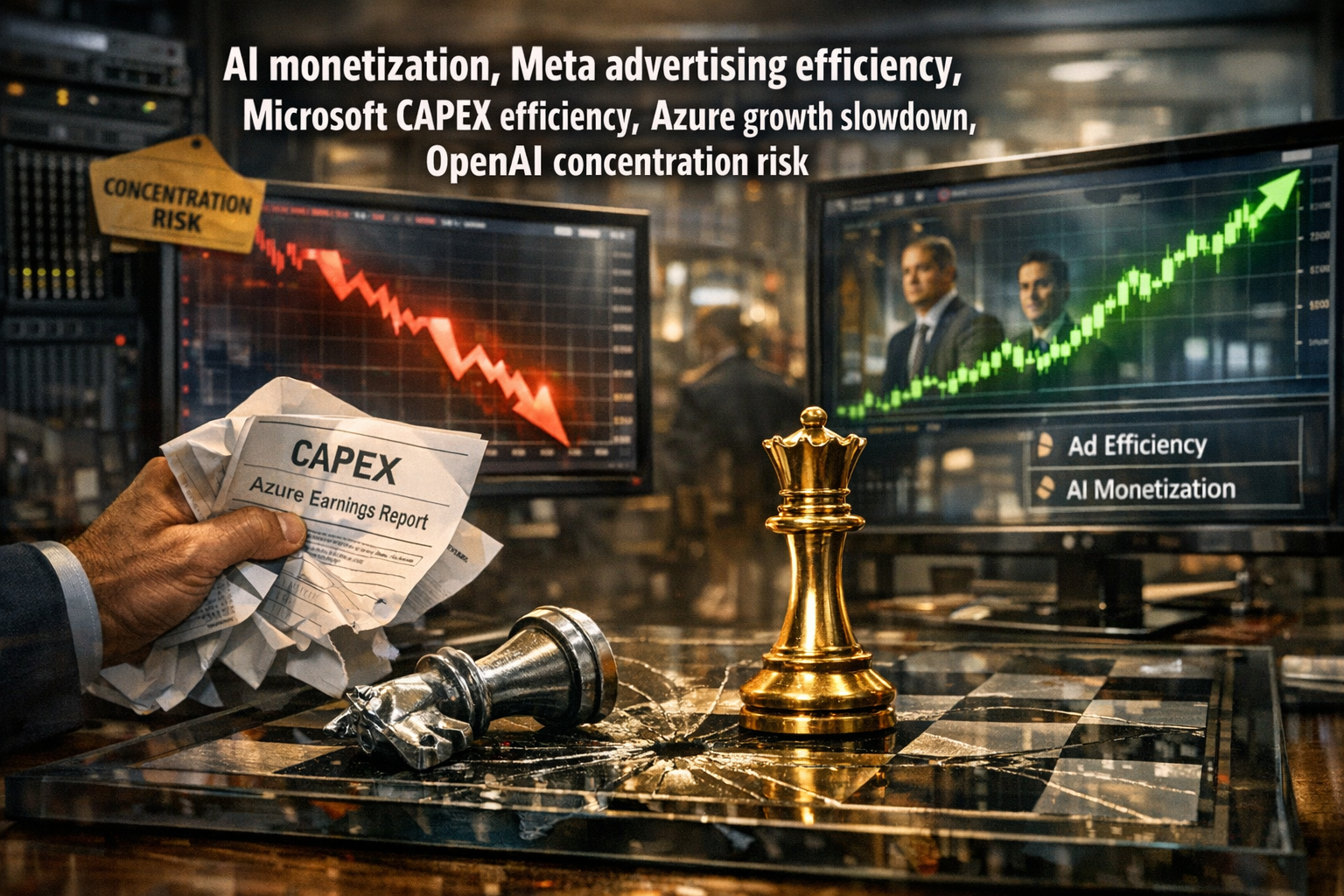
● Microsoft Plunges, AI Monetization Panic, Meta Defies Capex Surge
Microsoft’s First Double-Digit Drop in 6 Years: Whether This Signals an AI Bubble Break, Why Meta Outperformed, and Two Potential Next Sell-Off Triggers
This report consolidates four points:
1) Why Microsoft declined sharply for the first time in six years despite solid headline results
2) Why Meta rallied while Microsoft sold off, despite both increasing CAPEX materially
3) Whether the move marks the start of an AI bubble collapse or a healthy re-rating
4) A separate checklist of key risk signals that are often underemphasized in mainstream coverage
1) Market summary (news brief)
The Nasdaq fell intraday to roughly -2% before trimming losses into the close.
The initial catalysts were (i) a post-earnings sell-off in Microsoft and (ii) renewed concerns over a U.S. government shutdown.
Risk sentiment partially stabilized after comments related to shutdown-avoidance negotiations, but Microsoft remained the primary driver of market tone.
2) Microsoft’s sharp sell-off: Results were not weak; AI monetization visibility deteriorated
2-1. Why the stock declined despite a headline beat
Microsoft exceeded consensus on revenue and net income, yet the stock fell approximately 11–12%.
Such moves are infrequent and typically reflect a reassessment of structural confidence rather than near-term earnings weakness.
2-2. Three investor concerns: CAPEX surge, Azure deceleration, and OpenAI concentration
(1) CAPEX surge: accelerated spending on GPUs, servers, and data centers
Market focus has shifted from “AI growth” to the controllability and payback profile of AI-related CAPEX.
(2) Azure growth undershot expectations
Investors largely anchor AI monetization to cloud workload growth. Weaker-than-expected Azure growth reduces perceived evidence that AI demand is translating into scalable revenue.
(3) Backlog of 625B, +110% YoY, with ~45% tied to OpenAI
While the absolute figure is strong, high dependence on a single counterparty increases concentration risk and can invert strong headline metrics into a valuation headwind. Competitive pressure across enterprise and consumer AI remains a persistent market concern.
2-3. Management’s key explanation: GPU allocation prioritized first-party products
Microsoft indicated that GPU capacity was allocated preferentially to first-party demand (e.g., Microsoft 365 Copilot) rather than third-party Azure workloads.
The message implies demand strength but supply constraints (chips, power, data-center capacity) limiting reported Azure acceleration; the market response suggests reduced tolerance for delayed monetization timelines.
3) Why Meta rallied despite higher CAPEX: Quantifiable ROI already visible in the core business
3-1. Meta’s key earnings takeaways
Meta delivered revenue growth of ~24% YoY, above expectations, with net income also beating consensus.
The market’s strongest positive signal was forward guidance interpreted as enabling ~30% YoY growth next quarter, a level not commonly seen since 2021.
3-2. “AI translated into revenue”: time spent up → ad inventory up → pricing up
Meta provided operating metrics indicating AI-driven recommendation improvements that increased engagement and content consumption, supporting ad supply expansion alongside higher pricing.
Rising pricing alongside increased impressions indicates advertisers are seeing measurable performance, reinforcing the monetization narrative.
3-3. Why the market tolerated higher CAPEX
Meta discussed 2026 CAPEX in the 115–135B range. The market reaction suggests investors view the spend as funded by observable revenue and margin support from AI-driven ad efficiency gains.
4) Assessment: More consistent with a monetization proof phase than a broad AI bubble collapse
The price action is more consistent with a re-rating process based on demonstrable monetization than a wholesale abandonment of the AI theme.
Platforms where AI directly lifts core revenue (e.g., advertising efficiency) are being rewarded, while companies with rapidly rising CAPEX and less clear revenue conversion are facing valuation compression.
5) Key points often underemphasized
5-1. Microsoft’s central risk is not current earnings but low product penetration
Microsoft 365 has approximately 450 million paid accounts; if Copilot users are roughly 15 million, penetration is ~3%.
While low penetration can imply runway, it also raises questions about product value, pricing, and workflow utility given the breadth of the installed base and bundling leverage. Early signs of an AI-led de-rating often appear in adoption and conversion metrics before they appear in headline financials.
5-2. ~45% OpenAI dependence may signal strategic ambiguity
A backlog heavily tied to OpenAI is not only a customer concentration issue; it can also be interpreted as uncertainty in Microsoft’s longer-term AI roadmap (in-house models vs. multi-model strategy vs. partnerships). Elevated CAPEX alongside perceived strategic inconsistency reduces the probability of sustaining a premium multiple.
5-3. The higher-probability “true sell-off” triggers are not single-day drawdowns but a CAPEX pivot
Single-day declines are common; systemic risk increases if the following occur concurrently:
1) Multiple large-cap companies confirm through reported results that AI monetization is not materializing
2) Mega-cap firms simultaneously reduce or materially de-risk data-center and AI CAPEX plans
6) Investor checklist for upcoming quarters
AI monetization: separate where AI revenue is recognized (cloud, advertising, subscriptions, enterprise) by company
Cloud growth: monitor divergence among Azure, Google Cloud, and AWS growth trajectories
CAPEX vs. margins: quantify how CAPEX growth affects operating margins and whether management frames the impact as temporary
Customer concentration: assess reliance on single partners/customers within AI-related revenue and backlog
Policy and macro risk: track whether shutdown risk, rates, and regulatory developments amplify near-term volatility
Market sensitivity typically clusters around:
rates, inflation, recession risk, global supply chains, and U.S. dollar strength.
< Summary >
Microsoft’s decline reflects reduced confidence in AI monetization visibility amid surging CAPEX, softer-than-expected Azure growth, and concentrated exposure to OpenAI, rather than an outright earnings miss.
Meta outperformed because it demonstrated measurable AI-driven engagement gains translating into advertising revenue and pricing power, enabling investors to underwrite higher CAPEX.
This phase appears closer to a monetization proof and valuation re-rating cycle than a broad AI bubble collapse; the primary risk signal is a synchronized pullback in mega-cap AI CAPEX.
[Related]
- Post-Microsoft earnings re-pricing: key points to reassess mega-cap positioning
- Meta earnings and AI-driven ad optimization: next-quarter monitoring checklist
*Source: [ 내일은 투자왕 – 김단테 ]
– 6년만의 대폭락. 버블 붕괴 시작인가?
● AI Shakeout, Big Tech Bloodbath, Gold Surge, War Fear, Rates Higher Longer
2026.01.29 Key Takeaways from the New York Session: “AI Is Now Valued as ‘Earnings,’ Not ‘Investment’” + Gold at $5,600, Middle East Risk, and a U.S. GDP Upgrade
This report focuses on five items:
1) Why Microsoft declined ~10% despite a broadly solid earnings print
2) How Meta is being re-rated from an advertising company to an AI-driven cash-generation platform
3) Why Tesla’s equity is holding up despite weak vehicle fundamentals (pivot toward physical AI)
4) How a potential U.S. strike scenario involving Iran can accelerate gold to $5,600 and reinforce a commodity supercycle via a geopolitical risk premium
5) The market’s key implication from Goldman Sachs raising its U.S. GDP outlook to 2.9%
1) One-line market summary: “Big Tech earnings tape + intensified AI differentiation”
With the S&P 500 having recently touched 7,000, sensitivity to earnings and guidance remained elevated.
Meta rose ~8–9%, while Microsoft fell ~10%, pressuring the Nasdaq.
The key shift is that markets are increasingly assessing AI through monetization and cash-flow conversion rather than AI participation alone.
This repricing was reflected across U.S. equities, with volatility (VIX) higher.
The move signals a regime change in valuation criteria rather than a single-event reaction.
2) Microsoft -10%: not an earnings miss, but scrutiny of AI CAPEX efficiency
The earnings profile was not structurally weak.
Cloud (including Azure) growth was reported at 39%, a strong headline figure.
The sell-off centered on whether quarterly CAPEX of $37.5bn can translate into commensurate near-term earnings leverage and margin durability.
Market framing has shifted:
– Prior: “Build capacity first; monetize later”
– Now: “Demonstrate monetization and operating leverage alongside capacity expansion”
A Morgan Stanley action removing Microsoft from a “top pick” list amplified the downside.
The core issue is return on invested capital / equity and margin pressure risk from accelerated AI infrastructure spend.
AI infrastructure investment is increasingly treated as a potential margin headwind unless paired with clear monetization evidence.
The reaction is viewed as broader than a single-name event, influencing the market’s AI valuation framework.
Peer volatility across software/platform names (e.g., Oracle, Palantir) reflected the same mechanism.
3) Meta +9%: a near-term, measurable AI monetization model
Meta provided a straightforward monetization pathway: applying AI to improve ad efficiency across high-engagement surfaces (Instagram/Threads), translating directly into revenue and margin.
– Ad exposure/engagement improvement: ~18%
– Ad pricing uplift: ~6%
This differs from deferred “data center now, monetization later” narratives; the impact is visible in current revenue and profitability.
Following the results, Wedbush raised its price target to $900, with Goldman Sachs and JPMorgan also turning more constructive.
Meta is also recycling advertising cash flows into next-generation devices (e.g., Ray-Ban smart glasses), supporting a potential platform transition:
AI monetization (ads) → cash generation → next-device investment → platform repositioning
4) Tesla: weak reported fundamentals, but supported by a “physical AI” valuation lens
Reported fundamentals were weak:
– Revenue: $24.9bn, -3% YoY
– Net income: $0.84bn, -61% YoY
– Vehicle deliveries and annual sales down
Price resilience is more consistent with investors increasingly valuing Tesla as a physical AI platform rather than a conventional auto OEM.
Key cited triggers:
1) Model S/X production-line transition (greater emphasis on Optimus)
2) Robotaxi: plan to expand to 7 cities within 1H
3) $2bn investment in xAI (Grok), with ecosystem synergy highlighted
Primary watch items are regulatory clearance and execution timelines for robotaxi scaling and Optimus production, rather than a near-term rebound in vehicle unit sales.
5) Middle East risk (potential U.S.-Iran escalation) → gold touches $5,600: commodity supercycle absorbs a war premium
Risk-off positioning favored hard assets:
– Gold touched $5,600 (new highs)
– Broad strength across silver, copper, palladium
– WTI crude surged (mid-single digits)
This appears to extend beyond a generic safe-haven bid.
A commodity supercycle framework is reinforced by an incremental geopolitical risk premium: structural demand (power grids/data centers/defense/reshoring) + supply constraints + escalation risk.
Defense earnings strength (e.g., Lockheed Martin) aligned with this setup, including record backlog and rising missile/fire-control revenue, supporting the view that defense demand is becoming more structurally inelastic.
6) Goldman Sachs raises U.S. GDP to 2.9%: recession risk repriced lower; “higher-for-longer” remains plausible
A higher GDP track is superficially risk-positive, but it reduces urgency for aggressive rate cuts.
This supports a longer period of policy hold or limited easing.
The implication is a market driven less by multiple expansion from cheaper capital and more by realized earnings and operating leverage.
This backdrop is consistent with Microsoft de-rating on CAPEX efficiency concerns and Meta re-rating on demonstrated monetization.
7) Headline checklist
- Microsoft sold off as quarterly AI CAPEX of $37.5bn drew focus; market shifts toward verifying “AI investment-to-earnings” conversion
- Meta surged on ad-driven AI monetization; Wedbush raised its price target to $900
- Tesla held up despite weak vehicle results; physical AI narrative supported by Optimus, robotaxi, and xAI linkage
- Rising U.S.-Iran tension risk pushed gold to $5,600; oil and industrial metals rallied in tandem
- Goldman Sachs raised U.S. GDP outlook to 2.9%; supports a scenario of prolonged restrictive policy and earnings-driven equity selection
8) Core point frequently underemphasized
The key issue is not whether an AI bubble is forming or deflating.
The unit of valuation has changed.
① AI is increasingly scored by cash-flow conversion speed, not by the scale of infrastructure buildout.
Microsoft is positioned as a capacity builder; Meta is positioned as a near-term monetizer.
The relative premium shift reflects this criterion change.
② AI CAPEX is now assessed not only as growth investment but also as a potential margin and return-risk factor.
Earnings calls are increasingly judged on explicit proof statements linking CAPEX to ARPU, ad pricing, subscription conversion, and retention improvements.
③ The gold rally may be pricing in inflation re-acceleration risk in addition to safe-haven demand.
Broad-based commodity strength can compress corporate margins and influence rate expectations, increasing macro sensitivity in tech valuations.
< Summary >
Microsoft’s decline reflects a shift toward ROI verification on AI CAPEX rather than an outright earnings failure.
Meta demonstrated immediate AI monetization via advertising, prompting broad price-target upgrades and a re-rating.
Tesla is increasingly valued through an Optimus/robotaxi-led physical AI framework rather than EV unit economics.
Middle East escalation risk lifted gold to $5,600 and propelled oil and metals, reinforcing a commodity supercycle with a geopolitical premium.
Goldman’s 2.9% U.S. GDP upgrade supports a longer “higher-for-longer” policy stance and a more earnings-driven market.
[Related Links…]
- AI Monetization Separates Winners: Three Metrics to Track in Big Tech Earnings
- Gold Surge and the Commodity Supercycle: Inflation Implications and Portfolio Strategy
*Source: [ Maeil Business Newspaper ]
– 美 이란 침공? 금 5600달러 터치ㅣ웨드부시, 메타 목표가 900달러로 상향ㅣ골드만, 올해 美GDP 2.9%(예상치 상회)ㅣ홍키자의 매일뉴욕