● 2026 SMR Showdown, US Cash Blitz to Stop China AI Power Grab
Full-Scale “SMR War” in 2026: If the U.S. Falls Behind China, AI Power Dominance Is at Risk (Policy, Budget, Big Tech Capital, and the Beneficiary Value Chain)
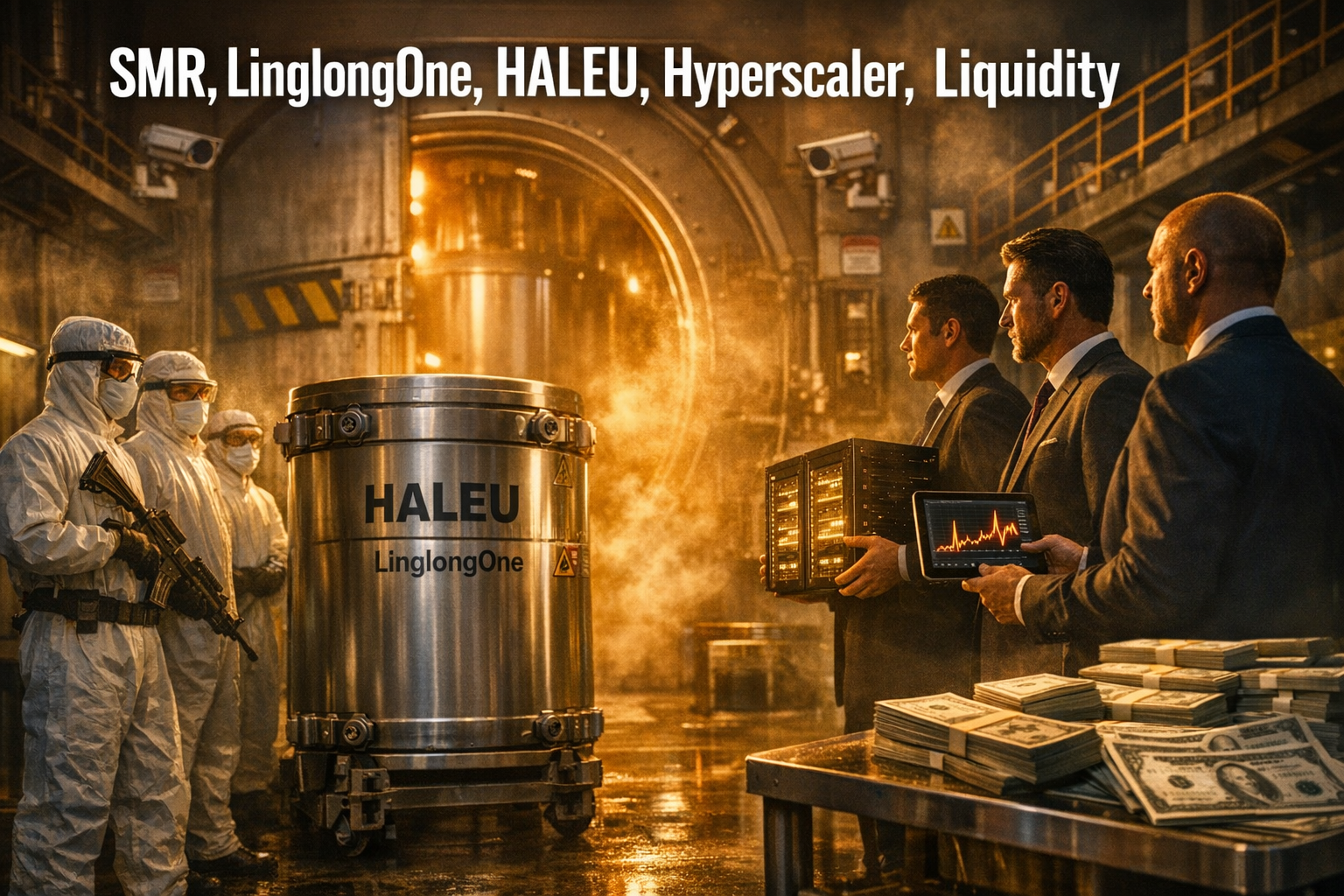
This report consolidates why the U.S. is treating SMRs (small modular reactors) as a deadline-driven priority in 2026 and deploying significant capital. It covers: (1) why 2026 matters (China’s Linglong One), (2) how U.S. legislation and executive actions translate into funding flows, (3) what the DOE’s HALEU budget and Meta’s SMR agreements indicate about an emerging power constraint, (4) where capital is likely to concentrate first within the SMR value chain (design and fuel), and (5) key volatility risks (equity offerings and insider selling). The final section isolates the most material points typically omitted from mainstream coverage.
1) Key Development: The U.S. 2026 SMR Push as an “AI Power-Supply Competition”
The U.S. remains relatively advantaged in semiconductors, but concerns are rising that China has structural advantages in electricity costs, power supply, and energy supply chains. As AI data center competition intensifies, power availability (grid capacity, generation, and fuel) increasingly determines the operating cost curve and deployment pace. SMRs are repositioned as a deployable nuclear option for stable baseload supply.
2) Why 2026 Is the “Deadline”: Commercialization Pressure from China’s Linglong One
China’s planned commercialization of the Linglong One SMR in 2026 is framed as a geopolitical risk rather than a pure technology race.
If China sustains an electricity cost and reliability advantage, it can operate AI training and inference at lower cost and higher utilization, influencing AI industry competitiveness. Expanded SMR exports to third countries (e.g., Africa and the Middle East) may further extend energy influence.
Accordingly, 2026 is treated as a tipping year for SMR standards, exports, and allied supply-chain alignment.
3) U.S. Execution Roadmap (2024–2026): Law → Executive Action → Military as Anchor Customer → Budget Deployment
3-1. 2024: Regulatory Foundation (Streamlining Licensing and Export Approvals)
In July 2024, legislative momentum aligned with the ADVANCE Act direction emphasized shorter timelines for nuclear/SMR licensing, siting, and overseas export approvals. This phase targets regulatory bottlenecks before large-scale capital deployment.
3-2. 2025: Executive Direction Raises the Target (4x Nuclear Capacity)
In 2025, an executive policy signal indicated an expansion target of nuclear capacity from 100 GW to 400 GW by 2050. For capital-intensive industries, a long-duration demand signal reduces uncertainty and can affect financing conditions.
3-3. October 2025: “Project Janus” (U.S. Military as Early Customer)
The U.S. Army’s role as an early customer is positioned to provide initial demand and support deployment pathways. For SMR developers with limited revenue history, government and defense procurement can serve as an anchor, improving bankability and enabling a “public-sector revenue → private-sector expansion” trajectory.
4) Visible Capital Direction in 2026: Fuel (HALEU) and Big Tech (Meta)
4-1. DOE HALEU Budget Deployment Begins
In early 2026, the U.S. Department of Energy began deploying HALEU (high-assay low-enriched uranium) procurement and capacity funding. The referenced 규모 is approximately USD 0.9 billion (about KRW 1.2 trillion equivalent), with potential direct linkage to U.S.-based producers (e.g., Centrus Energy).
The strategic objective is to reduce reliance on Russia and establish domestic supply-chain capacity. As SMR deployment scales, HALEU availability becomes a binding constraint; government funding is positioned to relieve that constraint early.
This indicates prioritization of supply-chain independence alongside reactor development.
4-2. Meta’s SMR Investment/Contracting: Formal Confirmation That the Next Bottleneck After Chips Is Power
On January 9, 2026, Meta referenced investment and/or contracting activity involving SMR players such as Oklo and TerraPower. The material takeaway is not immediate generation output, but the shift toward long-term power contracting and partial internalization of energy supply by hyperscalers.
AI infrastructure expansion is constrained by data center buildout, which is constrained by power procurement and interconnection. In an inflationary environment (construction and power-price pressure), long-term power positioning becomes increasingly strategic.
5) Late-2025 Pullback Drivers: Theme Risk and Growth-Equity Mechanics (Financing and Selling Pressure)
Two primary drivers were highlighted:
First, a broader valuation reset in AI-linked assets contributed to drawdowns across adjacent themes, including SMRs.
Second, idiosyncratic equity events (follow-on offerings, major shareholder sales, and lock-up expirations) increased volatility.
Given that many SMR equities are priced on expectations rather than operating earnings, financing activity and early-investor exits can drive disproportionate price swings.
6) Where Capital Typically Concentrates First in the SMR Value Chain: Design and Fuel as Binding Constraints
As the cycle transitions from policy signals to budget deployment and project awards, early capital concentration is most likely in design/development and fuel (including HALEU).
- Design/Development (Leadership Segment): Required at project initiation; positioned for early-cycle benefit.
- Fuel (including HALEU): Without adequate supply, reactors cannot operate; policy and funding tend to target this bottleneck early.
- Operations (generation/utilities): Existing cash-flow bases can reduce volatility and provide downside support.
- Components/Manufacturing: Typically re-rate later as construction and serial production drive order visibility.
This framework can remain relevant even amid recession concerns, as AI-driven power demand behaves more like structural infrastructure demand than a purely cyclical variable.
7) ETF Lens: Reducing Single-Name Volatility While Targeting Bottlenecks
The “ACE US SMR Nuclear TOP 10 (0155M0)” can be interpreted as follows:
- Higher weight in SMR design companies: Positioned for early benefits as policy and awards transition into execution.
- Inclusion of fuel companies (e.g., Cameco, Centrus): HALEU/uranium supply constraints support strategic relevance over the medium to long term.
- Partial allocation to operators/utilities: Potential volatility buffer via earnings-based profiles.
A key distinction versus Korea-focused nuclear ETFs is value-chain composition: the U.S. is relatively stronger in design, fuel, and supply-chain elements, while Korea is relatively stronger in construction, EPC, and equipment. These exposures may be complementary rather than overlapping.
8) Most Material Points Often Underemphasized in Mainstream Coverage
- SMRs are not only a technology theme; they represent a supply-chain competition for power dominance. Capital often flows first to fuel (HALEU) and to licensing/regulatory capacity rather than to reactor hardware.
- The military-as-anchor-customer structure is a commercial mechanism, not merely signaling. It can reduce the early-revenue gap and improve project finance feasibility.
- Big Tech SMR activity is less about near-term generation and more about securing long-term power contracts. This can stabilize AI infrastructure cost structures, particularly under inflation pressure.
- The critical 2026 monitoring variable is repeatability of budget deployment. Beyond single announcements, markets will watch for recurring quarterly execution across HALEU, licensing, defense demand, and state-level project pipelines.
< Summary >
In 2026, China’s Linglong One commercialization timeline increases pressure on the U.S. to accelerate SMR execution. The U.S. sequence is framed as regulatory streamlining in 2024, demand signaling and defense anchoring in 2025, and tangible capital deployment in 2026 via DOE HALEU funding and hyperscaler contracting activity. The principal bottlenecks emphasized are design and fuel (HALEU). Given equity-financing and insider-selling volatility, diversified value-chain exposure is presented as a risk-aware approach.
[Related Links…]
- Why SMR Commercialization May Reshape the AI Data Center Power Landscape
- Uranium and HALEU Supply Chains: The U.S. Path to Reducing Reliance on Russia
*Source: [ 소수몽키 ]
– 이번에 중국에 밀리면 끝난다, 트럼프가 작심하고 돈 쏟아붓는 전력 수혜주들
● Liquidity Shock, Dollar Slide, Korea Stocks Surge
2026 “Risky Liquidity” Market: Why the USD, FX, and Global Liquidity Matter More Than Rates—and Why Korean Equities Re-Enter Focus
This report consolidates four core points:
1) A framework shift: in 2026, liquidity—not rate cuts—dominates asset performance.
2) Why and under what conditions the U.S. could move toward quantitative easing (QE), including practical constraints.
3) A quantitative structure explaining why USD weakness and a peak-out in USD/KRW can favor Korean equities.
4) Why capital may rotate from generative AI to “physical AI,” and the primary Korean beneficiaries.
1) Key conclusion: in 2026, “liquidity,” not “rates,” is the main driver of cross-asset performance
The central message is that 2026 is likely a liquidity-led uptrend with elevated risk. The market may rise over time while experiencing repeated, sizable drawdowns driven by risk events.
A common interpretation frames 2026 primarily as a “rate-cut cycle.” This view is incomplete. The dominant variables are more likely to be global liquidity (monetary + fiscal) and foreign exchange dynamics (the USD cycle).
2) Practical limits to U.S. rate cuts: the neutral rate may be the effective floor
2-1. A 1% policy rate is unlikely under a baseline scenario
Using a practical constraint approach: if the current policy rate is approximately 3.75% and there are six remaining FOMC meetings, even 0.25% cuts at each meeting imply a maximum total reduction of -1.50%. That would place the policy rate near 2.25%, broadly within common estimates of the U.S. neutral rate range (approximately 2–3%).
Implication: under standard policy transmission, a move toward 1% is difficult without unusually restrictive conditions. Therefore, rate cuts alone are insufficient to explain a 2026 liquidity-driven environment.
2-2. Conditions for QE: it requires concurrent progress on inflation, Treasuries, and geopolitics
QE is not an automatic “next step” after rate cuts. It becomes plausible only if multiple constraints ease simultaneously:
- De-escalation of geopolitical risks (reducing drivers of oil price spikes)
- Increased crude supply (oil stabilization → reduced inflation pressure)
- Stabilization of the U.S. Treasury market (a disorderly yield spike can offset policy easing)
- External coordination that keeps inflation pressures contained despite tariffs and trade frictions
Core point: the 2026 debate is less about “how much the Fed cuts” and more about the mechanism and scale of U.S. liquidity provision and the resulting USD direction.
3) 2026 as a U.S.-centric phase: rate cuts elsewhere are maturing; liquidity reallocation becomes central
3-1. Why early movers cut first: inflation has already approached target
Some economies cut earlier because inflation had already converged toward target levels. Tariff-driven pressure can coexist with growth deceleration, which may reduce inflation momentum in certain regions.
3-2. Korea: 0–2 cuts are possible, conditional on FX stabilization
Korea’s easing capacity is described as limited (0–2 cuts), with a key condition: USD/KRW must first decline and stabilize, broadly around the low-1400s, to create space for cuts.
4) Why Korean equities re-enter focus: after FX peaks, U.S. equities are not structurally advantaged by default
4-1. Total return framework: “equity performance × FX”
For a KRW-based investor, foreign equity returns are a function of both local-market equity performance and the USD/KRW move. Evaluating U.S. equities on price performance alone can materially misstate KRW-based outcomes.
4-2. Regime shift under USD weakness: relative attractiveness can rotate
If the U.S. is compelled to ease more aggressively (or provide additional liquidity) and policy incentives favor a weaker USD, the dollar index may soften and USD/KRW may peak and stabilize.
In that regime, even with similar equity gains, KRW-based returns from U.S. assets may be diluted by FX, while Korean equities may see relative re-rating. Reduced FX volatility can also improve foreign investor access and risk-adjusted positioning toward Korea.
4-3. Signaling effects of FX “upper-bound management”
Messaging consistent with limiting extreme USD/KRW upside can reduce perceived tail risk. Lower FX tail risk can ease valuation headwinds for Korean equities.
5) Liquidity vs. money supply: a critical distinction
Liquidity should not be conflated with monetary aggregates (M1/M2). In this framework, liquidity includes monetary policy plus fiscal policy (government spending, subsidies, debt issuance, and fiscal expansion).
Implication: even if rate cuts are limited in 2026, fiscal impulse can materially raise effective market liquidity. A rates-only approach risks missing the liquidity cycle.
6) AI rotation: from generative AI infrastructure to physical AI (deployment and real-economy productivity)
6-1. Leadership rotation: batteries → semiconductors → physical AI
AI remains a multi-year theme, but market leadership can rotate from infrastructure (GPU/HBM/data centers) toward sectors that apply AI to raise real-world productivity (“physical AI”).
6-2. What “physical AI” implies: expansion into robots, autos, devices, and networks
The referenced value chain:
- HBM/semiconductors → GPUs → data centers
- AI deployment sectors: smartphones, consumer electronics, IT devices, PCs, robots, automobiles, platforms, telecom networks
Investment implication: leadership may broaden beyond infrastructure suppliers toward industries monetizing AI through adoption and utilization.
7) Checklist: key variables for 2026
- [U.S. monetary policy] The pace of cuts is constrained primarily by inflation, Treasury-market stability, and geopolitics rather than political preference.
- [Global liquidity] The main driver is liquidity reallocation across monetary and fiscal channels, not rates alone.
- [USD/FX] If the dollar index softens, USD/KRW peak-out can increase the relative attractiveness of Korean assets.
- [Korean equities] Equity outlook is jointly determined by earnings/valuation and the degree of FX upper-tail stabilization.
- [AI trend] Post-generative infrastructure, focus may expand to physical AI across robots, autos, smart devices, and telecom.
8) Under-covered but material points
-
(1) QE is conditional, not sequential
QE does not mechanically follow rate cuts; it requires concurrent normalization in inflation, oil, and Treasury-market conditions. -
(2) Korea’s relative appeal can rise due to the USD cycle
Korean equities may benefit less from domestic improvements and more from a shift in the USD/FX regime. -
(3) Liquidity is “monetary + fiscal,” not money supply alone
The market’s marginal buyer can be driven by fiscal channels even when rate cuts are limited. -
(4) AI exposure broadens beyond semiconductors
The next leadership phase may favor adopters that convert AI into measurable productivity and cash flow.
9) Keyword tracking framework
Key analytical categories: global liquidity, USD/KRW, U.S. policy rate, dollar index, Korean equity outlook.
< Summary >
In 2026, global liquidity conditions and the USD/FX cycle are likely to be more decisive for asset performance than rate cuts alone. U.S. rate reductions may be bounded near neutral levels, while QE would require simultaneous stabilization in inflation, oil, and the Treasury market. If USD weakness and a peak-out in USD/KRW materialize, Korean equities may gain relative attractiveness versus U.S. equities for KRW-based investors and for foreign flows. AI leadership may broaden from generative infrastructure toward physical AI across robotics, autos, smart devices, and telecom, shifting attention toward utilization-driven beneficiaries.
[Related links…]
- https://NextGenInsight.net?s=FX
- https://NextGenInsight.net?s=Liquidity
*Source: [ 경제 읽어주는 남자(김광석TV) ]
– 2026년은 유동성의 시간이다. 금리보다 중요한 한 가지 : 한국 주식이 다시 보이는 이유 | 클로즈업 – [김광석의 경제학교] 특강
● High Rates Kill Hype, AI Titans Swap the Baton
US Market Leadership Is Shifting “Here”: A Stock Roadmap for an AI Earnings-Driven Market (M7, Palantir, Google Gemini, Tesla, and the Next Baton)
This report consolidates:
- Why the current market is not a broad-based rally (earnings-driven vs. liquidity-driven cycles)
- The structural reasons leadership rotated from Nvidia to Broadcom to Palantir
- Why the competitive outcome between Google Gemini and OpenAI is likely to be determined within ~3 years
- Why robotics and autonomous driving (physical AI) can be high-risk at current levels, and what conditions may define a better entry window
- Why US equity investing often resembles a “zero-to-one” framework and why the approach differs from Korea-focused strategies
- A final section highlights key points that are typically underemphasized in mainstream media coverage
1) One-line market summary: the regime is earnings-driven, not liquidity-driven
The defining shift is the end of the zero-rate “everything rallies” environment (2020–2021). In a higher-rate regime, market leadership tends to concentrate in companies with demonstrable earnings momentum.
This matters because, in this phase, index-level narratives (Nasdaq, S&P 500) are less explanatory than company-level fundamentals: earnings, free cash flow, and margin structure.
- Liquidity-driven (financial) cycle: low rates expand valuations and lift broad risk assets
- Earnings-driven cycle: higher rates increase the weight of current earnings and earnings visibility in valuation
This framework helps explain why certain large-cap names can lag despite strong brands: capital concentrates where AI-driven profitability and productivity gains are most measurable.
2) The 2026 AI leadership sequence: hardware → custom silicon → software → physical AI (robotics/autonomy)
A core premise is that leadership rotates by phase. AI momentum may persist into 2029, but capital allocation within the theme typically progresses through identifiable stages.
2-1) Act 1: AI infrastructure (Nvidia) — rapid scaling to maximize performance
Following the 2022 inflection driven by generative AI adoption, GPU-based infrastructure became the first dominant trade. Over time, markets tend to shift from performance-first deployment to cost and efficiency optimization.
2-2) Act 2: Custom silicon (Broadcom, etc.) — optimization as GPU cost rises
At scale, GPU-only expansion can become cost-prohibitive. Buyers increasingly evaluate ASICs and workload-specific custom silicon to improve unit economics, power efficiency, and operating costs.
Key point: leadership rotation often occurs when AI investment transitions from “performance competition” to “cost, power, and operating-efficiency competition.”
2-3) Act 3: AI software (Palantir, etc.) — monetizing productivity and measurable ROI
Once infrastructure is deployed, the focus moves to monetization: which companies convert AI capability into earnings. The Palantir move is framed less as thematic momentum and more as alignment with an earnings-driven tape via visible profit expansion.
- Primary KPI: AI benefits often appear first as cost reduction and faster decision cycles, not only as top-line acceleration
- Software can re-rate materially if ROI becomes auditable and repeatable across customers
2-4) Act 4 (preview): Physical AI (robotics/autonomous driving) — low penetration, expectations priced early
Robotics and autonomy represent a potential end-state for AI adoption, but current penetration and earnings contribution remain limited. The risk is that expectations become capitalized before profitability is proven.
A “chasm” phase can occur when investment remains high but earnings fail to materialize, resulting in sharp drawdowns and industry consolidation.
3) Interpreting the “AI bubble” debate: the key variable is leader turnover risk
The core issue is less whether the industry is real and more whether the ultimate winners are already known. Technology waves frequently validate the thesis while replacing early leaders.
- AI adoption is structurally real
- The final winners across LLMs, agents, search/browsing, and ecosystem control remain uncertain
Capital can rotate rapidly on marginal signals of product superiority, trust, or execution. This is also a macro-capital issue: sustained capex intensity and ecosystem lock-in shape long-term competitive outcomes.
4) The US equity framework: investing often centers on “zero-to-one” category creators
A practical implication is that US markets often reward companies that create new markets rather than those primarily positioned for cyclical sector rotation.
Building zero-to-one categories typically requires substantial capital, which tends to concentrate capability within mega-cap platforms (M7). This dynamic is consistent with the persistent increase in index concentration.
5) Reframing Palantir (PLTR): potential “operating system” standardization in defense software
A broader hypothesis extends beyond “AI data platform.” The strategic angle is the potential for Palantir to embed standardized operational software across US-aligned defense networks (e.g., NATO and key allies), creating de facto interoperability.
If this develops, the valuation framework may shift from conventional SaaS toward infrastructure-like characteristics, including network effects and high switching costs.
6) Physical AI timing: current strength can be a risk signal
A central risk is that growth equities without near-term profitability often experience large drawdowns (e.g., 70–80%) before durable leadership emerges. In a higher-rate regime, this dynamic can intensify due to higher discount rates and tighter tolerance for long-duration cash flows.
- If profitability (or credible profitability visibility) is unlikely within ~3 years, correction risk increases
- For long-horizon accumulation, sharp drawdowns can present entry opportunities
- For momentum-driven positioning, late-stage chasing can amplify downside exposure during inflections
7) Key headlines (7-point summary)
- In a higher-rate environment, markets prioritize earnings over liquidity; this is an earnings-driven regime
- AI leadership is not static; rotation from Nvidia → Broadcom → Palantir has occurred
- The next AI battleground is measurable productivity and cost reduction; operational ROI drives valuation
- The long-term leader in LLM platforms is not yet determined; winner replacement risk remains high
- Physical AI adoption may accelerate in 2027–2029, but a chasm phase can precede profitability
- US equities often reward zero-to-one category creation more than cyclical rotation trades
- Palantir’s defense-standardization angle could change the narrative from software vendor to strategic platform
8) Underemphasized but decision-critical points
-
AI investing is defined by leader turnover risk more than “bubble vs. not” framing
Being long the AI theme differs materially from being concentrated in a single presumed winner. -
Physical AI is in the 0–5% penetration phase, where volatility is structurally highest
The strongest equity upside often occurs at 5–30% penetration; early-stage pricing can front-run earnings, increasing the probability of sharp corrections and consolidation. -
Palantir’s core optionality may be OS-like standardization, not only “AI software”
Beyond commercial expansion, alliance-level standardization can create durable network effects and switching costs. -
In a high-rate regime, cash flow tends to dominate technology narratives
Margins, free cash flow, and contract structure can be more determinative than long-duration expectations.
9) Investor checklist: five filters for AI leadership selection
- Earnings momentum: improving operating income and/or free cash flow, not only revenue growth
- Capex burden: whether incremental growth requires disproportionate capital intensity
- Switching costs and lock-in: structural customer retention and integration depth
- Economies of scale: defensibility via data, cloud infrastructure, or semiconductor supply chains
- Leader-shift signals: product trust, performance, and execution indicators that can trigger rapid capital rotation
< Summary >
The market is in an earnings-driven regime under structurally higher rates; capital is increasingly allocated to AI-linked leaders with visible profitability. AI leadership has rotated from infrastructure (Nvidia) to custom silicon optimization (Broadcom) to software monetization and productivity (Palantir). The ultimate leader in LLM platforms remains uncertain, making leader turnover risk a central portfolio consideration. Physical AI (robotics/autonomy) may scale meaningfully in 2027–2029, but chasm-like drawdowns can occur before earnings visibility improves. US equity investing often resembles a zero-to-one framework where category creation and scale advantages dominate long-term outcomes.
[Related Links…]
-
AI investment trends: checkpoints for US leadership stocks in an earnings-driven regime
https://NextGenInsight.net?s=AI -
FX dynamics after currency conflict: key variables in the 2026 global macro outlook
https://NextGenInsight.net?s=exchange-rate
*Source: [ Jun’s economy lab ]
– 미국 주도주는 여기입니다(ft. 박세익 대표 3부)